




RTV Silicone vs. Ceramic Coatings for Insulation
If outdoor insulators get wet and dirty, I’d usually pick RTV silicone over bare porcelain or glass. It helps keep leakage current down, cuts flashover risk, and can trim washing work for 10 to 15+ years.
Here’s the short version:
- RTV silicone works best at coastal, industrial, and dusty U.S. sites
- Porcelain and glass work well when surfaces stay clean and dry
- The main issue is surface wetting
- RTV is hydrophobic, so water beads up
- Porcelain and glass are hydrophilic, so water spreads into a film
- That film can mix with salt, dust, or pollution and increase leakage current
- RTV can often be applied in the field to existing insulators
- Typical RTV temperature range is about -50°C to 200°C and some formulas reach 25 kV/mm+ dielectric strength
My takeaway: if contamination drives outages or washing schedules, RTV silicone is often the better pick. If the site is clean and controlled, uncoated ceramic surfaces can still do the job.
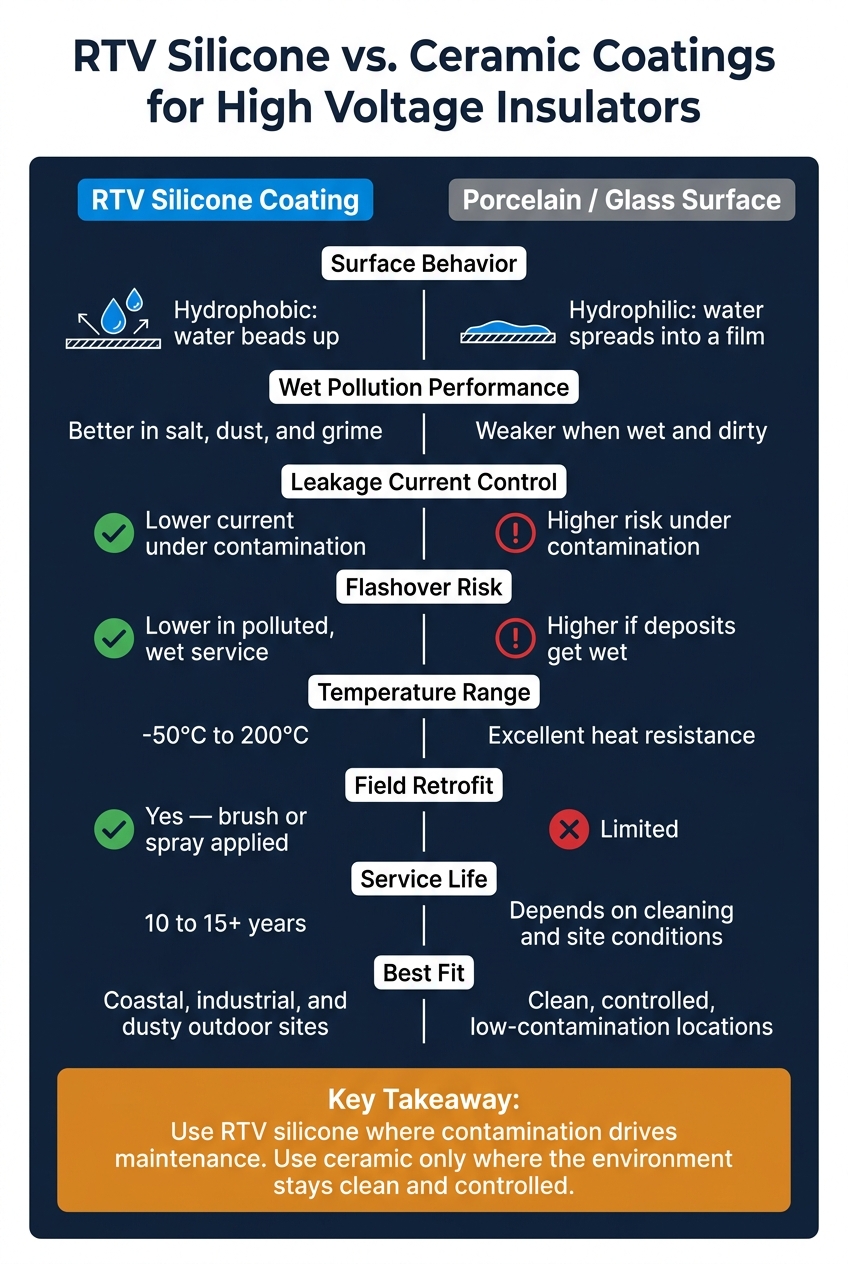
RTV Silicone vs. Ceramic Coatings: Side-by-Side Comparison for High Voltage Insulators
Anti Pollution Flashover Coating RTV - High Voltage Insulator Coatings HVIC - What is an RTV HVIC ?
sbb-itb-501186b
Quick Comparison
| Criteria | RTV Silicone Coating | Porcelain / Glass Surface |
|---|---|---|
| Surface behavior | Hydrophobic | Hydrophilic |
| Wet pollution performance | Better in salt, dust, and grime | Weaker when wet and dirty |
| Leakage current control | Lower current under contamination | Higher risk under contamination |
| Flashover risk | Lower in polluted, wet service | Higher if deposits get wet |
| Field retrofit | Yes, often by brush or spray | Limited |
| Service life | Often 10 to 15+ years | Depends on cleaning and site conditions |
| Maintenance | Less routine washing in many cases | More washing in polluted areas |
| Best fit | Outdoor sites with contamination | Cleaner locations |
If you’re choosing between them, I’d keep it simple: RTV helps dirty outdoor insulators stay safer in wet service, while bare ceramic surfaces depend much more on cleaning and site conditions.
RTV Silicone Coatings: Properties, Performance, and Common Uses
Material Properties and Electrical Behavior
RTV silicone is a single-component, moisture-curing silicone that cures at room temperature. After it cures, it forms a flexible coating that sticks to porcelain, glass, ceramics, and metal surfaces. That hydrophobic surface helps limit leakage current and dry-band arcing.
This material is made for outdoor service. It handles UV exposure well and stays thermally stable from about -40°F to 392°F (-40°C to 200°C+). High-performance formulations can reach dielectric strength of 25 kV/mm or more. Manufacturers also commonly add alumina trihydrate (ATH) fillers to improve tracking and erosion resistance. Those properties matter most when contamination and wetting start driving surface discharge.
Pollution Performance at Coastal, Industrial, and Dusty Sites
These coatings tend to show their value most clearly at coastal, industrial, and dusty sites. The big advantage is hydrophobicity transfer. Low-molecular-weight silicone oils move through layers of dust, salt, and industrial pollutants and help bring back a water-repellent surface on top of that contamination.
In plain terms, the coating doesn't just resist water on day one. It can keep working even after pollutants build up. That helps the surface shed contamination and keep leakage current low in salt fog, industrial pollution, and dust.
Application and Maintenance in Retrofit Projects
RTV can be applied in the factory or in the field, which makes it a good fit for retrofit work. Surface prep matters here. The surface needs to be clean and dry before application so the coating can adhere properly.
Service life is typically 10 to 15+ years. When refurbishment is needed, recoating can extend the life of existing porcelain and glass hardware without full replacement. That's a big reason RTV is often used when replacement isn't practical.
Ceramic Insulator Surfaces and Ceramic Coatings: Strengths and Limits
Here, ceramic refers to porcelain and glass insulator surfaces used in U.S. high-voltage infrastructure. Inorganic ceramic coatings also appear on some transformer and switch components.
Core Material Strengths
Porcelain and glass bring a lot to the table. They offer high dielectric strength, thermal stability, and dimensional stability. Their rigid structure also handles mechanical stress well.
Surface Behavior Under Wet and Polluted Conditions
The catch is the surface behavior. Ceramic surfaces are hydrophilic, which means water tends to spread out into a film instead of beading up.
That matters in the field. When salt, dust, or industrial pollution mixes with that water film, the surface can turn conductive. Leakage current goes up, and so does flashover risk. That’s one big reason silicone-based coatings are used as a retrofit: they help bring back the hydrophobic surface behavior that ceramic surfaces do not have on their own.
Maintenance Needs in Service
In polluted areas, uncoated ceramic insulators need regular washing and inspection. That adds work in service. Because of that, many utilities coat existing porcelain and glass hardware instead of relying on cleaning alone.
Direct Comparison: RTV Silicone vs. Ceramic Coatings
Side-by-Side Comparison Table
The main gap between these two options comes down to a few practical trade-offs: how they act in wet, dirty conditions, how much flex they have, how easy they are to apply in the field, and how much upkeep they need over time.
| Feature | RTV Silicone Coating | Porcelain or Glass Surface |
|---|---|---|
| Dielectric Strength | High dielectric strength | High dielectric strength |
| Wet/Pollution Behavior | Hydrophobic; resists wetting and contamination buildup | Generally hydrophilic; loses effectiveness when wet and contaminated |
| Leakage Current Control | Strong; hydrophobicity suppresses leakage current buildup | Weaker in contaminated conditions without supplemental coating |
| Mechanical Behavior | Flexible; handles thermal cycling and vibration | Rigid; high mechanical strength |
| Temperature Range | -50°C to 200°C | Excellent heat resistance |
| UV and Corona Resistance | Good UV and ozone resistance; handles outdoor thermal cycling | Excellent thermal stability and corona resistance |
| Maintenance Frequency | Lower; hydrophobic surface reduces routine washing needs | Higher in polluted zones; regular cleaning is often needed |
| Retrofit Suitability | High; field-applied by brush or spray at ambient temperature | Limited; often applied via enameling or industrial coating processes |
Where RTV Has the Advantage and Where Ceramic Still Fits
These trade-offs matter most when you're matching a coating to site contamination levels and maintenance limits.
RTV is usually the better fit for coastal, industrial, and dusty sites because it keeps the surface hydrophobic. That helps limit wetting and slows leakage current buildup when grime and moisture start stacking up. Its flexible nature also helps on hardware that sees vibration and thermal cycling.
Ceramic still makes sense in clean, controlled settings where rigidity and heat tolerance matter more than surface water repellency. In those cases, a hard surface can do the job just fine.
Those same factors shape which option makes more sense for a U.S. utility asset.
How to Choose the Right Option for U.S. High Voltage Equipment
Selection Factors by Environment and Asset Type
Once the material trade-offs are clear, the choice usually comes down to three things: site exposure, maintenance limits, and whether the asset is new or already in service.
RTV silicone is usually the better fit for polluted, weather-exposed outdoor assets. That matters most in U.S. sites near the coast, in industrial zones, in dusty areas, and in places that deal with freeze-thaw cycles.
That same exposure also tells you when uncoated ceramic still makes sense. Uncoated porcelain and glass work best in cleaner, more controlled locations where contamination doesn't show up often.
For retrofit work on existing assets, RTV silicone is the practical option. It bonds to porcelain, glass, metal, and many plastics, cures at ambient temperature, and works well when outage windows are short.
Conclusion: Key Decision Points
RTV silicone is generally the better choice when the goal is to improve contamination performance and cut maintenance frequency on outdoor insulators, especially in polluted, coastal, or high-humidity U.S. environments. Ceramic is durable, but once contamination gets wet, it becomes harder to keep low-leakage performance in place without an added coating.
In those cases, applying RTV silicone over the ceramic surface is often the most practical path forward. Use RTV silicone when contamination is what drives maintenance. Use ceramic only where the environment stays clean and controlled.
FAQs
When should I choose RTV over bare porcelain or glass?
Choose RTV silicone when you need stronger performance in harsh, dirty, or outdoor settings.
Its hydrophobic surface helps resist moisture, salt spray, and other buildup that can lead to flashovers, especially in ice, snow, and polluted areas. Bare porcelain or glass is durable, but RTV often does a better job of maintaining electrical insulation in these conditions.
How long does RTV coating usually last outdoors?
The sources do not provide a set standard outdoor lifespan for RTV silicone coatings.
That said, outdoor use can be tough on these coatings. Two common pressure points stand out:
- UV exposure, which can lead to brittleness and cracking over time
- Salt spray in coastal areas, which adds another layer of stress
So while no fixed service life is given here, the takeaway is pretty clear: outdoor conditions can be hard on RTV silicone coatings, especially in sunny or coastal settings.
Can RTV be applied to existing insulators in the field?
Yes. RTV silicone coatings can be applied to existing insulators in the field.
They’re often used as a maintenance fix to improve the performance of standard insulating columns and other hardware, especially in areas with ice, snow, or pollution.
The hydrophobic coating helps preserve electrical integrity on equipment that’s already in service.





