

Real-Time Analytics for Microgrids
Real-time analytics is transforming microgrids into smarter, more efficient energy systems. By processing sensor data continuously, these platforms optimize energy generation, storage, and load balancing in real-time. This is especially critical for managing renewable energy fluctuations and ensuring reliability during outages. Key benefits include:
- Improved energy efficiency: Reduces energy waste and lowers operational costs by up to 2%.
- Enhanced reliability: Fault detection and dynamic load prioritization ensure uninterrupted power during disturbances.
- Predictive maintenance: Identifies issues like battery degradation early, cutting maintenance costs significantly.
- Scalability: Supports seamless integration of multiple microgrids and advanced energy management tools.
These systems leverage AI, IoT, and digital twins to deliver actionable insights and ensure microgrids meet growing energy demands while minimizing costs and emissions.
How Real-Time Analytics Improves Microgrid Management
Processing Data in Real Time
Real-time analytics platforms are revolutionizing microgrid management by processing data from solar panels, wind turbines, battery storage, and load demands to make instant adjustments. Platforms like Thingspeak leverage IoT monitoring to maintain frequency and voltage across generators, improving load management efficiency. This capability is especially critical for managing the variability of renewable energy sources. For instance, AI systems can handle fluctuations in solar power (100–1,000 W/m²) and wind speeds (2–20 m/s).
Artificial Neural Networks (ANN) play a key role by automating power flow and frequency regulation, eliminating the delays associated with centralized controls. Multi-agent systems further enhance efficiency by coordinating AC and DC busbars. These systems monitor the state-of-charge on the DC side while simultaneously managing frequency and voltage on the AC side, ensuring optimal operation. For fault detection, Optimal Random Forest (ORF) algorithms analyze voltage and current signals in real time, even under island mode conditions. These technologies not only react to changes but also anticipate them, paving the way for proactive maintenance and improved microgrid resilience.
Predictive Maintenance and Monitoring
Real-time data is transforming maintenance strategies, shifting from fixed schedules to condition-based actions. By continuously monitoring asset performance, remote monitoring software can detect inefficiencies through logged data and alarm codes. This allows technicians to address issues like battery voltage drops or coolant problems before they escalate.
"Subtle deviations in performance can help diagnose potential problems before they turn into full-fledged failures."
– Mateusz Zając, Sustainability Leader, ABB
A real-world example comes from June 2025, when an ABB team implemented remote digital monitoring for a hospital in Finland. By using dry and oil transformers, they provided uninterrupted, real-time data on equipment health. This approach eliminated the need for complete shutdowns previously required for manual oil sampling. The financial benefits are striking - proactive maintenance costs significantly less than a "run-to-fail" strategy, which can be up to 10 times more expensive. For mission-critical facilities like oil and gas plants, unplanned stoppages can rack up costs of around $100,000 per hour.
Real-time monitoring doesn’t just enhance maintenance; it also drives smarter energy management across microgrids.
Energy Optimization and Load Balancing
Real-time analytics balance supply and demand within microgrids, ensuring network stability and cost efficiency. These insights optimize energy storage and load dispatch, effectively managing the challenges of high renewable energy penetration.
In January 2026, RavenVolt's 24/7 Network Operations Center demonstrated the power of real-time monitoring. By addressing battery voltage and coolant alarms during winter storms, they ensured uninterrupted power for critical sectors like retail, manufacturing, and healthcare.
"The integration of intelligent remote monitoring software and a 24/7 Network Operations Center has become a necessity for microgrid management, especially during the harsh conditions of winter storms."
– Debra Phipps, Director of Monitoring Operations, RavenVolt
Advanced tools like Phasor Measurement Units (PMUs) provide time-synchronized data for precise fault localization and near-instant isolation. Meanwhile, IoT-enabled smart meters deliver real-time insights into power quality and load behavior. Communication-assisted protection systems, built to comply with IEC 61850 standards, further enhance reliability by enabling real-time relay coordination and fault-current adjustments - crucial for managing bidirectional power flow.
sbb-itb-501186b
Techniques and Tools for Real-Time Analytics
Optimization Models for Energy Resources
Meta-heuristic algorithms like CSA, GWO, and G2O are being used to tackle the complexity of non-linear microgrid systems. These methods help lower operating costs and improve voltage regulation.
For example, in 2024, a real-time distribution system in Tamil Nadu, India, utilized the Crow Search Algorithm within the Electrical Transient Analyzer Program (ETAP). This approach optimized load scheduling across three distributed generation sources, leading to reduced power losses and better voltage profiles in both grid-connected and islanded modes. Unlike genetic algorithms, this method avoided heavy computational loads.
AC Optimal Power Flow (AC-OPF) is another key tool, managing active and reactive power flows to ensure bus voltage security. Recent advancements have integrated battery degradation-aware functions into these models. A notable example from 2025 at Brf Viva demonstrated a 3% reduction in annual energy and battery degradation costs through rolling-horizon optimization.
"The novelty lies in its ability to capture real-world BES degradation dynamics - including cycle aging and depth-of-discharge (DoD) effects - within an optimization-based energy scheduling framework."
– Nature Scientific Reports
Hybrid forecasting models have also shown promise. By combining neural networks like Gaussian Radius Zone Perceptron Net (GRZPNet) with optimization algorithms, these models refine load demand predictions. They can reduce the impact of renewable energy uncertainties by around 15% and improve multi-energy microgrid efficiency by up to 20% in simulations.
These optimization techniques are paving the way for more synchronized control across multiple microgrids.
Coordinated Scheduling for Multi-Microgrid Systems
Coordinated scheduling enables microgrids to work together while still meeting their individual operational goals. Shifting from independent operations to DSO-integrated coordination enhances overall grid efficiency and compatibility. A 2025 study at Chalmers University tested a Grid-Connected Microgrid Energy Management (GCM-EM) model on a 33-bus campus power network. Using rolling-horizon control and AC optimal power flow, the study showed that this coordination method improved grid efficiency and reduced localized energy costs by up to 2%.
Decentralized coordination schemes are gaining traction because they ensure data privacy for microgrid operators while allowing the Distribution System Operator to manage network constraints. Grey Wolf Optimization has been particularly effective, outperforming algorithms like Particle Swarm Optimization and Jaya in reducing microgrid operating costs. Additionally, techniques like K-means clustering simplify thousands of Monte Carlo-generated scenarios into as few as 10, making real-time optimization computationally manageable without sacrificing accuracy.
Simulation and Forecasting Tools
Advanced simulation and forecasting tools are key to improving operational planning. Digital twin frameworks, for instance, link physical assets with virtual models to monitor and predict system behaviors in real time. These systems can identify potential thermal overloads or power imbalances, triggering alerts for preventive actions like load shedding or power rerouting.
Machine learning tools, such as Support Vector Regression (SVR), analyze historical data, weather conditions, and grid states to forecast solar PV and wind power outputs. For solar PV, SVR achieved a Mean Squared Error of 2.002, while for wind power, it scored 3.059. These forecasts helped reduce overall operating costs by 8.4% and peak load demand by 15%.
"Machine learning optimization techniques are becoming increasingly important for solving microgrid energy management problems due to their adaptability and ability to handle complex, nonlinear systems."
– Scientific Reports
In 2025, Warsaw University of Technology introduced EnergyTwin, an agent-based simulation platform. This tool coordinated PV arrays, battery storage, and EV chargers on a university campus. By using forecast-driven rolling-horizon planning, it increased energy self-sufficiency and maintained higher battery reserves during grid disturbances.
How to Implement Real-Time Analytics for Microgrids
Integrating Data from Sensors and Devices
To get started with real-time analytics, you need a solid plan for collecting data from sensors and devices. Using Modbus RTU is a reliable way to gather local data from power meters, while MQTT works well for transmitting that data to cloud platforms. This setup ensures compatibility across different vendors.
For remote microgrid locations without a local network, cellular IoT gateways are a dependable option. These industrial gateways consolidate data from devices like three-phase power meters and send it directly to the cloud. Configuring these gateways to transmit data every 5 seconds helps with predictive maintenance and load balancing.
Data quality is critical from the beginning. Set up automated validation systems at the point of data ingestion to catch errors, such as incorrect meter IDs or faulty energy measurements, right away. To make the raw sensor data more useful, enrich it with metadata from systems like ERP and CRM. This could include facility specs, capacity baselines, or customer smart meter IDs. Adding this context turns basic telemetry into actionable insights.
For large utilities managing over 10 million energy events daily from 100,000 smart meters and 300 generation facilities, speed is essential. Your system should support subsecond latency for grid balancing tasks, with response times under two seconds for generation adjustments and under five seconds for demand response calculations.
Choosing Hardware and Software
Once your data integration is in place, the next step is selecting the right hardware and software. Tools like HOMER Pro are helpful for sizing components such as power converters, battery storage, and transformers to fit both current and future needs. It’s also important that your power distribution equipment, like breakers and transformers, connects seamlessly to your analytics platform.
Switching from traditional Rule-Based Control (RBC) to Deep Reinforcement Learning (DRL) frameworks can significantly improve system responsiveness. A study conducted in June 2025 by Moslem Uddin, Huadong Mo, and Daoyi Dong demonstrated this with a hybrid community microgrid in Central Tilba, New South Wales. Their DRL-based Proximal Policy Optimization (PPO) agent reduced operational costs by 18% and increased system reliability by 87.5%, thanks to its ability to dynamically manage battery state-of-charge and renewable energy availability.
When choosing hardware, ensure that your industrial IoT gateways support both MQTT and Modbus protocols and offer cellular connectivity for remote sites. Similarly, three-phase power meters should be compatible with Modbus RTU for seamless integration. For monitoring, cloud-based visualization platforms are a smart choice - they eliminate the need for custom local software, making it easier to scale as your microgrid grows.
Planning for Scalability and Interoperability
With the basics in place, it’s time to think about scaling and ensuring your system integrates smoothly with other components. Start small with a pilot program involving 10,000 to 20,000 smart meters before expanding to full-scale deployment. This allows you to test your setup and address any issues early on. Design your system to handle at least 500,000 smart meters from the start, while accounting for seasonal demand fluctuations.
Storage needs can grow rapidly. Large utilities might require between 200 TB and 2 PB of energy data every month. A tiered storage approach works best: keep three years of "hot" data readily accessible and archive the next seven years to meet regulatory requirements. Automate triggers for demand response and emergency protocols when capacity exceeds 90%.
Security is another key area to address. Implement role-based access control (RBAC) to ensure different teams - like grid operators, field technicians, and billing staff - only have access to what they need. Make sure your system complies with NERC CIP standards to protect sensitive data like smart meter readings and consumption patterns. Use standard APIs to integrate with systems like power plant controls and wind turbine SCADA to maximize compatibility. With this level of planning, your analytics framework will be ready to scale and adapt to future demands.
Webinar: De-risking Microgrids with Real-Time Simulation and HIL Testing
Benefits of Real-Time Analytics in Microgrids
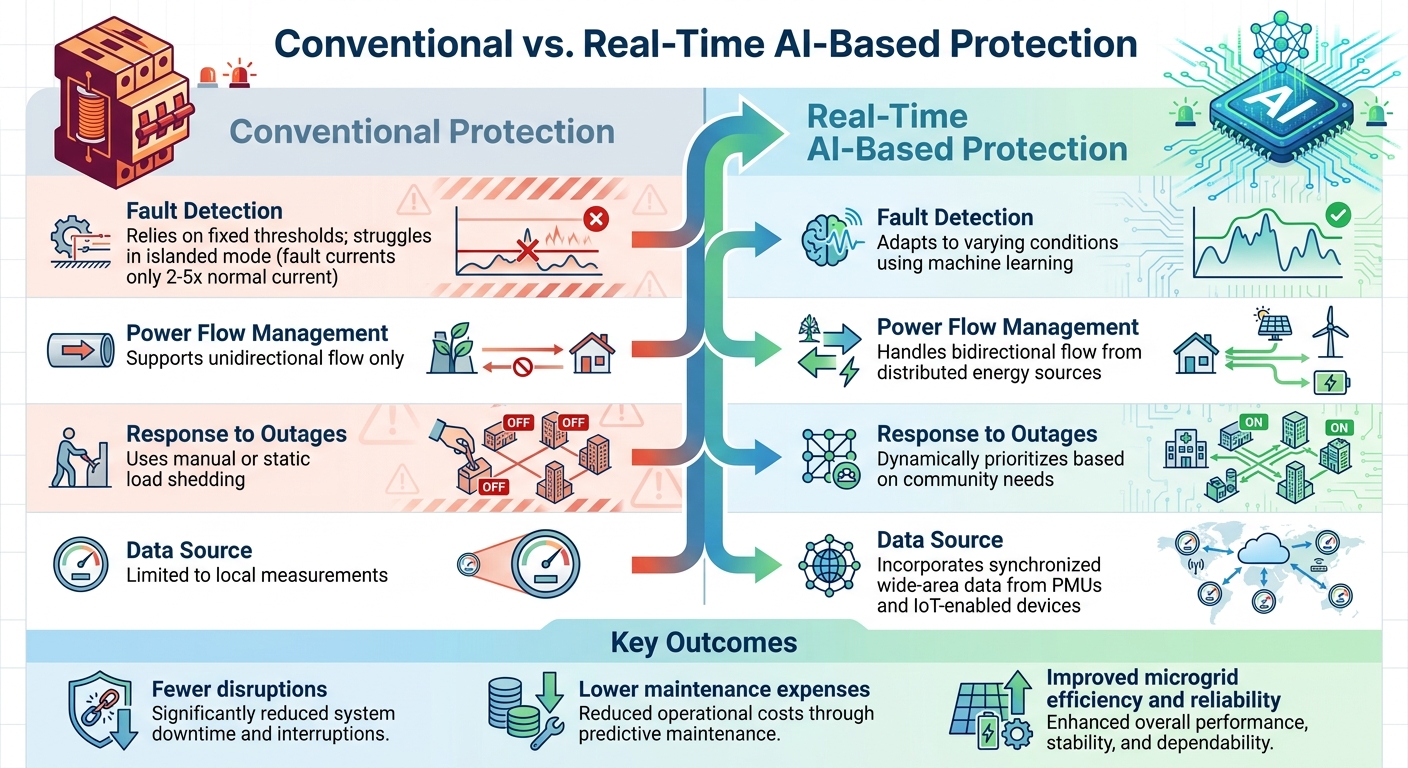
Conventional vs AI-Based Real-Time Analytics Protection Systems for Microgrids
Better Energy Efficiency and Lower Costs
Real-time analytics plays a key role in cutting energy waste and reducing costs by offering immediate insights into power flows within a microgrid. Instead of relying on static schedules, these analytics optimize load dispatch and energy storage in real-time, ensuring supply and demand are perfectly aligned. This not only helps minimize energy waste but also leads to financial and emission savings.
The financial benefits can be impressive. For example, in February 2026, Microsoft reached a significant milestone by matching 100% of its global electricity use with renewable energy. This achievement was part of their "100/100/0" strategy, which ensures zero-carbon sources power their operations continuously. Spearheaded by Chief Sustainability Officer Melanie Nakagawa and President of Cloud Operations Noelle Walsh, the company used a portfolio of 40 GW of contracted renewable energy through 400 agreements across 26 countries. This effort reduced electricity-related emissions by approximately 25 million tons of CO2.
"By providing a financial commitment through PPAs, Microsoft is helping to get renewable projects off the ground by guaranteeing a buyer, while also locking in a stable electricity price for its own use."
- Tom Quinn, Staff Writer, DIGIT
Real-time analytics also enhances the integration of distributed generation sources like rooftop solar panels and EV charging stations. By monitoring production and consumption patterns, it helps avoid expensive grid upgrades and supports smarter energy decisions, such as when to store energy versus when to use it immediately.
Increased Reliability and Resilience
When disruptions strike, real-time analytics ensures microgrids can respond effectively. Through dynamic load prioritization, systems can automatically allocate power to critical services and vulnerable populations during outages or brownouts. Instead of widespread shutdowns, analytics pinpoints essential loads, such as ensuring hospitals remain powered or residential heating systems operate during extreme weather.
Automated systems further enhance reliability by using PMU (Phasor Measurement Unit) data to determine the best times for a microgrid to disconnect from the main grid during disturbances. These PMU-driven protection schemes enable quick fault isolation - often within just a few cycles - and allow for safe reconnection once conditions stabilize.
The importance of resilience becomes clear in real-world events. For instance, in 2022, physical attacks on substations in Pierce County and North Carolina left tens of thousands without power, while an arson attack in Southern France in May 2025 disrupted electricity for over 160,000 households. With real-time analytics, microgrids can isolate problems swiftly and continue powering critical services even when the broader grid is affected.
"The idea behind hardening a microgrid controller with AI is to provide a solution for microgrid operators that adapts to their specific needs, under a variety of unprecedented conditions."
- Rachid Darbali-Zamora, Principal Investigator, Sandia National Laboratories
Performance Metrics: Before and After Analytics
The advantages of real-time analytics are evident in measurable performance improvements. Traditional systems often falter in islanded mode because fault currents are typically only 2–5 times the normal current, making it difficult for conventional overcurrent relays to detect faults. In contrast, AI-based protection adapts to changing conditions using machine learning.
| Feature | Conventional Protection | Real-Time AI-Based Protection |
|---|---|---|
| Fault Detection | Relies on fixed thresholds; struggles in islanded mode | Adapts to varying conditions using machine learning |
| Power Flow Management | Supports unidirectional flow only | Handles bidirectional flow from distributed energy sources |
| Response to Outages | Uses manual or static load shedding | Dynamically prioritizes based on community needs |
| Data Source | Limited to local measurements | Incorporates synchronized wide-area data from PMUs and IoT-enabled devices |
These advancements translate to fewer disruptions and lower maintenance expenses, making microgrids more efficient and reliable.
Conclusion
Real-time analytics have turned microgrids into smarter, more responsive networks. By continuously processing data from sensors and meters, these systems can balance energy generation, storage, and demand - even when unpredictable renewable sources like solar and wind are in the mix. For utilities, this data-driven approach can lead to profitability improvements of 20–30% through better resource optimization.
These analytics also bring reliability to the forefront. They can automatically detect and isolate faults, restoring power within minutes after grid failures. This capability has become increasingly important as global renewable capacity surged to 4,448 GW in 2024. Beyond reliability, predictive maintenance powered by sensor data reduces the risk of costly equipment failures, while advanced controls help operators meet regulations and monitor carbon emissions for sustainability goals.
As Honeywell explains, "Near real-time insights make it possible to balance generation, storage and demand, even as variable sources like solar and wind add unpredictability to the supply".
To fully harness these benefits, having the right hardware is essential. Reliable metering devices, energy storage systems, transformers, and circuit breakers are the backbone of effective data collection and analysis. Platforms like Electrical Trader simplify this process by offering a centralized marketplace where microgrid operators can source everything from breakers and transformers to power generation tools. This makes it easier to find interoperable devices that support real-time monitoring and ensure long-term stability.
As microgrids replace diesel-based systems with renewable energy in remote areas, advanced analytics and streamlined hardware procurement play a key role in cutting CO₂ emissions while maintaining dependable power. The technology is ready, and the necessary infrastructure is already in place.
FAQs
What data do I need for real-time microgrid analytics?
To carry out real-time microgrid analytics successfully, you need access to data on power flow, load demand, generation output, and system status. This data must be captured and processed instantly to enable precise monitoring and informed decision-making.
How fast does the analytics system need to react?
The analytics system needs to operate in real-time to effectively manage microgrids. This becomes particularly important in islanded scenarios, where maintaining accurate power flow monitoring and ensuring reliable control are essential for smooth operation.
How do I start a pilot without disrupting operations?
To roll out a pilot microgrid without causing interruptions, it's best to use a step-by-step approach that keeps things running smoothly. Begin by evaluating the existing infrastructure to pinpoint areas where interference might occur. Launch the pilot in a carefully chosen, controlled section of the grid. Use real-time monitoring and advanced analytics to track performance and maintain stability. Gradually scale up the pilot, making adjustments along the way, to test new strategies while ensuring the current grid remains dependable.