




Top 5 Trends in Digital Twin Tech for Power Plants
Digital twins are reshaping power plant operations by enabling real-time simulations, predictive maintenance, and AI-driven efficiency improvements. Here's a quick summary of the five key trends transforming the industry:
- AI-Powered Digital Twins: Use machine learning to optimize combustion, predict failures, and cut emissions, saving millions annually.
- Predictive Maintenance: Track thousands of data points to prevent breakdowns, reduce downtime by up to 50%, and lower maintenance costs by 25%.
- Real-Time Monitoring: Virtual sensors analyze critical metrics, improving thermal efficiency by up to 2.5% and reducing emissions.
- Renewable Energy Integration: Simulate weather impacts and optimize wind, solar, and hydro systems for better energy output and grid stability.
- Digital Twin-as-a-Service (DTaaS): Cloud-based platforms lower upfront costs, making digital twins accessible with flexible subscription models.
These advancements improve plant efficiency, cut costs, and support the transition to cleaner energy sources. With the market projected to grow from $2.1 billion in 2025 to $5.2 billion by 2033, digital twins are becoming essential for modern power plants.
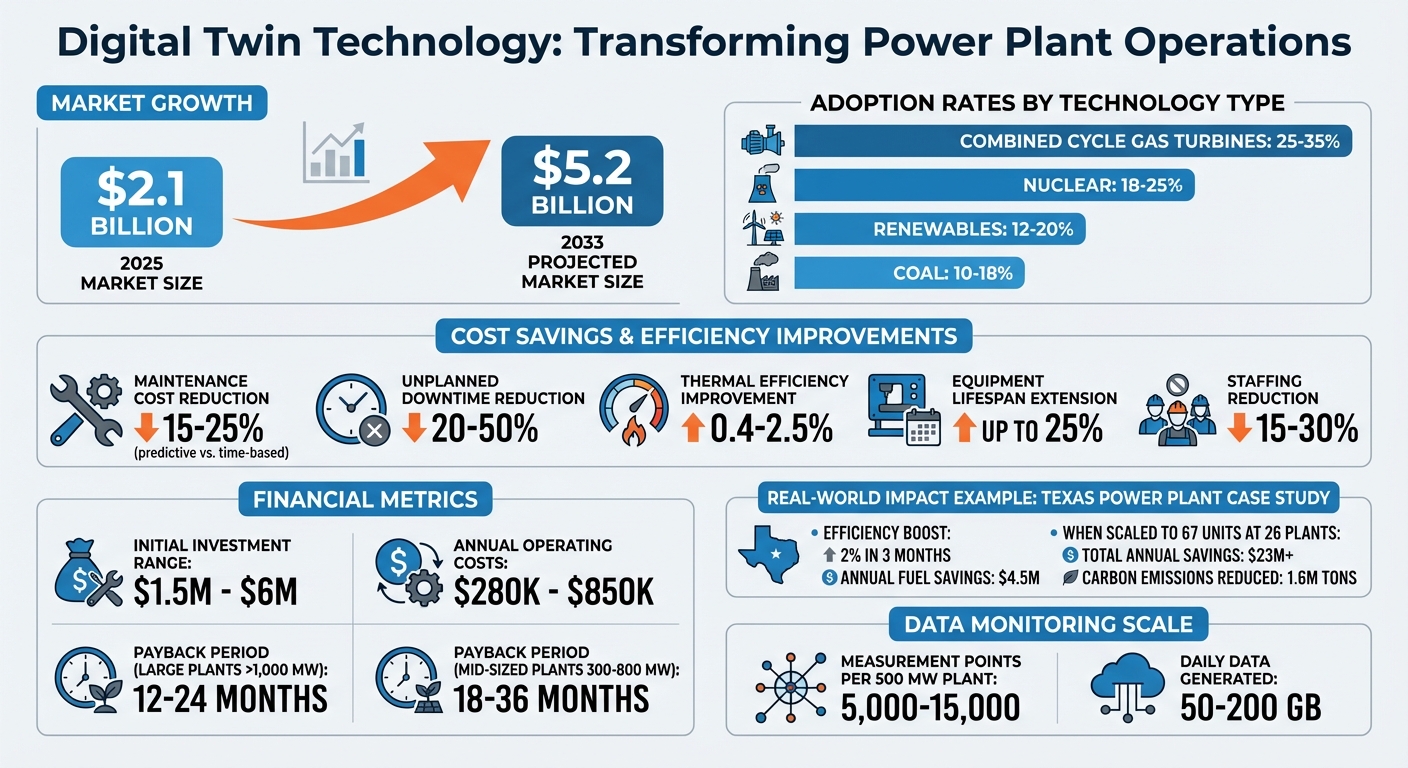
Digital Twin Technology Impact on Power Plant Efficiency and Cost Savings
TCS Cognitive Digital Twin for Predictive Maintenance in Power Plants
sbb-itb-501186b
1. AI-Powered Digital Twins
Artificial intelligence is taking digital twins to the next level, turning them from passive tools into active problem-solvers. By combining machine learning with physics-based modeling, these AI-enhanced twins can uncover optimization strategies that might escape human operators. For instance, they can adjust fuel-air ratios in real-time to improve combustion efficiency. They also analyze data from thousands of sensors to predict anomalies and prevent failures before they happen. These capabilities are driving impressive efficiency improvements.
Impact on Power Plant Efficiency
The financial benefits are hard to ignore. Take the example of an 800 MW combined cycle gas turbine (CCGT) plant in Asia. In 2025, this facility adopted AI-driven combustion optimization and achieved a 1.8% heat rate improvement, lowering it from 7,100 to 6,972 Btu/kWh. This change not only cut NOx emissions by 12% but also saved the plant $4.2 million annually in fuel costs.
Another case, highlighted by McKinsey & Company in August 2025, involved a Texas power plant. Here, AI optimization boosted efficiency by 2% in just three months, translating to $4.5 million in fuel savings. When applied across 67 units at 26 plants, the technology saved over $23 million annually and reduced carbon emissions by 1.6 million tons.
Scalability for Different Power Generation Types
AI-powered digital twins are versatile enough to adapt across various types of power generation. Using hybrid modeling approaches like Physics-Informed Neural Networks (PINNs), these systems blend thermodynamic principles with machine learning. This method requires 30–50% less training data compared to pure AI models, speeding up deployment while maintaining accuracy.
Adoption rates differ by technology. Combined cycle gas turbines lead with a penetration rate of 25–35%, followed by nuclear at 18–25%, renewables at 12–20%, and coal at 10–18%. Thanks to cloud-based platforms, centralized teams can oversee multiple facilities from remote operation centers, enabling operators to manage entire fleets efficiently.
Cost-Effectiveness in Implementation
The initial investment for AI-powered digital twins ranges between $1.5 million and $6 million, with annual operating costs from $280,000 to $850,000. Despite these expenses, the return on investment is compelling. Large facilities over 1,000 MW typically recover costs within 12–24 months, while mid-sized plants (300–800 MW) see payback in 18–36 months.
Predictive maintenance alone can cut costs by 15–25% compared to time-based strategies and by 40–60% compared to reactive maintenance. Avoiding a single unplanned outage - which can cost anywhere from $500,000 to $2 million - often justifies a significant portion of the investment.
2. Predictive Maintenance for Equipment
Digital twins are revolutionizing equipment maintenance in power plants by moving away from reactive fixes and rigid schedules toward condition-based strategies. These systems continuously track 5,000 to 15,000 measurement points across a facility, monitoring factors like vibration, temperature, pressure, and acoustic signatures. This constant surveillance can detect early signs of issues such as gear wear or bearing damage, allowing intervention before a breakdown occurs. The result? Reduced failures and noticeable cost savings.
Impact on Power Plant Efficiency
The financial benefits of these systems are clear. For example, a Middle East utility operating 12 Frame 9E gas turbines adopted GE Digital APM in 2025 to manage hot gas path components. Instead of replacing all parts on a fixed schedule, they replaced only those that exceeded damage thresholds. This approach cut average inspection costs from $2.8 million to $2.1 million per turbine, saving $4.2 million annually (an 18% drop in their maintenance budget). Additionally, unplanned outages fell from 2.3 to 0.8 events per unit annually.
At DTE Energy's Dearborn Central Energy Plant in Michigan, the 34-MW facility implemented the VTS HardHAT digital twin system in 2022 to monitor 12,000 data points. When the oil temperature exiting shaft bearings rose by 10°F - still well below the alarm level - the system issued an alert. This early warning led to a seal replacement that kept downtime to just two trips and four hours for the year.
"It is vital that we catch issues at an early stage to prevent a major failure." - Kevin Siess, Regional Operations Manager, DTE Energy
Cost-Effectiveness in Implementation
For a 500 MW facility, annual savings from predictive maintenance can range from $1.2 million to $3.8 million, depending on the type of equipment. For instance, monitoring boiler tubes can reduce failures by 60% to 75%, translating into savings of $2 million to $5 million annually. With a single forced outage costing anywhere between $500,000 and $2 million, avoiding even one unplanned shutdown can cover a significant portion of the investment.
Scalability for Different Power Generation Types
This technology is adaptable across various power generation methods. Using Physics-Informed Neural Networks (PINNs), which need 30% to 50% less training data than traditional machine learning models, these systems are particularly effective. Adoption rates vary by generation type, with combined cycle gas turbines leading at 25% to 35% penetration, followed by nuclear at 18% to 25%, renewables at 12% to 20%, and coal at 10% to 18%.
At China's Wuqiangxi and Jinweizhou hydropower plants, a Smart Remote O&M system equipped with AI and sensors has been in use since 2020. This system has delivered 10% savings in maintenance costs, increased available generation time by 0.5%, and boosted power output by 0.3%.
3. Real-Time Monitoring and Virtual Sensors
Digital twins use virtual sensors to calculate parameters that physical sensors can't measure. These include metrics like turbine blade temperatures, boiler tube wall temperatures, and vibration patterns in rotating machinery. A single 500 MW plant can generate an enormous amount of data - about 50–200 GB daily - from these virtual sensors. This continuous data flow allows operators to quickly detect anomalies and safely test scenarios before making real-world changes.
Impact on Power Plant Efficiency
Power plants often experience thermal efficiency improvements of 0.4% to 2.5% by optimizing combustion and benchmarking performance. For instance, in a 500 MW combined cycle gas turbine (CCGT) plant, just a 1% efficiency improvement can reduce CO2 emissions by 18,000 to 28,000 tons annually. Real-time monitoring lets operators fine-tune fuel-air ratios and adjust staging to maximize thermal output while staying within emissions limits.
Take the example of the Platte River Power Authority's Rawhide Energy Station. In February 2024, Senior Electrical Controls Engineer Johel Comas used an Ovation digital twin to virtually test control designs on the 280 MW coal unit. This reduced startup and shutdown times by 44%, saving fuel and improving operator workflows. Across the industry, unplanned downtime has been cut by 20% to 50% with the adoption of real-time monitoring systems. These advancements highlight the practical benefits of virtual sensor technology in boosting efficiency and cutting costs.
Cost-Effectiveness in Implementation
The cost of deploying digital twin technology in an existing power plant ranges from $1.5 million to $6 million. Annual operational expenses, typically between $280,000 and $850,000, often result in a payback period of 12–36 months.
Focusing on high-value components like gas turbines or boilers can justify the initial investment before expanding further. Tools like Physics-Informed Neural Networks (PINNs) simplify virtual sensor modeling without sacrificing accuracy. Additionally, plants can use existing SCADA and historian data to build their digital twin systems, which minimizes upfront hardware costs. Real-time monitoring also allows for control room consolidation, enabling a single team to oversee multiple facilities remotely and reducing staffing needs by 15% to 30%. These financial savings align seamlessly with the operational benefits of digital twins.
Support for Sustainability and Renewable Energy
Real-time monitoring plays a key role in helping thermal plants adapt to the variability of renewable energy sources. Digital twins simulate the strain on equipment caused by load cycling when conventional plants act as backups for renewables. They also model grid interactions and battery storage behavior, helping operators prepare for fluctuating renewable inputs. This capability not only improves operations but also promotes sustainable practices.
For example, at Equinor's Hywind Tampen floating wind farm in the Norwegian Continental Shelf, a digital twin system built on Unity3D and OPC-UA monitors turbine performance and optimizes maintenance. By January 2025, the project aims to cut 200,000 tons of CO2 and 1,000 tons of NOx emissions annually. Similarly, a Southeast Asian utility used a digital twin to virtually test 15 hydrogen blending scenarios (ranging from 5% to 40% by volume). They identified an optimal 25% blend, which achieved an 18% CO2 reduction with minimal impact on efficiency. These examples showcase how real-time monitoring is driving both operational and environmental progress.
4. Digital Twins for Renewable Energy Systems
Renewable energy sources like wind, solar, and hydropower are heavily influenced by ever-changing weather and environmental conditions. Digital twins provide a way to simulate these fluctuations, helping operators enhance energy output and maintain grid stability. This technology seamlessly manages a variety of renewable energy assets, making it an essential tool for modern energy systems.
Scalability for Different Power Generation Types
Today's digital twin platforms can handle mixed renewable energy portfolios, removing the need for separate monitoring systems. This unified approach simplifies operations, allowing operators to oversee wind farms and solar arrays from a single control room. The result? Less complexity in tooling and reduced training requirements.
Digital twins are scalable, working across individual components and entire national grids. For instance, a single wind turbine blade can have its own digital twin to track wear and tear, while the same system can model how thousands of solar panels interact with the energy market. This adaptability is especially valuable for utilities managing growing renewable portfolios. Between 2025 and 2030, renewable capacity is projected to expand by 4,600 GW - a figure that surpasses the combined power capacity of China, the EU, and Japan.
Impact on Power Plant Efficiency
Digital twins bring tailored optimization to each type of renewable energy. For solar farms, they identify issues like defective panels, dust buildup, and tracker misalignment that could lower energy output. Wind energy twins fine-tune blade angles and turbine orientation to minimize downtime and reduce mechanical stress. In hydroelectric plants, they model water flow and reservoir levels to maximize energy production while minimizing environmental impact.
Real-world examples highlight these benefits. At SANY Heavy Energy, a digital twin improved energy efficiency by 10%, boosted wind farm design efficiency by 50%, and reduced maintenance costs by dynamically adjusting operations to real-time wind conditions. Similarly, California's Topaz Solar Farm uses digital twins to analyze data from inverters and modules, pinpointing maintenance needs before they affect production. Oregon's The Dalles Dam employs digital twins to monitor turbine performance and water flow, enabling precise repair scheduling to extend equipment life.
Support for Sustainability and Renewable Energy
Beyond boosting efficiency, digital twins play a key role in advancing renewable energy's sustainability. They enable renewable plants to integrate more effectively with traditional grids by simulating battery behaviors and managing the unpredictable output of wind and solar systems. Operators can also run "what-if" scenarios to evaluate the impact of new carbon reduction strategies or regulatory changes before implementing them. These capabilities, alongside AI-driven predictive maintenance, represent a major step forward in renewable energy management.
"Digital twins are no longer a futuristic concept. They are rapidly becoming the foundation of how renewable energy operators plan, monitor, and grow their assets." - Naomi Stol Zamir, vHive
The growing use of autonomous drones and robots is making digital twins even more cost-effective. Instead of relying on expensive third-party inspection teams, utilities can now update their digital twin data on demand, cutting lead times from weeks to days. This self-reliant approach not only lowers costs but also ensures consistent data quality across large-scale sites. With digital twins currently adopted by just 12–20% of the renewable energy market, their use is expected to grow significantly by 2030 as more operators recognize their practical advantages.
5. Digital Twin-as-a-Service Platforms
Digital Twin-as-a-Service (DTaaS) platforms are reshaping how power plants adopt advanced monitoring technologies. Instead of requiring a hefty upfront investment - ranging from $1.5 million to $6 million - for traditional digital twin systems, these cloud-based platforms turn capital expenses into manageable monthly operating costs. This subscription-based model makes the technology accessible to facilities that might have previously found the initial costs prohibitive. By combining AI-driven performance improvements, predictive maintenance, and real-time monitoring, DTaaS platforms bring advanced analytics within reach for a broader range of operators.
Cost-Effectiveness in Implementation
The financial advantages of DTaaS become apparent early on. For mid-sized plants (300–800 MW), payback periods typically range between 18 and 36 months, while larger facilities can recoup their investment in as little as 12 to 24 months. Annual costs for cloud and support services fall between $280,000 and $850,000 - significantly lower than maintaining traditional on-site infrastructure. These platforms also enable predictive maintenance, which can slash total maintenance expenses by 15% to 25% and reduce unplanned downtime by 20% to 50%. By adopting this subscription-based model, power plants can achieve substantial cost savings while simplifying maintenance operations.
Scalability for Different Power Generation Types
One of the standout features of cloud-based DTaaS platforms is their ability to scale seamlessly across various types of power generation assets, including thermal, nuclear, and renewable energy, without requiring custom installations for each unit. A single team of experts can remotely oversee multiple facilities, cutting staffing needs by 15% to 30%. For example, at DTE Energy's Dearborn Central Energy Plant, the VTS HardHAT digital twin system monitors a 34 MW facility with just one person per shift 76% of the time, managing 12,000 data points.
"Digital twins provide a realistic, safe, and risk-free environment for users in different roles - such as operations, engineering, performance monitoring, and maintenance - to interact with a variety of operating scenarios without disrupting the live process."
- Rick Kephart, Vice President of Technology, Emerson Power and Water Solutions
The global digital twin power plant market is expected to grow from $2.1 billion in 2025 to $5.2 billion by 2033, underscoring the rapid adoption of these platforms. By removing the barrier of high upfront costs, DTaaS allows more operators to benefit from AI-powered optimization, predictive maintenance, and real-time monitoring. For facilities handling aging equipment or expanding renewable energy portfolios, DTaaS offers a practical and budget-friendly way to harness advanced analytics without adding pressure to IT teams or financial resources.
Conclusion
Digital twins are transforming power plants by leveraging AI-driven optimization, predictive maintenance, real-time virtual sensing, renewable energy integration, and cloud-based platforms. These advancements improve efficiency, reduce costs, and increase reliability. For instance, predictive maintenance can lower total maintenance expenses by 15% to 25% and reduce unplanned downtime by 20% to 50%. AI-powered optimization has shown impressive results, such as a 2% efficiency boost in just three months at a Texas power plant, leading to $4.5 million in annual fuel savings and preventing 340,000 tons of carbon emissions. Additionally, these technologies can extend equipment lifespan by up to 25%, enabling operators to maximize asset value while navigating the challenges of renewable energy integration.
Although initial investments for digital twin deployment range from $1.5 million to $6 million, many large facilities achieve breakeven within 12 to 24 months. These financial returns help ensure reliable operations and support grid stability, even as power plants adopt more flexible and renewable-focused operations. Digital twins offer the visibility and control needed to manage mechanical stress from rapid ramping, optimize battery storage, and plan for the variability of solar and wind power. The global market for digital twins in power plants is expected to grow from $2.1 billion in 2025 to $5.2 billion by 2033, highlighting the industry's rapid adoption.
For power plants expanding their sensor networks, sourcing accurate components is critical. A typical 500 MW plant requires between 5,000 and 15,000 measurement points, sampled at intervals ranging from 1 to 60 seconds, to maintain a reliable digital twin. Electrical Trader serves as a one-stop marketplace for essential components like breakers, transformers, and power distribution equipment, ensuring seamless hardware integration for digital twins.
FAQs
What data do I need to build a reliable digital twin for a power plant?
To build an effective digital twin for a power plant, you need precise data about the plant's physical assets and how they operate. Critical inputs include real-time sensor data from equipment such as turbines and boilers, operational models detailing factors like temperature and pressure, and historical records of maintenance activities and environmental conditions. When this data is paired with advanced analytics and AI, it opens the door to predictive maintenance, scenario testing, and improving overall performance.
How do digital twins connect to existing SCADA and historian systems?
Digital twins work seamlessly with SCADA (Supervisory Control and Data Acquisition) and historian systems through data frameworks that allow for real-time data streaming and secure information sharing. SCADA and historian systems collect high-resolution, timestamped data, which is then fed into the digital twin. This enables real-time monitoring, predictive maintenance, and analytics. As a result, the digital twin stays aligned with the actual operational state of power plant assets, providing support for smarter and more informed decision-making.
What are the biggest cybersecurity risks of cloud-based digital twins?
Cloud-based digital twins carry notable cybersecurity risks, especially since they often house sensitive details about critical infrastructure, such as power plants. If attackers gain access, they could exploit this information to disrupt essential operations or even endanger public safety.
On top of that, weaknesses in software, APIs, or network connections open the door to unauthorized access, data breaches, or even harmful alterations. This makes implementing strong security protocols absolutely crucial to safeguard both these virtual systems and the physical assets they represent.





