Raceway Support Spacing Guide: NEC 2026 Rules
If you miss the first support or use the wrong spacing, you can fail inspection fast. I’d boil this guide down to a few field numbers: EMT/RMC/IMC = 3 ft first support and 10 ft max spacing, FMC/LFMC = 12 in. first support and 4.5 ft max spacing, and PVC spacing changes by trade size.
Here’s what I’d want in front of me before laying out a run:
- EMT: first support within 3 ft of the box; then every 10 ft
- RMC/IMC: same 3 ft / 10 ft rule, with a narrow 5 ft first-support allowance on unbroken runs when framing blocks closer support
- PVC: first support within 3 ft; span limit depends on conduit size
- FMC/LFMC: first support within 12 in.; then every 4.5 ft
- Short FMC/LFMC runs: the 12 in. support can be skipped when the run is 3 ft or less at equipment
- Hot PVC runs: a 100°F change over 100 ft can move conduit about 4 in., so expansion planning matters
My main takeaway: most support violations come from just two mistakes - using the wrong rule for the raceway and measuring from the wrong point. I’d also confirm which NEC edition the local AHJ uses before applying any number in the field.
| Raceway | First support | Max spacing |
|---|---|---|
| EMT | 3 ft | 10 ft |
| RMC / IMC | 3 ft (sometimes 5 ft) | 10 ft |
| PVC | 3 ft | By trade size |
| FMC / LFMC | 12 in. | 4.5 ft |
This intro gives the full field-level picture up front, so I can move into the article with the key numbers already clear.
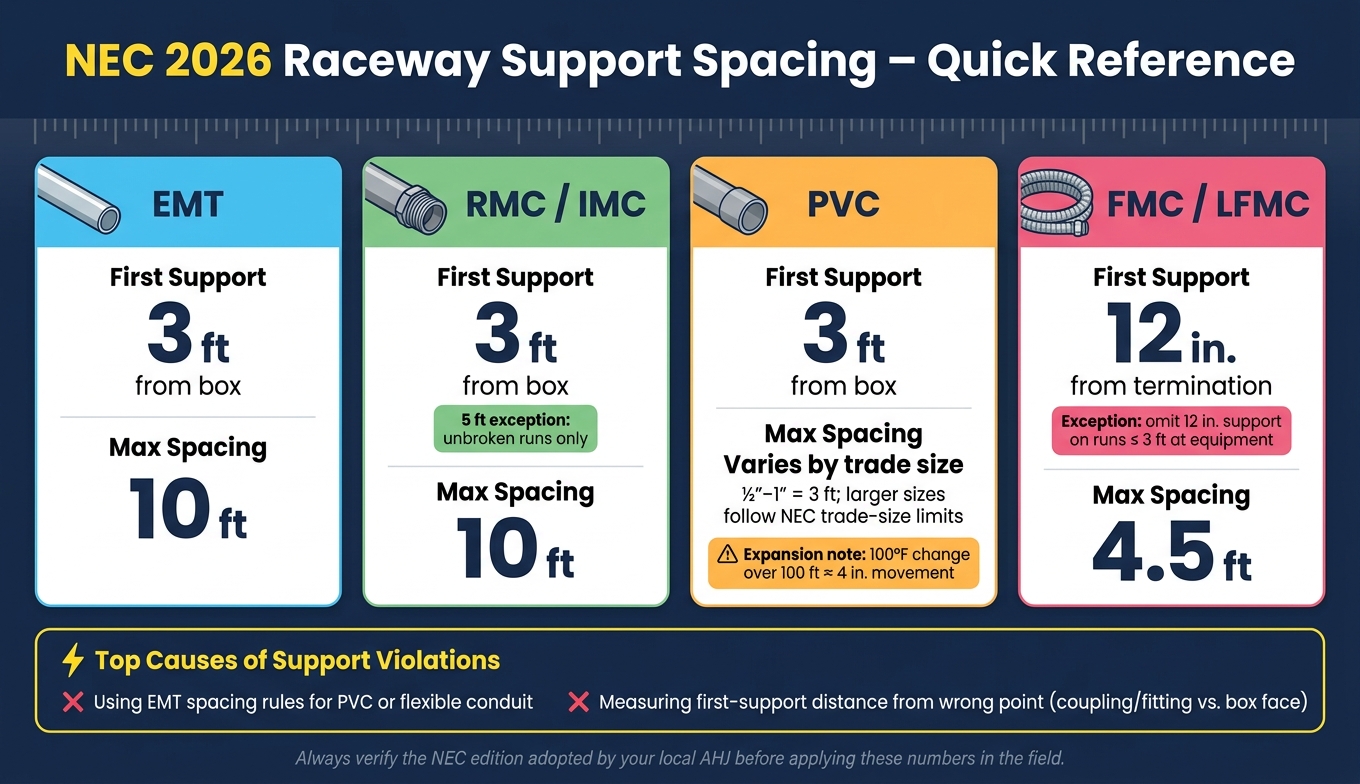
NEC 2026 Raceway Support Spacing Quick Reference Chart
Support Spacing Rules by Raceway Type
Use these raceway-specific limits to mark supports before you pull wire. It saves time later and helps keep the run straight, secure, and code-ready.
EMT and RMC/IMC Support Spacing
EMT, RMC, and IMC all follow the same basic rule: place the first support within 3 ft of the box, then support the raceway at intervals of no more than 10 ft.
There’s one narrow exception for RMC and IMC. If framing makes the 3 ft point impossible to reach, the first support can be as far as 5 ft from the box, but only when the run is unbroken and has no couplings.
| Raceway Type | First Support from Box | Max Interval Between Supports |
|---|---|---|
| EMT | 3 ft | 10 ft |
| RMC | 3 ft, or 5 ft if framing prevents closer support and the run is unbroken | 10 ft |
| IMC | 3 ft, or 5 ft if framing prevents closer support and the run is unbroken | 10 ft |
PVC Support Spacing and Expansion Details
PVC spacing depends on trade size. Smaller sizes use 3 ft spacing, while larger sizes can use 8 ft spacing.
Heat changes the picture. On rooftops and other hot runs, PVC can expand and contract enough to cause sagging or buckling if the run isn’t planned well. That’s why expansion fittings and tighter support spacing matter in those spots. A 100°F temperature change over 100 ft can move the conduit by about 4 in.
Flexible runs near equipment follow different limits.
FMC and LFMC Support Spacing at Equipment
FMC (NEC 348.30) and LFMC (NEC 350.30) need a support within 12 in. of each box or termination point. After that, support them at intervals of no more than 4.5 ft.
| Raceway Type | First Support from Termination | Max Interval Between Supports |
|---|---|---|
| FMC | 12 in. | 4.5 ft |
| LFMC | 12 in. | 4.5 ft |
There’s also a short-run exception. You can omit the 12 in. support when an FMC or LFMC run is 3 ft or shorter at equipment, such as a motor connection.
sbb-itb-501186b
How to Lay Out Supports Correctly in Industrial Installations
Once you know the spacing limits, the next job is laying out the supports along the run.
Start at the Box, Then Build the Span Layout
Mark support points before you pull wire. That keeps the run code-compliant and makes inspection a lot smoother.
Start at the box, cabinet, or conduit body. Put the first support within the NEC-required distance. Set that first support first, then measure the rest of the run from that point.
From there, work outward using even spans that stay at or below the maximum spacing allowed for that raceway type.
After the first support is in place, pick hardware that fits both the raceway and the surface you're fastening to.
Choose the Right Support Hardware for the Raceway and Structure
Use straps, hangers, or clamps that are rated for both the raceway and the structure. Attach supports to the building structure itself, not to ceiling grid or piping. Do not support conduit from ceiling grids or piping.
When you mark support locations, use the raceway-specific spacing limits listed above. Those simple layout checks help you avoid the spacing errors covered next.
Common Raceway Support Mistakes That Cause Violations
Once the spacing plan is set, the next wave of inspection failures usually comes from plain measurement mistakes and bad support choices.
Applying the Wrong Spacing Rule for the Raceway Type
One of the most common slipups is using EMT spacing as the default for every raceway. That’s where jobs get into trouble.
EMT does not set the rule for PVC, and flexible conduit comes with its own stricter first-support limits. PVC spacing is based on trade size, so if someone spaces a PVC run using EMT intervals, that run is headed for a violation. FMC and LFMC also have a stricter rule: they need support within 12 in. of every termination point. Crews that usually work with rigid conduit often miss that detail when they switch over to flexible runs.
A lot of bad spacing starts with one simple issue: measuring from the wrong spot.
Getting the First-Support Distance Wrong at Boxes and Equipment
For EMT, RMC, and IMC, the first-support distance is measured from the face of the box or enclosure. Not from a coupling. Not from a conduit body. Not from a fitting.
That mix-up shows up all the time, and it usually means the support lands too far from the box or enclosure.
An LB or LL doesn’t cancel the support rule either. The raceway on each side of that termination point still needs support within the required distance.
Even when the spacing is right, the job can still fail if the support method isn’t approved.
Using Non-Approved or Overloaded Support Methods
Some support methods are automatic red flags. Raceways tied to sprinkler piping, strapped to plumbing, or hung from ceiling grid wire are violations. And ceiling grid wire is not approved unless it is listed for that use.
In heavy industrial settings, trapeze hangers are another common problem area. On paper, one trapeze holding several large RMC runs may look fine. In the field, the combined weight can push past the hanger rating. That can lead to sagging and, over time, structural failure.
Conclusion: Raceway Support Spacing Numbers to Remember
Figure out the raceway material before you lay out supports. Then use the table below to check the first-support distance and the maximum span.
These are the numbers to keep handy in the field.
| Raceway Type | First Support from Box or Termination | Max Interval Between Supports |
|---|---|---|
| EMT, RMC, and IMC | 3 ft | 10 ft |
| PVC 1/2 in. to 1 in. | 3 ft | 3 ft |
| PVC (size-specific) | 3 ft | follow NEC trade-size limits |
| FMC / LFMC | 12 in. | 4.5 ft |
PVC and flexible conduit need closer attention because their spacing rules are tighter than EMT. FMC and LFMC also tend to fail most often at the first support, so that measurement matters.
A lot of violations come down to two simple mistakes:
- Using the wrong spacing rule for the raceway type
- Measuring from the wrong point
Check the NEC edition adopted by your AHJ before you use these numbers in the field.
FAQs
How do I measure the first support correctly?
Follow the raceway or cable tray manufacturer’s instructions first. Under NEC 392.30(A), support spacing needs to match those specs, including how far the supports can be from boxes, enclosures, or fittings.
When cables leave the tray and run to equipment, the unsupported span can’t be more than 6 feet. Go past that, and you need added support so the conductors aren’t put under mechanical stress.
When can RMC or IMC use the 5 ft exception?
RMC and IMC can use the 5-foot exception when framing or other structural members get in the way of the usual support spacing.
In that case, the conduit needs to be securely fastened within 5 feet of each outlet box, junction box, cabinet, or conduit termination if the structure makes the standard spacing impracticable.
How do I know the right PVC support spacing?
Check the manufacturer’s documentation for the specific PVC conduit you’re installing. The NEC says raceway systems, including PVC, must be supported based on the manufacturer’s instructions.
So before you install anything, verify those specs. It helps the conduit stay secure and puts you in a better spot for local inspection.