Metal vs. Non-Metal Conduits: NEC Comparison
Choosing the right conduit matters. Metal conduits like RMC, IMC, and EMT offer durability, fire resistance, and grounding capabilities, making them ideal for high-impact or hazardous locations. Non-metal conduits, such as PVC and fiberglass, resist corrosion and moisture, excelling in underground or chemically harsh environments.
Key differences include:
- Grounding: Metal conduits can act as a grounding conductor; non-metal conduits require a separate grounding wire.
- Durability: Metal conduits handle physical damage better; non-metal conduits outperform in corrosive or wet areas.
- Cost: Non-metal conduits are generally cheaper and faster to install.
Quick Comparison:
| Factor | Metal Conduits (RMC, EMT) | Non-Metal Conduits (PVC, Fiberglass) |
|---|---|---|
| Grounding | Acts as grounding conductor | Requires separate grounding wire |
| Corrosion Resistance | Moderate to poor | Excellent |
| Temperature Range | –40°F to +250°F | Varies: PVC (+40°F to +150°F), Fiberglass (–60°F to +250°F) |
| Installation Labor | Higher | Lower |
| Cost | More expensive | More affordable |
Understanding NEC guidelines ensures compliance and safety. Metal conduits are better for hazardous or high-impact areas, while non-metal conduits are ideal for underground or corrosive environments. Always match conduit type to project needs for optimal performance.
Electrical Conduit Types PVC EMT and Rigid Explained
sbb-itb-501186b
NEC Guidelines for Conduits
The NEC (National Electrical Code) outlines specific rules for each conduit type, detailing their use, support, and required fittings. Familiarizing yourself with these guidelines is crucial before diving into installation projects.
Relevant NEC Articles
Each conduit type falls under a dedicated NEC article, which specifies its intended applications and limitations:
- Rigid Metal Conduit (RMC): Covered by Article 344, RMC is robust and suitable for areas prone to severe physical damage or hazardous conditions.
- Intermediate Metal Conduit (IMC): Governed by Article 342, IMC is a lighter, more economical option compared to RMC, offering moderate physical protection.
- Electrical Metallic Tubing (EMT): Regulated by Article 358, EMT is commonly used in commercial and residential interior wiring.
- Rigid PVC Conduit: Addressed in Article 352, this includes Schedule 40 (ideal for underground or concrete-encased runs) and Schedule 80 (used above ground in areas with minimal risk of physical damage).
- Liquidtight Flexible Metal Conduit (LFMC): Covered by Article 350, LFMC is metallic yet flexible, featuring a waterproof jacket for wet environments or equipment exposed to vibration.
| NEC Article | Conduit Type | Primary Use Case |
|---|---|---|
| 342 | IMC | General wiring with moderate physical protection |
| 344 | RMC | Hazardous locations, severe physical damage areas |
| 350 | LFMC | Wet locations, equipment with vibration |
| 352 | Rigid PVC | Underground, corrosive, and wet environments |
| 358 | EMT | Commercial and residential interior wiring |
Key NEC Requirements to Know
Location ratings play a crucial role in selecting the right conduit. For example, EMT can be used in wet locations, but only if paired with fittings specifically rated for such conditions. RMC and IMC, on the other hand, are suitable for nearly all environments without the need for special fittings. When it comes to underground installations, PVC Schedule 40 is the go-to choice, though burial depth depends on factors like circuit voltage and the surface type, as outlined in NEC Table 300.5.
Two common pitfalls to watch out for are conduit fill and bend limits:
- Conduit fill: For three or more conductors, the total cross-sectional area of the wires must not exceed 40% of the conduit’s interior space, as detailed in NEC Annex C.
- Bend limits: Conduit runs are limited to 360 degrees of total bends (e.g., four 90-degree bends) between pull points, as per NEC 358.26. Exceeding this requires an additional pull box.
Specialized environments bring additional considerations. For example, NEC Article 500 requires threaded RMC or IMC in Class I, Division 1 areas where flammable gases or vapors are present. Threaded connections are essential here to contain arcs and withstand potential blast pressures.
"Non-metal conduit dramatically outperforms metal in corrosive environments. PVC is completely immune to moisture, salt air, chemicals, and electrochemical corrosion." - Conduit Fill Calculator Guide
For PVC installations, Article 352 requires the use of expansion fittings when thermal expansion exceeds 0.25 inches. In outdoor runs longer than 30 feet, this is almost always necessary. Skipping these fittings can lead to cracked conduits or damaged internal wiring due to thermal movement.
Metal Conduits: Types and Applications
Metal conduits, as outlined by NEC guidelines, are designed to meet specific industrial needs, combining durability with performance.
Types of Metal Conduits
There are four primary types of metal conduits, each suited for different protection levels and installation scenarios:
- Rigid Metal Conduit (RMC): The heaviest and most robust option, RMC is crafted from galvanized steel or aluminum. Its threaded ends ensure secure, tight connections, making it ideal for high-impact environments.
- Intermediate Metal Conduit (IMC): Similar in design to RMC but with thinner walls, IMC is about 25–30% lighter. Despite this, it still offers excellent mechanical protection.
- Electrical Metallic Tubing (EMT): Known for its lightweight design, EMT has walls roughly 40% thinner than RMC. Instead of threads, it uses compression or set-screw fittings for connections.
- Liquidtight Flexible Metal Conduit (LFMC): This flexible conduit features a spiral-wound metal construction covered by a waterproof jacket. It’s perfect for installations requiring flexibility due to movement or vibration.
| Conduit Type | NEC Article | Wall Thickness | Connection Method | Hazardous Location Rated |
|---|---|---|---|---|
| RMC | 344 | Heavy-wall | Threaded | Yes |
| IMC | 342 | Medium-wall | Threaded | Yes |
| EMT | 358 | Thin-wall | Set-screw/Compression | No |
| LFMC | 350 | Flexible/Jacketed | Specialized fittings | Conditional |
These design variations directly influence NEC compliance and performance in challenging conditions.
Performance and NEC Compliance
Metal conduits do more than protect wiring - they simplify installations by doubling as an Equipment Grounding Conductor, as specified in NEC Article 250.118. With approved fittings, RMC, IMC, and EMT provide a reliable, low-resistance path for fault currents, often eliminating the need for a separate grounding wire.
"Metal conduit can serve as equipment grounding conductor per NEC 250.118, eliminating separate grounding wire in many installations." - Conduit Fill Calculator
Their fire-resistant properties make metal conduits invaluable in high-risk environments. They neither burn nor melt, even under extreme heat. Additionally, steel conduits maintain their integrity across a wide temperature range, from –30°F to over 150°F. For sensitive electronic systems, metal conduits also offer built-in shielding against electromagnetic interference (EMI) and radio frequency interference (RFI), a feature non-metallic conduits lack.
Common Industrial Applications
Each type of metal conduit shines in specific industrial scenarios:
-
RMC: Best for hazardous locations (NEC Articles 500–516), industrial floors, and areas with heavy machinery or vehicle traffic where impact resistance is critical.
"RMC is required or strongly preferred in several specific situations: above-grade transitions from underground runs to surface equipment, installations in hazardous locations classified under NEC Articles 500 through 516, [and] locations with a high exposure to physical damage." - Utility Pipe Supply
- IMC: A lighter alternative for rooftops and parking structures, where load reduction is important but threaded connections are still necessary.
- EMT: Ideal for branch circuits and lighting in controlled environments like offices and hospitals. Its lightweight design speeds up installation.
- LFMC: Used for final motor connections and setups involving vibrating equipment, where rigid conduits might fail.
A noteworthy update in the 2023 NEC revision to Article 358.10 allows EMT to be used for direct burial and concrete encasement, provided it’s specifically listed for underground installations. This expands EMT's utility beyond its traditional above-ground role.
Choosing the right conduit type ensures NEC compliance and optimal performance tailored to your project's specific needs.
Non-Metal Conduits: Types and Applications
Non-metal conduits trade off mechanical strength for exceptional resistance to corrosion. Unlike galvanized steel, which deteriorates in challenging environments such as acidic soil, salty air, or areas with chemical exposure, plastic and fiberglass conduits remain durable for decades. In fact, with proper use, they can last over 50 years without requiring maintenance.
Types of Non-Metal Conduits
Non-metallic conduits come in several types: Rigid PVC (NEC Article 352), High-Density Polyethylene (HDPE) (NEC Article 353), Reinforced Thermosetting Resin Conduit (RTRC/Fiberglass) (NEC Article 355), and Liquidtight Flexible Nonmetallic Conduit (LFNC). Each has unique characteristics tailored for specific applications.
- Rigid PVC: Available in Schedule 40 for standard burial and concealed runs, and Schedule 80 for above-ground installations or areas prone to physical damage. PVC joints are quickly assembled using solvent cement.
- HDPE: Delivered on reels for seamless, continuous runs, making it a favorite for horizontal directional drilling (HDD) and telecom projects. Unlike PVC, HDPE requires heat fusion or mechanical couplings for connections.
- Fiberglass (RTRC): Suitable for both underground and above-ground use, it connects using bell-end fittings or adhesives. Its durability makes it ideal for harsh environments.
- LFNC: Designed for short, flexible connections, such as to pumps or air conditioning units, where vibration is a factor.
| Property | PVC (Sch 40/80) | HDPE | Fiberglass (RTRC) |
|---|---|---|---|
| NEC Article | 352 | 353 | 355 |
| Temp Range | +40°F to +150°F | -40°F to +190°F | -60°F to +250°F |
| Joining Method | Solvent cement | Heat fusion/Mechanical | Bell-end/Adhesive |
| Pull Friction (COF) | ~0.90 | ~0.50 | ~0.38 |
| Best Application | Standard burial | HDD/Long runs | Duct banks/Corrosive sites |
These properties influence both the performance and compliance of non-metal conduits under NEC guidelines.
Performance and NEC Compliance
Under NEC rules, non-metallic conduits cannot double as equipment grounding conductors (EGCs). Instead, a separate grounding conductor must be installed within the conduit, as specified in NEC 352.60.
Temperature limits also play a crucial role in selecting the right conduit. PVC, with a maximum temperature of 150°F, may soften under heavy cable loads in duct banks. HDPE, which tolerates up to 190°F, and fiberglass, which withstands up to 250°F, offer better performance in heat-intensive environments. Fiberglass has another advantage - it doesn’t melt or bond to cable insulation during electrical faults, simplifying conductor replacement. For PVC installations in areas with temperature fluctuations, it’s essential to use support straps that allow for linear movement. Without this flexibility, the material’s higher thermal expansion could lead to warping or joint damage over time.
Common Industrial Applications
PVC Schedule 40 is a go-to choice for underground utility distribution, thanks to its affordability, moisture resistance, and widespread availability. It requires a minimum burial depth of 18 inches, per NEC standards, though local regulations may demand deeper installations, particularly in colder regions where frost depth is a concern.
For duct banks and substations, fiberglass is gaining popularity. Its lower coefficient of friction (COF) of 0.38 - compared to 0.90 for PVC - allows for longer cable pulls with reduced tension, minimizing the risk of damage. Labor efficiency is another factor: installing 100 feet of 4-inch fiberglass conduit takes approximately 8.25 man-hours, while the same length of PVC Schedule 80 requires 16.8 man-hours. In corrosive settings like wastewater treatment plants, chemical facilities, or coastal installations, non-metallic conduits outperform galvanized steel, which may need frequent maintenance or early replacement due to corrosion.
Metal vs. Non-Metal Conduits: A Direct NEC Comparison
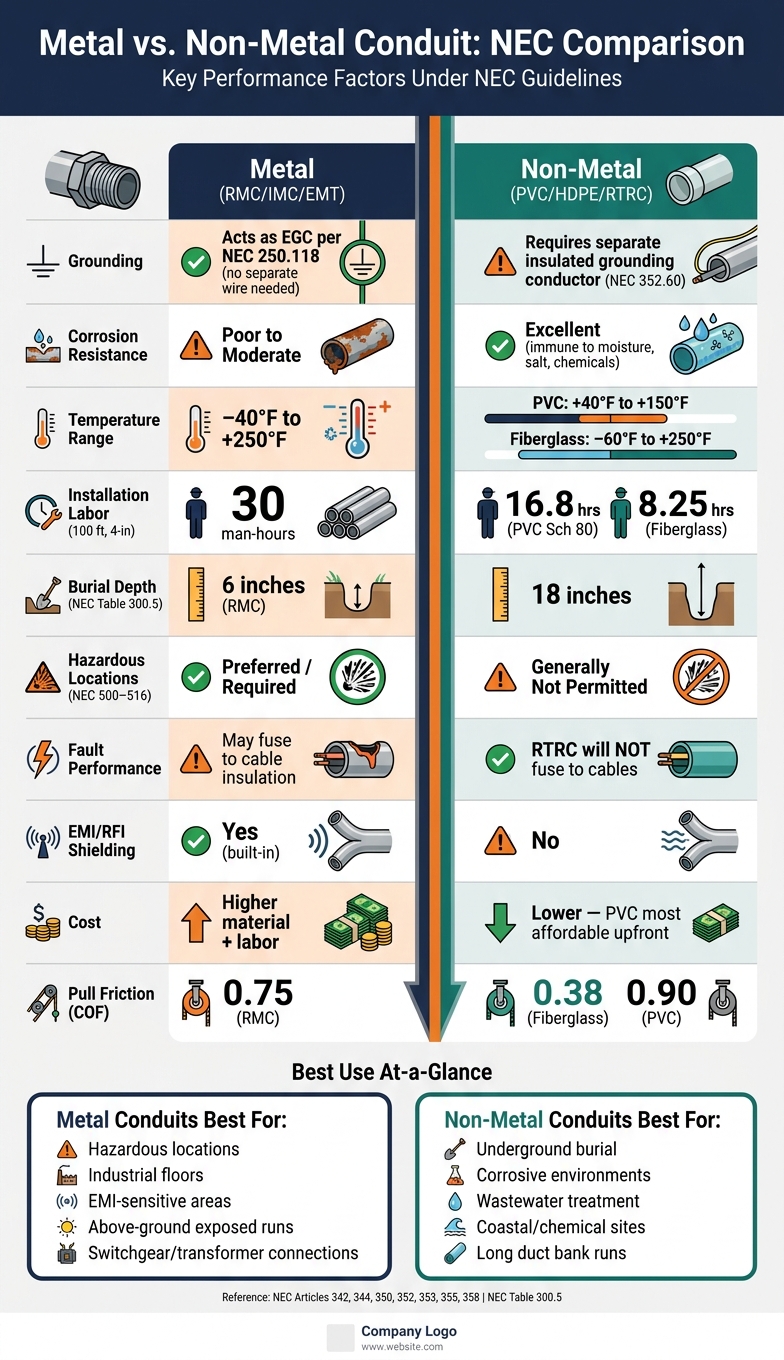
Metal vs. Non-Metal Conduit: NEC Comparison Chart
When deciding between metal and non-metal conduits, it’s helpful to weigh them against key factors like grounding, environmental performance, durability, and cost. Let’s break down how they compare, using NEC guidelines as a foundation.
Grounding and Bonding
This is where the two types differ most. Metal conduits - such as RMC, IMC, and EMT - are conductive, which allows them to double as the equipment grounding conductor (EGC) when properly bonded, following NEC Articles 344 and 358. This can save time and materials since there’s no need to run a separate grounding wire.
Non-metal conduits, on the other hand, require a separate insulated grounding conductor, which drives up both material and labor costs.
There’s also a notable difference in fault handling. In the event of a fault, metal conduits can fuse to cable insulation, often requiring a full replacement. Fiberglass (RTRC), however, avoids this issue entirely:
"Fiberglass also does not melt under fault conditions. PVC, aluminum, and steel conduit can fuse to cable insulation during an electrical fault, requiring full conduit replacement." - Utility Pipe Supply
Suitability for Different Environments
The environment often determines the best choice. Metal conduits excel in dry, indoor, and industrial settings above ground. However, they’re prone to corrosion in conditions like acidic soil, salty air, or chemical-heavy areas. Non-metal conduits - such as PVC, HDPE, and fiberglass - offer strong resistance to corrosion, making them ideal for direct burial and harsh outdoor environments.
Hazardous locations bring additional considerations. NEC Articles 500–516 generally recommend or require metal conduits in areas with flammable gases or vapors, as their containment properties help reduce ignition risks. Metal conduits also provide EMI shielding, which is critical for industrial settings where sensitive control systems operate near high-power equipment.
Temperature extremes further highlight differences:
- Fiberglass (RTRC): –60°F to +250°F
- Metal: –40°F to +250°F
- PVC: +40°F to +150°F
Mechanical Strength and Installation
Physical durability and installation labor are other areas where these conduits diverge. Metal conduits like RMC offer the highest level of mechanical protection and are approved by the NEC for areas subject to severe physical damage. Among non-metals, only PVC Schedule 80 meets this same durability standard, while Schedule 40 PVC does not.
When it comes to installation, non-metal conduits have a clear advantage. For example, installing 100 feet of 4-inch RMC takes 30 man-hours, while the same run in PVC Schedule 80 takes 16.8 man-hours, and fiberglass (RTRC) cuts that to just 8.25 man-hours. This labor efficiency can make a huge difference in large-scale projects. Fiberglass also has a lower coefficient of friction (0.38) compared to RMC (0.75) and PVC (0.90), allowing for longer cable pulls with less tension and fewer pull boxes.
Cost and Installation Efficiency
Metal conduits generally come with higher material and labor costs, while non-metal options are often less expensive and quicker to install - fiberglass being the standout in both categories. A common strategy is to use Schedule 40 PVC for buried horizontal runs and reserve Schedule 80 or RMC for vertical risers and exposed sections.
| Factor | Metal (RMC/EMT) | Non-Metal (PVC/HDPE/RTRC) |
|---|---|---|
| Grounding | Serves as EGC when bonded | Requires separate grounding wire |
| Corrosion resistance | Poor to moderate | Excellent |
| Burial depth (NEC) | 6 inches (NEC Table 300.5) | 18 inches |
| Install labor (100 ft, 4-in) | 30 man-hours | 8.25–16.8 man-hours |
| Fault performance | May fuse to cable insulation | RTRC will not fuse to cables |
| Hazardous locations | Preferred/required | Generally not permitted |
Ultimately, there’s no one-size-fits-all solution. The best choice depends on the specific conditions and requirements of your project, which we’ll explore further in the next section.
How to Choose the Right Conduit for NEC Compliance
Matching Conduit to Site Conditions
The conditions at your site are a key factor in choosing the right conduit. For dry, indoor locations - such as office buildings or clean manufacturing areas - EMT is a practical and economical choice. It's lightweight, easy to bend, and meets NEC standards for above-grade interior installations. For outdoor or underground applications, non-metal options like PVC Schedule 40 or HDPE perform well. These materials resist moisture and corrosion, which can degrade metal over time. Keep in mind that NEC Table 300.5 specifies different burial depths: RMC requires only 6 inches of cover, while non-metal conduits need 18 inches. This difference can significantly impact excavation and installation costs.
In corrosive environments, non-metal conduits are often the better option since metal requires protective coatings and still risks long-term corrosion. Temperature extremes also play a role. For example, fiberglass (RTRC) can handle temperatures from –60°F to +250°F, making it a better choice than PVC, which is limited to a range of +40°F to +150°F.
"Picking the wrong conduit material is one of the most expensive mistakes on an underground utility project." - Utility Pipe Supply
Tailoring your conduit selection to these specific conditions ensures both compliance and cost efficiency.
Conduit Selection for Industrial Sites
Industrial sites often require a mix of conduit types to balance performance and cost. A common approach is to use PVC Schedule 40 or HDPE for underground feeders and RMC or IMC for above-ground sections. This hybrid setup meets NEC standards while keeping material costs reasonable.
Here’s a quick guide to conduit choices for typical industrial applications:
| Application | Recommended Conduit | Reason |
|---|---|---|
| Underground feeders | PVC Sch 40 or HDPE | Corrosion resistance, cost-effective burial |
| Production floors | RMC or IMC | Impact resistance, protection from damage |
| Wastewater treatment | PVC Sch 80 or Fiberglass | Resistant to chemicals and moisture |
| Motor final connections | LFMC | Vibration isolation and flexibility |
| Sensitive control/data areas | EMT or RMC | EMI/RFI shielding for signal integrity |
One often-overlooked detail is support spacing. For example, PVC requires support every 3 feet on horizontal runs to prevent sagging, while RMC only needs support every 10 feet. On a large production floor, this difference can add up in terms of hardware and labor costs.
Aligning Conduit Choices with Electrical Equipment
Conduit systems must also align with the electrical equipment they connect to. For switchgear or transformers, NEC requires the use of threaded RMC fittings. These fittings offer a secure, impact-resistant connection, which is crucial in areas where accidental contact is possible. In hazardous locations, as defined by NEC Articles 500–516, RMC or IMC is typically mandatory.
For motor control centers and industrial motors, LFMC is ideal for the final connection. Its flexibility and vibration damping help protect both the conduit and the conductors inside. When purchasing equipment like transformers or motor control centers, platforms like Electrical Trader provide both new and used options that meet NEC specifications. Always check the equipment’s nameplate or installation manual for conduit entry requirements before finalizing your design.
Conclusion
The NEC standards outlined above highlight that choosing the right conduit is about more than just performance - it’s also about adhering to code requirements. As the Electricians Authority notes, "Conduit selection directly affects code compliance, physical protection levels, moisture resistance, and long-term system serviceability." Each project comes with its own unique needs, and the NEC provides a structured approach to align those needs with the appropriate conduit type.
Metal conduits, such as RMC and IMC, are ideal for applications where physical protection and grounding are priorities. According to NEC Article 250.118, these conduits can also function as the equipment grounding conductor. On the other hand, non-metal conduits are better suited for environments prone to corrosion, moisture, or underground exposure, where metal conduits may fail over time. This distinction can have a notable impact on both costs and installation methods.
PVC stands out as the most cost-effective option upfront, while fiberglass offers significant labor savings for larger installations - requiring about 8.25 man-hours per 100 feet compared to the 30 man-hours needed for RMC. While metal conduits have the highest combined material and labor costs, their durability and integrated grounding capabilities often make them worth the expense in more demanding scenarios.
To ensure your design meets all requirements, consult NEC Articles 344, 352, 355, and 358, as well as NEC Table 300.5 for burial depth specifications. When sourcing electrical components, platforms like Electrical Trader provide a wide range of NEC-compliant options, from transformers to motor control centers. By aligning your conduit selection with NEC guidelines and site-specific conditions, you can achieve installations that are both safe and compliant.
FAQs
When does the NEC require metal conduit instead of PVC or fiberglass?
The National Electrical Code (NEC) specifies the use of metal conduit in situations where strong physical protection, impact resistance, or containment in hazardous locations is necessary. This often applies to industrial facilities, construction sites, areas with significant vibration, spaces exposed to flammable gases, and above-grade transitions. These guidelines are designed to prioritize safety and ensure long-lasting performance in demanding environments.
Can EMT be used underground or in concrete under the 2023 NEC?
Yes, EMT can be used in concrete and underground installations under the 2023 NEC, as long as the fittings are explicitly listed and marked for these purposes. For underground setups, additional corrosion protection is necessary to meet NEC requirements.
How do I size conduit for wire fill and bend limits?
To size conduit for wire fill and bend limits according to NEC guidelines, follow these steps:
- Identify conductor size and quantity: Refer to NEC charts to ensure the wire fill stays within the allowable limit, which is 40% for three or more conductors.
- Calculate total conductor area: Add up the cross-sectional areas of all conductors and choose a conduit size that accommodates this total while staying within NEC limits.
- Keep bends in check: Restrict each conduit run to no more than two 90-degree bends. This helps maintain an appropriate bend radius, reduces strain, and makes wire pulling much easier.