Direct Burial vs. Duct Installation for MV Cables
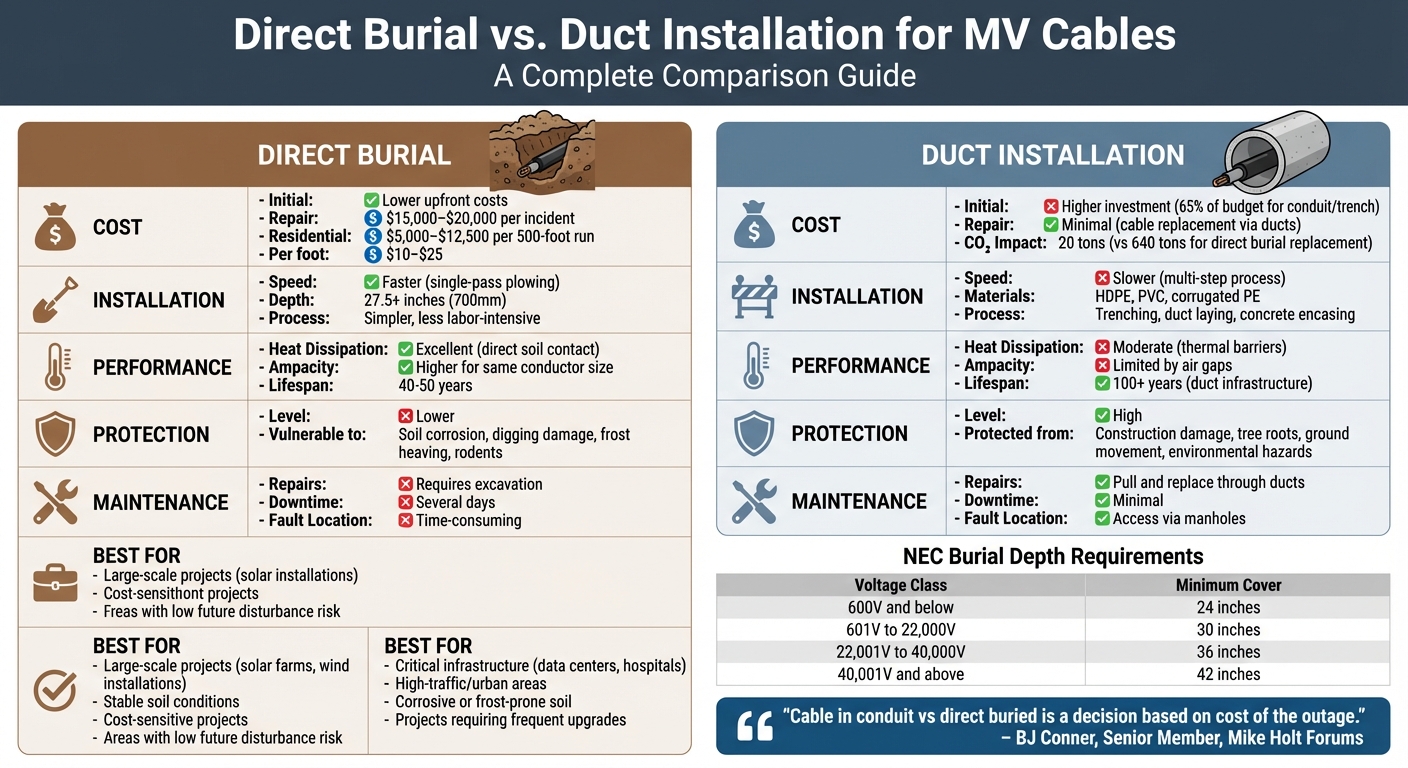
When installing medium voltage (MV) cables, you have two main choices: direct burial or duct installation. Each method has its pros and cons, and the right choice depends on your project's needs, budget, and site conditions.
Key Points:
- Direct Burial: Lower upfront cost, faster installation, and better heat dissipation. However, repairs are labor-intensive, and cables are more prone to damage from soil conditions and digging.
- Duct Installation: Higher initial cost but easier to maintain and upgrade. Offers better mechanical protection and durability, especially in urban or high-traffic areas.
Quick Comparison:
| Feature | Direct Burial | Duct Installation |
|---|---|---|
| Cost | Lower upfront costs | Higher initial investment |
| Repair Process | Excavation required | Cables can be replaced via ducts |
| Heat Dissipation | Better (direct soil contact) | Limited (air/conduit barriers) |
| Protection | Less durable, exposed to soil risks | High protection, especially in ducts |
| Lifespan | 40–50 years (cables) | 100+ years (ducts) |
Choosing the right method depends on factors like soil conditions, project scale, and future maintenance needs. Direct burial suits large-scale projects with stable conditions, while duct installation is ideal for critical infrastructure and areas requiring frequent upgrades.
Direct Burial vs Duct Installation for MV Cables: Complete Comparison Guide
Direct Burial Cable Installation
How Direct Burial Works
Before starting any direct burial installation, the first step is to contact utility locating services like 811 to mark existing underground lines. This ensures you avoid damaging any pre-existing utilities during the process. Once cleared, dig a trench at least 27.5 inches deep (700 mm) or deeper in areas prone to freezing, ensuring it extends below the permafrost level.
The trench bottom should be free of debris. Add a 4-inch layer of fine sand or soil to cushion the cable and protect its jacket. When unrolling the cable, be cautious, especially if temperatures are below 32°F. In such cases, preheat the cable to a range of 68–86°F before installation to prevent damage. Leave about 3 feet of slack at connection points, allowing for future repairs or any ground movement.
After the cable is in place, cover it with another 4-inch layer of sand. For added protection, place concrete slabs or bricks over the cable, ensuring they extend at least 2 inches beyond the cable on all sides. To warn future excavators, lay bright warning tape approximately 12 inches above the cable. Finally, backfill the trench in 4-inch layers, tamping each layer to prevent the soil from settling over time. Surface markers should then be added to indicate the cable's route.
By following these steps, direct burial installation ensures both durability and efficiency, especially in challenging conditions.
Benefits of Direct Burial
One of the main advantages of direct burial is its cost-effectiveness. It eliminates the need for conduit materials and the labor-intensive process of duct bank construction. Additionally, cables can often be installed in a single pass using specialized plows, which significantly shortens project timelines compared to duct installations.
As Sylvia Feng from Belden highlights, "Direct-burial cable supports a much faster and easier installation (with less material and time required)".
Direct burial also excels in heat management. Since the cable is in direct contact with the soil, heat dissipates more efficiently than it would through air gaps inside a conduit. This can increase the ampacity of the cable for the same conductor size. Moreover, being underground protects the cables from external hazards like UV exposure, ice storms, and falling debris that often damage overhead lines. When properly installed and not overloaded, these cables can last anywhere from 50 to 100 years.
However, despite these advantages, direct burial does come with some challenges.
Drawbacks of Direct Burial
One major downside of direct burial is the difficulty of making repairs. Locating faults often requires excavation, unlike conduit systems where cables can simply be pulled and replaced. The cable’s constant exposure to soil and groundwater can also lead to degradation. Over time, corrosive chemicals, fertilizers, and microbes in the soil can weaken the outer jacket. Even with protective measures, moisture can eventually seep through, altering the cable's electrical properties.
Accidental damage from digging is another concern. While warning tapes help, they don't eliminate the risk entirely. In cold climates, frost heaving can stress the cables, even when buried below the frost line. Rodents and burrowing insects also pose a threat unless the cable jacket is specifically designed to resist them. For long-distance installations, voltage drop can become an issue, often requiring larger conductor sizes to maintain performance.
While direct burial offers many advantages, understanding and mitigating these challenges is key to ensuring a successful installation.
sbb-itb-501186b
Duct Installation for MV Cables
How Duct Installation Works
Duct installation takes a different approach compared to direct burial, focusing on added protection and easier maintenance. The process begins with trenching and laying conduits between access points like manholes or chambers. In areas with heavy traffic or under roads, ducts are secured with spacers and often encased in concrete for extra durability. When digging isn't practical - such as across railways or waterways - Horizontal Directional Drilling (HDD) is used. This trenchless technique creates an underground bore path and pulls a specialized pipe through without disturbing the surface.
Before cables are installed, ducts are cleaned using brushes or foam pigs, followed by pulling a 3-meter test cable to check for obstructions. The actual cable pulling process involves specialized tools like cable winches for pulling force, rope guide rollers to reduce strain on bends, and bellmouths at duct exits to prevent scraping. Cable lubricant is also applied to minimize friction and protect the cable's outer layer.
Materials commonly used for ducts include HDPE and PVC, valued for their durability and resistance to chemicals. In situations requiring tight bends or complex routing, corrugated PE or polypropylene ducts offer the flexibility that rigid pipes lack.
This methodical approach not only ensures proper installation but also sets the foundation for its operational advantages.
Benefits of Duct Installation
One of the standout benefits of duct installation is the ease of maintenance and upgrades. If a cable fails or needs to be replaced, it can be removed and swapped out without additional digging. This is particularly beneficial in urban settings, where excavation can disrupt traffic and businesses. As Kåre Yttervik, a Cable Protection Project Engineer at Pipelife Norway, puts it:
"Due to the smooth inner surface of ducts, cables can be retracted and replaced whenever necessary without repeated excavation".
Ducts also provide excellent physical protection, shielding cables from damage caused by construction equipment, tree roots, or ground movement. For critical infrastructure, concrete-encased duct banks offer an added layer of security. There's also a notable environmental advantage: replacing a cable through an existing duct generates about 20 tons of CO₂, compared to 640 tons for digging up and replacing a buried cable. Additionally, high-quality HDPE or PVC duct systems are designed to last over a century, far exceeding the typical 40–50 year lifespan of the cables they house. Installing extra empty ducts during initial construction allows for future capacity upgrades without further excavation. Brightly colored, standardized ducts improve safety by making underground utilities easier to locate, reducing the risk of accidental damage during future projects.
While the benefits are clear, duct installations come with their own set of challenges.
Drawbacks of Duct Installation
Duct installation tends to be more expensive upfront because of the higher cost of materials and the labor-intensive process of trenching and duct placement. The multi-step installation process can also extend project timelines.
Moisture and waterlogging are persistent issues. Ducts can collect water from condensation or seepage, particularly in areas with high clay content or elevated water tables. This often necessitates the use of cables designed for continuous submersion, which can drive up material costs. Proper sealing at duct ends is critical - without gas-proof and waterproof seals, ducts can accumulate natural gas, debris, or even allow rodents to enter.
Another concern is heat dissipation. Unlike direct burial, where cables are in direct contact with soil for better heat transfer, ducts can limit a cable's ability to shed heat, potentially affecting its ampacity. While concrete-encased systems can sometimes help with heat management, this is not always the case. Lastly, using inappropriate materials, such as white plumbing PVC that might be mistaken for water lines, can pose safety risks.
Direct Comparison: Cost, Maintenance, and Performance
Cost Analysis
When it comes to upfront expenses, direct burial is the more affordable option. The savings come from skipping conduit materials and the labor-heavy process of building concrete-encased duct banks. Instead, the plowing method for direct burial is quicker and simpler compared to the "dig, feed, and backfill" process required for duct systems. To put it in perspective, conduit and trench work alone can account for 65% of the total budget for an undergrounding project. For residential projects, burying existing power lines typically costs between $5,000 and $12,500 for a 500-foot run, while underground service drops range from $10 to $25 per foot.
However, duct installations are more cost-effective in the long run, especially when repairs or upgrades are needed. For instance, replacing a cable using an existing duct generates only 20 tons of CO₂, compared to a staggering 640 tons for digging up and replacing a buried cable. Repairing a damaged underground cable can cost between $15,000 and $20,000 per incident. In industrial environments where downtime can be costly, duct banks with spare conduits are often the go-to choice. Pinpointing and excavating faults in direct-buried cables is not only time-consuming but also expensive.
Maintenance and Repair Considerations
When it comes to maintenance, duct systems offer clear advantages. Faulty cables can be removed and replaced through existing manholes or access points, eliminating the need for excavation. BJ Conner, a Senior Member at Mike Holt Forum, highlights the efficiency:
"Replacing a cable via ducts is significantly faster than excavating and splicing a fault in direct-buried lines".
Many industrial setups even include spare conduits at key distribution points, allowing power to be restored quickly while the damaged cable is repaired later.
On the other hand, direct burial repairs are more complex and time-intensive. The process involves locating the fault, excavating the area, repairing or replacing the damaged section, and restoring the surface. This can take several days to complete. Additionally, direct-buried cables are more susceptible to damage from construction equipment, tree roots, and frost heaving, even when buried below the frost line. For critical facilities like hospitals or data centers, this kind of downtime can be a major issue.
Performance and Ampacity
Performance is another key factor to consider when choosing between these methods.
Direct burial excels in heat dissipation, which improves its current-carrying capacity. As broadgage, a Senior Member at Mike Holt Forum, explains:
"Direct burial not only saves the cost of ducts but in some cases permits of a greater current being carried since heat is more readily transferred to the surrounding soil".
In contrast, duct installations provide better mechanical protection and durability. High-quality HDPE or PVC ducts are built to last 100 years or more, far outliving the standard 40–50 year lifespan of the cables they house. In challenging conditions like rocky or corrosive soil, ducts shield cables from insulation damage and other environmental hazards. For extreme cold, cables with Polyethylene (PE) jackets can handle temperatures as low as -40°F, compared to -4°F for standard PVC jackets. These features make duct systems a more reliable choice for critical infrastructure where minimizing downtime is essential.
| Feature | Direct Burial | Duct Installation |
|---|---|---|
| Initial Cost | Lower – no conduit or concrete needed | Higher – includes materials and labor |
| Repair Process | Locate fault, excavate, splice; longer downtime | Replace cable via ducts; minimal downtime |
| Heat Dissipation | Excellent – direct soil contact | Moderate – thermal barriers from air/conduit |
| Mechanical Protection | Low – prone to damage from external factors | High – especially with concrete-encased ducts |
| Future Upgrades | Challenging – requires new trenching | Easier – spare ducts can be used |
| Typical Lifespan | 40–50 years (cable) | 100+ years (duct infrastructure) |
3 methods of laying underground cables
Choosing the Right Method for Your Project
When deciding on the best installation method, it's essential to go beyond cost, maintenance, and performance. The specific conditions of your project play a big role in determining the right approach.
Site and Environmental Factors
Start by evaluating the soil and site conditions. For example, soil corrosivity and compaction levels are key considerations. If you're dealing with deep trenches or highly compacted areas, heavier-walled conduit protection may be necessary if direct burial isn't used. Corrosive soils, frost-prone areas, or locations with high groundwater levels can gradually damage direct-buried cables, making duct installation a better choice for long-term durability.
In regions with extreme cold, frost heaving can stress cables even when buried below the frost line. Polyethylene (PE) jackets, which can handle temperatures as low as –40°F, are a better option compared to standard PVC jackets that are only rated to –4°F. Additionally, think about future land use. If construction or landscaping is likely in the area, duct systems simplify cable repairs and replacements down the line. These site-specific factors are crucial in selecting the most suitable installation method.
Application Scenarios
The scale and importance of your project also influence the choice of method. Direct burial is ideal for large-scale installations where cost and speed are the primary concerns. Projects like wind farms, solar arrays, and utility loops often benefit from the lower upfront costs and quicker installation times associated with direct burial. These types of projects usually have lower risks of accidental damage and don’t demand frequent maintenance access.
On the other hand, duct systems are better suited for critical industrial applications. Facilities like paper mills, semiconductor plants, and data centers often rely on duct banks because they allow for quicker cable replacement without the need for excavation, minimizing downtime. Duct systems are also the go-to option for high-traffic zones, roadway crossings, or areas where cables need extra mechanical protection.
Regulatory and Safety Considerations
Compliance with the National Electrical Code (NEC) is non-negotiable. Burial depths vary based on cable voltage levels:
- 601V to 22,000V: 30 inches
- 22,001V to 40,000V: 36 inches
- Above 40,001V: 42 inches
For all medium-voltage (MV) cables operating above 600 volts, a continuous, effectively grounded shield, sheath, or concentric neutral is required.
Mechanical protection standards also depend on the location. For example, NEC 300.5 mandates specific types of protection, like PVC Schedule 80 conduit, for cables running under walkways or in areas prone to physical damage. Additionally, direct-buried cables must maintain a minimum clearance of 12 inches - both horizontally and vertically - from other underground utilities like water or fuel lines.
Before starting any excavation, call 811 to mark existing utilities. To prevent future mishaps, install red magnetic warning tape above the cable route and keep a detailed property map showing exact cable locations and depths.
| Voltage Phase to Ground | Minimum Depth of Burial (Inches) |
|---|---|
| 600V and below | 24 |
| 601V to 22,000V | 30 |
| 22,001V to 40,000V | 36 |
| 40,001V and above | 42 |
Conclusion
Key Takeaways
Choosing between direct burial and duct installation depends heavily on the specifics of your project. Direct burial is often the go-to option for large-scale projects like solar farms or wind installations due to its lower upfront cost and quicker installation process. Its ability to dissipate heat effectively also supports higher ampacity. However, locating faults in these systems can be labor-intensive, as it often requires significant excavation.
On the other hand, duct installation offers stronger mechanical protection, making it ideal for areas with heavy traffic, frost heave, or risks of accidental damage. While it involves higher initial costs and takes longer to install, it simplifies future upgrades or cable replacements. Instead of digging, cables can be pulled through existing ducts, saving time and effort. As BJ Conner, Senior Member of Mike Holt Forums, aptly put it:
"Cable in conduit vs direct buried is a decision based on cost of the outage."
For environments like data centers or industrial plants, where downtime can be extremely costly, duct systems provide a practical, long-term solution.
Final Recommendations
When deciding between these methods, consider factors like site conditions, project timelines, and future maintenance needs. Direct burial is a cost-effective choice for stable soil conditions with minimal risk of future disturbances. Meanwhile, duct systems are better suited for areas with corrosive soils, high water tables, or frost-prone conditions, offering better durability and easier upgrades over time.
For projects involving critical infrastructure or frequent upgrades, it’s wise to install duct systems with spare conduits from the start. This proactive approach can save both time and money in the long run. Always check local NEC requirements, contact 811 before digging, and use red magnetic warning tape and detailed maps to mark cable routes. With careful planning and the right method, you can build a medium voltage system that remains reliable and efficient for decades.
FAQs
When should I choose direct burial over ducts?
When selecting direct burial cable, ensure it’s specifically rated for this purpose. Such cables are designed to handle outdoor conditions, resist moisture, and endure exposure to soil and other elements without additional conduit protection. Opt for direct burial when it’s a simpler and more budget-friendly choice, but always confirm the cable meets all safety and durability standards required for this type of installation.
How do soil and groundwater affect MV cable life?
Soil and groundwater pose serious threats to the longevity of medium voltage (MV) cables, primarily through physical and chemical damage. Groundwater can seep into cables, allowing moisture to compromise insulation and heightening the risk of corrosion. Similarly, factors like soil acidity, high moisture content, and corrosive substances can break down cable jackets and damage conductors over time. To combat these issues, using cables designed for water resistance and implementing protective measures is critical for extending the lifespan of MV cables.
How do ducts affect ampacity and cable sizing?
When cables are housed in ducts, heat dissipation becomes restricted. This can reduce their ampacity - their ability to carry current safely. To address this, cable sizes may need to be adjusted to account for the thermal buildup and interactions within the duct. Ensuring the correct sizing is essential to prevent overheating and to maintain the cables' ability to handle the intended electrical load safely.