




How Preventive Maintenance Cuts High-Voltage Failures
High-voltage failures usually start small, and routine maintenance can stop many of them before they turn into outages. I’d boil the article down to this: inspect equipment on schedule, test for hidden electrical trouble, fix small defects early, and use maintenance records to judge used equipment before you buy.
Here’s the short version:
- Small issues grow into big failures: loose connections, worn breaker parts, dirty insulation, moisture, overload, and bad terminations.
- The cost of failure is high: in some plants, unplanned downtime can hit $2.3 million per hour.
- Safety is part of the issue: failed switchgear, cables, and transformers can lead to arc-flash, shock, and fire.
- Maintenance finds early warning signs: hot spots, rising contact resistance, oil problems, gas formation, leaks, and tracking marks.
- Testing matters: insulation resistance, dielectric tests, contact resistance checks, thermography, DGA, and control circuit checks each catch a different problem.
- Records matter when buying used gear: complete logs, test reports, and repair history help you judge condition and price with less guesswork.
A few numbers stand out:
- 16.4% of failures in one IEEE-cited dataset were tied to poor maintenance.
- 64% of HEAF events were found preventable.
- Electrical failures are 3x more common in equipment without a scheduled maintenance program.
If I were turning this into one plain takeaway, it would be this: planned maintenance costs less than emergency failure, and good records lower risk twice - first while equipment is in service, and again when someone needs to buy or sell it.
That’s the core idea behind the article.
High Voltage Maintenance Training – MV/HV Systems Testing, Safety & Reliability by EFTI
sbb-itb-501186b
What Causes High-Voltage Equipment to Fail
High-voltage equipment tends to fail in a handful of predictable ways. The key is understanding the conditions that push that damage forward.
Aging, Insulation Breakdown, and Mechanical Wear
Insulation breakdown is one of the most common root causes in transformers, cables, busbars, switchgear, and breakers. Over time, insulation loses dielectric strength under thermal, electrical, mechanical, and environmental stress. In transformers, winding insulation and tap changers deteriorate from heat, oxidation, and moisture. In cables, insulation can crack and form treeing - microscopic channels that grow under repeated electrical stress until they turn into a fault. Routine testing and inspection help spot these warning signs before they turn into failures.
Mechanical wear is a major problem in breakers and switchgear. Pivot points, linkages, springs, contact assemblies, and other moving parts degrade with repeated operation. Breaker failure data found that wear and aging caused 55.9% of minor failures and 42.3% of major failures. Contact erosion from arcing during normal switching makes things worse. As contact area shrinks, resistance goes up, heat builds at the contact point, and the damage snowballs over time.
Bolted connections in busbars and cable terminations are another frequent weak point. Thermal cycling makes joints expand and contract again and again, which slowly reduces clamping pressure. Once a joint starts to loosen, resistance rises, heat builds, and the damage tends to speed up.
Environmental Stress, Loading, and Installation Defects
Moisture, dust, salt, and chemicals all speed up deterioration. Humidity and condensation increase surface conductivity on insulators and bushings, which promotes tracking and partial discharge. Moisture is a leading environmental failure factor for medium-voltage switchgear, accounting for roughly 17.7% of failures in studied facilities. Dust, salt, and industrial chemicals can settle on insulating surfaces and form conductive films. That cuts down effective creepage distance and increases flashover risk, especially in coastal and industrial settings.
Overloading pushes temperatures past design limits, which speeds up aging. High inrush currents from large motor starts and transformer energization add mechanical stress to windings and may cause nuisance tripping or transient overvoltages. Bad installation work can make all of this worse. Under-torqued connections create high-resistance joints from the start, misaligned bus joints concentrate stress at contact surfaces, and poor cable terminations open the door to partial discharge and moisture ingress. Proper commissioning stops many of these issues before the equipment is placed in service.
In practice, these stressors often show up first as loosened joints, surface contamination, and insulation damage.
Failure Causes by Equipment Type
| Equipment | Primary Failure Causes | Visible Symptoms | Likely Consequences |
|---|---|---|---|
| Circuit Breakers | Contact erosion, mechanism wear, insulation breakdown, contamination or moisture inside enclosures | Slow or failed operation, hot spots at terminals, gas or oil leaks | Failed trip, arc-flash, extended outage |
| Transformers | Insulation aging, oil degradation, moisture ingress, tap changer wear | Oil leaks, elevated temperature, abnormal noise, DGA gas formation | Winding failure, fire risk, unplanned outage |
| Switchgear | Bus contamination, loose connections, worn racking mechanisms | Tracking marks, corrosion, thermal anomalies on bus joints | Flashover, arc-flash, equipment damage |
| Busbars | Loose joints, corrosion, insulation damage, contamination | Hot spots at joints, discolored insulation, visible discharge marks | Arcing fault, overheating, production shutdown |
| HV Cables | Water treeing, insulation defects, poor terminations, external damage | Partial discharge, elevated leakage current, visible termination damage | Insulation failure, ground fault, outage |
Studies found that 64% of HEAF events were preventable. The main causes were loose connections, contamination, and insulation damage.
Each of these failures usually leaves a visible or measurable clue before it turns into an outage. That’s exactly what inspections and tests are supposed to catch early.
How Preventive Maintenance Cuts Failure Risk
Preventive maintenance is about finding trouble before it turns into failure.
In high-voltage equipment, problems rarely appear out of nowhere. They usually leave small clues first. Preventive maintenance means inspecting, testing, and fixing equipment while those clues are still small. That matters because run-to-failure can lead to arc flash, equipment damage, and long downtime.
The numbers make the point. IEEE Std. 3006.3 cites a dataset of 1,469 failures. Out of those, 240 failures (16.4%) were tied to inadequate maintenance, and the standard notes that poor maintenance caused more failures than no maintenance.
Inspections That Catch Early Warning Signs
For switchgear and circuit breakers, inspections should look for contamination, tracking marks, cracked insulators, corrosion, overheating, leaks, and damaged seals. Mechanical checks should also confirm that operating mechanisms open and close smoothly, interlocks work as intended, shutters and safety barriers move freely, and latches are not worn or sticking.
For transformers, the inspection list shifts a bit. Look for oil leaks, bulging tank walls, rust, broken or dirty bushings, cracked porcelain, loose connectors, and signs of partial discharge or tracking around high-voltage terminations. Cooling systems also need attention. Check fans, radiators, and oil pumps for damage, odd noise, or vibration.
Outdoor equipment needs another layer of attention. Bird nests, salt deposits, industrial pollution films, and chipped or dirty surfaces can all push equipment toward flashover.
Good records matter here. Take photos. Add condition ratings. Build a ranked work list. It is far better to tighten a loose connection, clean an insulator, or swap out a bad seal during a planned outage than to let a minor defect turn into a flashover, a stuck breaker, or insulation failure.
Tests That Reveal Hidden Electrical Problems
A visual inspection shows what you can see on the surface. Electrical testing shows what is going on inside.
Each test points to a different kind of failure:
- Insulation resistance testing finds low-resistance paths in windings, cables, and bus systems. That can warn of insulation breakdown, moisture ingress, or contamination before an earth fault happens.
- Dielectric tests such as applied voltage, power factor/dissipation factor, or VLF testing for cables check insulation under stress. These tests can show deterioration, moisture ingress, or contamination.
- Contact resistance testing finds high-resistance joints on breaker poles, bus connections, and disconnects. If resistance keeps rising, the joint can overheat under load and end in thermal runaway or burn-off.
- Control circuit functional checks confirm that trip coils, close coils, auxiliary switches, and protective relays work right. That cuts the risk of a breaker failing to open during a fault.
- Infrared thermography spots hot areas on terminations, bus joints, and transformer cooling systems that a normal visual check can miss.
Transformers need a few more checks. Dissolved gas analysis and oil quality testing help find early internal faults, overheating, and insulation degradation. For gas-insulated equipment, SF₆ gas pressure and density checks make sure dielectric and arc-interrupting performance stay within spec.
Maintenance Tasks, Failure Modes, and Typical Intervals
In U.S. practice, service intervals usually come from manufacturer guidance, industry recommended practices, the operating environment, and how critical the asset is. Tough conditions like coastal salt exposure or heavy industrial pollution often mean shorter intervals. Clean indoor equipment with light loading may allow some tasks to stretch out if test trends stay steady.
| Preventive Activity | Failure Risks Reduced | Equipment Type | Example Service Interval |
|---|---|---|---|
| External visual inspection & IR thermography scan | Tracking, hot joints, flashover risk, corrosion | HV switchgear, breakers, transformers | Annually |
| Internal breaker mechanism inspection & lubrication | Sticking mechanisms, failure to trip or close, mechanical wear | HV circuit breakers (air, vacuum, SF₆) | Every 3–5 years, or after 2,000–5,000 operations |
| Contact resistance testing | Hot joints, busbar burn-off, connector failure under load | Switchgear bus, breaker poles, disconnects | Every 3 years, or after major load changes |
| Insulation resistance & dielectric testing | Insulation breakdown, ground faults, cable and winding failures | Cables, transformers, switchgear | Every 3–5 years; more often in harsh environments |
| Oil quality & dissolved gas analysis (DGA) | Internal transformer faults, overheating, insulation aging | Oil-filled transformers | Annually, with trend analysis across years |
| SF₆ gas pressure/density checks | Low dielectric strength, failure to interrupt fault currents | Gas-insulated switchgear and breakers | Semi-annually, and before major switching campaigns |
| Control circuit functional checks | Failure to trip/close on command, protective relay misoperations | Breakers, relays, control panels | Annually, and after protection system upgrades |
When scheduling the work, use U.S. month/day/year format and line it up with planned outage windows. And don’t rely on the calendar alone. Trends often tell the better story. If resistance starts climbing or gas readings start getting worse, shorten the interval and act sooner.
Those same maintenance records also help buyers judge risk in used high-voltage equipment.
Using Maintenance History When Buying Used High-Voltage Equipment
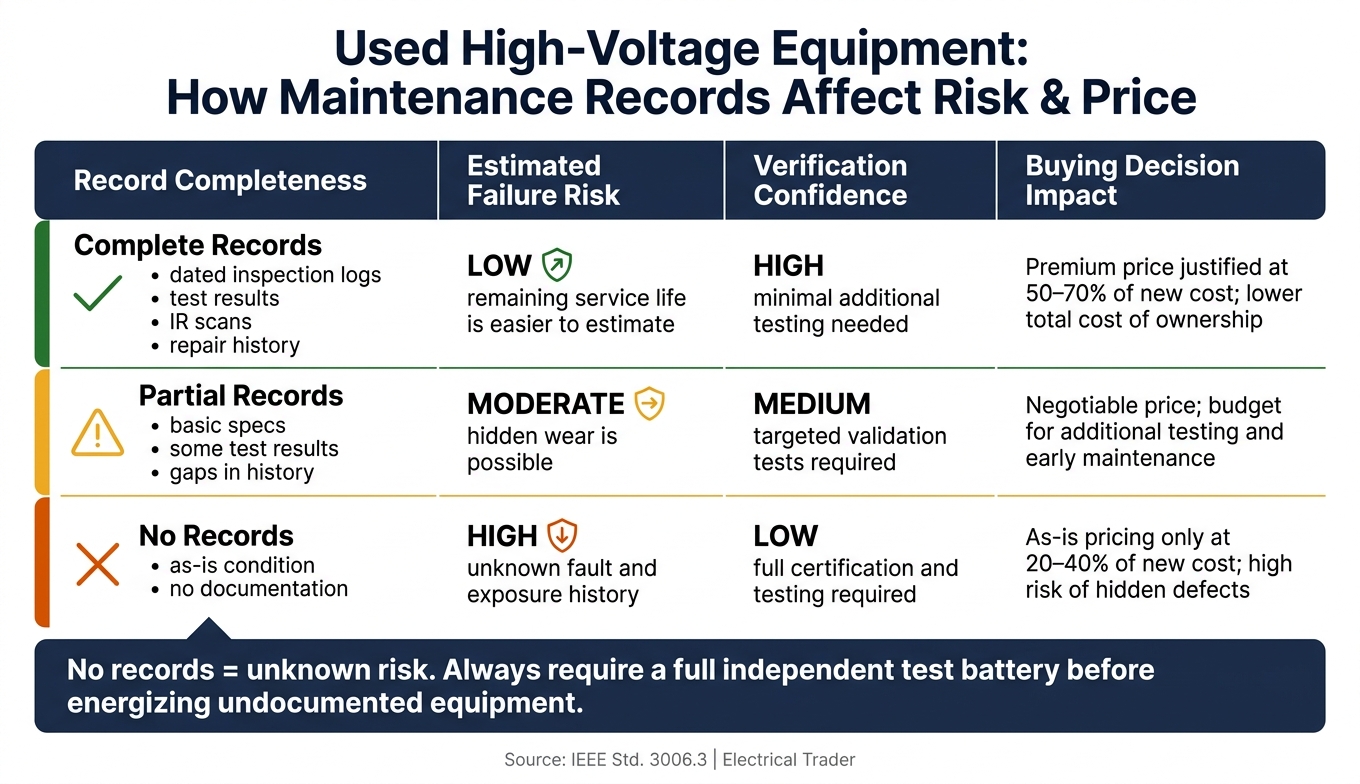
Used High-Voltage Equipment: How Maintenance Records Affect Risk & Price
Maintenance history helps buyers size up risk when they’re looking at used high-voltage equipment. Those same records that support upkeep also give you a clearer sense of how much service life the asset may still have.
What Buyers Should Review Before Purchase
Ask for dated inspection logs, test reports, thermography images, and transformer or gas-analysis results. For oil-filled transformers, request DGA, moisture content, dielectric strength, and acid number.
Don’t stop at test data. Ask for the repair and refurbishment history too - what parts were replaced, when the work happened, and who did it. Loading history matters as well. Equipment that operated near, or above, its nameplate rating for long stretches usually sees more thermal stress than a unit that ran at moderate loads. It also helps to review the operating environment and the level of exposure, since humidity, salt air, and chemicals speed up aging.
"Documented test reports and maintenance records add value and are essential to ensure safe and reliable operation."
Once the records are on the table, it gets much easier to compare sellers based on how well they can back up the condition of the equipment.
How Electrical Trader Fits the Buying Process
Electrical Trader lists new and used high-voltage equipment, which gives buyers a way to compare documentation before they buy. Still, listing claims are just the starting point. Ask for the source reports behind them.
When you’re comparing several listings, treat documentation quality as part of the deal right alongside price and physical condition. A unit that costs a bit more, but comes with years of steady test records and professional service logs, can carry less total risk than a cheaper one with no paper trail at all. And if a seller says they’ll provide certain records or run tests before shipment, get that promise in writing.
Used Equipment Risk Based on Maintenance Records
Record quality should shape both risk and price. The table below shows how record completeness affects estimated failure risk, verification confidence, and buying decisions for used high-voltage equipment.
| Record Completeness | Estimated Failure Risk | Verification Confidence | Buying Decision Impact |
|---|---|---|---|
| Complete records (dated inspection logs, test results, IR scans, repair history) | Low; remaining life is easier to estimate | High; minimal additional testing needed | Premium price justified (50–70% of new); lower total cost of ownership |
| Partial records (basic specs, some test results, gaps in history) | Moderate; hidden wear is possible | Medium; targeted validation tests required | Negotiable price; budget for additional testing and early maintenance |
| Missing records ("as-is" condition, no documentation) | High; unknown fault and exposure history | Low; full certification and testing required | As-is pricing only (20–40% of new); high risk of hidden defects |
If records are missing across the board, treat the equipment as an unknown. That means planning for a full independent test battery before energizing it. No records should also push the offer price down, because the risk can’t be pinned down in advance.
Conclusion: Planned Maintenance Lowers Risk and Improves Buying Decisions
Most high-voltage failures don't happen all at once. They build over time, which means there's usually a chance to stop them before they turn into a bigger problem. That's why prevention tends to work better than repair.
Scheduled inspections and testing are built for exactly this job. They help spot trouble early, before a part fails and takes other equipment down with it. In practice, planned maintenance pays for itself. Scheduled inspections, torque checks, thermography, insulation testing, and cleaning can catch loose, contaminated, or overheating components before failure. Electrical system failures are three times more frequent in equipment that isn't covered by a scheduled maintenance program. And in most cases, planned service costs far less than emergency replacement, collateral damage, and downtime.
That same habit of keeping records and staying on schedule also helps when you're buying used equipment. Maintenance records give buyers a quick way to screen for risk. Complete logs cut uncertainty and reduce the need for extra testing. Electrical Trader listings are most useful when they're backed by dated service and test records.
Planned maintenance lowers risk and makes used-equipment decisions more dependable.
FAQs
What maintenance task prevents most failures?
Regular maintenance helps stop the worst high-voltage failures before they start. Daily and weekly visual checks are the first line of warning.
These inspections can spot leaks, cracked bushings, and odd noises early, before they turn into bigger problems. When you pair them with regular oil testing, yearly diagnostics, and condition-based monitoring, they can help prevent most failures.
How do I know when test intervals should be shortened?
Shorten test intervals when condition checks or trend data point to fast-moving deterioration or repeated warning signs. Use an Equipment Condition Assessment (ECA) to factor in physical condition, operating environment, and criticality.
Compare results against baseline commissioning data and long-term trends, not one-off readings, to spot insulation wear early. If partial discharge gets worse over time, step up monitoring, including 24/7 monitoring with alerts when needed. It also makes sense to shorten intervals after major repairs or new installs, especially for older or hard-worked assets.
What records matter most when buying used high-voltage equipment?
Prioritize a complete, traceable maintenance history so you can verify current condition and get a clearer sense of service life left. The main records to ask for are manufacturer datasheets, maintenance logs, service interval records, reconditioning reports, pre-shipment test results, and compliance certificates.
For circuit breakers, look at operation counts, contact wear, and overhaul history. For transformers, review DGA history, loading history, and insulation maintenance reports.





