

Power Distribution Systems: Types and Uses
If I had to boil this down to one point, it’s this: pick your power distribution system based on load, outage tolerance, voltage, and fault current - in that order. In most U.S. buildings, the main choices are radial, loop, ring main, and interconnected layouts, plus low-voltage secondary service or medium-voltage primary service.
Here’s the short version:
- Radial systems cost less but have one power path, so a feeder fault can shut down everything downstream.
- Loop systems give power from two directions, which cuts outage impact.
- Ring main and interconnected systems fit sites where downtime can cost a lot, like hospitals and data centers.
- 120/240 V, 208Y/120 V, and 480Y/277 V cover most U.S. building service needs.
- Medium voltage - often 4.16 kV to 13.8 kV - starts to make sense when loads grow into the multi-MVA range or when feeder runs get long.
- Equipment should be sized to demand load, not just connected load, with room for about 10%–30% future growth.
- Feeders and services also need the NEC check: 125% of continuous load plus 100% of noncontinuous load.
For most buyers, the path is simple:
small buildings usually use low-voltage radial distribution; mid-size buildings often move to 480Y/277 V; and large campuses, hospitals, and plants often use medium-voltage primary distribution with local transformers.
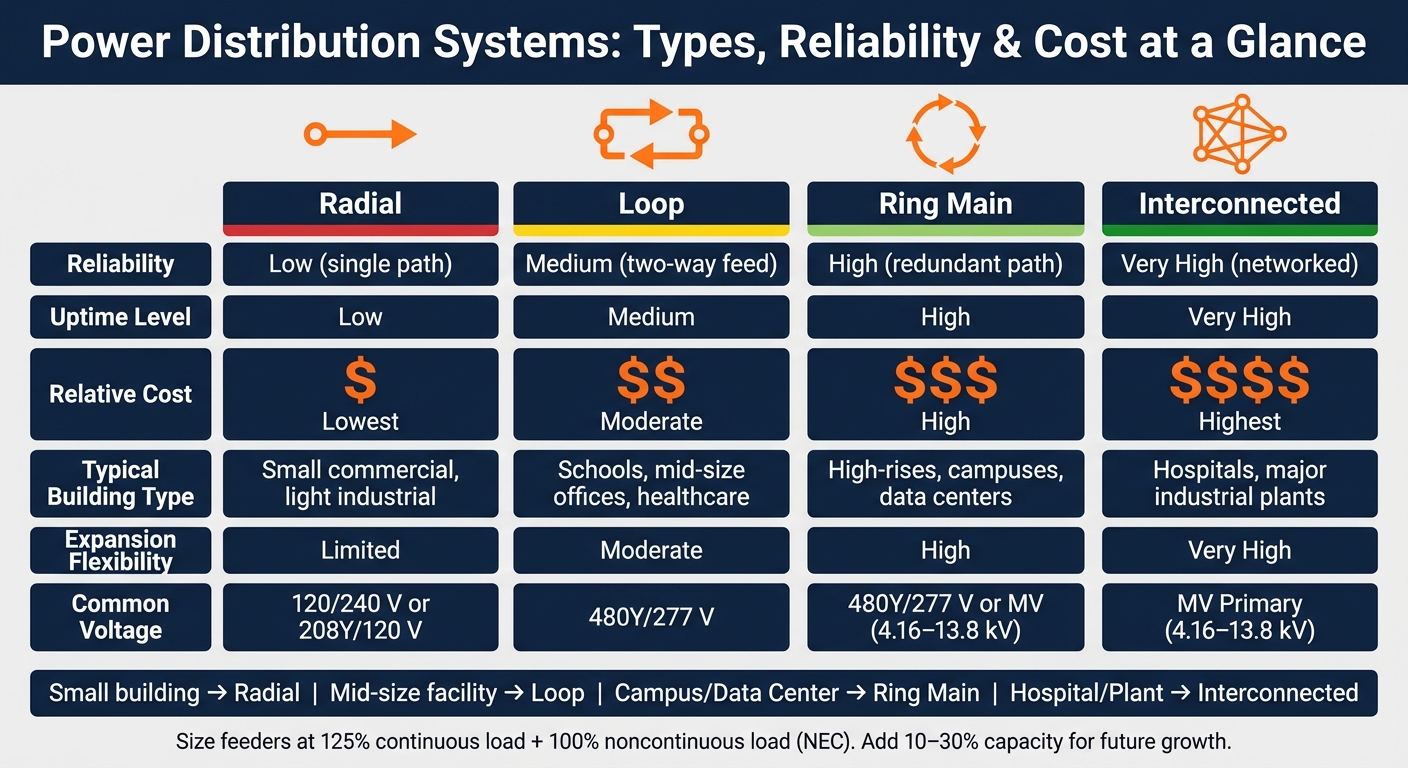
A fast side-by-side view:
| Type | Best fit | Uptime level | Cost level |
|---|---|---|---|
| Radial | Small commercial, light industrial | Low | Low |
| Loop | Schools, offices, healthcare | Medium | Mid |
| Ring Main | High-rises, campuses, data centers | High | High |
| Interconnected | Hospitals, large plants | Very high | Highest |
If I were buying, I’d lock down the load study, voltage, topology, bus rating, and AIC before looking at any breakers, switchgear, transformers, or busway.
Power Distribution System Types: Reliability, Cost & Best Use Cases
Distribution Systems : Radial & Ring Main Distribution | TheElectricalGuy
sbb-itb-501186b
Main Power Distribution System Types and Where They Fit
Once load and service voltage are set, the next big call is topology. This is what shapes downtime risk, fault isolation, and overall outage impact. It also has a direct effect on cost.
The main options are radial, loop, ring main, and interconnected. In plain English, heavier loads and higher voltages often push a project toward more involved layouts. Smaller, lighter-load buildings usually don't need that extra complexity. The goal is simple: match the system type to the site's load, uptime target, and future expansion plans before picking equipment.
Radial Systems: Simple, Lower-Cost Distribution
A radial system sends power in one direction, from the source to the load, with no backup route. If a feeder fails, everything downstream goes dark until crews clear the fault.
That's the tradeoff: low first cost and straightforward maintenance versus limited fault isolation. This setup makes sense when a short outage won't cause major trouble.
Loop Systems: Better Continuity for Mid-Size and Larger Facilities
A loop system can feed loads from two directions. If one feeder section fails, that section can be isolated, and the rest of the circuit can be brought back from the other side.
That gives you better fault isolation and better continuity. It's a good fit when one feeder problem shouldn't knock out the entire building. The catch is that you need more switchgear, and protection settings get more involved. If uptime demands keep climbing, ring main or interconnected layouts are usually the next move.
Ring Main and Interconnected Systems: Redundant, High-Availability Sites
Ring main systems keep a closed loop. Interconnected systems link multiple power sources together.
Both are built for places where downtime is expensive. They fit sites that need redundancy, fast fault isolation, and high availability. You'll often see them in hospitals, data centers, high-rise buildings, campuses, and major industrial plants. These layouts make sense when continuity, redundancy, and selective fault clearing matter more than first cost.
For a quick side-by-side view, use the table below.
| System Type | Reliability | Typical Building Type | Expansion Flexibility | Relative Cost |
|---|---|---|---|---|
| Radial | Low (single path) | Small commercial, light industrial | Limited | Lowest |
| Loop | Medium (two-way feed) | Schools, mid-size offices, healthcare | Moderate | Moderate |
| Ring Main | High (redundant path) | High-rises, campuses, data centers | High | High |
| Interconnected | Very high (networked) | Hospitals, major industrial plants | Very high | Highest |
Voltage Levels, Primary vs. Secondary Distribution, and Building Size
Once you’ve settled on topology, voltage is the next big call. It affects conductor size, equipment footprint, losses, and what gear will work with the system.
Primary Distribution: When Medium Voltage Makes Sense
Primary distribution is the medium-voltage part of the system - everything between the utility connection and the service transformer. In U.S. facilities, that usually means 4.16 kV to 13.8 kV, though the full primary range is often about 4 kV to 34.5 kV, depending on feeder length and load density.
As loads get larger and runs get longer, medium voltage starts to look like the better option. Why? Because higher voltage means lower current for the same power. That cuts conductor size and line losses. Typical MV sizing bands are 1–3 MVA at 600 V or 4.16 kV, 3–10 MVA at 4.16 kV, and 10–50 MVA at 13.8 kV.
There’s another big plus. A medium-voltage primary system can let one utility service feed several building substations across a campus, instead of sending separate low-voltage services to each building. For universities, corporate campuses, and large industrial sites, that setup can be a much better fit.
The downside is pretty plain: MV gear costs more and takes more room. Medium-voltage switchgear is larger, needs more clearance, and has to be handled by people trained for MV work. For a small retail site, that’s usually overkill.
Secondary Distribution: Common Low-Voltage Service Options
Secondary distribution starts on the load side of the service transformer. It feeds panelboards, motor control centers, and branch circuits at 600 V and below. In the U.S., three setups cover most commercial and industrial buildings.
- 120/240 V single-phase, 3-wire: Used for small retail, standalone offices, and light commercial spaces. It supports 120 V receptacles and 240 V loads like small HVAC units or water heaters.
- 120/208 V three-phase, 4-wire wye: Common in small to mid-size commercial buildings with mixed receptacle loads, office equipment, lighting, and smaller three-phase loads.
- 480Y/277 V three-phase, 4-wire wye: Common in larger commercial and industrial buildings. It can feed large HVAC equipment, motors, and 277 V lighting directly. Where 120 V receptacles or smaller loads are needed, step-down transformers provide 208Y/120 V.
Matching Voltage to Building Type and Load Profile
The easiest way to narrow the voltage choice is to look at the load and the building type.
Small retail or office buildings - usually under 20,000 sq ft with loads below about 300 kVA - are often well served by 120/240 V single-phase or 120/208 V three-phase service. As a building moves into the mid-size commercial range, 480Y/277 V often makes more economic sense, especially when HVAC and lighting loads start to climb.
Large commercial buildings in the 50,000–500,000 sq ft range often need service entrances rated 1,200–4,000 A at 480Y/277 V three-phase, with step-down transformers feeding 120/208 V panels for receptacles and other general-purpose loads.
Industrial sites and large campuses usually go a step higher and take medium-voltage primary service - often 13.8 kV. From there, power is sent to building substations, stepped down to 480 V for motors and process equipment, and then reduced again through local transformers to 208/120 V for office and control loads.
| Building Type | Approximate Load Scale | Common Service Voltage | Likely Distribution Approach |
|---|---|---|---|
| Small retail / single-tenant | ~50–150 kVA | 120/240 V 1φ or 120/208 V 3φ | Direct low-voltage service; simple radial panelboards |
| Small office / mixed-use | ~100–300 kVA | 120/208 V 3φ | Low-voltage radial; step-down panels for tenants |
| Mid-size commercial | ~300–1,000 kVA | 120/208 V 3φ or 480Y/277 V 3φ | Main low-voltage switchboard; possible 480 to 208 V transformers |
| Large commercial / hospital | ~1–5 MVA | 480Y/277 V 3φ (from MV primary) | MV feed to main substation; 480 V radial/loop feeders; local 208/120 V transformers |
| University / corporate campus | Multi-MVA, many buildings | MV (4.16–13.8 kV) with LV secondaries | MV radial or loop feeders; building substations with 480Y/277 V distribution |
| Industrial plant | Multi-MVA, heavy motor loads | MV primary, 480 V secondary | MV primary switchgear; 480 V motor control centers; local LV panels for offices |
One compatibility detail matters more than it may seem at first: 480 V lines up well with common U.S. motor ratings. That makes 480Y/277 V a natural choice for motor-heavy facilities. If the site voltage doesn’t line up with standard motor or panelboard ratings, you can end up needing custom transformers or equipment derating, which adds cost and extra hassle.
With voltage set, the next step is matching the gear to the topology and the available fault duty.
How to Match System Type to Load, Service Needs, and Equipment Requirements
After you pick the topology and voltage, the next job is simple in theory but easy to get wrong in practice: match the equipment ratings to the load and the available fault current.
Assess Load, Demand, and Future Expansion Before You Buy
The mistake people make most often is sizing to connected load instead of demand load. Nameplate totals usually make the load look bigger than what the building will use at peak, and that difference changes by building type. Offices usually run at a diversity factor of 0.7–0.85, hospitals are closer to 0.8–0.95, and data centers tend to land around 0.9–1.0.
That matters because you should size for the load that operates at the same time during peak use, not for every connected item running at once if that never happens. Then add room for growth:
- 10%–20% for most commercial sites
- 20%–30% for sites likely to add major loads such as HVAC, production lines, EV charging, or new tenants
You also need to size feeders and services at 125% of continuous load plus 100% of noncontinuous load. So there are two checks to finish before you lock in equipment ratings: the demand calculation and the NEC sizing rule.
Once the load basis is clear, the system topology starts to shape the rest of the equipment plan. A simple radial layout calls for one level of gear. A dual-source or network-style setup is a different animal.
Choose Equipment That Matches the System Topology and Fault Duty
Topology has a direct effect on equipment choice. Radial systems use a single source path, so they usually rely on simpler switchboards. Loop, ring main, and interconnected systems need alternate feeds, tighter coordination, and gear built for higher duty. Loop and selective setups use load-break switches or breakers arranged for alternate feeds. Dual-source and network-style systems usually call for multiple transformers, main-tie-main bus layouts, transfer controls, and tighter protective coordination.
Interrupting rating must be higher than the available fault current at each point in the system. This is where transformer details start to matter fast. Fault current is tied directly to transformer size and impedance. A larger kVA transformer or lower impedance means more fault current downstream, which pushes up the interrupting rating needed for breakers and switchgear.
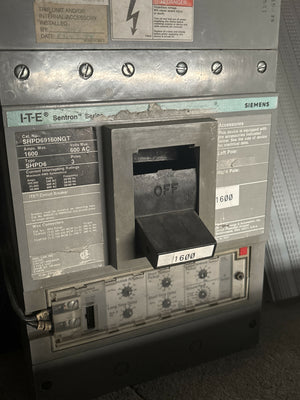
Before you buy, verify the core specs against the calculated load and fault duty: voltage, kVA, bus rating, frame size, and AIC.
| Equipment Type | Key Specs to Verify | Typical Use Case |
|---|---|---|
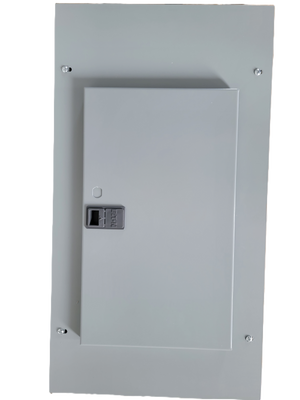
| Panelboards | Voltage, ampacity, AIC, circuit spaces | Branch distribution in commercial and light industrial spaces |
| Switchboards | Bus rating, AIC, feeder count | Main distribution for larger commercial or light industrial sites |
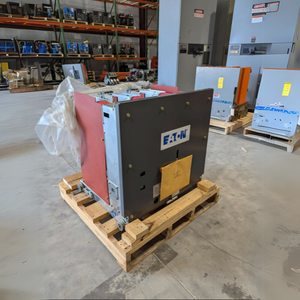
| Switchgear | Interrupting capacity, short-time withstand, relay compatibility | High fault-duty or selective and dual-source systems |
| Transformers | kVA, primary/secondary voltage, impedance, cooling type | Service entrance step-down or local voltage conversion |
| Busway | Ampacity, voltage class, plug-in spacing | Flexible distribution on manufacturing floors or data halls |
Using Electrical Trader to Source Distribution Equipment
Once load, voltage, topology, and fault duty are nailed down, sourcing becomes much more straightforward. At that point, you're not hunting by product name. You're matching equipment to a defined spec.
Electrical Trader carries breakers, transformers, and low- to high-voltage equipment across a wide range of ratings, including both new and used inventory. You can filter by voltage class, kVA, frame size, and interrupting rating after the design basis is set. That can speed up sourcing and cut the odds of buying under-rated equipment.
But the order matters: load calculations and fault studies come first.
Conclusion: Choosing the Right Distribution System for the Site
After topology, voltage, and fault duty are set, the buying decision gets a lot simpler. At that point, it usually comes down to reliability, cost, and service needs.
The choice of distribution system hinges on three things: load, outage tolerance, and budget. Radial is the low-cost option. Loop gives you better continuity. Ring main adds another layer of backup. Interconnected systems offer the highest availability.
Small commercial sites usually stick with low-voltage secondary distribution, such as 208Y/120 V or 480Y/277 V. But as load grows and feeder distances get longer, medium-voltage primary distribution like 4.16 kV or 13.8 kV often makes more sense.
Use that framework to buy in this order:
Key Takeaways for U.S. Buyers
- Define current demand and 5–10 year growth.
- Choose primary or secondary voltage based on building size and load density.
- Match topology to outage tolerance. Radial works for sites that can handle outages. Loop fits facilities with limited tolerance. Ring main is a good fit for low-tolerance operations. Interconnected is usually reserved for sites that need near-zero downtime.
- Verify fault current, interrupting ratings, and coordination before buying.
Once the spec is set, Electrical Trader helps buyers source new and used breakers, transformers, switchgear, and other low- to high-voltage distribution equipment.
Load, voltage, and topology should define the purchase spec.
FAQs
How do I choose between radial, loop, and ring main?
Choose the setup based on your site's budget, uptime needs, and growth plans.
- Radial: the simplest and lowest-cost option, but a single failure can take the whole system offline.
- Loop: costs more than radial, but gives you better uptime with a backup feeder path.
- Ring main: the top choice for maximum reliability, though it comes with a higher upfront cost.
When should a building use medium-voltage service?
Use medium-voltage service - usually 2,400 to 69,000 VAC - for industrial facilities, university campuses, high-rise buildings, data centers, and large commercial complexes where power needs to move across long distances.
It makes sense to look at medium voltage when low-voltage switchboards go past 5,000 to 6,000 amperes, or when you need to serve large motors or long cable runs. In many cases, it can cut costs, improve safety by reducing arc flash risk, and reduce losses over distance.
How do fault current and AIC affect equipment selection?
Fault current is the large current that flows during a short circuit. For safe operation, breakers, switchgear, and distribution panels need an AIC (or kAIC) rating that is higher than the maximum available fault current at that point in the installation.
If the AIC rating is too low, the equipment can fail during a fault and cause major damage. Fault current changes based on transformer impedance and the way the system is set up, so a short-circuit study during design helps confirm the chosen gear stays within safe limits as the system expands.