

Plastic vs. Metal: Best Material for Outdoor Hazardous Locations
If I had to boil it down to one rule, it’s this: match the enclosure material to the harshest thing the site will throw at it. Sun, salt, chemicals, cold, impact, and heat swings all change the right answer.
Here’s the short version:
- Polycarbonate is light and lower cost, but it needs UV protection for direct sun and can crack under some solvent or base exposure.
- Fiberglass (GRP/FRP) is often the safer plastic pick for coastal, wastewater, and chemical sites because it won’t rust and tends to hold up longer outdoors.
- 304 stainless steel fits many general outdoor jobs.
- 316 or 316L stainless steel is the better call for coastal, offshore, refinery, or chloride-heavy areas.
- Aluminum works well when weight and heat flow matter, but salt air can be hard on it without the right coating.
- Coated carbon steel costs less up front, but once the coating gets scratched, rust can start.
A few numbers make the tradeoff clearer:
- Outdoor temperature swings can run from -60°F to 104°F or more in direct sun.
- Fiberglass can weigh about one-third to 40% of a similar steel enclosure.
- Stainless steel can weigh about 6 to 7 times more than polycarbonate.
- Polycarbonate may turn brittle below about 14°F (-10°C).
- Polycarbonate max temperature is about 248°F (120°C), while fiberglass is about 300°F (148°C).
What I’d check first before buying:
- UV exposure: For plastic in sun, look for UL 746C f1.
- Corrosion risk: NEMA 4X matters more than NEMA 4 when rust is a concern.
- Chemical contact: Plastics and metals fail in different ways.
- Thermal cycling: Gaskets, hinges, and cable entries often fail before the shell does.
- Impact and vandalism risk: Metal usually takes abuse better.
- Weight and mounting: This matters a lot for pole mounts and remote installs.
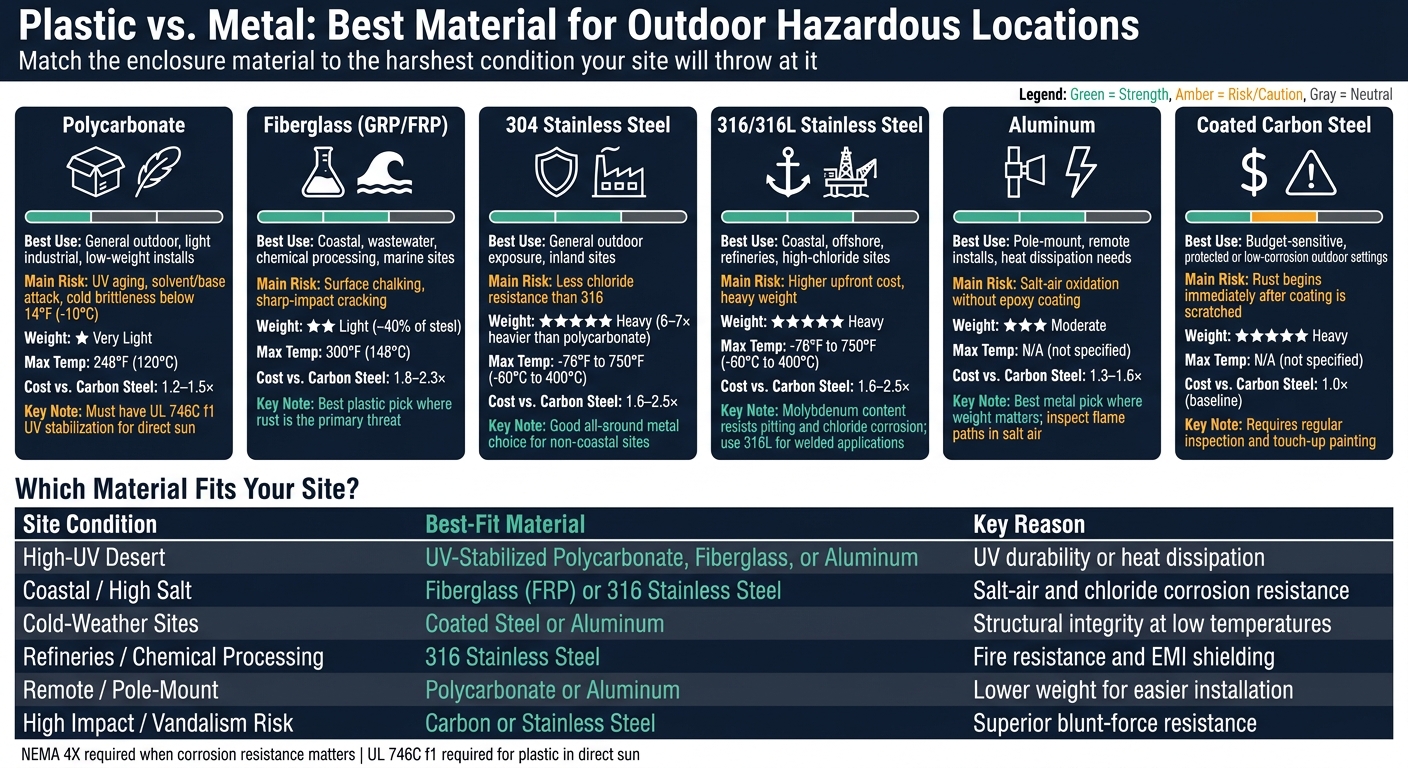
Plastic vs. Metal Enclosures: Material Selection Guide for Outdoor Hazardous Locations
Enclosures for Harsh Environments
sbb-itb-501186b
Quick Comparison
| Material | Best use | Main risk | Weight | Outdoor note |
|---|---|---|---|---|
| Polycarbonate | General outdoor, light industrial, low-weight installs | UV aging, solvent/base attack, cold brittleness | Very light | Use UV-stabilized grades for direct sun |
| Fiberglass (GRP/FRP) | Coastal, wastewater, chemical areas | Surface chalking, sharp-impact cracking | Light | Strong pick where rust is the main problem |
| 304 Stainless Steel | General outdoor exposure | Less chloride resistance than 316 | Heavy | Good all-around metal choice inland |
| 316/316L Stainless Steel | Coastal, offshore, refineries, high-chloride sites | Higher upfront cost, heavy weight | Heavy | Often the better long-life pick in harsh areas |
| Aluminum | Pole-mount, lighter metal installs, heat flow needs | Salt-air oxidation without coating | Moderate | Good where weight matters |
| Coated Carbon Steel | Lower-cost sites with mild corrosion exposure | Rust after coating damage | Heavy | Better for protected outdoor locations |
So if you want the fastest answer: pick fiberglass or 316 stainless for salt and chemicals, aluminum for lower weight, coated steel for tighter budgets, and polycarbonate only when UV and chemical exposure are under control. The rest of the article helps you sort that out by site condition, service life, and maintenance load.
Key Factors to Evaluate Before Choosing a Material
Before you compare plastic and metal, start with the four things that tend to cause outdoor enclosure failure: UV exposure, sealing, corrosion, and thermal cycling. Once you know those pressure points, the plastic-versus-metal tradeoff gets a lot clearer.
UV Resistance and Sunlight Exposure
UV radiation causes UV-driven polymer breakdown, which can lead to embrittlement and, eventually, structural failure. This catches people off guard because NEMA and IP ratings deal with ingress, not UV durability.
If you're using a plastic enclosure in direct sun, check for UL 746C f1 certification. That rating shows the material can handle outdoor exposure. Also, pay close attention to how the plastic is protected. UV stabilization should be built into the resin itself, not sprayed or painted on later. Why? Because surface coatings wear away, and once that happens, the base material is left exposed.
Metal doesn't lose strength from UV exposure. But the finish on metal can break down. When paint or coatings fail, the substrate can oxidize fast. For powder-coated aluminum in high-UV settings, AAMA 2605 is the top spec for color and gloss retention. That's a big separator between plastic and metal in sunny outdoor use.
Weather Sealing, Corrosion, and Temperature Swings
Ingress protection comes from the whole enclosure system, not just the shell material. Long-term sealing depends on whether gaskets, hinges, and cable entries keep doing their job over time. NEMA 4 covers rain and hose-directed water. NEMA 4X adds corrosion resistance, and that extra "X" matters because NEMA 4 by itself does not require corrosion-resistant construction.
For metal, material grade matters a lot:
- Use 304 stainless steel for general outdoor exposure
- Use 316 stainless steel for coastal areas or chloride-heavy sites
Plastic won't rust, which is a clear plus outdoors. But some plastics don't handle solvents or strong bases well.
Temperature swings create another problem. Thermal cycling can reduce gasket compression over time, especially in non-metallic enclosures that don't hold their shape as well under hardware stress. Plastic acts as an insulator, so it can limit solar heat gain but also trap heat inside. Metal sheds internal heat more easily, though it also picks up solar load fast. That's often the difference between a box that meets the rating on paper and one that keeps performing in the field.
Comparison Table: Core Performance Criteria
| Criterion | Plastic (Polycarbonate/GRP) | Metal (Stainless/Aluminum) |
|---|---|---|
| UV Resistance | Requires UL 746C f1 stabilization; prone to embrittlement without it | Not weakened by UV; coatings and paints can degrade |
| Weather Durability | Good with proper gaskets; door warping can reduce seal over time | Excellent; holds shape better under hardware stress |
| Corrosion Resistance | Excellent - no rust, but some plastics are sensitive to solvents and alkalis | Varies - 316 stainless steel is superior; carbon steel is poor without coating |
| Impact Strength | Moderate to high; can become brittle with age or UV exposure | Very high; resists blunt force and maintains alignment |
| Weight | Lightweight - GRP is roughly one-third the weight of comparable metal enclosures | Heavy (steel) to moderate (aluminum) |
| Thermal Behavior | Insulator - reduces solar heat gain but can trap internal heat | Conductor - dissipates internal heat and absorbs solar load quickly |
Plastic Enclosures: Strengths and Limits Outdoors
Polycarbonate and Fiberglass Performance Outdoors
Once UV exposure and thermal cycling enter the picture, the big question becomes simple: how do these plastics age outside?
Polycarbonate is lighter and handles impact better. Fiberglass tends to last longer in sun, heat, and chemical-heavy settings.
Polycarbonate has excellent impact resistance at room temperature, but it has a weak spot: UV exposure. In high-UV climates, unstabilized polycarbonate can age much faster.
Fiberglass can chalk on the surface, but it usually keeps its structure longer than polycarbonate. It also does a better job over long stretches of sun exposure, handles higher heat, and resists a broader set of chemicals, including acids, alkalis, and chlorinated compounds.
So the tradeoff is pretty clear. Polycarbonate is lighter and costs less. Fiberglass is the tougher pick for harsher outdoor sites.
Plastic Advantages and Limits at Hazardous Sites
One big plus with plastic is that it avoids a common outdoor failure mode: corrosion. That matters in coastal areas, washdown zones, fertilizer plants, and humid sites. Because the enclosure shell is non-conductive, installation can also be simpler in some cases.
Still, the weak points matter just as much. Polycarbonate does not handle organic solvents such as acetone or toluene very well, and it can also struggle with strong bases like ammonia. Those exposures can lead to crazing and stress-cracking. Plastic also expands more than metal, so temperature swings can put stress on seals and cable entry points. And if someone overtightens hardware, the enclosure wall itself can crack.
That makes plastic a strong fit when corrosion is the main problem. But metal still has the edge when you need more stiffness, better heat handling, or EMI protection.
Comparison Table: Polycarbonate vs. Fiberglass/GRP/FRP
| Feature | Polycarbonate | Fiberglass (GRP/FRP) |
|---|---|---|
| UV Resistance | Moderate - requires stabilizers; prone to yellowing and embrittlement | Good - may chalk at the surface, but structural integrity lasts longer |
| Chemical Resistance | Good for acids and oils; poor for solvents and alkalis | Excellent - resists acids, alkalis, chlorine, and many solvents |
| Impact Resistance | Excellent at room temperature; brittle below 14°F (-10°C) | High rigidity; can crack rather than deform under sharp impact |
| Weight | Very light | Lightweight - roughly 40% of comparable steel enclosures |
| Max Operating Temp | 248°F (120°C) | 300°F (148°C) |
| Maintenance Profile | Low - inspect periodically for UV embrittlement and crazing | Very low - no rust or repainting; inspect for surface chalking |
| Typical Outdoor Use | General outdoor and light industrial sites with visual inspection needs | Wastewater, chemical processing, marine, and coastal sites |
| Cost vs. Carbon Steel | 1.2–1.5× baseline | 1.8–2.3× baseline |
Metal Enclosures: Strengths and Limits Outdoors
When corrosion resistance alone won’t cut it, metal is often the better pick for impact strength, stiffness, and long service life.
Stainless Steel, Aluminum, and Coated Steel
Use stainless steel in chloride-heavy sites, aluminum when weight and heat dissipation matter, and coated carbon steel only where corrosion risk stays low.
Stainless steel 316 is usually the top choice for the harshest environments. Its molybdenum content helps it resist pitting and chloride corrosion. A simple way to think about it:
- Use 304/304L for inland exposure
- Use 316 for coastal service
- Use 316L for offshore or persistently high-chloride sites
The L grades also matter on welded gland plates because they help prevent sensitization and intergranular corrosion at weld zones.
Aluminum sits between stainless steel and coated steel on both price and performance. It dissipates heat well and costs about 1.3–1.6x as much as carbon steel. But there’s a catch: in salt-heavy air, aluminum is more corrosion-sensitive. It needs epoxy coatings in those settings, and flame paths should be inspected often to help prevent oxidation.
Coated carbon steel is the lower-cost option and still offers strong impact resistance. But the whole system depends on the coating staying intact. One scratch can expose bare steel and start corrosion.
Metal Advantages and Limits in Outdoor Exposure
Metal tends to dent instead of crack, which means it often stays usable after impact. That matters in busy industrial areas or any site where physical abuse is a real risk.
Metal also holds its shape well. Unlike plastic, it doesn’t warp or creep under fastener loads, so gasket compression stays more consistent over long service intervals. Stainless steel keeps its mechanical properties from about -76°F to over 750°F (-60°C to 400°C). And metal itself is UV-stable; the part that needs inspection is the coating.
Still, metal has downsides. Stainless steel can weigh 6 to 7 times more than a similar polycarbonate enclosure. That can make installation harder and may call for reinforced mounting hardware. All metal enclosures also need proper bonding and grounding.
In harsh sites, metal often wins on lifecycle cost. Stainless steel may cost more up front, but over time it can cost less by avoiding repeat enclosure swaps and the labor that comes with them.
That’s the real choice here: pick the material that fits the site, not just the spec sheet.
Comparison Table: Stainless Steel vs. Coated Steel
| Feature | Stainless Steel (304/316) | Coated Carbon Steel |
|---|---|---|
| UV Effect | Immune to UV degradation | Depends on coating quality |
| Corrosion Performance | Excellent; 316 resists chlorides in coastal and high-chloride environments | Poor if the coating is breached |
| Maintenance Interval | Minimal; inspect seals and hardware periodically | High; requires regular inspection and touch-up painting |
| Impact Resistance | Very high; dents without cracking | Very high, but dents become corrosion sites if the coating breaks |
| Typical Cost vs. Carbon Steel | 1.6–2.5x baseline | 1.0x baseline |
| Best Fit | Marine, coastal, chemical processing, long-service installations | Budget-sensitive projects in protected or low-corrosion outdoor settings |
Next, compare these materials by site conditions, budget, and maintenance tolerance.
Plastic vs. Metal: Which Fits Your Site and Budget
Best-Fit Material by Site Conditions
No single material works for every site. The simplest way to narrow your choice is to look at the harshest condition the enclosure will face.
For high-UV desert sites, go with UV-stabilized polycarbonate, fiberglass, or aluminum. The right pick depends on what matters more to you: UV life or heat dissipation. Light-colored finishes or sunshields can also help cut solar gain.
For salt-air exposure, FRP or 316 stainless steel is the safer bet.
In cold climates, coated steel or aluminum tends to be a better choice than plastic.
In refineries, 316 stainless steel is usually the best fit.
For remote or pole-mounted sites, aluminum stands out because it weighs less.
These patterns give you a short list fast, which makes the final call much easier.
Comparison Table: Plastic vs. Metal Decision Matrix
The matrix below turns those site exposures into a quick shortlist.
| Site Condition | Best-Fit Material | Key Reason |
|---|---|---|
| High-UV Desert | UV-Stabilized Polycarbonate, Fiberglass, or Aluminum | UV durability or heat dissipation |
| Coastal / High Salt | Fiberglass (FRP) or 316 Stainless Steel | Salt-air and chloride corrosion resistance |
| Cold-Weather | Coated Steel or Aluminum | Structural integrity in low temperatures |
| Refineries / Chemical Processing | 316 Stainless Steel | Fire resistance and EMI shielding |
| Remote / Pole-Mount | Polycarbonate or Aluminum | Lower weight |
| High Impact / Vandalism Risk | Carbon or Stainless Steel | Superior blunt-force resistance |
Conclusion and Sourcing Considerations
Once you know the site fit, the next step is to double-check the enclosure spec and hardware.
Plastic enclosures often cost less upfront. Metal tends to make more sense when you need impact resistance, fire safety, EMI shielding, or a longer service life.
Before ordering, verify:
- Enclosure dimensions
- Required NEMA type
- Cable-entry ratings
It also helps to look past the sticker price. A lower-cost enclosure can end up costing more if it needs repeat replacement or extra labor later on.
FAQs
How do I choose between fiberglass and 316 stainless?
Choose fiberglass (GRP) for coastal, wastewater, or chemical processing environments. It won’t corrode, it stays intact even when scratched, and it’s lighter and non-conductive, which can make installation easier.
Choose 316 stainless steel when you need better impact resistance, EMI shielding, or fire-rated security. It handles chlorides well, but it’s heavier, costs more, and can pit if the surface gets damaged.
What rating should I check for sun exposure?
Check for UL 746C F1 certification. NEMA and IP ratings don't guarantee UV stability. They cover protection from water, dust, and corrosion.
If you're using plastic enclosures, confirm that the material is UV-stabilized too. The best option is resin-stage UV inhibitors because they protect the entire material thickness, not just the surface.
When is aluminum a better choice than steel?
Aluminum is often the better pick for outdoor hazardous locations when you need strong durability without the extra weight. It also sheds heat well and stands up to UV exposure, which makes it a solid fit for long-term outdoor use.
It naturally resists rust and corrosion, though special coatings may still be needed in highly acidic or alkaline settings. It’s also a go-to option when EMI or RF shielding is required.