




NEC Voltage Classes for Electrical Equipment
If I buy electrical equipment without checking voltage class, I can end up with gear that fails code, fails inspection, or cannot interrupt the fault current on site.
Here’s the short version: the NEC splits equipment into two voltage groups - up to 1,000 V ac (or 1,500 V dc nominal) and above that level. From there, I need to check nameplate voltage, SCCR or kAIC, system type, and the one-line diagram before I place an order.
My pre-buy check is simple:
- Classify the system voltage first
- Match the nameplate to the system
- Check fault current against SCCR or interrupting rating
- Review transformer primary/secondary data and impedance
- Confirm field markings and use limits
A few common examples make the split clear:
- 120/240 V, 208Y/120 V, and 480Y/277 V are in the 1,000 V and below group
- 4.16 kV and 13.8 kV are in the over 1,000 V group
- A breaker marked 22 kAIC at 480 V does not work where available fault current is 65 kA
- A transformer with 2% impedance can drive much more secondary fault current than one with 6% impedance at the same kVA
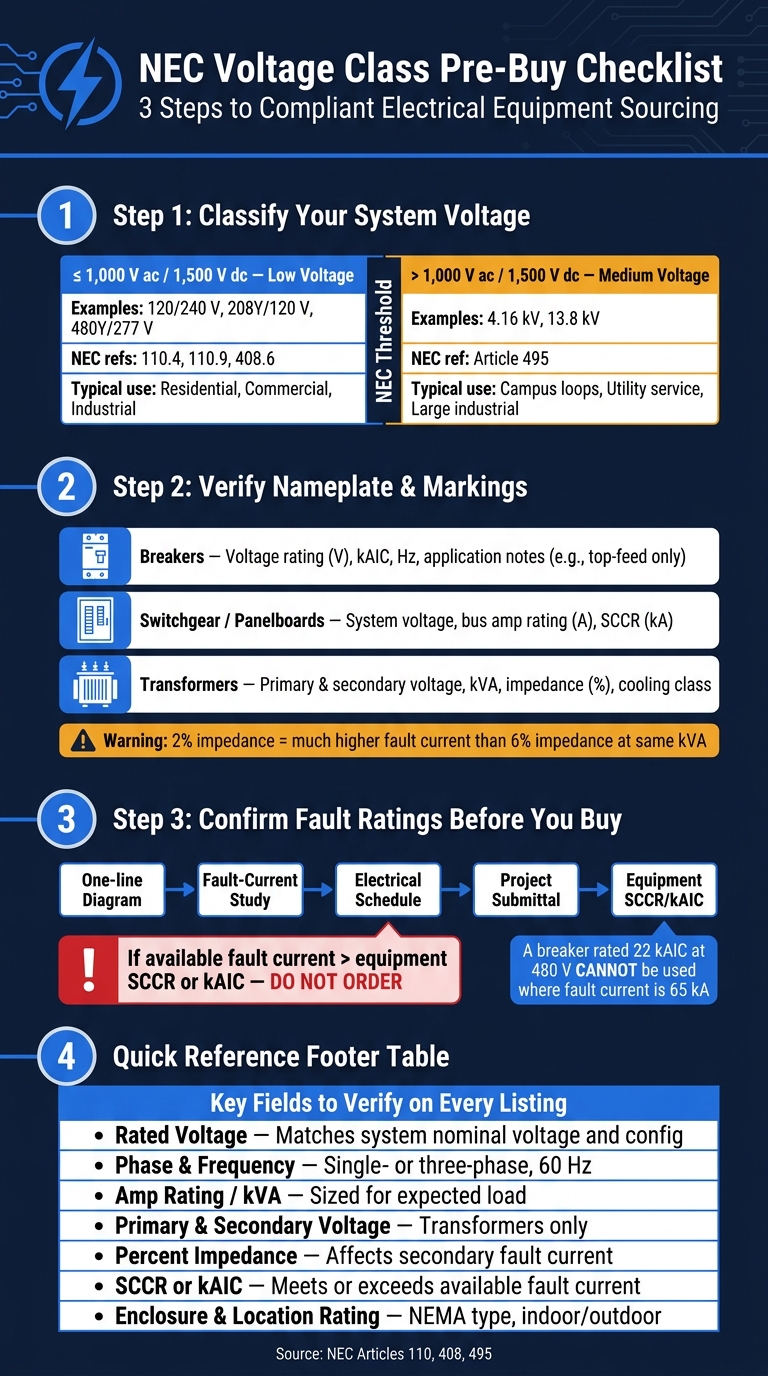
NEC Voltage Class Pre-Buy Checklist for Electrical Equipment
Understanding Voltage Designations in the National Electrical Code
sbb-itb-501186b
Quick comparison
| Check | 1,000 V and below | Over 1,000 V |
|---|---|---|
| NEC split | Low-voltage group | Higher-voltage group |
| What I review first | Rated voltage, phase, frequency, SCCR/kAIC | System voltage class, interrupting data, BIL |
| Common examples | 240 V, 208Y/120 V, 480Y/277 V | 4.16 kV, 13.8 kV |
| Main risk if I miss it | Wrong gear for the system or fault level | Wrong class of equipment and missing higher-voltage checks |
Bottom line: I should never buy from the listing title alone. I need the label, cut sheet, and fault-current data to know if the equipment fits the job.
Step 1: Classify the System Using NEC Voltage Thresholds
Start with the system voltage. Don’t start with the product listing.
If a listing only says "600 V," that still doesn’t tell you whether the equipment fits your job. First, you need to know the system voltage. That cutoff tells you which nameplate details and markings to check next.
At or below 1,000 V vs. over 1,000 V
The NEC splits equipment into two buckets: at or below 1,000 V ac (1,500 V dc) and over those limits. Once you go above that line, different higher-voltage rules apply. Those rules now sit under Article 495 (formerly Article 490).
Common U.S. system voltages and their equipment classes
The table below shows common U.S. system voltages, the NEC class for each one, and where you’ll usually see them.
| System Voltage | NEC Class | Typical Application |
|---|---|---|
| 120/240 V single-phase | ≤1,000 V (low voltage) | Residential and light commercial |
| 208Y/120 V three-phase | ≤1,000 V (low voltage) | Multitenant commercial buildings |
| 480Y/277 V three-phase | ≤1,000 V (low voltage) | Large commercial and industrial |
| 4.16 kV (4,160Y/2,400 V) | Over 1,000 V (medium voltage) | Campus loops, industrial primary distribution |
| 13.8 kV | Over 1,000 V (medium voltage) | Utility service entrance, large industrial |
Systems at 4.16 kV and 13.8 kV are over 1,000 V, so they need equipment rated for that class. That often means gear like metal-clad switchgear, primary-side fuses, and medium-voltage breakers.
One project can include both low-voltage and higher-voltage sections. That’s where people get tripped up. Equipment for each part of the site has to match its own NEC voltage class before you even start checking listings. After you set the system class, the next move is to verify the nameplate before you buy.
Step 2: Read Nameplates and Markings Before You Buy
Before you buy, check the nameplate and markings. NEC 110.21(A) says equipment markings must be durable, legible, visible after installation, and show the ratings needed for safe operation. For voltage class ID, the big fields are rated voltage, frequency, and any use limits.
Those markings should match the catalog or cut sheet. If they don’t, that’s a red flag. If a label is faded, missing, or looks altered, stop and verify it before buying. If the equipment is reconditioned, check the reconditioning mark, date, and listing status before purchase.
Use the markings to confirm voltage class first. Then check protection ratings.
Breakers: voltage rating, interrupting rating, and application notes
Three checks matter on a breaker nameplate: voltage rating, interrupting rating (kAIC), and application notes.
Start with voltage. The breaker rating must be equal to or greater than the system’s nominal voltage and fit the system voltage and application. Then check kAIC against available fault current. For example, a breaker rated 22 kAIC at 480 V is too small if available fault current is 65 kA, even when the voltage lines up.
Then read the application note. Labels may say top-feed only, interchangeable line/load, or reverse-feed approved. That small print matters more than people think.
Series ratings have a tight rule: they only apply when the exact tested combination is copied. That means the same panel model, the same upstream device, and the same voltage. If your existing panel doesn’t match that setup, you can’t use the higher rating.
Assembled gear needs the same review at the equipment level.
Switchgear, switchboards, and panelboards: SCCR, bus rating, and field markings
For assembled equipment, confirm three things: system voltage, bus ampere rating and SCCR, and field marking. A panelboard marked 480Y/277 V, 800 A bus, 65 kA SCCR tells you where it fits and what fault level it can handle.
NEC 408.6 requires the available fault current and the date of the calculation to be field-marked on the enclosure in non-dwelling installations. If you’re buying used gear, look for that field label. If it’s for a new installation, you need a new fault current study, and the equipment SCCR must match the site fault study.
Transformers need a separate check because they set the downstream fault current.
Transformers: primary and secondary voltage, kVA, impedance, and cooling data
A transformer nameplate shows both sides of the voltage boundary at the same time. A unit marked Primary 13.8 kV / Secondary 480Y/277 V is a step-down from medium voltage to low voltage. Before purchase, make sure both sides are rated for their NEC voltage class.
Impedance (%) is easy to miss, but it directly changes downstream equipment sizing. A transformer with 2% impedance produces much higher secondary fault current than one with 6% impedance at the same kVA. That means the SCCR and interrupting ratings of every downstream breaker and panelboard must be checked against that number, not guessed.
| Equipment Type | Key Nameplate Fields | What It Tells You About Voltage Class |
|---|---|---|
| Breakers | Voltage rating (V), kAIC, Hz, application notes | Confirms suitability for 240 V, 480 V, 600 V, or higher-voltage systems; kAIC must meet available fault current at that voltage |
| Switchgear / Switchboards / Panelboards | System voltage, bus amp rating (A), SCCR (kA) | Shows the nominal system voltage and whether the assembly can withstand fault current at the installation point |
| Transformers | Primary voltage, secondary voltage, kVA, impedance (%), frequency, cooling class / temperature rise | Primary and secondary voltages show whether the unit steps down from medium voltage or stays in the low-voltage class; impedance drives secondary fault current |
Use these fields as the first filter on Electrical Trader listings before requesting cut sheets.
Step 3: Match Code Checks to the Equipment You Are Buying
Once you’ve checked the nameplate, line it up with the project documents that control the exact installation point.
Check rated voltage against the one-line diagram
Start with the one-line diagram, not the product listing. Find the nominal voltage, phase, frequency, and system type at the exact point where the equipment will be installed. Then compare those details to the product nameplate and cut sheet to make sure the equipment is listed for at least that voltage class.
Under NEC 110.4, the listed voltage rating must meet or exceed the nominal circuit voltage. So, on a 480Y/277 V system, you need equipment rated for 480Y/277 V or higher. A 240 V panelboard is still wrong, even if it fits the same enclosure size. That’s a common mistake, especially with used gear.
Using equipment rated above the system voltage is allowed. Using equipment rated below it is not. Check this before you think about price or lead time. The wrong voltage class can turn gear that looks fine on paper into equipment you can’t legally or safely use in the field.
Confirm SCCR or interrupting rating for the installation point
Available fault current depends on the site. The same breaker or panelboard might work in one part of a system and fail the check in another. It all comes down to the fault-current calculation at that location.
NEC 110.9 says overcurrent devices must have an interrupting rating at nominal circuit voltage that is at least equal to the available fault current at the line terminals. NEC 408.6 applies the same idea to assembled equipment: the SCCR of switchboards, switchgear, and panelboards must not be less than the available fault current at the point of supply. For installations other than one- and two-family dwellings, the available fault current and the date of the calculation must also be field-marked on the enclosure.
That means you need to check the:
- one-line diagram
- electrical schedule
- fault-current study
- project submittal
Do that before ordering.
If you’re reviewing a used panelboard listing, look for that field label. If it’s missing or unreadable, ask for close-up nameplate photos, cut sheets, or inspection records before you buy. A used disconnect rated 10 kA does not work at a location with 22 kA available fault current, even if all the other ratings match.
Apply the same checks to fused switches, busway, and other distribution gear
Fused switches, busway, and other distribution gear need the same basic review: voltage, fault rating, and installation limits.
For fused switches, check the voltage rating, fuse class compatibility, and any marked short-circuit rating. For busway, check the voltage rating, ampacity, and fault withstand or SCCR data. For other distribution gear, review phase, frequency, enclosure type, and indoor or outdoor rating. Those details matter more than people think. A unit can look right on voltage alone and still be wrong for the job.
Low-voltage checks come first. Gear above that range brings more limits around clearance and insulation. For equipment above 1,000 V ac / 1,500 V dc nominal, also verify BIL, minimum clearances, and isolation rules under Article 495.
Use the table below to match each voltage class to the right label fields:
| Voltage Class | Nominal Range | NEC Threshold | Common Label Fields |
|---|---|---|---|
| Low voltage | ≤ 1,000 V | NEC 110.4, 110.9, 408.6 | Nominal voltage, phase, frequency, current rating, SCCR or interrupting rating, enclosure or bus data |
| Over 1,000 V | > 1,000 V ac / 1,500 V dc | Article 495 | System voltage class, BIL rating, interrupting capacity |
Cross-check the one-line, electrical schedule, fault-current study, and submittal before ordering. If one document says one thing and the nameplate says another, fix that conflict before the order goes out - not after the equipment lands on site.
Conclusion: A Short NEC-Based Checklist for Compliant Equipment Sourcing
Use the same sequence every time: classify first, verify markings second, and confirm fault ratings before you buy. That simple order helps you avoid bad picks and wasted time.
For every breaker, transformer, switchgear assembly, or other distribution gear, check the system voltage, voltage class, nameplate ratings, SCCR or interrupting rating, and the one-line diagram.
If the available fault current is higher than the equipment SCCR or kAIC, do not order it. That kind of mismatch is a safety problem, not just a paperwork problem.
Key fields to verify on every listing or nameplate
Use these fields as your final pre-order check.
| Item | Verify |
|---|---|
| Rated voltage | Matches system nominal voltage and configuration (e.g., 480Y/277 V) |
| Phase and frequency | Single- or three-phase, 60 Hz |
| Amp rating or kVA | Sized for expected load; kVA applies to transformers |
| Primary and secondary voltage | Transformers only - both sides and connection type (wye/delta) |
| Percent impedance | Transformers only - affects secondary fault current and device coordination |
| SCCR or kAIC | Meets or exceeds available fault current at the installation point |
| Enclosure and location rating | NEMA type, indoor/outdoor, and field markings |
If a listing leaves out any of these fields, especially SCCR or primary/secondary voltage, treat the equipment as unspecified until you confirm the data. On Electrical Trader, check the listing details, cut sheets, and nameplate photos before buying.
FAQs
How do I tell if my system is over 1,000 V?
Check the actual operating voltage on the equipment nameplate or label. Then compare that rating with the system’s maximum operating voltage.
If the equipment runs from 1,000 V up to about 69,000 VAC, it falls under medium voltage. If it’s below 600 V, it’s low voltage.
That line matters in practice. NEC Tables 110.31 and 110.34(A) also treat systems above 1,000 V as needing stricter minimum working clearances.
What nameplate ratings should I check first?
Start with the manufacturer’s name, model or serial number, and the main and backup electrical ratings: voltage, current, frequency, and phase. Those details need to match your system. If they don’t, you can run into fit, performance, and safety problems fast.
You should also check for a recognized safety listing, such as UL or ETL, and confirm the SCCR or interrupting capacity. Electrical Trader can help you find equipment that lines up with these key nameplate specs.
Why do transformer impedance and SCCR matter?
Transformer impedance (%Z) and SCCR matter because they shape two big things during a fault: fault current and voltage sag.
Here’s the simple version. A lower %Z means the transformer offers less opposition to fault current, so the available fault current at the secondary terminals goes up. A higher %Z does the opposite. It limits fault current, but there’s a trade-off: voltage drop increases.
That’s why the connected breaker or switchgear needs an SCCR, or short-circuit rating, that sits above the worst-case fault current. If it doesn’t, the equipment may not interrupt the fault safely. And when fault levels get extreme, that gap can lead to equipment damage and a much bigger system problem.





