Mineral Oil vs. Plant-Based Insulating Oils
If upfront price is your main concern, mineral oil usually wins. If fire risk, spill risk, and moisture in paper insulation matter more, plant-based natural ester oil often makes more sense.
I’d boil the choice down like this:
- Mineral oil costs less: about $8–$15 per gallon
- Natural ester costs more: about $15–$25 per gallon
- Natural ester is much better on fire safety: fire point around 360°C (680°F) vs. 160–180°C (320–356°F) for mineral oil
- Natural ester breaks down much faster after a spill: about 97–99% in 21–28 days
- Mineral oil stays below 30% after 28 days
- Natural ester holds far more water: about 3,000 mg/kg vs. about 60 mg/kg for mineral oil
- That higher water capacity can help keep paper insulation drier and may help extend transformer life
- Mineral oil flows more easily, so it often fits standard transformer designs better
- Retrofilling either option can cost about $15,000–$50,000 per unit
If I were choosing for an outdoor, low-risk, cost-sensitive site, I’d lean mineral oil. If I were choosing for an indoor unit, urban location, industrial site, or spill-sensitive area, I’d look hard at natural ester.
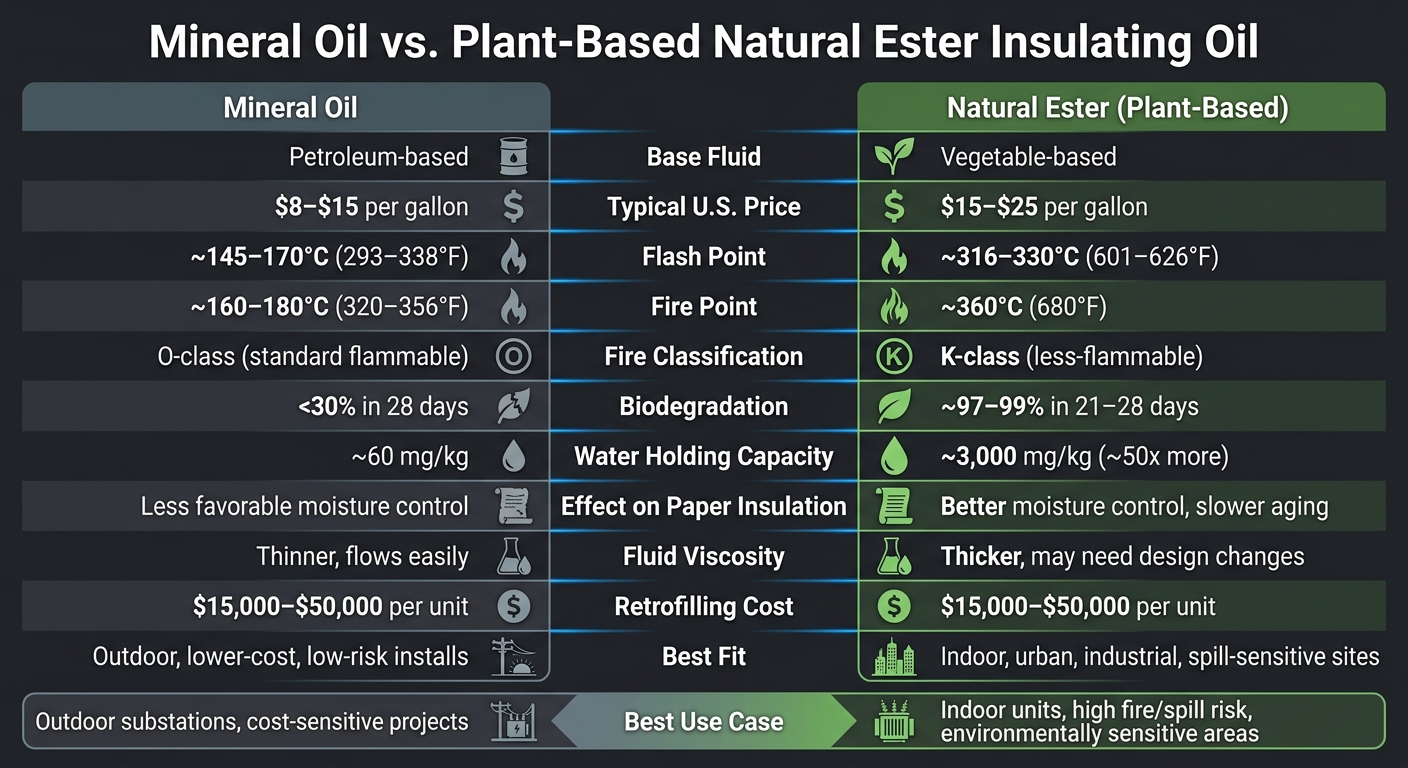
Quick Comparison
| Point | Mineral Oil | Plant-Based Natural Ester |
|---|---|---|
| Base fluid | Petroleum-based | Vegetable-based |
| Typical U.S. price | $8–$15/gal | $15–$25/gal |
| Flash point | ~145–170°C (293–338°F) | ~316–330°C (601–626°F) |
| Fire point | ~160–180°C (320–356°F) | ~360°C (680°F) |
| Fire class | O-class | K-class less-flammable |
| Biodegradation | <30% in 28 days | ~97–99% in 21–28 days |
| Water holding capacity | ~60 mg/kg | ~3,000 mg/kg |
| Effect on paper insulation | Less favorable moisture control | Better moisture control |
| Fluid flow | Thinner | Thicker |
| Best fit | Outdoor, lower-cost installs | Indoor, higher fire or spill concern |
So before I pick a fluid, I’d look at four things first: budget, fire exposure, spill exposure, and transformer design. That gives a clear starting point before getting into standards, testing, and retrofit details.
Mineral Oil vs. Plant-Based Natural Ester Transformer Oil: Key Differences
Transformer Oil - What it does and what kind to get (Mineral vs FR3) | Maddox Transformer

sbb-itb-501186b
Core Properties: Mineral Oil vs. Plant-Based Oils
Both fluids insulate and cool transformers. The big differences show up in cost, fire safety, moisture behavior, and environmental impact.
Mineral oil is still the common pick because it costs less and has a long track record in power equipment. It does the job well, but it has a lower fire point and tends to handle moisture less favorably.
Plant-based oils, often called natural esters, usually cost more up front. But they bring a few clear upsides. They have better fire safety, can hold more moisture without hurting insulation paper as much, and are generally seen as the cleaner option from an environmental standpoint.
So while both fluids serve the same basic role, they behave differently where it matters day to day: price, risk, water tolerance, and environmental impact.
Side-by-Side Comparison: Environmental Profile and Performance
Environmental Profile and Fire Safety
Natural esters do better than mineral oil in two areas that matter a lot: biodegradability and fire safety.
On biodegradability, the gap is hard to miss. CEC and OECD tests show natural esters reach about 97–99% biodegradation within 21–28 days. Mineral oil is far behind. After 28 days, it stays below 30% biodegradable and is not classed as readily biodegradable. That difference matters in the field. A mineral oil spill can stick around longer and may call for excavation, while a natural ester spill still needs reporting and cleanup but tends to leave less long-term damage.
Fire behavior shows a similar pattern. Natural esters have much higher flash and fire points, and they are classed as less-flammable liquids. In practice, that can reduce fire-barrier and containment needs.
Here’s the side-by-side view:
| Attribute | Mineral Oil | Natural Ester |
|---|---|---|
| Biodegradability | Less than 30% in 28 days; not readily biodegradable | About 97–99% in 21–28 days; readily biodegradable |
| Flash Point | ~145–170°C (~293–338°F) | ~316–330°C (~601–626°F) |
| Fire Point | ~160–180°C (~320–356°F) | ~360°C (~680°F) |
| Fire Classification | O-class insulating liquid | K-class less-flammable liquid |
| Spill Response | More persistent; may require excavation and long-term remediation | Lower long-term environmental impact, but reporting and cleanup are still required |
Dielectric Performance, Moisture Control, and Insulation Life
The safety upside is only part of the story. Moisture control is where natural esters often make their biggest mark over time.
Dry dielectric strength is similar between the two fluids. The bigger difference is how much water each one can hold. Natural esters can absorb far more moisture, which helps pull water out of paper insulation and slow down cellulose aging. Mineral oil reaches moisture saturation at about 60 mg/kg at room temperature. Natural esters can hold about 3,000 mg/kg under the same conditions - roughly 50 times more. At about 104°F (40°C), esters still hold about 15 times more water than mineral oil.
That shows up in paper performance too. In one experiment, Kraft paper in natural ester dropped from 7.27% to 5.19% moisture content over long exposure. In mineral oil, it measured 7.47%. Put simply, the ester did a better job drying the paper instead of letting that moisture linger.
Thermal aging results point the same way. Under the same aging conditions, paper in natural ester keeps more polymerization and shows less surface damage. Another study found mineral oil aged paper about three times faster. For operators in humid parts of the U.S., that can mean fewer drying interventions and steadier performance over the long haul.
There is a tradeoff, though: viscosity. Mineral oil flows more easily. Natural esters are thicker, so equipment may need design changes such as wider ducts, larger pumps, or revised winding geometry. Those choices can shape operating efficiency and total cost.
Cost, Standards, and Best-Fit Applications
Upfront Cost vs. Total Cost of Ownership
Once performance differences are on the table, the decision usually comes down to cost and site risk.
In the U.S., mineral oil usually runs $8–$15 per gallon, while plant-based natural esters are usually $15–$25 per gallon. At first glance, mineral oil looks like the cheaper pick. And in many cases, it is.
But fluid price is only part of the story.
Higher-priced ester fluid can sometimes make up that gap through lower fire-protection costs and lower spill-related liability. That matters more than many buyers expect. Fire cleanup alone can exceed the original building cost. Natural esters also tend to carry less long-term liability after a spill.
If you're planning a retrofit, that's a separate budget item. Retrofilling an existing transformer means draining the old fluid and replacing it with new fluid, along with processing and handling. That work usually costs $15,000–$50,000 per unit, depending on transformer size.
| Factor | Mineral Oil | Plant-Based Natural Esters |
|---|---|---|
| Typical U.S. Price | $8–$15 / gallon | $15–$25 / gallon |
| Primary Standard | ASTM D3487 | ASTM D6871, IEEE C57.147 |
| Fire Protection Costs | Higher (containment and barriers often required) | Potentially lower (K-class, high flash point) |
| Spill Remediation Risk | Higher long-term liability | Lower due to rapid biodegradation |
| Retrofilling Cost | $15,000–$50,000 per unit | $15,000–$50,000 per unit |
On the standards side, ASTM D3487 sets the requirements for mineral oil. ASTM D6871 and IEEE C57.147 cover natural esters and how to monitor them in service.
Those cost and code differences shape where each fluid makes the most sense.
Which Oil Fits Which Application
Mineral oil is still the practical default for conventional outdoor installations. That includes large utility substations, transmission-level equipment, and cost-sensitive projects where meeting fire separation distances isn't a big hurdle.
Why does it stay the default? Simple: it has a long service record, and the fluid itself costs less. If fire risk and spill sensitivity aren't top concerns, mineral oil is often the plain, workable choice.
Plant-based natural esters fit better in places where the consequences of a fire or spill are harder to deal with. That includes indoor transformers, high-density urban sites, industrial complexes, and environmentally sensitive locations. They're also a strong option for high-heat industrial units, such as furnace and rectifier transformers.
For retrofills, don't treat it like a simple fluid swap. Check the transformer's DGA results and insulation history first to make sure the unit is a good candidate. The starting point should always be the transformer's condition and the environment it operates in.
Conclusion: Choosing the Right Insulating Oil
Neither fluid fits every situation. Mineral oil is still the standard pick for outdoor, well-contained installations when upfront cost is the main issue. Natural esters cost more at the start, but they bring better fire safety, fast biodegradability, and stronger moisture tolerance. Those points matter most when a fire or spill could lead to serious harm.
So the choice comes down to the application and the level of risk. Go with natural esters when the transformer is indoors, near people, or in a sensitive site. Go with mineral oil when the installation is outdoors and well-contained.
Two other things can shift that default choice: insurance requirements and maintenance readiness. An insurer or customer may require natural esters for critical use cases. And if you switch to esters, the job doesn’t stop at the fluid itself. You’ll likely need to update DGA interpretation limits, train your team, and in some cases work with different lab partners. That change is manageable, but it needs a plan.
The same thinking applies to used equipment. In resale listings, state the fluid type clearly so buyers can line it up with their risk, compliance, and budget needs.
Match the fluid to the installation’s risk profile, compliance needs, and lifecycle priorities, not just the purchase price. Write down the reasoning so the decision can stand up over the transformer’s service life.
FAQs
Can natural ester oil be used in any transformer?
Natural ester oil works with many standard transformer designs, especially distribution transformers, and in most cases you can use it without major system changes.
It also works for retrofits, but there’s a clear limit to watch: residual mineral oil needs to stay below 7% by weight to keep a 350°C (662°F) fire point. Before making the switch, check older transformers for gasket compatibility. It’s also smart to review cooling and insulation performance first, since those can change from one unit to another.
Does natural ester oil change maintenance or testing?
Yes. Switching to natural ester oil can change both maintenance and testing, especially when you’re retro-filling an existing transformer.
Why? It doesn’t behave the same way as mineral oil. Its dielectric and flow properties are different, so compatibility testing is a smart step before the switch.
You’ll also want to check safety standards. Natural ester oil has a different cooling profile, which may mean the insulation system needs adjustments to help heat move out of the transformer as intended.
One nice upside on the maintenance side: during repairs, parts can stay exposed to air for up to two weeks without major oxidation concerns.
When does the higher cost of natural ester pay off?
Usually, these savings show up over the transformer’s lifetime. Natural esters can cost more at the start because their higher viscosity may call for larger equipment or extra radiators. But over time, they can bring down total cost.
Here’s why:
- They can extend insulation life by up to 12 times
- They can support peak load increases of up to 50% without costly aramid insulation
- They can cut maintenance costs and possible cleanup costs