




Oil-Impregnated vs. Resin Bushings
Transformer bushings are critical for insulating high-voltage connections in transformers, and choosing the right type can prevent costly failures. The two main options are Oil-Impregnated Paper (OIP) and Resin-Impregnated Paper (RIP) bushings. Here's a quick breakdown:
- OIP Bushings: Use mineral oil and layered paper for insulation. They are well-understood, widely available, and suitable for legacy systems. However, they require frequent maintenance, are prone to oil leaks, and pose fire risks.
- RIP Bushings: Feature epoxy resin and paper insulation without oil. They are safer, require less maintenance, and handle extreme conditions better. However, they are costlier upfront, and failures are irreversible.
Quick Comparison
| Feature | OIP Bushings | RIP Bushings |
|---|---|---|
| Insulation Type | Oil-impregnated paper | Resin-impregnated paper |
| Fire Risk | High (oil is flammable) | Low (oil-free design) |
| Maintenance | Frequent (oil checks, DGA) | Minimal |
| Failure Mode | Repairable in some cases | Generally permanent |
| Voltage Range | Conventional systems | Up to 550 kV (EHV applications) |
| Durability | Affected by oil leaks/moisture | Sensitive to mechanical damage |
Key Takeaway: OIP bushings are better for older systems with established maintenance routines, while RIP bushings are ideal for new installations prioritizing safety and reduced upkeep. Your choice should depend on your system's needs, safety requirements, and maintenance capacity.
Oil-Impregnated Bushings: Features, Advantages, and Limitations
How OIP Bushings Are Built
Oil-impregnated paper (OIP) bushings are designed with a core made of layered paper that is saturated in mineral oil. This paper core acts as insulation, surrounding the central conductor while also evenly distributing electrical stress through a specialized condenser core design. Thanks to this design, modern OIP bushings can operate without partial discharge at up to twice the phase-to-ground voltage.
The outer housing, typically made of porcelain, provides both mechanical durability and resistance to environmental factors. A main flange secures the bushing to the transformer tank, ensuring stability. This thoughtful construction allows OIP bushings to handle high-voltage applications effectively.
Advantages of OIP Bushings
OIP bushings have been a cornerstone of transformer technology for decades. Their long history has provided a deep understanding of their aging process and common failure mechanisms. This has led to the development of reliable diagnostic tools like Dissolved Gas Analysis (DGA) and Tan Delta testing, which help monitor insulation health and detect potential issues early.
Another major benefit is their versatility. OIP bushings cover a wide voltage range and are readily available, making replacements straightforward and maintenance planning easier for utility companies managing large transformer fleets.
Limitations of OIP Bushings
However, OIP bushings are not without challenges. The mineral oil used for insulation, while effective, introduces certain risks. Over time, seals can degrade, leading to oil leaks and allowing moisture to infiltrate the system. Moisture is particularly harmful to the paper insulation, as it accelerates aging and weakens its dielectric properties.
Additionally, there are safety concerns. In the event of an internal arc, the flammable mineral oil can ignite, while the porcelain housing, being brittle, may shatter. This combination can cause severe damage to the transformer and surrounding equipment. Surveys by CIGRE have highlighted bushing failures as a major contributor to overall transformer failures.
OIP bushings also demand regular maintenance, including oil sampling, DGA, and electrical testing, which can be both time-consuming and costly. These factors make them a less attractive option in scenarios where reduced maintenance and enhanced safety are priorities.
Resin-Impregnated Bushings: Features, Advantages, and Limitations
How RIP Bushings Are Built
Resin-impregnated paper (RIP) bushings are designed without any reliance on oil insulation. Instead, the core is made by winding crepe paper, which is then impregnated with curable epoxy resin under vacuum conditions. This process creates a solid, gas-tight insulator. The outer housing is typically constructed from composite materials and features silicone rubber sheds instead of porcelain. This design makes RIP bushings significantly lighter and better adapted to challenging environments, such as areas with heavy pollution, salt spray, or high coastal humidity - conditions where porcelain surfaces might struggle with contamination. This durable construction contributes to their operational reliability.
Advantages of RIP Bushings
RIP bushings offer several benefits over their oil-impregnated counterparts. Their oil-free design eliminates the risks of leaks, ignition, and pressurization, making them explosion-proof and fire-resistant. They can be transported, stored, and installed in any orientation, offering flexibility for various applications. These bushings also feature low dielectric losses, high flexural strength, and thermal resistance up to 248°F (120°C).
Additionally, RIP bushings are partial discharge–free up to twice the phase-to-ground voltage and accommodate a voltage range from 72.5 kV to 550 kV. They are often regarded as maintenance-free, as they do not require oil sampling, dissolved gas analysis, or routine electrical testing under normal operating conditions.
Limitations of RIP Bushings
One major limitation of RIP bushings is the irreversible nature of failures in their solid resin core. Unlike oil-impregnated bushings, which can sometimes be diagnosed and treated before failure, an issue with an RIP bushing is generally permanent and cannot be repaired.
The resin core is also vulnerable to mechanical damage and excessive vibration. Rough handling or improper installation can lead to internal cracking, which may reduce the bushing's service life. Additionally, the manufacturing process for RIP bushings is more complex due to the vacuum impregnation with epoxy resin.
Another concern is the hygroscopic nature of the paper used in their construction, as it can absorb moisture. This has led to a gradual industry shift toward Resin Impregnated Synthetic (RIS) technology, which replaces paper with synthetic fabrics to eliminate moisture absorption. These considerations underscore the importance of selecting the right bushing type based on specific transformer needs and environmental conditions.
What is the difference between OIP and RIP bushings?
sbb-itb-501186b
OIP vs. RIP Bushings: Direct Comparison
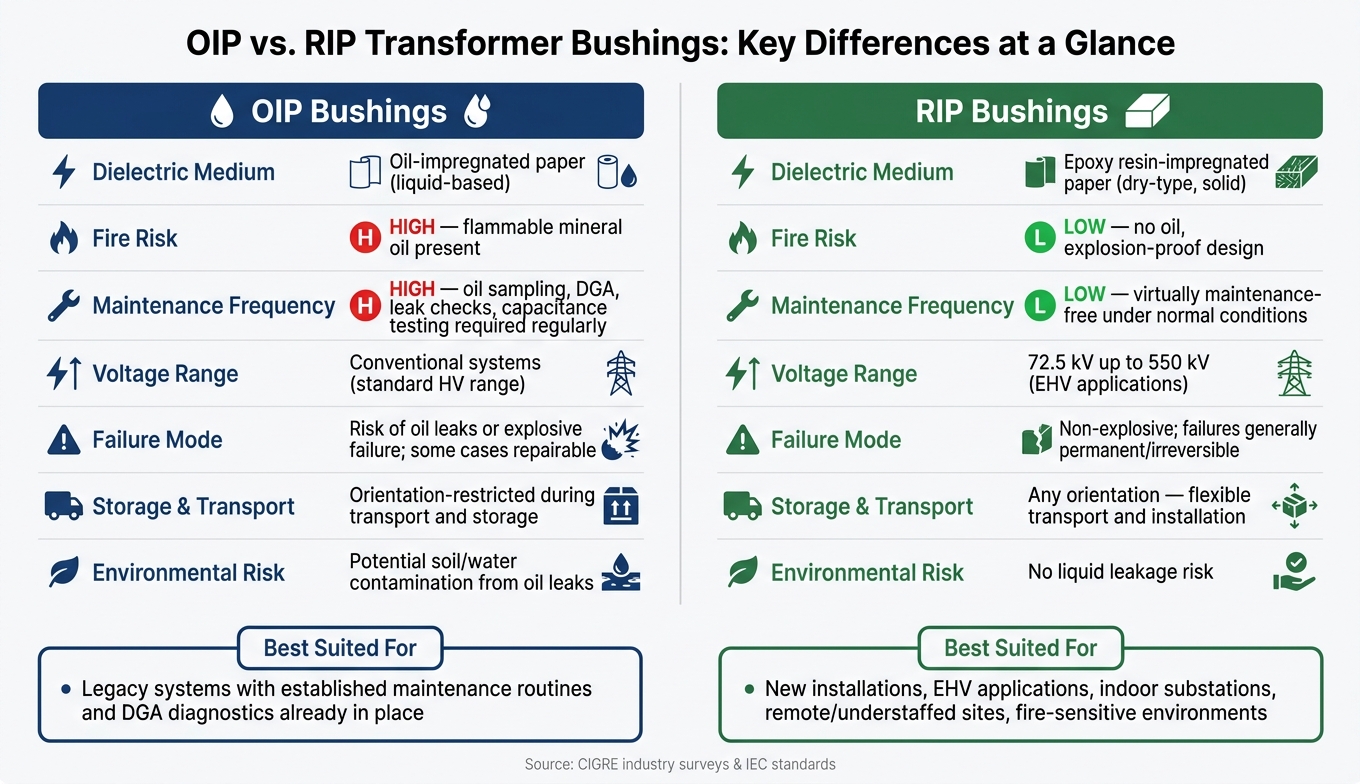
OIP vs. RIP Transformer Bushings: Side-by-Side Comparison
Comparison of Key Attributes
OIP and RIP bushings differ in their construction, which influences their operation, safety, and long-term costs. Below is a breakdown of their key attributes, highlighting how these factors affect maintenance and diagnostics.
| Attribute | Oil-Impregnated Paper (OIP) | Resin-Impregnated Paper (RIP) |
|---|---|---|
| Dielectric Medium | Oil-impregnated paper | Resin-impregnated paper (dry-type) |
| Fire Risk | Higher - due to flammable oil content | Lower - no oil to leak or ignite |
| Maintenance Frequency | High - requires regular oil sampling and level checks | Low - almost maintenance-free |
| Failure Mode | Risk of oil leaks or explosive failure | Generally non-explosive |
| Voltage Range | Suitable for conventional systems | Up to 550 kV; ideal for Extra High Voltage (EHV) applications |
| Storage/Transport | Orientation must be restricted | Can be stored or transported in any orientation |
| Environmental Risk | Potential soil contamination from oil leaks | No risk of liquid leakage |
OIP bushings have the advantage of well-established diagnostic methods, including dissolved gas analysis, oil sampling, and capacitance measurements, which provide insights into their internal condition. On the other hand, RIP bushings rely on newer diagnostic techniques, primarily focusing on power factor and capacitance readings. These differences not only influence maintenance but also have long-term cost implications.
Key Tradeoffs Between OIP and RIP Bushings
Choosing between OIP and RIP bushings often comes down to balancing initial investment with operational and safety considerations over time.
OIP bushings are a time-tested choice with standardized maintenance routines and widely available replacement parts. However, their reliance on oil introduces risks such as leaks and fire hazards.
RIP bushings, with their dry-type insulation, offer a safer and lower-maintenance solution, particularly for Extra High Voltage systems. The absence of oil eliminates concerns about leaks or ignition, making them a strong option for modern applications .
Choosing the Right Bushing for Your Transformer
Factors to Consider
Selecting the right transformer bushing involves weighing factors like installation conditions, maintenance needs, and safety requirements. RIP bushings operate in voltage ranges from 72.5 kV to 550 kV, making them well-suited for EHV applications. On the other hand, indoor substations, urban areas, or locations near sensitive equipment often prioritize stricter fire safety measures.
OIP bushings require regular upkeep, including oil sampling, leak checks, and capacitance testing, which makes them a better fit for facilities with sufficient staffing and resources. Meanwhile, RIP bushings stand out in remote or under-staffed locations due to their maintenance-free design. Although RIP bushings come with a higher initial cost, the savings on maintenance and fire suppression can balance out the expense over time. These considerations are key in deciding whether OIP or RIP bushings align best with your operational requirements.
When to Choose OIP Bushings
OIP bushings are a reliable option for older transformer systems, especially when diagnostic tools like Dissolved Gas Analysis (DGA) are already integrated into the setup. Their compatibility with established protocols makes them a practical choice for legacy systems. Additionally, sourcing replacement parts and standardized components is often simpler, particularly in facilities with experienced personnel familiar with oil-filled equipment.
When to Choose RIP Bushings
For new installations, RIP bushings are often the preferred choice, particularly in situations where fire safety is critical. Their dry-type, explosion-resistant design eliminates oil leaks and the potential for costly environmental cleanups. This makes them ideal for indoor substations or areas with high population density.
RIP bushings also offer advantages in terms of flexibility - they're easier to transport, store, and install, even in tight spaces or during retrofits. For applications requiring superior thermal performance, some RIP models can handle temperatures up to 248°F (120°C), making them a strong candidate for thermally demanding environments.
Conclusion: Picking the Right Bushing
OIP bushings remain a reliable choice for older systems with established maintenance routines, while RIP bushings are better suited for new installations or settings where safety is a top priority. To decide what works best for your needs, ask yourself: How much maintenance can your team realistically handle? How important is fire and explosion protection at your site? What are the long-term cost implications of a lower initial price versus ongoing oil monitoring? These questions highlight the delicate balance between maintenance requirements, safety considerations, and overall cost.
"Safe operation is directly related to the reliability of the power system." - IET Generation, Transmission & Distribution
This holds particularly true for bushings, which are a frequent point of failure if not chosen or sourced correctly. This makes the procurement process just as critical as the technical decision itself.
Whether you're replacing an aging OIP bushing or upgrading to a dry-type RIP design, selecting the right component is essential. Electrical Trader simplifies the process by offering a broad range of new and used transformers and electrical components. This ensures you can find the compatible bushing equipment you need for a replacement or upgrade - without the headache of dealing with multiple vendors. A thoughtful decision here guarantees dependable transformer performance and enhanced operational safety.
FAQs
Can I retrofit a transformer from an OIP bushing to a RIP bushing?
Retrofitting a transformer from an oil-impregnated paper (OIP) bushing to a resin-impregnated paper (RIP) bushing can be a challenging process. The two types of bushings differ in their construction, sealing methods, and mounting requirements, often necessitating extensive modifications to the transformer. Before proceeding, it’s crucial to consult with the transformer manufacturer or a qualified electrical engineer to evaluate compatibility and ensure the retrofit is carried out safely and effectively.
What tests should I run to check bushing health (OIP vs. RIP)?
To assess the condition of oil-impregnated (OIP) and resin-impregnated (RIP) bushings, it's important to measure the power/dissipation factor and capacitance. These tests should be conducted after installation, one year later, and then every 3–5 years. A noticeable increase in these values could signal potential deterioration. For RIP bushings, partial discharge (PD) testing is an effective method for identifying insulation problems. Performing these tests regularly and comparing the results to manufacturer specifications helps maintain safe and reliable operation.
How do I estimate the total lifetime cost difference between OIP and RIP?
To compare the lifetime costs of oil-impregnated paper (OIP) and resin-impregnated paper (RIP) bushings, you need to look beyond just the upfront price. Consider the long-term expenses tied to maintenance and potential replacements. RIP bushings can be more cost-effective in the long run due to their advantages, such as fire resistance, easier storage, and less susceptibility to moisture-related problems. They also tend to last longer and require less upkeep compared to OIP bushings, which are more vulnerable to aging and moisture damage.





