How to Match Transformers to System Requirements
Selecting the right transformer is critical to avoid costly downtime, energy waste, and equipment damage. Here's how to choose the best match for your system:
- Voltage Compatibility: Ensure the primary and secondary voltages align with your power source and equipment needs. Check for voltage taps to handle fluctuations.
- kVA Sizing: Calculate your total load using diversity factors. Add a 20–25% safety margin and aim for 60–80% loading for optimal efficiency.
- Phase and Frequency: Use single-phase transformers for smaller loads and three-phase for industrial systems. Always match the frequency (e.g., 60 Hz in the U.S.).
- Efficiency: Transformers run best at 40–80% load. Core losses dominate at low loads, while winding losses increase at higher loads.
- Cooling and Temperature: Choose between air-cooled (dry-type) or oil-cooled transformers based on your environment. Lower temperature rise models last longer and handle overloads better.
- Environmental Factors: Derate capacity for high temperatures or altitudes to prevent overheating and insulation damage.
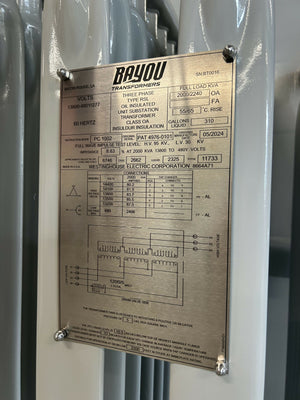
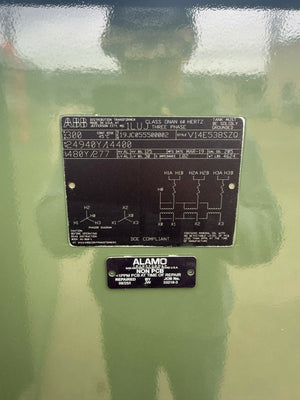
- Compliance and Nameplates: Check nameplates for kVA, voltage, impedance, and cooling class. Follow IEEE and NEMA standards for safety and performance.
TRANSFORMER SIZING FOR INDUSTRIAL PLANT NORMAL LOAD
sbb-itb-501186b
Critical Transformer Specifications
Getting the specifications right for a transformer is key to ensuring it operates reliably and efficiently. Four key factors - voltage ratings, kVA capacity, phase type, and frequency - must match both your power source and the equipment it’s powering. If any of these parameters are off, you could face equipment damage, poor performance, or even system failure.
Voltage Ratings and Ratios
The primary voltage of a transformer is the incoming power from your utility or generator, and it needs to match the supply at your connection point. In the U.S., common primary voltages for commercial and industrial setups include 480V, 600V, and 240V. The secondary voltage is what your equipment requires - typically 120V, 208V, 240V, or 480V.
One important detail: the secondary voltage listed is the no-load voltage. Transformers naturally experience a voltage drop under load because of internal impedance. To account for this, manufacturers often design transformers with a slightly higher no-load voltage rating. For instance, a transformer meant for a 415V system might have a nameplate showing 433V. Voltage taps (usually ±2.5% and ±5%) are often included, allowing you to manually adjust the turns ratio to handle consistently high or low supply voltages. Once you’ve checked the voltage ratings, move on to calculating the transformer’s capacity.
kVA Capacity and Load Calculation
Transformers are rated in kVA (apparent power), not kW, because their thermal limits depend on total current flow, which includes both real and reactive power. If you size a transformer based only on kW, you risk undersizing it - sometimes by as much as 30–40%.
To size your transformer correctly, calculate the total connected load and apply diversity factors that reflect actual usage. For instance:
- Lighting typically runs at 90–100% of its rated load.
- Production equipment operates at 70–80%.
- Office equipment usually runs at 50–70%.
Avoid adding up all loads directly, as this can lead to an oversized transformer that operates inefficiently. For three-phase systems, use this formula:
kVA = (√3 × V(Line-to-Line) × I(Amps)) / 1,000
For single-phase systems, use:
kVA = (V × I) / 1,000
Once you know the demand load, add a safety margin of 20–25% for continuous loads. This typically places the transformer in the 70–80% loading range, which is its most efficient operating zone. If you need to convert from kW to kVA, divide by the power factor (commonly around 0.85 in industrial setups). Finally, round up to the nearest standard NEMA size, such as 15, 30, 45, 75, 112.5, 150, 225, 300, 500, 750, or 1,000 kVA for three-phase transformers.
Phase Type and Frequency Requirements
Single-phase transformers are ideal for residential or light commercial use, powering things like lighting, outlets, and smaller equipment. On the other hand, three-phase transformers are the go-to choice for industrial applications and larger distribution systems. They’re more efficient and cost-effective per kVA for handling large loads. If your facility uses both single-phase and three-phase equipment, it’s usually best to go with a three-phase transformer, connecting single-phase loads to individual phases.
Matching the frequency is equally critical. In the U.S., the standard operating frequency is 60 Hz. While some 50 Hz transformers can run at 60 Hz, the reverse isn’t true. A transformer designed for 60 Hz should never be used on a 50 Hz system, as this can cause core saturation and overheating. Always check the nameplate to confirm the frequency compatibility before installation to avoid issues like core losses or impedance mismatches.
Transformer Efficiency and Environmental Considerations
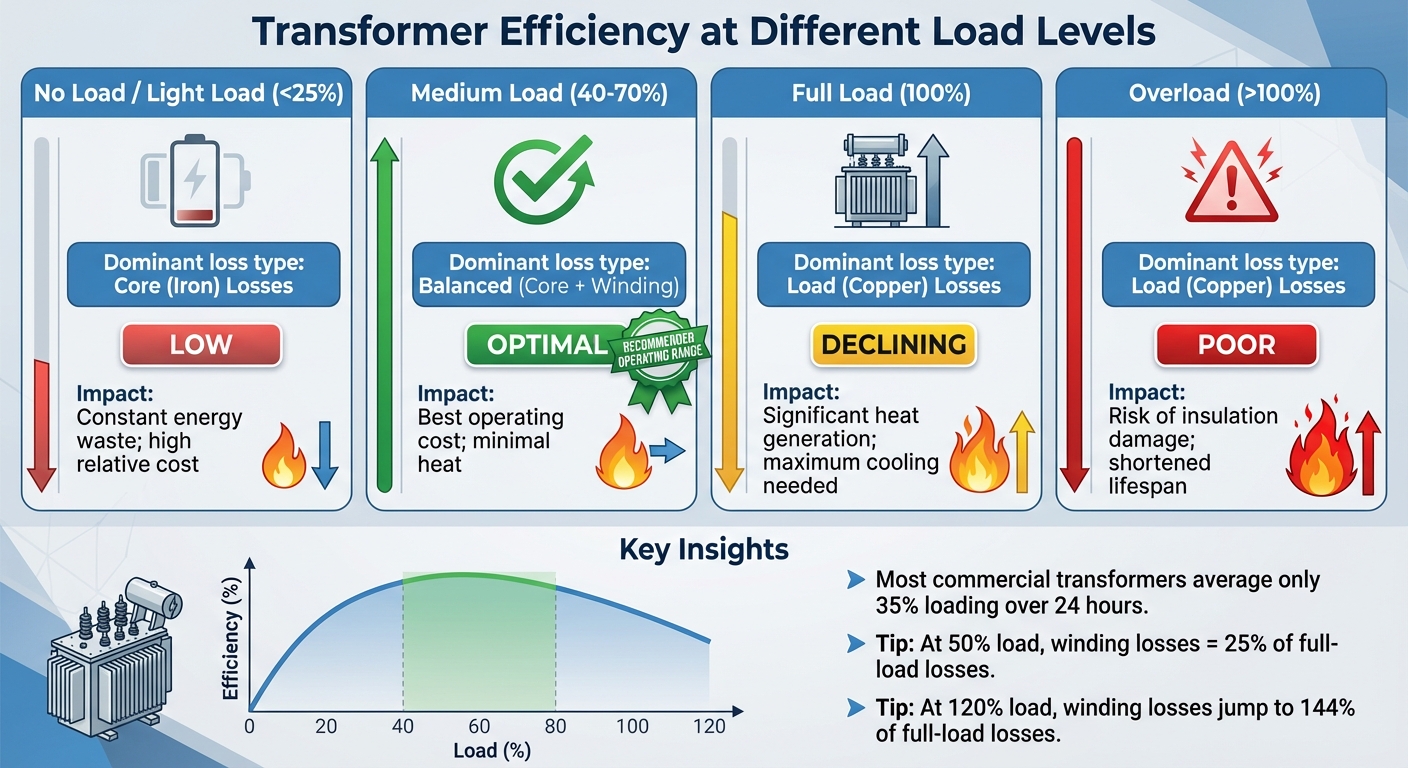
Transformer Efficiency at Different Load Levels: Core vs Winding Losses
Efficiency at Different Load Levels
Transformer efficiency changes depending on how much load it's carrying. Core losses - caused by hysteresis and eddy currents - remain constant, whether the transformer is running at 10% or 100% capacity. When the load is light, these losses dominate, which is why efficiency drops significantly below 40% load. On the other hand, winding losses increase with the square of the current. For example, at 50% load, winding losses are about 25% of full-load copper losses, but at 120% load, they jump to approximately 144%.
Transformers operate most efficiently at 40%–80% load because core and load losses balance out in this range. However, most commercial and industrial transformers only average about 35% loading over a 24-hour period. This is why NEMA TP-1 standards evaluate efficiency at that specific load point. If your facility operates on a single-shift schedule with long idle periods, focus on NEMA TP-1 compliant transformers designed for low no-load losses. For facilities with consistent loads above 50%, 80°C rise transformers are a better choice, as they consume 13%–21% less energy compared to 150°C rise models.
| Load Level | Dominant Loss Type | Efficiency Status | Impact on System |
|---|---|---|---|
| No Load / Light Load (<25%) | Core (Iron) Losses | Low | Constant energy waste; high relative cost |
| Medium Load (40%–70%) | Balanced | Optimal | Best operating cost; minimal heat |
| Full Load (100%) | Load (Copper) Losses | Declining | Significant heat generation; maximum cooling needed |
| Overload (>100%) | Load (Copper) Losses | Poor | Risk of insulation damage; shortened lifespan |
Next, let’s explore how cooling systems and environmental conditions influence transformer performance.
Cooling Systems and Temperature Effects
Knowing how efficiency varies with load helps in selecting the right cooling system. Dry-type transformers rely on air cooling and are rated by their temperature rise: 80°C, 115°C, or 150°C. Units with lower temperature rise have larger cores and heavier windings, making them more efficient at higher loads and capable of handling continuous overloads. For example, an 80°C rise transformer can manage 15–30% continuous overload without damaging the insulation. Oil-immersed transformers, on the other hand, use mineral oil for cooling and are categorized as ONAN (natural cooling), ONAF (air fans), or OFAF (forced oil and air). These units are ideal for outdoor high-power substations, while dry-type transformers are better suited for indoor applications due to their safety and low maintenance needs.
Temperature plays a critical role in transformer longevity. A 6°C–8°C increase in hot-spot temperature can halve the life of the insulation. In hot climates or at high altitudes, cooling efficiency decreases, which may require derating the transformer's capacity. Humidity is another concern, as moisture accelerates insulation degradation and weakens dielectric strength. For outdoor installations, consider using moisture-absorbing breathers and regularly sample the oil, especially for older equipment. In freezing climates, synthetic or cold-resistant oils are essential to prevent viscosity issues that could disrupt cooling circulation.
These factors are essential when aligning transformer performance with your operational demands.
Compliance Standards and Nameplate Information
Insulation Classes and Testing Requirements
When it comes to transformers, safety and durability go hand in hand with efficiency and cooling. In the U.S., transformers must meet standards like IEEE C57.12.00, ANSI, or NEMA, while international markets adhere to IEC 60076 guidelines. These standards set benchmarks for safety features, including Basic Insulation Level (BIL), insulation classes, and testing protocols.
BIL is a critical measure of a transformer's ability to handle voltage surges, such as those caused by lightning or switching events. For instance, a transformer rated at LI75 can endure a 75 kV impulse without its insulation breaking down. In regions with frequent electrical storms, pairing the BIL rating with lightning arresters is essential to avoid expensive damage.
Insulation classes define the temperature limits a transformer can handle. High-performance dry-type transformers often use Class F (155°C) or Class H (180°C), while standard oil-filled transformers typically fall under Class A (105°C). Lowering a transformer's operating temperature by just 10°C below its rated hot spot can nearly double the life of its insulation. However, if your facility’s ambient temperature exceeds 104°F (40°C), you’ll need to derate the transformer by about 1% of its kVA rating for every degree above that threshold.
Another key factor is short-circuit impedance (%Z), which impacts safety during fault conditions. For example, reducing impedance from 5% to 4% in a 1,000 kVA transformer can increase fault current from 27.8 kA to 34.8 kA - a significant jump that underscores the importance of proper impedance ratings.
How to Read Transformer Nameplates
"A transformer nameplate has been compared to a birth certificate because it contains so many vital statistics that will follow it throughout its service life." - Edvard Csanyi, Electrical Engineer
Transformer nameplates are packed with information crucial for installation, maintenance, and system integration. Start by checking the kVA rating and voltage notation. A dash (e.g., 480–120) means the primary and secondary voltages are on separate windings, while a slash (e.g., 120/240) indicates both voltages come from the same winding, such as in a center-tapped secondary. A "Y" in notations like 208Y/120 signals a three-phase Wye connection, providing 208V line-to-line and 120V line-to-neutral.
For paralleling transformers, vector groups (e.g., Dyn11) are critical. These codes describe the winding configurations: "D" for Delta on the primary side, "y" for Wye on the secondary, "n" for neutral availability, and "11" for a 30° phase displacement. Ensure transformers have matching vector groups and that their impedances differ by less than 10% before connecting them in parallel.
The cooling class is another key detail. Codes like ONAN (Oil Natural, Air Natural) indicate self-cooled operation, while ONAF (Oil Natural, Air Forced) means fans are used to increase capacity by around 25%. For dry-type transformers, look for codes like AN (Air Natural) or AF (Air Forced). Lastly, always document the serial number from the nameplate - it’s essential for warranty claims and tracking maintenance. Don’t forget to double-check phase and frequency compatibility to ensure seamless operation.
Finding Transformers on Electrical Trader
Matching Your Specifications to Available Products
When you're clear on your voltage, kVA, and phase needs, Electrical Trader simplifies the search for transformers from leading brands. The platform organizes its inventory into categories like 3-phase, substation, padmount, polemount, dry-type, and oil-filled transformers, so you can easily focus on options that align with your system's design.
You can filter results by voltage, capacity (kVA), and condition. For three-phase systems, head to the "3 Phase Transformer" section, while single-phase setups have their own dedicated category. When it comes to kVA ratings, stick with standard sizes such as 75, 112.5, 150, 300, or 500 kVA - these align with NEMA and IEC standards, ensuring quicker availability compared to custom units that might have extended lead times.
The advanced search tool is particularly helpful if you're looking for specific configurations, such as a step-down transformer for 480V to 208Y/120V applications or a substation unit for distribution. You can also explore options for new, used, and refurbished transformers - ideal for sourcing high-capacity substation models at a more budget-friendly price. These filters streamline the process, allowing you to focus on relevant listings before diving into the details.
Using Product Listings and Support Resources
Each product listing includes detailed specifications, seller information, and even a "Get Shipping Quotes" feature. As you review listings, pay special attention to the primary and secondary voltages, cooling class codes, and phase or frequency compatibility.
"Find the right transformer by voltage, capacity, and condition - all in one place." - Electrical Trader
Electrical Trader's resource center is another valuable tool. It offers buying guides, comparison tools, and tailored recommendations to help you navigate choices between different transformer types. For instance, if you're deciding between dry-type and oil-filled transformers, their guides provide clear insights into the pros and cons of each option. This is especially useful when considering refurbished models or weighing the benefits of various cooling systems and insulation classes.
Conclusion
When selecting transformers, focus on proper kVA sizing, voltage compatibility, and compliance with standards. Start by calculating your total connected load, then apply diversity factors that reflect actual usage - typically 70–80% for production equipment and 90–100% for lighting. Add a safety margin of 20–25%, and round up to the nearest standard size. This method ensures your transformer operates within the optimal 60–80% load range, maximizing efficiency and controlling energy costs.
Pay close attention to nameplate data, particularly impedance and temperature rise, as these influence fault current handling and insulation longevity. The impedance percentage determines fault current levels, which impacts the ability of downstream circuit breakers to manage short circuits. Additionally, for every 6–8°C (11–14°F) rise above the rated hot spot temperature, the insulation life is reduced by half.
Environmental factors also play a role in transformer performance. Derate by about 1.5% per °F above 86°F and another 0.5% per 328 feet above 3,280 feet to ensure safe operation. These adjustments align with NEC Article 450 and IEEE C57.12 standards, complementing cooling and efficiency considerations.
Once you've established these parameters, finding the right transformer becomes easier. Platforms like Electrical Trader simplify the process by categorizing inventory and offering filters for voltage, kVA, and condition. Whether you're sourcing a 150 kVA dry-type transformer for a commercial project or a 2,500 kVA substation unit for industrial needs, their tools and resources make it easy to match your requirements to available options. This ensures the transformer you choose will meet your system's demands while operating efficiently and reliably.
FAQs
How do I choose the right transformer impedance (%Z)?
When choosing the right transformer impedance (%Z), it’s essential to weigh its influence on fault current and voltage regulation. A higher %Z limits fault currents but leads to more significant voltage drops. On the other hand, a lower %Z enhances voltage regulation but results in higher fault currents.
Evaluate your system’s requirements for fault current levels and voltage stability. Once you’ve established these parameters, check the transformer's nameplate for its impedance value to confirm it aligns with your design needs and safety considerations.
What happens if my site is hot or at high altitude?
If your site is located in a hot climate or at a high altitude, your transformer could experience increased temperature rise and reduced cooling efficiency. These factors can directly affect its performance and shorten its lifespan. To ensure the transformer operates reliably and lasts as long as intended, it’s important to consider both the ambient temperature and altitude when choosing and sizing the unit.
When should I choose dry-type vs oil-filled transformers?
Dry-type transformers are a great choice for indoor or safety-sensitive locations. Instead of oil, they rely on air for cooling, which eliminates fire hazards and minimizes environmental risks. Plus, they tend to require less upkeep compared to their counterparts.
On the other hand, oil-filled transformers are better suited for handling high voltage capacities, even up to 1000 kV. They come with lower initial costs, but they demand regular maintenance. Additionally, they carry higher safety and environmental risks due to the potential for oil leaks or fires.