

High Voltage Transformer Maintenance Tips for Urban Systems
High voltage transformers in cities are under constant stress due to pollution, humidity, and heavy loads. Regular maintenance is critical to ensure reliability, prevent failures, and extend their lifespan. Here's what you need to focus on:
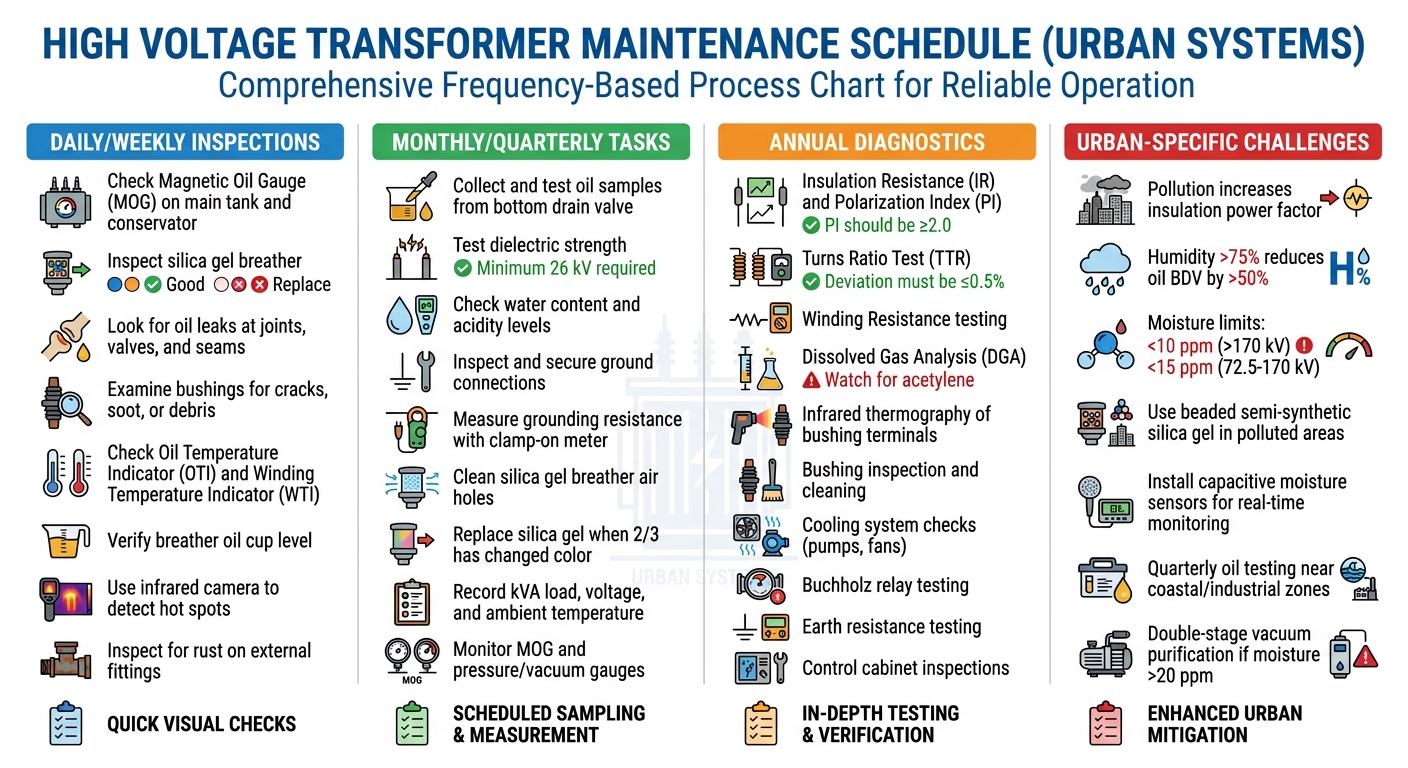
- Daily/Weekly Inspections: Check oil levels, silica gel breathers, and bushings for cracks or leaks. Use infrared cameras to detect hot spots.
- Oil Quality: Test annually for dielectric strength, moisture, and contaminants. Replace or filter oil if needed.
- Monthly/Quarterly Tasks: Inspect grounding, clean breather systems, and test load/voltage performance to catch gradual issues.
- Annual Diagnostics: Perform insulation resistance, dissolved gas analysis (DGA), and thermographic scans to prevent major failures.
- Urban Challenges: Address pollution and humidity with improved desiccants, moisture sensors, and frequent checks near industrial or coastal zones.
Proper maintenance ensures transformers operate safely and reliably, even in tough urban conditions.
High Voltage Transformer Maintenance Schedule and Checklist
Preventive Maintenance for Power Transformer
sbb-itb-501186b
Daily and Weekly Visual Inspections
Daily and weekly visual inspections are crucial for identifying potential transformer issues before they grow into major problems. These regular checks act as an early warning system, especially in urban areas where transformers face harsher operating conditions. Consistently monitoring these systems helps establish a proactive maintenance routine, which is essential for keeping transformers in good working order over the long term.
What to Check During Routine Inspections
Daily inspections focus on three key areas: the Magnetic Oil Gauge (MOG), the silica gel breather, and visible oil leaks. Start by checking the MOG readings on both the main tank and the conservator tank to ensure oil levels are within the correct range. Examine the silica gel breather; its color should be blue or orange. If it turns pink or white, it’s saturated with moisture and needs replacement. Additionally, inspect the entire unit for oil leaks, paying close attention to joints, valves, and seams.
Weekly inspections cover a broader range of components, including bushings, temperature indicators, and external fittings. Look for cracks, soot, or debris on bushings, as these can lead to flashovers. Check the Oil Temperature Indicator (OTI) and Winding Temperature Indicator (WTI) to ensure the transformer is staying within safe temperature limits. Inspect the breather oil cup to confirm it has enough oil, and make sure the breather holes are clear of urban dust. Also, look for rust on external fittings and assess the condition of paint or zinc coatings, as pollution in cities often speeds up corrosion.
Using a heat-sensitive infrared camera during inspections can help identify hot spots on energized joints and bushings. These thermal images can reveal loose or dirty connections that aren’t visible to the naked eye. In areas with heavy dust or soot, clean bushings with methylated spirit during service outages to prevent electrical discharges. Address any leaks immediately - tighten bolts to fix gasket issues, or consult a skilled welder for problems with welded joints.
Recording and Reporting Inspection Results
Thorough record-keeping after each inspection is essential for maintaining reliability and ensuring compliance. Keeping detailed logs of inspections creates a historical record that tracks the transformer's condition over its lifespan, often exceeding 40 years. Record key details like the date, time, weather conditions, and gauge readings during every check. This information not only helps with compliance to standards like IEEE, NETA, and NFPA but also satisfies insurance requirements.
"A secondary and equally essential purpose [of maintenance] is to maintain a historical record of the condition of the transformer." – Edvard Csanyi, Electrical Engineer
Comparing current readings with historical data can reveal subtle changes that signal developing issues. These small deviations often surface long before a major failure occurs. If an alarm or trip is triggered, document environmental and operational data, such as network load at the time and any unusual observations like the color or smell of gas. In heavily polluted urban or industrial zones, consider increasing the frequency of inspections to address the faster buildup of contaminants on insulators and cooling systems.
Checking Oil Levels and Temperature
After completing visual and structural inspections, the next step in transformer maintenance is ensuring proper oil levels and temperature. Transformer oil serves two main purposes: it insulates electrical components and cools the windings. Keeping oil levels stable and maintaining safe operating temperatures are critical to avoiding equipment failures and extending the transformer's lifespan. This is particularly important in urban areas where transformers often operate under heavy loads and face more challenging conditions. Monitoring oil levels complements earlier visual checks, forming a thorough approach to transformer care.
Reading Magnetic Oil Gauges and Conservator Tanks
Daily checks of the Magnetic Oil Gauge (MOG) on both the main tank and the conservator are essential for spotting leaks and confirming proper oil levels. Modern oil level indicators are designed to work with various systems, including conservators equipped with rubber bags (diaphragms) and hermetically sealed configurations.
If MOG readings fall outside acceptable ranges, inspect for leaks and refill the oil immediately. For oil-filled bushings with dedicated gauges, conduct monthly visual inspections and refill oil during transformer shutdowns as needed. Additionally, check the oil level in the cup beneath the silica gel breather each month, topping it up if it falls below the required mark, and ensure the breather holes are clean. Annually, inspect the pockets for Oil Temperature Indicators (OTI) and Winding Temperature Indicators (WTI), replenishing oil as needed, and calibrate these devices every two years for accurate readings.
Once oil levels and temperature readings are verified, attention shifts to testing oil quality to prevent degradation.
Testing Oil Quality and Knowing When to Replace It
In urban environments, where transformers are often under higher loads and exposed to harsher conditions, oil degradation happens faster, making annual testing a priority. Over time, oxidation, moisture, and particulates break down the oil's insulating and cooling properties, which can lead to serious issues. The presence of water and particulates significantly reduces the oil's dielectric strength, compromising its performance.
"The quality of your transformer oil will effect its insulation and cooling properties. Under normal operating conditions, a minimal breakdown of oil quality will occur from oxidization and contamination."
– Judie Rice, General Manager, A.F. White Ltd.
To assess oil condition, measure its dielectric strength and moisture content. Perform an annual five-part test, which includes dielectric breakdown, acid number, interfacial tension, color, and water content, to establish a baseline and track changes in oil quality. For OLTC oil, test annually for dielectric strength and moisture content. Signs of oil degradation, such as color changes, a sooty appearance, or unusual odors in the gas relay, indicate the oil needs attention.
When dielectric strength is low or moisture levels are high, filter or replace the oil. If PCB levels are below 2 ppm, onsite reclamation is typically an option. For PCB levels between 2 ppm and 50 ppm, the oil should be sent to a recycling facility for retrofilling. PCB levels exceeding 50 ppm require specialized handling.
Consistently high temperatures can signal ventilation issues, which may require load adjustments or improved cooling systems. Excessive heat can also cause gaskets to lose elasticity, leading to oil leaks around covers, bushings, and valves. Regular cleaning of coolers is critical - brush the interior of water tubes or vacuum the air side if you notice increased pressure loss or a reduced temperature differential. These oil quality checks are an integral part of a broader preventive maintenance strategy, ensuring the transformer’s long-term performance and reliability.
Monthly and Quarterly Maintenance Tasks
Monthly and quarterly maintenance helps tackle issues that develop gradually but can jeopardize transformer reliability. These inspections are crucial for catching problems like moisture buildup, contamination, and electrical stress before they lead to failures. In urban areas, staying diligent with these tasks is key to avoiding unplanned outages. They complement daily checks by addressing longer-term concerns that can impact performance.
Collecting and Testing Oil Samples
Quarterly oil sampling is essential for identifying early signs of contamination or wear. To collect a sample, use the bottom drain valve and flush it first to ensure the sample reflects true internal conditions. For standard screening tests, use a clean, dry plastic bottle. If you're conducting Dissolved Gas Analysis (DGA), use airtight syringes to prevent atmospheric gases from interfering with results.
Key tests include measuring the oil's dielectric strength, which should be at least 26 kV, and checking its water content and acidity. If DGA results detect acetylene, even in small amounts, it could indicate arcing and requires immediate attention. Regular oil analysis is vital for protecting the transformer's insulation and cooling systems while providing insights into its overall health.
Checking Ground Connections and Silica Gel Breathers
Building on daily visual inspections, monthly and quarterly checks ensure grounding and breather systems remain effective. Grounding connections can loosen over time due to vibrations or nearby construction. Inspect these connections monthly to confirm they are secure. Quarterly, use a clamp-on earth resistance meter to measure grounding resistance, and thermal imaging to spot hot spots that might signal loose connections.
Silica gel breathers play a critical role in keeping moisture out of the conservator tank, which helps slow insulation aging. Clean the breather's air holes regularly to maintain airflow. Replace the silica gel when about two-thirds of it has changed color - typically from blue to pink or vice versa.
Measuring Load and Voltage
Monitoring electrical performance is just as important as checking physical components. Record the kVA load, voltage, and ambient temperature every month to spot unusual trends early. Urban transformers often operate near capacity, and consistent overloading can shorten their lifespan. Keep an eye on MOG (Magnetic Oil Gauge), pressure/vacuum gauges, and fluid level indicators for any signs of leaks. If the transformer frequently exceeds its rated load, work with your utility to redistribute demand or explore capacity upgrades.
Handling Urban-Specific Maintenance Challenges
Transformers in urban areas deal with unique stress factors that speed up wear and tear, requiring tailored maintenance approaches. Pollution, humidity, and limited access create challenges that rural transformers typically avoid, adding complexity to standard maintenance routines. For instance, dust and smog increase the insulation power factor of transformer oil, which can lead to dielectric breakdown. In areas where humidity exceeds 75%, moisture becomes a major issue, drastically lowering the Dielectric Breakdown Voltage (BDV) of transformer oil - sometimes by over 50% - and compromising performance.
Another issue urban transformers face is the daily heating and cooling cycles, which cause pressure changes inside the transformer. During cooling, a slight vacuum can form, pulling in polluted, moist air through tiny gasket leaks. Urban heat islands further exacerbate the problem by making Nitrile or Viton O-rings and gaskets brittle, increasing the risk of contamination even if there’s no visible oil loss. To prevent damage, transformers rated above 170 kV must keep moisture levels below 10 ppm, while those rated between 72.5 kV and 170 kV should stay under 15 ppm. Research highlights that just 1% humidity in paper insulation can reduce the mechanical strength of the transformer core by half. These factors call for additional protective measures, which are explained in the next sections.
Protecting Transformers in Polluted or Humid Areas
Handling transformers in polluted or humid environments starts with improved desiccants and enhanced thermal management. Beaded semi-synthetic silica gel is a better option in such conditions, offering higher moisture absorption compared to standard granular silica gel. Replace the desiccant when the bottom two-thirds changes color - from blue to pink or orange to green - indicating saturation.
Keeping loads stable is another key step, as it minimizes temperature swings that can lead to pressure changes and condensation. Regular inspections of radiator fins and valves are critical; sweating or condensation on these parts often signals potential entry points for moisture during cooling cycles. For high-priority transformers, installing capacitive moisture-in-oil sensors is a smart move. These sensors provide real-time ppm readings, enabling quick responses to sudden contamination. If moisture levels exceed 20 ppm, initiate double-stage vacuum purification to remove moisture without risking overheating. These measures help maintain reliability, even in tough urban settings.
More Frequent Inspections Near Coastal or Industrial Zones
Transformers located near coastal areas or industrial plants face higher risks of contamination due to environmental factors, making quarterly oil testing essential. Both BDV testing (IEC 60156) and Karl Fischer Titration (ASTM D1533) are recommended to detect moisture and contaminants early. Moisture levels above 30 ppm in transformers rated over 66 kV can significantly increase the risk of flashover during surge events. In areas with high humidity, offline filtration is preferred because it ensures a fully hermetic seal, preventing the oil from reabsorbing atmospheric moisture during cleaning. By adopting these rigorous inspection and maintenance practices, transformers can continue operating safely in challenging coastal and industrial environments.
Annual Testing and Diagnostics
Regular annual testing shifts the focus from emergency fixes to planned repairs that can be scheduled during periods of low demand. By conducting condition-based testing, nearly all equipment failures can be prevented. For urban high-voltage distribution systems, these diagnostics should adhere to NETA (InterNational Electrical Testing Association) and IEEE C57 standards, complementing the routine inspections mentioned earlier. The aim is straightforward: identify issues like moisture ingress, insulation wear, and mechanical faults before they escalate into major failures.
"Transformers fail quietly, then all at once. Condition-based testing identifies moisture, insulation, and mechanical issues early, allowing you to plan repairs instead of incurring downtime." - ABM
The effectiveness of annual diagnostics is amplified when results are compared to previous years' data and industry benchmarks. Tracking trends over time can uncover gradual changes - such as creeping moisture levels or shifts in power factor - before they hit critical limits. For example, Dissolved Gas Analysis (DGA) can pinpoint early-stage problems like overheating, arcing, or partial discharges long before they cause system trips. In urban settings, where pollution and fluctuating loads accelerate wear, these diagnostics are essential for ensuring reliable performance over the long haul. This method turns maintenance into a proactive, strategic process rather than reactive damage control.
Annual Testing Checklist
Here’s a list of key tests to include in your annual diagnostics:
- Insulation Resistance (IR) and Polarization Index (PI): These tests evaluate the health of insulation between windings and ground. A PI value below 2.0 typically indicates deteriorating insulation that may need drying.
- Turns Ratio (TTR): Confirms the primary-to-secondary ratio. Deviations beyond ±0.5% from nameplate data suggest potential issues like shorted or open turns, requiring internal inspection.
- Winding Resistance: Identifies loose connections or high-resistance joints inside the transformer.
- Fluid Sampling for DGA: Collect samples from the tank’s bottom to detect thermal and electrical stresses. Ensure the dielectric breakdown voltage is at least 26 kV.
- Infrared Thermography: Scan bushing terminals and primary connections under load to spot hot spots caused by loose or dirty joints.
- Bushing Inspection and Cleaning: Use soft cotton cloths to clean bushings and check for cracks or chips that could lead to flashovers.
- Cooling System Checks: Test oil pumps and air fans for smooth operation and ensure cooling fans reach full speed within five seconds.
- Buchholz Relays and Pressure Release Devices: Short trip and alarm contacts to verify remote panel responses.
- Earth Resistance Testing: Measure the resistive value of earth connections and risers with a clamp-on earth resistance meter.
- Control Cabinet Inspections: Confirm weather seals are intact and wire insulation is not brittle.
These tests provide actionable insights for targeted maintenance.
Interpreting Test Results
Understanding test outcomes is critical for maintaining transformer health. For example, if the PI value drops below 2.0, it signals insulation deterioration that may require drying. A TTR deviation greater than 0.5% points to potential winding or tap changer issues that need further inspection. Rising acetylene levels in DGA indicate active arcing, necessitating immediate load adjustments and further investigation. A dielectric strength below 26 kV confirms severe oil degradation, requiring filtration or replacement. High temperatures detected on bushings during infrared scans suggest loose or dirty connections that need attention.
| Finding | Action Required |
|---|---|
| PI < 2.0 | Schedule drying or oil processing |
| TTR Deviation > 0.5% | Inspect tap mechanism and internal connections |
| Rising Acetylene Gas | Adjust load and investigate arcing sources |
| Dielectric Strength < 26 kV | Filter or replace oil |
| High Bushing Temperature | Clean and retighten connections |
To ensure accurate year-over-year comparisons, adjust insulation resistance and power factor results for temperature variations. In urban areas with high pollution or critical loads, consider adjusting the testing frequency based on asset importance and observed trends instead of adhering strictly to annual intervals.
Conclusion
Taking care of high voltage transformers in urban systems is key to keeping the grid running smoothly. Regular inspections, oil testing, and thorough annual diagnostics help these transformers last as long as they’re designed to while avoiding expensive breakdowns. Staying ahead with maintenance ensures operations continue without interruption.
Urban environments bring unique challenges that require fine-tuned maintenance strategies. Factors like pollution, humidity, and fluctuating loads can speed up wear and tear - not just on the transformer’s core components but also on external parts. Even if the main components are in good shape, addressing issues with accessories like bushings or silica gel breathers on time can keep the transformer dependable. Simple yet targeted actions, such as cleaning or oil filtering, can extend the equipment’s life without the need for costly replacements.
"It is the goal of good maintenance practice to pre-emptively detect issues before they cause unnecessary damage." - CIGRE
The methods in this guide - ranging from quick daily visual checks to advanced techniques like dissolved gas analysis - offer a well-rounded approach to maintenance. Spotting problems early avoids major failures and helps make the most of maintenance budgets. In densely populated urban grids, where even brief outages can affect thousands, planned inspections and diagnostics become a powerful tool for system reliability.
For those managing urban power systems, Electrical Trader is a dependable resource for sourcing transformers and accessories, ensuring critical infrastructure stays operational without disruption.
FAQs
What are the first warning signs a transformer is failing?
Transformers often give off clear signals when something isn't right. Some of the most common warning signs include:
- Unusual noises: If you hear strange humming, buzzing, or crackling sounds, it could be a sign of internal issues.
- Overheating: Excessive heat can indicate an overload or a malfunction in the cooling system.
- Visible damage or wear: Cracks, leaks, or discoloration on the transformer’s exterior might point to underlying problems.
These signs shouldn’t be ignored. Addressing them quickly can help avoid serious damage or costly downtime.
How do I decide between filtering, reclaiming, or replacing transformer oil?
Deciding what to do with transformer oil - whether to filter, reclaim, or replace it - comes down to its condition and its ability to insulate effectively.
- Filter the oil if it contains particles or moisture but still maintains sufficient dielectric strength.
- Reclaim the oil if it’s heavily contaminated or has a low breakdown voltage (BDV) that can be restored.
- Replace the oil if it’s severely degraded, with consistently low BDV or significant sludge accumulation.
How often should maintenance increase in coastal or industrial city areas?
Maintenance schedules need to be adjusted in coastal or industrial areas because these environments expose transformers to harsher conditions. Factors like salt-laden air or industrial pollutants can accelerate wear and tear. To counter this, frequent inspections and preventive actions are crucial. While the exact timing depends on the situation, stepping up the frequency of checks can go a long way in maintaining reliable transformer performance and minimizing the risk of failure.