Checklist for Buying Hydrogen Fuel Cell Systems
If I were buying a hydrogen fuel cell system today, I’d check three things first: power sizing, site/code fit, and 10-year cost. That’s because a fuel cell can run for hours or days as long as hydrogen is available, but a bad fit on load, permitting, or fuel supply can add delay and cost fast.
Here’s the short version:
- Size to continuous load, not peak marketing numbers. Add about 25% headroom for inrush and future load.
- Match hydrogen quality to PEM stack limits. The article calls for ISO 14687-2 Grade D, including ≥99.97% purity and CO below 0.2 ppm.
- Check code and listing before you compare price. That means items like NFPA 2, NFPA 853 / IFC Section 1206, NEC, and ANSI/CSA FC1.
- Plan the full system, not just the stack. Inverters, storage tanks, controls, cooling, and monitoring may be separate line items.
- Look past purchase price. A 30 kW PEM system with storage may cost about $40,000 to $90,000, and stack service or MEA replacement can shape long-term cost.
A few numbers stand out. PEM systems often run at 50%–60% electrical efficiency, can cold-start in 30–60 seconds, and often operate around 60–80°C. In backup use, storage size drives runtime. The article’s example shows a 30 kW system with 500 kg of hydrogen supporting about 72 hours at rated load.
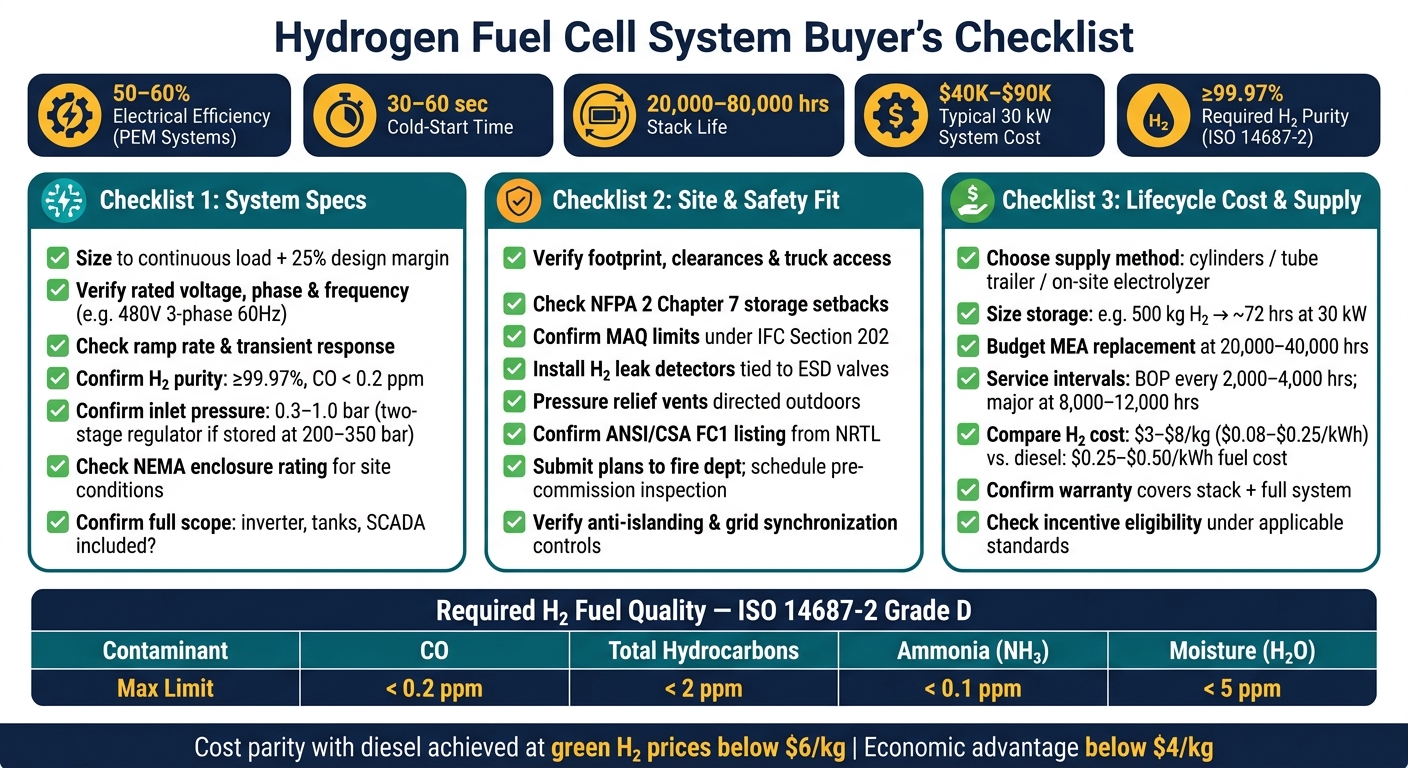
Hydrogen Fuel Cell System Buyer's Checklist: Key Specs, Costs & Standards
Hydrogen Fuel Cells Explained - Every Hidden System Inside the Stack
sbb-itb-501186b
Quick comparison
| What I’d check | What to confirm | Why it matters |
|---|---|---|
| System specs | Continuous kW, voltage, phase, ramp rate, efficiency, hydrogen pressure/purity | Helps stop undersizing and fuel mismatch |
| Site and electrical fit | Footprint, ventilation, storage area, detectors, one-line, switchgear, interconnection | Helps stop permit and install issues |
| Lifecycle cost | Hydrogen supply method, maintenance hours, stack life, warranty, replacement cost | Helps judge full cost over time |
If you’re comparing vendors, I’d use this article as a buyer’s filter: first confirm the unit can carry your load, then confirm the site can legally and safely support it, and only then compare fuel, service, and warranty terms.
Checklist 1: Confirm Core System Specifications
Before you ask for a quote or line up vendors side by side, pull the datasheet for each system on your shortlist and review three areas. Most sizing mistakes start here.
Go in this order: size the load, verify fuel quality, then check installation limits.
Power Output, Load Profile, and Electrical Characteristics
Start with rated continuous power output, not peak power. Peak numbers on datasheets may only hold for a few seconds or minutes, so they shouldn't drive sizing for a stationary or backup setup. Calculate your facility's peak simultaneous load, then add a 25% design margin to cover inrush current and future load growth.
Also check ramp rate and transient response. If your site has high inrush loads, use a battery buffer. It also helps to confirm how compressors, pumps, and power electronics deal with fast load swings without voltage droop.
On the electrical side, fuel cells natively produce DC output. So you'll need a DC-to-AC inverter sized to match your facility's voltage, phase, and frequency needs - for example, 480V three-phase at 60 Hz. Check inverter power factor and THD too. High distortion can create problems for sensitive loads.
Efficiency, Hydrogen Consumption, and Fuel Requirements
PEM systems usually operate at 50%–60% electrical efficiency. If you're using CHP, total efficiency can reach 80%–85%. At 50% efficiency, a system uses about 70 Nm³ of hydrogen per MWh. At 60%, that drops to around 59 Nm³/MWh - about a 16% cut in fuel cost.
Fuel quality matters more than many buyers expect. Match supply to ISO 14687-2 Grade D: ≥99.97% total purity, with CO below 0.2 ppm. CO can poison the platinum catalyst at levels as low as 10 ppm, which can cause fast and irreversible performance loss. If you're using reformate supply, inline purification is required.
You should also confirm inlet pressure. Stacks usually need 0.3–1.0 bar, so if you're storing hydrogen at 200–350 bar, you'll need two-stage regulation.
| Contaminant (ISO 14687-2) | Maximum Limit |
|---|---|
| Carbon Monoxide (CO) | < 0.2 ppm |
| Total Hydrocarbons | < 2 ppm |
| Ammonia (NH₃) | < 0.1 ppm |
| Moisture (H₂O) | < 5 ppm |
| Total Purity | ≥ 99.97% |
Environmental Ratings and Equipment Scope
Check the ambient temperature range, altitude derating, and enclosure rating. PEM systems can be built for harsh conditions, including lows of -40°F with cold-start preheating and highs of 113°F with forced-air or liquid cooling. For outdoor use, make sure the NEMA enclosure rating fits your site's wind, rain, dust, and washdown exposure.
Then look closely at scope. Confirm whether the quote includes the stack, hydrogen and air subsystems, thermal management, and basic controls. In many cases, DC-to-AC inverters, storage tanks, electrolyzers, and SCADA are extra items unless the quote clearly says they're included.
With specs and scope locked in, the next step is site fit, safety, and electrical integration.
Checklist 2: Verify Site Fit, Safety, and Electrical Integration
Once you've confirmed the specs, the next step is simple: make sure the site can support the system in the real world - physically, safely, and electrically.
Site Layout, Hydrogen Storage, and Ventilation
Start with the footprint and required clearances. A fuel cell skid is often compact, but the full setup needs more room than the skid alone. You still need space for hydrogen storage, truck access, and safe movement for technicians around the stack. Compressed cylinder banks, tube trailers, and on-site electrolyzers each come with different space and piping needs.
Hydrogen storage should sit in a dedicated, ventilated area that meets local fire code setbacks, including the safety distances in NFPA 2 Chapter 7. You should also check whether the total hydrogen volume goes past the Maximum Allowable Quantity (MAQ) under IFC Section 202. If it does, extra storage and separation rules may apply.
It also pays to look at the basics. Confirm that the floor or pad can support the combined weight of the skid and storage. And make sure the layout leaves enough room for maintenance work and fuel deliveries.
Those layout decisions affect more than convenience. They also determine where leak detectors, vent points, and emergency shutdown access need to go.
Safety Controls, Monitoring, and Permits
Hydrogen leak detectors should be installed at all inlet connections and inside enclosures, with those detectors tied to ESD and isolation valves. Pressure relief devices must vent outdoors, and the full system should work with the facility's fire detection and suppression systems.
On the certification side, IFC Section 1206 says these systems must be listed to ANSI/CSA FC1. If a vendor can't show that listing from a Nationally Recognized Testing Laboratory (NRTL), that's the point to stop.
Permitting usually means sending plans to the local fire department for review, then setting up a site inspection before commissioning.
Once the safety controls are mapped out, shift to the electrical one-line and the utility tie-in.
Switchgear, Protection, Grounding, and Utility Interconnection
The system's output needs to match the facility through rated conversion equipment, breakers, switchgear, and overcurrent protection sized for that output. Grounding and bonding are not optional. Make sure the system is grounded the right way to avoid static electricity buildup, which is a major hazard when handling hydrogen.
For grid-connected systems, check utility interconnection rules early. That includes anti-islanding and synchronization controls. If the system will run in parallel with the grid, those controls need to be checked before commissioning.
After electrical integration is cleared, compare hydrogen supply and service terms.
Checklist 3: Review Hydrogen Supply, Maintenance, and Lifecycle Cost
Hydrogen Supply Logistics and Operating Profile
Once site fit and electrical tie-in are confirmed, the next step is hydrogen supply. This is where the day-to-day reality of the system starts to show up.
Pick the supply method based on three things: delivery access, how long the system needs to run without refueling, and how often refills are feasible. The main choices are:
- delivered compressed gas in cylinders or tube trailers
- liquid hydrogen with cryogenic storage
- on-site generation through a PEM electrolyzer
Delivered gas is usually the easiest option to get up and running. The tradeoff is simple: you're tied to truck access and whatever regional hydrogen supply looks like in your area. On-site electrolysis cuts that delivery link and can produce hydrogen at 99.999% purity, which fits PEM fuel cells well.
Storage size matters more than many buyers first assume. For example, a 30-day supply for a 10 kWh/day load needs about 35 standard 50-liter cylinders. That adds up fast. If the site is remote or road access is limited, tube trailers or on-site production may make more sense.
The supply method should match the actual operating profile. A standby-only setup can live with less frequent refills. A continuous or load-following system is a different story and needs a supply plan built for more regular use.
Maintenance Intervals, Stack Life, and Service Support
After fuel supply, look closely at service intervals and stack life. This part has a direct effect on long-term cost.
Commercial PEM stacks are rated for 20,000 to 80,000 operating hours, and output usually drops by about 0.5% to 2% per 1,000 operating hours. Most hydrogen fuel cell systems have a total life expectancy of 10 to 15 years with regular maintenance. For long-term installations, plan for a Membrane Electrode Assembly (MEA) replacement somewhere around the 20,000- to 40,000-hour range.
Routine service can include air filter changes, coolant circuit checks, solenoid valve testing, and deionizer cartridge replacement. In many systems, some balance-of-plant items need service every 2,000 to 4,000 hours, while broader system work often lands around 8,000 to 12,000 hours.
For backup systems in healthcare and other critical facilities, NFPA 110 also calls for monthly load tests and annual system testing. That requirement alone can shape the service plan.
Before signing anything, pin down the service model in plain terms:
- who performs the work
- how often visits are required
- which parts are not covered
- what the response time looks like if the system goes down
Maintenance should be handled by qualified technicians, often trained by the manufacturer or through vocational programs. Remote monitoring through CAN bus or Modbus can also help cut service delays.
Upfront Cost, Ongoing Cost, Warranty, and Incentives
Once service expectations are clear, compare ownership cost across the full life of the system, not just the purchase price.
A 30 kW PEM fuel cell system with 24-hour hydrogen storage typically costs between $40,000 and $90,000. In the U.S., hydrogen fuel usually runs from $3 to $8 per kg, or about $0.08 to $0.25 per kWh depending on the supply source. For comparison, diesel generation costs about $0.25 to $0.50 per kWh on fuel alone.
"Over a 10-year horizon, a PEM fuel cell backup power system typically achieves total cost of ownership parity with diesel generation at green hydrogen prices below $6/kg, and economic advantage at hydrogen prices below $4/kg." - Hovogen Engineering Team
When you compare options, look at the whole package: system price, fuel cost, maintenance cost, warranty scope, and incentive eligibility before making a commitment. Check whether the warranty applies to the full system, the stack only, or both. Also ask for the out-of-warranty stack replacement cost. Incentive eligibility should be confirmed under the applicable recognized standards.
Final Comparison Checklist and Conclusion
Build a Vendor Comparison Matrix
Turn your shortlist into a simple side-by-side scorecard. One item matters more than it may seem at first: stack life. It has a big effect on total cost of ownership.
Also, check whether the vendor builds the stack in-house or buys it from another supplier. That detail matters because it affects who stands behind the warranty and whether long-term service support will still be there when you need it.
| Criteria | Unit | Vendor A | Vendor B | Vendor C |
|---|---|---|---|---|
| Rated Power | kW | |||
| Voltage Output | V (DC/AC) | |||
| Electrical Efficiency | % (LHV) | |||
| H₂ Consumption | kg/kWh or Nm³/h | |||
| H₂ Purity / Pressure | % / bar | |||
| Stack Life | Hours | |||
| Warranty | Years / Hours | |||
| Certifications | ISO / UL / CSA | |||
| Maintenance Interval | Hours | |||
| CAPEX | USD | |||
| Estimated OPEX | USD/kWh |
Use continuous rated power, not peak output, in the kW column.
Collect the Required Project Documents
Before you approve any purchase order, get the full documentation package from the vendor. Missing paperwork can slow down permitting and commissioning, and that kind of delay can throw off the whole project.
Ask for technical datasheets, piping and instrumentation diagrams (P&IDs), electrical one-line diagrams that show inverters, transformers, and switchgear, and site drawings that mark hydrogen storage locations and ventilation layouts. You should also request certification documents such as ANSI/CSA FC1 or UL listing, a commissioning scope that covers start-up sequences and safety interlock triggers, O&M manuals, and staff training requirements.
On top of that, ask for a Certificate of Analysis (COA) or ISO 14687-2 compliance records that confirm hydrogen purity of at least 99.97% and CO levels below 0.2 ppm. It’s also smart to request a reference list of installed systems with more than 10,000 hours of documented runtime. That gives you a clearer read on technology maturity.
Key Checks Before You Buy
Before signing, run through these final checks:
- Load match: Size for peak simultaneous load, not average draw. Add a 25% design margin.
- Hydrogen quality: Confirm purity meets ISO 14687-2 Grade D (≥99.97%).
- Code compliance: Verify the system is listed by a Nationally Recognized Testing Laboratory (NRTL) to ANSI/CSA FC1. Also confirm NFPA 2, NFPA 853, and IFC Section 1206 compliance. AHJ approval alone is often not enough.
- Stack replacement plan: Budget for a Membrane Electrode Assembly (MEA) replacement at the 20,000–40,000 hour mark.
- Balance of plant: Account for cooling circuits, hydrogen recirculation pumps, air compressors, and power conditioning equipment, since these balance-of-plant components affect total system cost.
FAQs
How do I calculate the right fuel cell size for my site?
Start by defining your site's load profile. List each electrical load and its duty cycle so you can calculate total energy demand. Then apply a system efficiency factor of 0.85-0.90 to cover inverter and wiring losses.
Next, identify the peak simultaneous load and add about 25% for inrush current and future growth. Pick a system rated for continuous power, and make sure it fits your space, maintenance clearances, and fuel supply.
What permits and code checks should I expect before installation?
Before you install a hydrogen fuel cell system, you’ll need to meet local and state fire and building code rules. It’s smart to check with your local municipality early for permits tied to environmental review, land use, public health, building, and zoning.
You may also need to show that the system complies with NFPA 2, NFPA 853, and any applicable international fire and fuel gas codes, along with any required third-party testing or certification. Meeting with local planning agencies at the start can help clear up permit steps and submission needs before the project moves ahead.
How often will the stack or MEA need replacement?
There’s no set schedule for replacing a fuel cell stack or membrane electrode assembly (MEA). How long it lasts depends on the job it’s doing, the way it’s run, and how well it’s maintained.
Before you buy, check the manufacturer’s service intervals and maintenance schedule. Some systems need very little upkeep. Others may need parts replaced from time to time, such as PEM membranes or deionizer cartridges.