How Grid-Interactive Standards Improve Load Management
If you want load control that works across sites and vendors, standards are the key. They let HVAC, lighting, EV charging, batteries, and other equipment respond to utility or in-house signals without custom setup for every device.
Here’s the short version:
- I use OpenADR, IEEE 2030.5, and CTA-2045 to make devices speak a common language.
- That helps me shift, shed, and modulate load with less manual work.
- In commercial buildings, OpenADR-based programs have delivered about 5% to 15% peak demand reduction, with 13% on average in one field study.
- In practice, that can mean cooling setpoint changes of 2–4°F, lighting cuts of 20% to 30%, and scheduled load moves to off-peak hours.
- The setup still needs device checks, protocol mapping, commissioning, alarms, and fallback steps.
- I also need to verify reporting, firmware support, safe failure behavior, and cybersecurity controls before rollout.
At a basic level, standards help me turn load management from a custom integration project into a repeatable control process. That matters if I’m trying to cut peak demand, lower utility costs, join demand response programs, or coordinate loads with solar and battery storage.
A simple way to think about it: standards don’t do the control by themselves - but they make automated control far easier to deploy, test, and run across many systems.
| Topic | What matters most |
|---|---|
| Communication | Devices must receive commands, confirm action, and fail safely |
| Main standards | OpenADR, IEEE 2030.5, BACnet, CTA-2045 |
| Common load actions | HVAC setpoint changes, lighting dimming, EV charge shifting |
| DER coordination | Solar, batteries, and backup power need clear priority rules |
| Buying checks | Protocol support, visibility, fallback behavior, firmware support |
| Rollout steps | Inventory loads, set control tiers, test events, monitor results |
Below, I break down how these standards improve device communication, support demand response, and help me set up load control that works under live grid events.
OpenADR 3.0 Explained: A Common Language for Grid Flexibility | Codibly Webinar
sbb-itb-501186b
How standards improve communication and interoperability
The next step is the communication layer that lets devices work like one system. Shared data is what turns a group of separate devices into coordinated load control.
Device-to-system communication requirements
Each device needs to report its state, accept commands, confirm that it carried them out, and fail safely if communication drops. That's a big deal because operators need the same status signals and command behavior across devices if they want to shift, shed, or modulate load in a set order.
IEEE 2030.5 and OpenADR 2.0b spell out these behaviors for DER control, demand response, and pricing. BACnet can work with OpenADR through web services, which lets building management systems coordinate HVAC and other loads without custom point-to-point integrations.
That gives operators a clean way to sequence actions by priority and check that each reduction actually happened. But that only holds together when every device reports, responds, and recovers the same way.
Why open standards lower integration risk
Once communication is standardized, the buying decision shifts to long-term fit. Open standards make it less likely that replacements or firmware updates will break the system.
When devices use a common protocol, buyers can compare equipment based on technical fit instead of getting stuck inside one vendor's ecosystem. That's especially important for multi-site portfolios like retail chains, corporate campuses, or data centers. In those cases, steady load-management behavior across locations depends on a repeatable integration pattern, not a one-off setup at each site.
What buyers should check before purchasing equipment
Before buying equipment for a standardized load-control project, procurement teams should verify three things:
- Protocol support: Does the device natively support OpenADR 2.0b or 3.0, IEEE 2030.5, BACnet, or CTA-2045, based on the project's needs? In California, IEEE 2030.5 support is effectively mandatory for certain DERs under Rule 21, so communication fit can directly affect interconnection approval.
- Reporting visibility: Command support alone isn't enough. If a device can accept a load-reduction command but can't confirm execution, operators are left guessing.
- Safe fallback behavior and firmware support: Check whether the equipment reverts to a safe state during a communication loss. Also review the vendor's firmware support policies, since interoperability can erode over time if protocol support stops being maintained.
Load management functions that standards support
Once interoperable controls are in place, a facility can manage flexible loads and on-site DERs across different asset types from the same control setup. That makes it possible to shift, shed, and modulate load in a planned sequence instead of reacting on the fly.
Load shifting, shedding, and modulation
Standards give operators a way to sequence HVAC, lighting, EV charging, and other flexible loads in a set order, so demand cuts can happen automatically. In plain terms, the system knows what to dial back first, what comes next, and what should stay untouched unless things get tight. The same control layer can also handle demand response and coordinate DERs.
Demand response and interoperability
OpenADR carries utility event signals, while IEEE 2030.5 lets inverters and batteries receive commands and report status. Together, they let different control layers send compatible commands to the same devices, whether the trigger comes from a grid constraint or a market signal.
Coordination with distributed energy resources
If a site has solar, battery storage, or backup generation along with controllable loads, a coordination layer helps sort out conflicting instructions. It follows clear priority rules:
- Safety and thermal limits come first
- Contractual commitments come second
- Economic optimization uses whatever capacity is left
Facilities that take part in FERC Order 2222 aggregation programs need this kind of standards-based coordination.
Those priority rules also need to be mapped to each controllable load and tested before any automation goes live.
How to implement grid-interactive load management
Identify flexible loads and control priorities
Once you've picked your standards, the next step is to turn them into a site control plan. Start with an inventory of controllable loads. Then sort them into critical, shiftable, or adjustable for grid-interactive control.
Critical loads are the ones that can't go down, like life safety systems and core IT infrastructure. Shiftable loads are easier to move around in time, such as ice-storage chillers and EV charging. Adjustable loads can be tuned within set limits, like variable-speed fans, pumps, and zone-level HVAC.
From there, set demand limits in kW and build tiered control priorities. For example:
- Tier 1: dim noncritical lighting
- Tier 2: shift HVAC setpoints by 2°F
- Tier 3: curtail nonessential process loads
Map those tiers to single-line diagrams and panel schedules. That keeps the automation inside feeder limits and helps protect critical loads. At the same time, document backup power dependencies. Note which panels feed emergency circuits and how much capacity is set aside for life safety loads.
Check equipment compatibility and protocol mapping
With the load map ready, inventory each controllable device and record the protocols it supports. Then compare that list against what your utility or aggregator asks for. Many U.S. demand response programs use OpenADR 2.0b for event signals, while programs tied to smart inverters or battery storage may call for IEEE 2030.5 for equipment control.
If there's a mismatch, a protocol gateway can fill the gap. For instance, it can translate an OpenADR event message into a BACnet priority array that changes zone temperature setpoints. That's useful, but don't treat gateways like magic boxes. Write down any limits, such as added latency or less detailed data, so your control logic accounts for them from day one.
In RFQs, ask for:
- open protocol support
- time-stamped interval logging
- configurable rule engines
Test automation, monitoring, and fallback procedures
After the protocol work is done, commission the whole sequence under a simulated grid signal. Confirm that the gateway receives the signal and reads it the right way. Then verify that each load tier responds in the proper order and inside the required time window.
Check interval meters to make sure they show the expected kW reduction. If controls aren't commissioned well, they can wipe out the grid gains you're aiming for. It's also smart to validate event timing against your program's contract terms, since many demand response programs set maximum response ramp times.
Set alarms for missed responses, unexpected shedding, and temperature drift. Document manual fallback steps and drill them on a regular basis.
Benefits, tradeoffs, and final takeaways
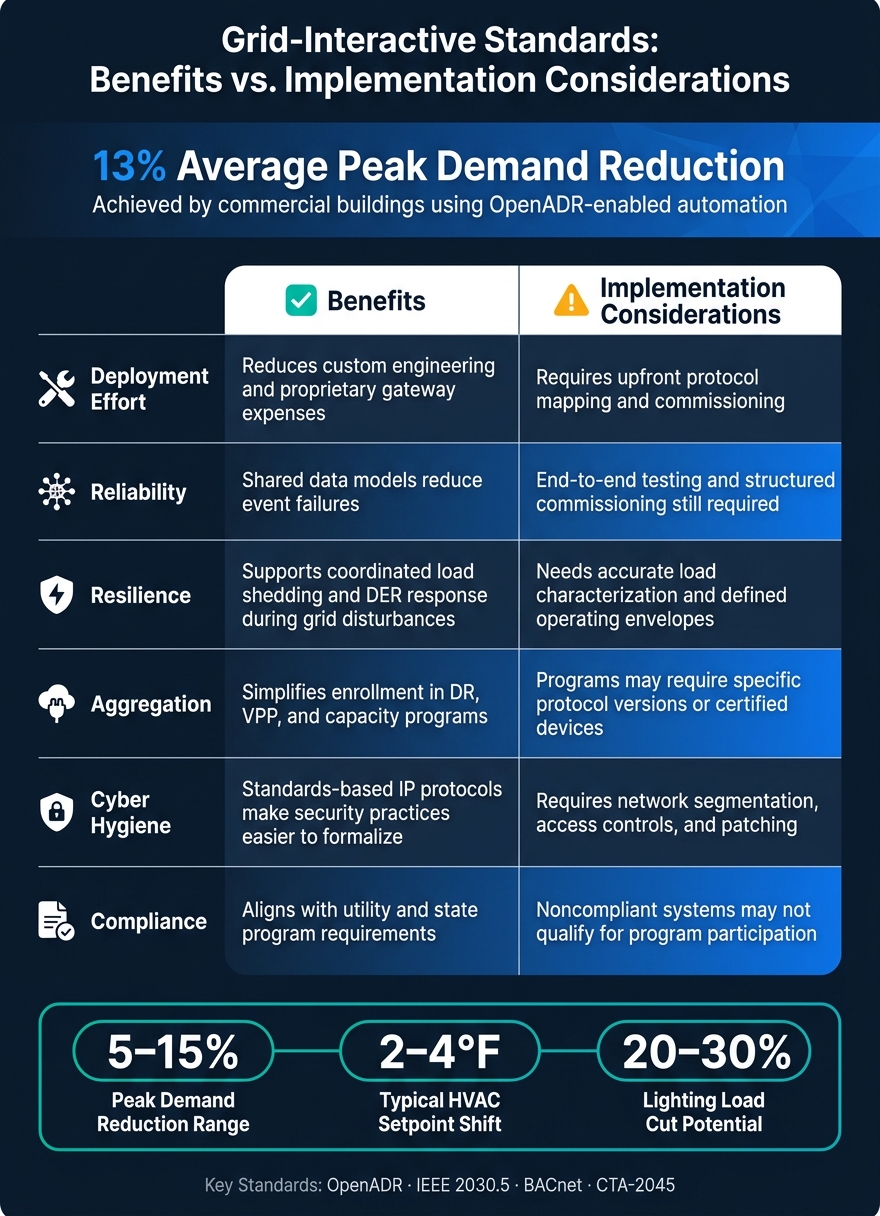
Grid-Interactive Standards: Benefits vs. Implementation Considerations
Comparison table: standardization benefits vs. implementation considerations
Once the control sequence is up and running, the next step is pretty simple: decide whether the standard justifies the integration work.
Commercial buildings that use OpenADR-enabled automation have historically delivered about 13% average peak demand reduction. But that result doesn’t happen by default. It depends on how well the control design handles peak reduction, load shifting, and event reliability.
Use the table below to compare day-to-day gains with what deployment takes.
| Area | Benefit | Implementation Consideration | Why It Matters |
|---|---|---|---|
| Deployment effort | Reduces custom engineering and proprietary gateway expenses | Requires upfront mapping and commissioning | Makes multi-site rollouts more repeatable |
| Reliability | Shared data models reduce event failures, but end-to-end testing is still required | Needs structured commissioning | Event success rate affects incentive payments |
| Resilience | Supports coordinated load shedding and DER response during grid disturbances | Needs accurate load characterization and defined operating envelopes | Helps protect operations during price spikes or reliability events |
| Aggregation | Simplifies enrollment in DR, VPP, and capacity programs | Programs may require specific protocol versions or settings | Can unlock capacity-based and performance-based payments |
| Cyber hygiene | Standards-based IP protocols make security practices easier to formalize | Requires network segmentation, access controls, and patching | Weak controls can undermine automation |
| Compliance | Aligns with utility and state program requirements | Some programs require specific protocol versions or certified devices | Noncompliant systems may not qualify for participation |
Where to prioritize upgrades first
After you weigh the tradeoffs, start with the loads that can move the needle fastest.
Large HVAC systems, chillers, and cooling towers are usually the best first targets. They run often, and they’re generally easier to modulate with BACnet- and OpenADR-based controls. EV charging infrastructure also stands out. Open protocols can shift charging away from peak periods without major disruption.
Another smart place to act: equipment that’s already due for replacement. If a system is getting swapped out anyway, install control-ready gear during that cycle. That move can help you avoid costly retrofits later.
Conclusion: Key points for better load management
Standards make automated load control far more dependable across multi-vendor systems and multiple sites. Without them, each integration turns into a custom job, and every DR event brings a higher risk of failure. With them, facilities can shift, shed, and modulate loads in a more predictable way while joining utility programs that pay for flexibility.
Before buying, verify protocol fit. Then test against live utility signals, keep cybersecurity in good shape, and track DR event success rate along with peak kW reduction. Standards are not a one-time checkbox. They’re the base layer that keeps repeatable load control working as programs, tariffs, and equipment change.
FAQs
Which standard should I use first?
For grid-interactive systems, start with IEEE 2030.5.
It’s widely used to manage distributed energy resources like solar, batteries, and EV chargers through secure, two-way communication with utility systems.
IEC 61850 matters too, especially for substation environments and high-speed utility operations. But IEEE 2030.5 is built to integrate and control consumer-facing IoT energy devices.
Do I need a gateway for older equipment?
Yes, older equipment often needs a gateway to work in modern grid-interactive systems.
Many legacy devices, including ones that use Modbus or Z-Wave, don't natively support newer standards like IEEE 2030.5.
A protocol gateway closes that gap. It converts data from older, separate protocols into a format your building management system or SCADA system can read, monitor, and control.
How do I safely test load control?
Safe load control testing starts with UL 1741-certified equipment before anything goes live. That helps make sure devices can handle fault conditions safely, including overcurrent and short-circuit protection.
If you're working with Modbus or BACnet, check register values in a diagnostic tool and compare them with the device’s local display before integration. If you use machine learning or automated dispatch, put version control in place, run stress tests, and keep documented rollback plans ready.