

IEEE 2030.5: Standard for Energy IoT
IEEE 2030.5 is a communication protocol designed to manage distributed energy resources (DERs) like solar panels, EV chargers, and home batteries. It ensures secure, two-way communication between these devices and utility systems, using a RESTful architecture over TCP/IP. The protocol is critical for modernizing grid management, enabling utilities to handle millions of devices efficiently while maintaining grid stability.
Key features include:
- Security: Uses TLS 1.2 encryption and a three-tier Public Key Infrastructure (PKI) for device authentication.
- Polling Model: Devices periodically check for updates, ensuring reliability during connectivity issues.
- Compatibility: Works across multiple communication technologies (Wi-Fi, Power Line Communications, etc.) and integrates with existing utility standards like IEC 61968 and IEC 61850.
- Applications: Supports demand response, smart inverter control, EV charging, and Vehicle-to-Grid (V2G) services.
Since 2020, California has mandated IEEE 2030.5 compliance for DER interconnection under Rule 21, with global adoption growing in regions like Hawaii and Australia. This protocol simplifies device integration, enhances grid coordination, and ensures secure operations for energy systems.
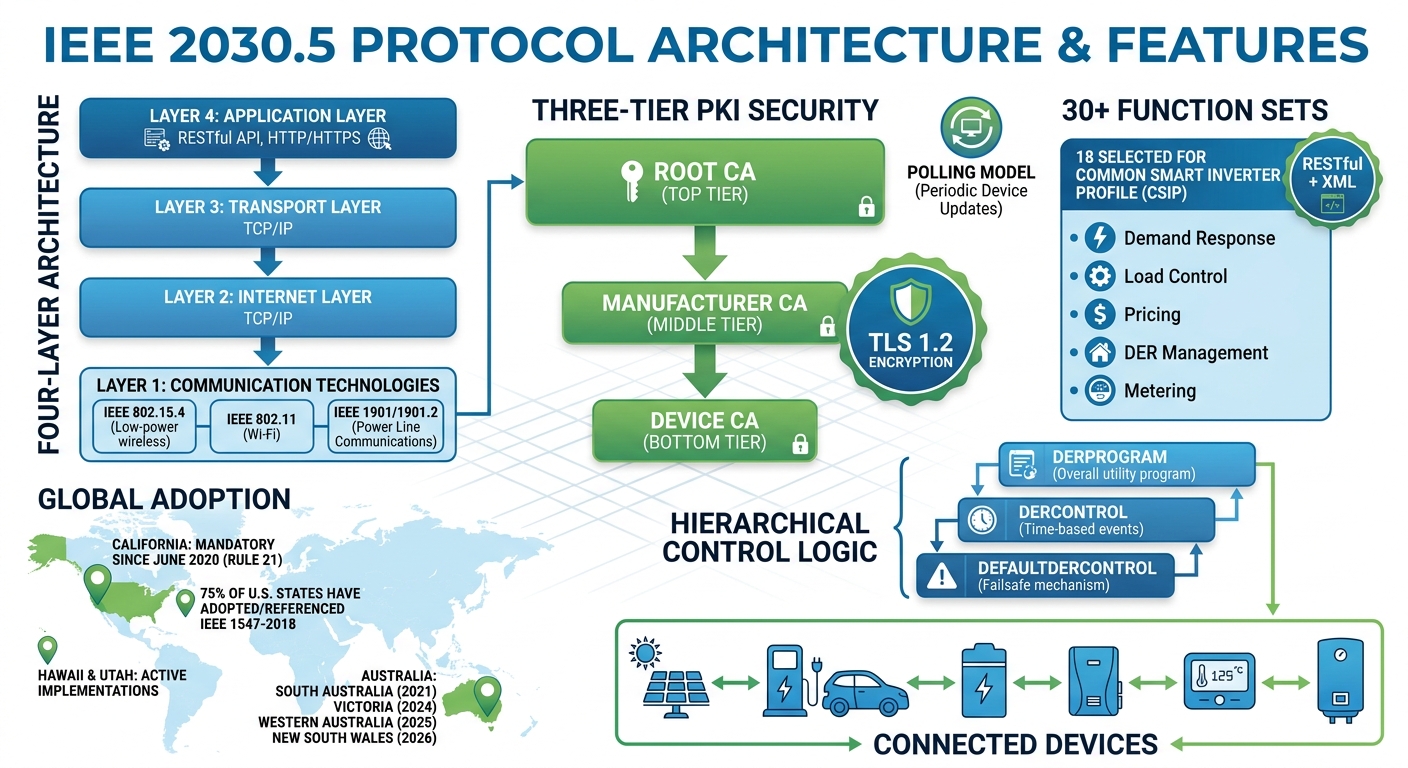
IEEE 2030.5 Protocol Architecture and Key Features Overview
Core Features and Functions
Key Features of IEEE 2030.5
IEEE 2030.5 is built on the four-layer Internet stack model, utilizing TCP/IP for transport and internet layer functions. It operates on standard networking infrastructure and follows a RESTful architecture, employing HTTP/HTTPS for communication and XML for data payloads. By adhering to widely used web standards, it simplifies implementation and integration.
Security is at the heart of its design. It uses TLS 1.2 and enforces a mandatory three-tier Public Key Infrastructure (PKI) system, comprising Root CA, Manufacturer CA, and Device CA. This ensures that only authenticated devices can establish connections - no valid certificate means no access.
The protocol supports over 30 function sets to handle energy-related tasks, ranging from metering to Distributed Energy Resource (DER) management. Of these, 18 are specifically selected under the Common Smart Inverter Profile for grid interconnection. These functions address areas like Demand Response, Load Control, Pricing, and DER management.
To enhance reliability, IEEE 2030.5 employs a mandatory polling model. DER devices are required to periodically update their status with utility servers, ensuring consistent communication even during connectivity issues. While this approach introduces slightly higher latency, it provides the stability needed to manage millions of distributed devices, which is critical for maintaining grid reliability.
How IEEE 2030.5 Enables IoT Device Integration
The protocol's design makes it media-independent, meaning it can operate across a variety of communication technologies. These include IEEE 802.15.4 (low-power wireless), IEEE 802.11 (Wi-Fi), and IEEE 1901/1901.2 (Power Line Communications). This flexibility allows utilities to seamlessly connect a wide range of devices, such as smart meters, solar inverters, battery storage systems, EV chargers, and even smart appliances like water heaters.
To ensure compatibility with existing utility systems, IEEE 2030.5 incorporates elements from IEC 61968 and IEC 61850 standards. This allows utilities to adopt the protocol without overhauling their infrastructure. Moreover, its compatibility extends beyond electricity, enabling integration with water, gas, and other utilities, which lays the groundwork for unified smart building and smart city systems.
The protocol’s operational structure is hierarchical. At the top level, the DERProgram defines the utility's overall program. Below this, DERControl specifies time-based events, while DefaultDERControl serves as a failsafe mechanism. This ensures that devices continue to function appropriately, even in cases of communication loss or conflicting control commands.
sbb-itb-501186b
Applications in Energy Systems
Demand Response and Smart Grid Integration
IEEE 2030.5 empowers utilities to manage millions of distributed energy resources (DERs) during periods of high demand. When grid usage spikes, operators can send control signals to devices like solar inverters and batteries, adjusting their output or charging behavior. This approach helps balance the grid and avoids the need for expensive infrastructure upgrades.
The protocol plays a key role in grid stabilization by automatically adjusting reactive power, active power, and frequency regulation. It uses functions such as Volt-VAR, Volt-Watt, Freq-Watt, and Freq-Droop to maintain system stability based on real-time local conditions.
In California, Rule 21 has mandated IEEE 2030.5 compliance for all DERs connected to PG&E, SCE, and SDG&E since June 2020. This requirement has standardized IoT communication across the state, making California the largest residential solar market in the U.S. The protocol’s hierarchical control system ensures safe operation of devices, even during communication disruptions. This integration highlights IEEE 2030.5 as a critical framework for modern energy IoT.
Outside of California, other regions are adopting IEEE 2030.5. Utah’s Wattsmart program, for instance, uses the protocol to manage distributed batteries as a unified system. In Australia, South Australia implemented the CSIP-AUS adaptation of IEEE 2030.5 in 2021, with Victoria and Western Australia following in 2024 and 2025, respectively. New South Wales plans to adopt it for its Emergency Backstop Mechanism starting in June 2026. These programs utilize Dynamic Operating Envelopes, which allow for real-time adjustments to export and import limits based on live grid conditions. The protocol’s flexibility also supports efficient communication for EV charging and smart inverters.
EV Charging and Smart Inverter Communication
IEEE 2030.5 extends its functionality to optimize EV charging and smart inverter operations. Acting as a secure communication link, it connects EV chargers to the grid, enabling Vehicle-to-Grid (V2G) services. This setup allows EVs to send power back to the grid during peak demand, enhancing overall grid resilience.
For EV infrastructure, IEEE 2030.5 often works in tandem with other protocols. OCPP manages charger-to-network communication, while OpenADR handles enrollment in demand response programs. Together, these systems provide a comprehensive framework for EV charging management.
The protocol also allows utilities to dynamically control charging rates based on grid conditions. For example, during peak demand, utilities can signal chargers to reduce speeds or shift charging to off-peak hours, preventing transformer overloads in residential areas. The V2G-AC Profile (SAE J3072) relies on IEEE 2030.5 to enable this two-way communication.
Additionally, IEEE 2030.5 has gained broad regulatory acceptance. About 75% of U.S. states have adopted or referenced IEEE 1547-2018, which lists IEEE 2030.5 as an approved communication protocol for DER interconnection. This widespread adoption allows manufacturers of EV chargers and smart inverters to use a single IEEE 2030.5 codebase, simplifying development and ensuring compatibility across multiple markets.
Meet IEEE 2030 5 Smart Energy Profile 2 0 SEP2 Gordon Lum
Benefits of IEEE 2030.5 for Energy IoT
These advantages enable utilities to efficiently and securely manage a wide range of Distributed Energy Resources (DERs).
Security and Network Scalability
IEEE 2030.5 places a strong emphasis on security by requiring a three-tier Public Key Infrastructure (PKI) model. This means every device must present a valid certificate chain - including the Smart Energy Root CA, Manufacturer CA, and Manufacturer-Installed CA - before it can communicate with a utility server. By using RESTful communication over HTTPS, combined with TLS 1.2 encryption and XML-based data payloads, the protocol ensures a robust "security-by-design" framework to safeguard critical grid systems from cyber threats. As Codibly highlights:
This security-by-design approach is non-negotiable for grid operators managing critical infrastructure.
On the scalability front, IEEE 2030.5's mandatory polling model ensures reliability. Devices periodically check for updates, which slightly increases latency but enables millions of devices to recover seamlessly from connectivity issues. This level of scalability far surpasses what traditional SCADA systems can handle.
Device Compatibility and Remote Management
Beyond security and scalability, IEEE 2030.5 simplifies device integration and remote management. Its use of standardized XML-based message structures and a RESTful architecture allows various devices - like smart inverters, battery storage systems, EV chargers, smart thermostats, and water heaters - to connect to a single utility server with ease.
The protocol's hierarchical control logic, structured through DERProgram, DERControl, and DefaultDERControl, empowers utilities to issue precise, time-specific commands. For example, utilities can limit energy export to 50% during peak demand hours while ensuring a default failsafe state if communication fails. Advanced implementations, such as CSIP-AUS, further extend functionality by supporting Dynamic Operating Envelopes, which allow real-time adjustments to import and export limits based on grid conditions.
Approximately 75% of U.S. states have adopted or referenced IEEE 1547-2018, establishing IEEE 2030.5 as one of only three approved communication protocols for DER interconnection. This widespread regulatory support enables manufacturers to standardize on a single IEEE 2030.5 codebase across multiple markets, reducing development costs and speeding up deployment. What might normally require 12–18 months of engineering can be completed in just 8–16 weeks when using pre-certified protocol components.
Using IEEE 2030.5 in Smart Buildings
Smart buildings rely on IEEE 2030.5 to establish a unified energy management system that seamlessly integrates solar panels, battery storage, EV chargers, and demand-response devices. This standardized interface allows building operators to manage multiple distributed energy resources (DERs) efficiently through a single platform.
Energy Optimization Through DER Coordination
With its established grid coordination capabilities, IEEE 2030.5 enables smart buildings to optimize energy use through its structured control hierarchy. This system operates on three levels: setting operational goals, sending time-sensitive commands, and maintaining fallback settings in case of outages. This layered approach ensures devices remain functional and predictable, even during network disruptions.
For instance, a building operator might configure the system to restrict battery discharge during high-demand periods while maintaining voltage stability using Volt-VAR control. The polling model built into IEEE 2030.5 ensures that all DERs can recover smoothly from connectivity issues, supporting uninterrupted operations.
Finding Compatible Equipment for Implementation
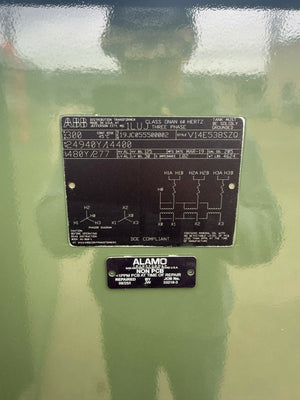
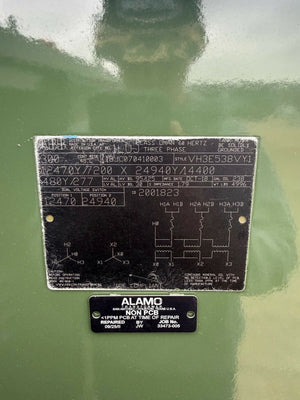
Implementing IEEE 2030.5 in smart buildings also requires compatible equipment. Devices like smart inverters, battery storage systems, and EV chargers must support the Common Smart Inverter Profile (CSIP), which incorporates 18 to 20 function sets from the standard. Additionally, electrical infrastructure - such as transformers, breakers, and power distribution components - must handle bidirectional power flows effectively.
Resources like Electrical Trader offer access to both new and used electrical components that meet the requirements of modern DER installations. Since California Rule 21 mandated IEEE 2030.5 certification for all grid-connected DERs starting in June 2020, ensuring compliance through verified equipment has become essential. Operators should confirm that their entire electrical distribution system can manage the dynamic power flows associated with coordinated DERs. This alignment reinforces IEEE 2030.5's pivotal role in driving energy IoT advancements across various building environments.
Conclusion
IEEE 2030.5 has grown from being a California-specific regulation into a globally recognized standard for grid-connected energy systems. This protocol plays a key role in ensuring secure device integration and long-term system reliability. For professionals in the electrical and construction fields, understanding this standard can directly influence project timelines, equipment choices, and system effectiveness.
This standard offers clear operational benefits. Its security-by-design approach, which includes a mandatory three-tier PKI and TLS 1.2 encryption, ensures secure communication across the grid while enabling reliable remote management. The polling model helps systems recover smoothly from connectivity issues, and the DefaultDERControl feature prevents unsafe operations during communication failures. Together, these safety measures minimize liability risks and promote consistent performance across various installations.
"The OEMs that treat IEEE 2030.5 as an architecture decision rather than a compliance checkbox will be the ones that enter new markets in weeks, not quarters." - Codibly
For installations in regions like California, Hawaii, Utah, and Australia, CSIP certification is essential, as IEEE 2030.5 compliance is mandatory for DER interconnections. Since June 2020, all DERs connecting to California's three major investor-owned utilities are required to communicate using this protocol. When selecting equipment, ensure that smart inverters, battery storage systems, and EV chargers are properly certified. For example, platforms like Electrical Trader offer certified components to meet these requirements.
Emerging opportunities, such as vehicle-to-grid services and demand response programs, also highlight the value of IEEE 2030.5. The recent 2023 update and the development of CSIP 3.0 enhance both security and interoperability, ensuring systems can adapt to future demands without expensive overhauls. As a result, IEEE 2030.5 is more than just a regulatory requirement - it’s a strategic tool for building energy systems that are ready for the future.
FAQs
Do I need IEEE 2030.5 for my solar, battery, or EV charger project?
If your project requires grid interconnection or must comply with regulations in places like California, Hawaii, or even countries like Australia, then IEEE 2030.5 is a must-have. This standard ensures secure and standardized communication between your solar panels, battery storage, or EV charger and utility networks. It's key for meeting compliance requirements and ensuring smooth, reliable operation.
How does the polling model affect response time and reliability?
The polling model in IEEE 2030.5 improves response times and ensures reliability by facilitating continuous, real-time monitoring of feeder conditions. This capability allows utilities to swiftly and accurately respond to grid changes, boosting the overall efficiency and dependability of the system.
What does CSIP certification mean for choosing compatible equipment?
CSIP certification verifies that a smart inverter or DER device adheres to a defined subset of IEEE 2030.5 standards. This certification ensures compatibility and compliance with regulatory requirements, especially in California, where it is a requirement for grid interconnection. Opting for CSIP-certified equipment simplifies approval processes and ensures seamless integration with energy systems built to these standards.