

IoT Energy Device Testing: IEEE 2030.5 Explained
IEEE 2030.5, also known as Smart Energy Profile 2.0 (SEP 2.0), is a communication standard designed for secure, two-way data exchange between utilities and energy devices like solar panels, batteries, and EV chargers. It uses IP-based technology (e.g., HTTP, TCP/IP) and supports various communication methods, including Wi-Fi and Ethernet. The latest version (IEEE 2030.5-2023) builds on the 2018 edition, addressing evolving energy requirements.
Key insights:
- Mandatory in California: Since June 2020, all Distributed Energy Resources (DERs) connecting to major utilities like PG&E and SCE must comply with IEEE 2030.5 under the Common Smart Inverter Profile (CSIP).
- Global Adoption: Beyond California, regions like Hawaii, Australia, and Utah have adopted the standard for DER integration.
- Core Features: Includes time synchronization, device capability communication, server discovery, and secure communication using TLS 1.2 encryption and digital certificates.
- Applications: Supports demand response, real-time pricing, EV integration (including Vehicle-to-Grid functionality), and DER aggregation for grid management.
Testing for compliance involves protocol conformance and interoperability checks, ensuring devices meet security and functionality standards. Certification costs start at $5,000, with optional features adding $1,000 each. IEEE 2030.5 is essential for modernizing energy systems and ensuring compatibility across devices.
Meet IEEE 2030 5 Smart Energy Profile 2 0 SEP2 Gordon Lum
sbb-itb-501186b
Core Features of IEEE 2030.5 for IoT Interoperability
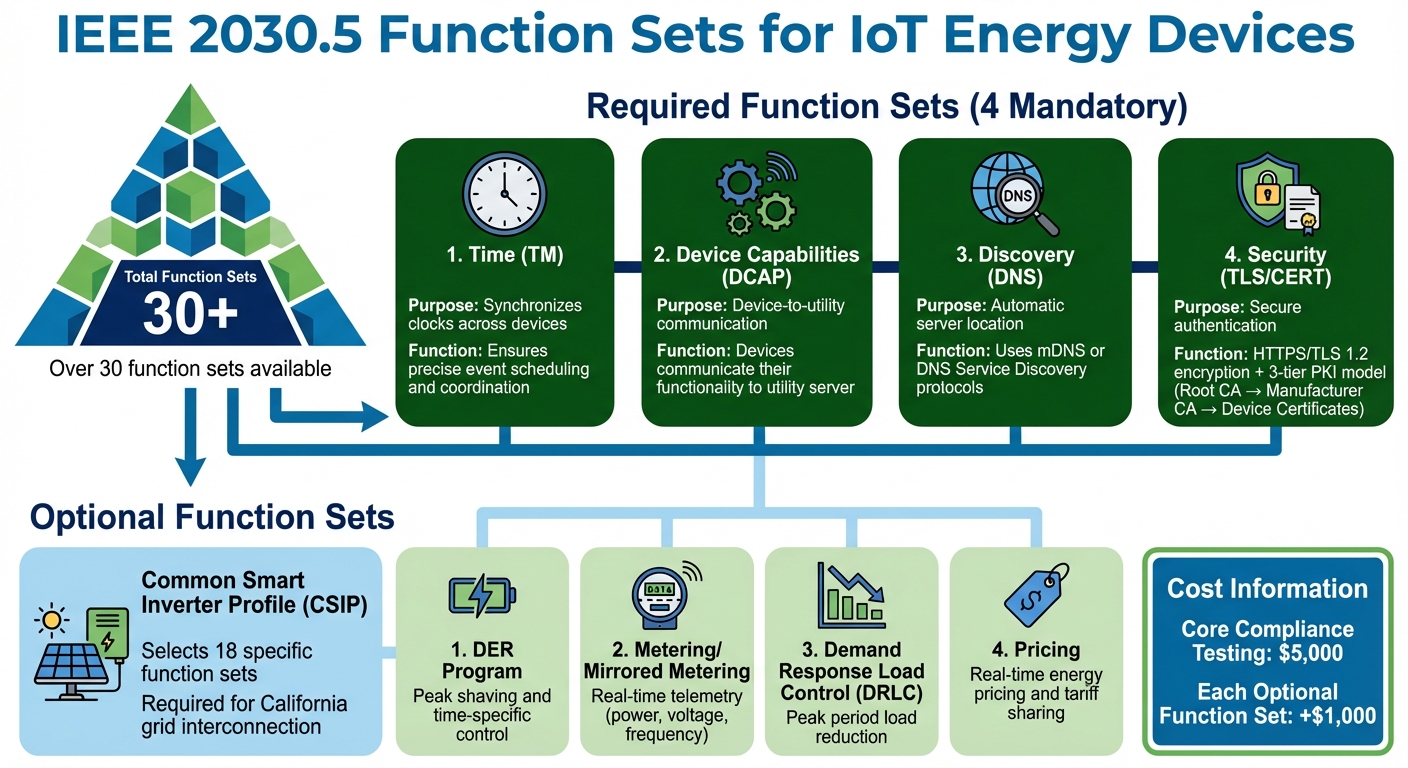
IEEE 2030.5 Function Sets: Required vs Optional Features for Smart Energy Devices
Required Function Sets
IEEE 2030.5 outlines over 30 function sets designed to facilitate secure communication between utilities and distributed energy resources (DERs). Among these, four function sets are mandatory for all compliant devices. These core components lay the groundwork for interoperability across IoT energy systems.
- Time (TM): Synchronizes clocks across devices to ensure precise event scheduling and coordination.
- Device Capabilities (DCAP): Allows devices to communicate their functionality to the utility server, clarifying what tasks they can perform.
- Discovery (DNS): Enables devices to automatically locate the utility server using protocols such as multicast DNS (mDNS) or DNS Service Discovery.
- Security (TLS/CERT): Enforces HTTPS/TLS 1.2 encryption and a three-tier Public Key Infrastructure (PKI) model, which includes Root CA, Manufacturer CA, and Device Certificates. This ensures that only authenticated devices with a valid certificate chain can communicate with the utility.
While these four function sets are essential, additional optional sets can expand device functionality.
Optional Functions for Energy Systems
Optional function sets offer advanced capabilities for energy management. A prime example is the Common Smart Inverter Profile (CSIP), which selects 18 specific function sets from the standard to meet California's grid interconnection requirements. This modular approach allows manufacturers to tailor their devices to specific needs or markets.
- DER Program: Manages operational programs like peak shaving and coordinates time-specific control events.
- Metering and Mirrored Metering: Provides real-time telemetry, such as power output, voltage, and frequency data - critical for balancing the grid as more variable resources like solar panels and electric vehicles are integrated.
- Demand Response Load Control (DRLC): Reduces energy consumption during peak periods by controlling connected loads.
- Pricing: Shares energy prices and tariffs with devices, enabling consumption that aligns with real-time market dynamics.
Testing for core compliance starts at $5,000, with each additional optional function set adding $1,000 to the cost.
Testing IoT Energy Devices with IEEE 2030.5
Interoperability and Compliance Testing
When it comes to IEEE 2030.5 compliance, testing involves two main approaches: the Functional Test Suite (FTS) and ad hoc interoperability tests. The FTS is an automated process that checks if a device’s protocol implementation follows the standard’s rules. It ensures strict adherence to IEEE 2030.5-2018 and specific profiles, such as the SunSpec Common Smart Inverter Profile (CSIP).
Ad hoc testing, on the other hand, mimics real-world Distributed Energy Resource Management Systems (DERMS). This type of interoperability testing focuses on verifying whether devices can communicate effectively with products from other vendors. It does so by testing against "golden reference" implementations for both clients and servers. QualityLogic explains the value of this approach:
"By understanding what the functionality is supposed to look like and by getting to iteratively test your developing code against a 'golden reference' implementation, you can have confidence your code is on its way to being a quality product as well as certifiable".
These tests ensure that devices respond correctly to IEEE 2030.5 commands, demonstrating the expected physical behavior. Development teams typically achieve SunSpec certification within 8 to 16 weeks after starting the process. Since June 22, 2020, California Rule 21 has required IEEE 2030.5 CSIP certification for all grid-connected Distributed Energy Resources (DERs). This ensures seamless interoperability across diverse DERMS environments.
Beyond functionality, secure communication is just as crucial for maintaining grid reliability.
Security Testing with IEEE 2030.5
Security testing complements functional evaluations by focusing on five key areas: TLS, CERT, DNS, DCAP, and TM. The IEEE 2030.5 conformance test program includes 31 specific tests targeting these security functions.
These tests confirm that devices use TLS 1.2 encryption, ECC-based authentication, and a valid PKI chain to secure their communications. As the SunSpec Alliance explains:
"PKI is designated as the method of authentication used for Institute of Electrical and Electronics Engineers Standard (IEEE Std.) 2030.5 and is therefore the method to be used for authenticating and securing communications for SunSpec Certified™ products and services".
Applications and Benefits of IEEE 2030.5 in Smart Energy Systems
Dynamic Load Management for EV Charging
IEEE 2030.5 plays a key role in improving how electric vehicle (EV) charging integrates with the energy grid. By leveraging Internet protocols like TCP/IP and HTTP and using a RESTful architecture, this standard enables utilities to remotely monitor and control EV chargers as part of the grid. This real-time control helps utilities adjust charging rates based on grid conditions, preventing transformer overloads and ensuring grid stability.
Another standout feature is its support for bidirectional energy flow, which powers Vehicle-to-Grid (V2G) capabilities. This allows EVs to act as mobile energy storage, returning power to the grid during peak demand. For instance, utilities can reduce charging speeds during high-demand periods and ramp them up when renewable energy is more plentiful. The 2023 update to IEEE 2030.5 added specific function sets for EV charging and improved monitoring of distributed energy resources (DERs).
Joachim Lohse highlights its importance:
"IEEE 2030.5 is a game-changer for EV charging and utility grid management. By enabling two-way communication, demand response, and V2G functionality, this standard ensures that electric vehicles can be seamlessly integrated into the modern energy grid".
While EV charging is a major focus, the standard also supports demand response strategies and DER aggregation, which are discussed next.
DER Aggregation and Demand Response
One of IEEE 2030.5's strengths lies in its ability to unify communication across a wide range of distributed energy resources (DERs). Utilities can use it to monitor, control, and coordinate millions of assets like solar panels, batteries, and EVs. Its mandatory polling model and model-driven design make it easier to scale up operations without needing extensive custom integrations. This approach simplifies onboarding devices from various vendors in both residential and commercial settings.
By providing this reliability, IEEE 2030.5 enables utilities to integrate EV charging with other resources like solar power and battery storage through Distributed Energy Resource Management Systems (DERMS). This creates a more harmonized and efficient energy ecosystem.
Real-Time Pricing and Energy Optimization
Another advantage of IEEE 2030.5 is its ability to help buildings respond to real-time pricing signals from utilities. Using IoT-enabled devices like smart thermostats, appliances, meters, and EV chargers, building management systems can automatically adjust energy usage to save on costs based on pricing signals.
The IEEE Smart Grid organization explains:
"IEEE 2030.5 is a standard for communications between the smart grid and consumers. The standard is built using Internet of Things (IoT) concepts and gives consumers a variety of means to manage their energy usage and generation. Information exchanged using the standard includes pricing, demand response, and energy usage".
Although initially developed to meet California's regulatory requirements, IEEE 2030.5 is now being adopted globally. Mandates and pilot programs are emerging in places like Hawaii (Rule 14H), Australia (CSIP-AUS), and Texas (ERCOT ADER program). Smart building systems increasingly pair IEEE 2030.5 with technologies like OpenADR for demand response and OCPP for EV charger management, creating interconnected energy solutions.
Conclusion
Key Points on IEEE 2030.5
IEEE 2030.5 uses a RESTful, IP-based framework to enable secure, two-way communication between utilities and distributed energy resources (DERs) like solar panels, batteries, and electric vehicles. Since June 2020, compliance with this protocol has been required for all DERs connecting to California's three largest investor-owned utilities. Additionally, the International Electrotechnical Commission (IEC) formally approved the protocol in 2021.
Achieving interoperability involves more than just adopting the protocol. It requires implementing regional profiles such as the Common Smart Inverter Profile (CSIP), completing certification through organizations like SunSpec, and adhering to regulatory mandates for grid connection. All communications within this framework must use TLS 1.2 encryption and validated device certificates to ensure security.
Testing includes two key components: Protocol Conformance Testing, which uses Functional Test Suites, and Interoperability Testing to verify compatibility across different vendors. As QualityLogic explains:
"Building a truly interoperable 'plug and play' eco-system of vendors and products is not a trivial task, especially in the electric utility industry".
This rigorous process highlights the importance of sourcing equipment that has successfully passed these stringent standards.
Sourcing IEEE 2030.5-Compliant Devices
When sourcing equipment, prioritize devices with SunSpec certification to ensure they meet CSIP requirements and have undergone testing at authorized labs. Using SunSpec-certified devices simplifies achieving interoperability across DER systems. Before purchasing smart breakers, transformers, or other IoT energy components, always verify the product's certification status and review any associated test reports.
For professionals seeking IEEE 2030.5-compliant smart grid equipment, platforms like Electrical Trader offer a range of new and pre-owned power distribution products. Whether you're looking for breakers, transformers, or other infrastructure that integrates seamlessly with IEEE 2030.5 systems, sourcing from reliable marketplaces ensures the quality and dependability needed for energy projects.
FAQs
Do I need IEEE 2030.5 for my inverter or EV charger in California?
If you're in California and dealing with inverters or EV chargers, you might need to ensure IEEE 2030.5 compliance. This is crucial for meeting California Rule 21 requirements, which demand that smart inverters adhere to IEEE 2030.5 standards to connect to the grid and participate in energy markets.
What’s the difference between IEEE 2030.5 and CSIP?
The main distinction lies in their purpose and range. IEEE 2030.5 serves as a comprehensive, IP-based protocol designed to facilitate secure communication among utilities, energy systems, and distributed energy resources (DERs). On the other hand, CSIP (Common Smart Inverter Profile) operates as a specialized subset within IEEE 2030.5, concentrating specifically on standardizing communication for smart inverters. This ensures smooth, plug-and-play compatibility. In short, IEEE 2030.5 sets the overall framework, while CSIP hones in on smart inverter interactions.
How long does IEEE 2030.5 certification usually take?
The certification process for IEEE 2030.5 usually spans several months. While exact timelines aren't often shared publicly, the duration depends on factors like the certification body's procedures, the complexity of the testing involved, and the availability of the testing provider. These variables can make the timeline somewhat flexible.