Blockchain-Based Demand Response Frameworks
Blockchain is reshaping how energy grids manage supply and demand by introducing decentralized, transparent, and automated systems. Traditional demand response (DR) programs, which encourage consumers to adjust electricity usage during peak times, often face inefficiencies due to their centralized nature. Blockchain addresses these issues by enabling secure peer-to-peer (P2P) energy trading, automating processes with smart contracts, and providing a transparent record of transactions.
Key takeaways:
- Demand Response (DR): Helps balance energy grids by managing consumption instead of increasing power generation. Examples include Time of Use (TOU) pricing and Direct Load Control (DLC).
- Blockchain Benefits: Decentralization, transparency, secure P2P trading, and automation through smart contracts.
- Real-World Applications: Examples include microgrid management, where blockchain reduced peak demand by 62%, and large-scale pilots enabling faster, secure energy trades.
- Challenges: Integrating blockchain with existing grid systems, addressing computational demands, and navigating privacy regulations.
Blockchain-based DR systems are evolving with advanced technologies like AI and IoT to optimize energy grids further. These systems promise efficiency, security, and transparency, making them a promising solution for modern energy challenges.
Blockchain Virtual Power Plants Pay EV Owners Instantly
sbb-itb-501186b
Recent Research on Blockchain-Based DR Frameworks
In recent years, blockchain-enabled demand response (DR) frameworks have made strides in addressing challenges faced by modern power grids. Research from 2023 to 2025 highlights two key areas of focus: peer-to-peer (P2P) energy trading and smart contract automation. These advancements demonstrate the potential of blockchain to simplify and enhance demand response operations in energy systems.
Peer-to-Peer Energy Trading Models
Recent innovations in P2P trading models allow prosumers to directly exchange energy. One standout example is the Decentralized Retail Electricity Market Framework, developed using Hyperledger. This framework operates through two modules: one ensures secure P2P energy trading, while the other employs intelligent energy prediction to align supply with demand.
Predictive analytics play a significant role in these P2P systems. By integrating supervised learning and data mining, these models help prosumers pinpoint the best times to enter or exit the energy market. This approach enables participants to optimize earnings by identifying when market clearing prices surpass their bid-offer thresholds. Masoud H. Nazari from Wayne State University highlights the broader benefits of such systems:
"P2P trading is beneficial for prosumers, utilities, and network providers".
These models also address practical limitations. For instance, specific thresholds like maintaining a 60% State of Charge for home batteries or 80% for electric vehicles ensure user needs are prioritized before trading begins. A notable milestone in this space occurred in January 2025, when PowerLedger's TraceX energy marketplace facilitated 1.2 million renewable energy certificate trades in just one month, accounting for 167 GWh of green energy transactions. These developments set the stage for further automation through smart contract systems.
Smart Contract-Based Systems
Smart contracts complement P2P trading by automating DR transactions. For example, the Cooperative Prosumer Cluster (CPC) Framework, built on Ethereum, enables domestic prosumers to form clusters that balance local energy demand and supply. Dr. Pavan Ramchandra Padghan from the National Institute of Technology Tiruchirappalli elaborates on its functionality:
"The proposed cooperative grants incentives to prosumers participating in demand response (DR) using a logarithmic barrier function".
These systems manage various tasks, from validating offers at peer nodes to executing transactions and activating physical ON/OFF switches for distributed energy resources or EV charging stations. The adoption of high-performance platforms like Hyperledger Fabric, capable of processing 3,000 to 20,000 transactions per second, is making real-time retail electricity markets increasingly attainable.
Advantages and Challenges of Blockchain in DR
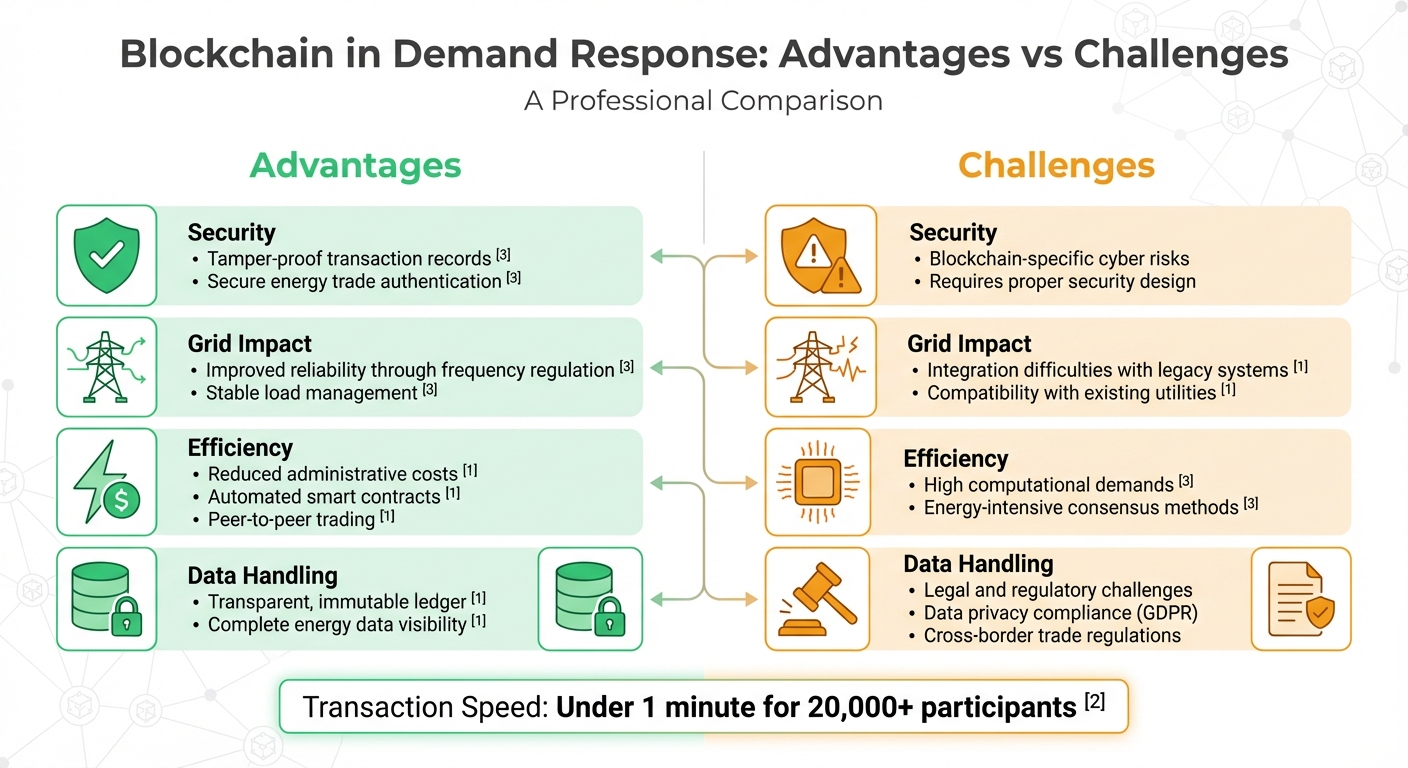
Blockchain Demand Response: Advantages vs Challenges in Energy Grid Management
Blockchain brings a mix of opportunities and obstacles to demand response (DR) systems. By moving from centralized, opaque models to decentralized frameworks, it offers greater transparency and security. However, these benefits come with their own set of challenges.
Take the GUARDIAN Framework, for example. Developed by Anish Jindal and Neeraj Kumar between 2019 and 2020, this blockchain-based system secures energy trading while keeping costs manageable. Published in IEEE Transactions on Services Computing, it uses a lightweight approach where miner nodes are selected based on power consumption and processing power. The framework effectively authenticated energy transactions without requiring heavy computational resources, making it a practical solution for managing loads across residential, commercial, and industrial sectors.
Despite these advancements, implementation isn’t without hurdles. Integrating blockchain with legacy grid infrastructure poses technical difficulties. Traditional consensus mechanisms, known for their high computational demands, can also strain resources. For instance, a blockchain-based DR allotment mechanism demonstrated it could process transactions in under a minute for a marketplace with over 20,000 participants. Yet, scaling such systems across entire grids means addressing regulatory and data privacy concerns.
Comparison of Advantages and Challenges
Here’s a quick breakdown of how blockchain’s benefits stack up against its challenges:
| Feature | Advantages | Challenges |
|---|---|---|
| Security | Ensures tamper-proof transaction records and secure energy trade authentication | May face blockchain-specific cyber risks if not properly designed |
| Grid Impact | Improves reliability through frequency regulation and stable load management | Difficulties in integrating with legacy grid systems and existing utilities |
| Efficiency | Cuts administrative costs with automated smart contracts and peer-to-peer trading | Traditional consensus methods can lead to high computational and energy costs |
| Data Handling | Offers a transparent, immutable ledger for energy data | Faces legal and regulatory challenges, especially with data privacy and cross-border energy trades |
Blockchain adoption in DR systems can drive innovation. Features like real-time pricing and automated load shedding help optimize energy usage, reducing dependence on costly "peaker" plants. Still, utilities must carefully navigate both the technical and regulatory landscapes to ensure successful deployment.
Case Studies of Blockchain-Based DR Frameworks
Recent case studies shed light on how blockchain technology is making a real-world difference in demand response (DR) systems, complementing earlier research findings.
Microgrid Applications
In December 2020, researchers Shivam Saxena and Hany E. Z. Farag implemented a permissioned Hyperledger Fabric blockchain to manage a Canadian microgrid serving eight homes. This system coordinated distributed energy resources like electric vehicles (EVs), battery storage, and smart thermostats using automated double auction mechanisms.
The results were impressive: peak demand dropped by 62% (a 48 kW reduction), saving the local Distribution System Operator an estimated $1.02 million by delaying costly transformer upgrades. Additionally, smart contract execution averaged 17.12 seconds across 12 nodes.
"Blockchains are key enablers of RETS, by virtue of providing a decentralized, self-governed network that mitigates concerns regarding privacy and transparency." - Shivam Saxena, Lead Author, IEEE Access
This framework tackled a major issue - uncoordinated EV and battery charging that often causes demand spikes and infrastructure overloads. By enabling homeowners to trade energy from their distributed resources without a central auctioneer, the system balanced individual energy needs while maintaining grid stability for the entire community.
Utility-Scale Pilot Programs
Beyond microgrids, utility-scale pilots have shown blockchain's potential to scale effectively. Companies like Drift and Restart Energy initiated programs allowing homeowners to choose specific energy sources, with participating consumers seeing projected energy savings of around 20%. These pilots highlighted how blockchain-based systems eliminate the single points of failure that plague traditional centralized platforms.
Speed is critical for grid reliability. For instance, Ethereum-based smart contracts averaged 42.6 seconds per 100 trades. However, permissioned systems using partial-permission consensus algorithms reduced trading times by 57.2% compared to traditional Proof of Work methods. This demonstrated significant efficiency improvements for utilities managing thousands of participants.
Future Directions in Blockchain-DR Research
The next wave of advancements in blockchain for demand response (DR) systems is set to harness the power of AI and IoT. These technologies aim to create smarter, more responsive energy grids. IoT sensors gather real-time energy data, AI processes this information for precise forecasting, and blockchain ensures secure and transparent transactions between all participants. Together, these tools promise to refine predictions and boost operational efficiency.
Integration with Artificial Intelligence
AI is transforming how blockchain-based DR systems handle demand forecasting and management. For example, in November 2025, researchers Arvind R. Singh and Mohit Bajaj introduced GridSyncNet, a framework that merges blockchain with multi-agent deep reinforcement learning. In simulations, GridSyncNet achieved impressive results: a 98.2% efficiency in DR, 97.4% accuracy in forecasting, and a 30.6% reduction in carbon emissions compared to benchmark models.
Another promising development is federated learning, which allows decentralized training of AI models while keeping raw energy usage data private. This approach not only enhances prediction accuracy but also safeguards consumer privacy. Moreover, AI-integrated blockchain frameworks have shown significant improvements in scalability - up to 98.43% - when managing large-scale electric vehicle networks. These systems treat electric vehicles as flexible loads, adjusting their energy consumption in real time based on grid conditions.
"Blockchain is providing trust. It gave us tokenisation, it gave us smart contracts, and it gave us a new way of automating, which is now spilling over into the wider business landscape." – David Palmer, Chief Product Officer, Pairpoint by Vodafone
AI integration works hand in hand with IoT, ensuring real-time data flows seamlessly into these advanced systems.
Role of IoT in Blockchain-Enabled DR
IoT devices play a critical role in blockchain-powered DR systems by delivering real-time energy data that feeds directly into smart contracts. These smart meters and sensors track energy consumption down to individual appliances, enabling dynamic load balancing. This approach has been shown to cut electricity use during peak hours by 20%.
A pilot project in Singapore during 2024–2025 demonstrated the potential of combining IoT sensors with blockchain. The system tracked real-time energy usage, recorded data on the blockchain, and executed automated smart contracts, resulting in a 25% reduction in peak energy loads. Lightweight protocols like MQTT and CoAP were used to ensure low-latency data transmission.
However, as the number of IoT devices worldwide is expected to exceed 30 billion by 2030, "blockchain bloating" from high-frequency IoT data poses a challenge. To address this, experts suggest storing raw data off-chain while keeping only aggregated metadata on the blockchain. This approach maintains system speed and security without overwhelming the network.
Conclusion
Blockchain technology is changing the way demand response systems function within the power grid. By moving away from centralized, opaque systems to decentralized frameworks, it introduces greater transparency, security, and efficiency - capabilities that traditional approaches struggle to provide. With every transaction being traceable and unchangeable, the system fosters accountability for everyone involved, from grid operators to individual energy users.
The benefits are both practical and measurable. For example, blockchain-enabled demand response systems can handle transactions for over 20,000 participants in under a minute. Smart contracts bring automation to tasks like baseline calculations and compensation for participants, cutting down operational costs for utilities while ensuring consumers are fairly rewarded for adjusting their energy consumption during peak times.
"The blockchain technology and the use of smart contracts for DR allow the creation of a distributed system, in which customers can communicate directly, in a transparent, secure, and traceable way, with the grid operator to provide their flexibility." – IEEE Transactions on Industry Applications
For those working in the electrical industry, this shift enables more direct interaction between stakeholders. Consumers and prosumers can now connect directly with grid operators, reducing the need for traditional intermediaries and reshaping the role of market operators. Permissioned blockchains, such as Hyperledger Fabric, add another layer of functionality by offering selective transparency. This ensures flexibility services are verified while safeguarding sensitive consumption data, aligning with regulations like GDPR.
As the energy sector continues to transform, blockchain-based demand response systems are poised to become a cornerstone of creating power grids that are more efficient, transparent, and resilient.
FAQs
Which blockchain type works best for demand response: permissioned or public?
Research shows that permissioned blockchains are a better fit for demand response applications. These blockchains provide a secure and transparent way to manage energy flexibility, ensuring only authorized participants can access and interact within the system. This makes them particularly well-suited for handling the complexities of such tasks.
How do smart contracts connect to real devices like EV chargers and thermostats?
Smart contracts integrate seamlessly with devices like EV chargers and thermostats, automating actions based on real-time data. These blockchain-driven programs follow predefined rules, such as modifying charging rates or adjusting thermostat settings when certain conditions are met. IoT sensors and communication protocols play a key role by transmitting data - like energy consumption or grid demand - allowing smart contracts to respond efficiently and autonomously. At the same time, blockchain ensures transparency and security with tamper-proof records.
How can demand response stay GDPR-compliant if energy data is stored on-chain?
Demand response can adhere to GDPR regulations by utilizing privacy-focused methods such as zero-knowledge proofs. These techniques confirm activities without revealing sensitive details, safeguarding personal information while staying compliant with GDPR standards. This ensures that energy data can be securely managed on-chain without compromising user privacy.