




Peer-to-Peer Energy Trading in Microgrids
Peer-to-peer (P2P) energy trading is reshaping how energy is shared and consumed. It allows individuals, called prosumers, to sell surplus electricity directly to neighbors, bypassing utility companies. When paired with microgrids - localized energy systems that can operate independently - this approach reduces transmission losses, lowers costs, and promotes local energy use. Combining these technologies creates a decentralized energy network where both electricity and payments flow directly between participants.
Key Takeaways:
- What It Is: P2P energy trading enables direct energy exchanges between users using digital platforms and smart meters.
- How It Works: Prosumers list surplus energy for sale; transactions are automated using blockchain and smart contracts.
-
Benefits:
- Cuts costs for buyers and sellers.
- Reduces energy waste by using local renewable sources.
- Strengthens local energy reliability during outages.
- Challenges: Regulatory hurdles, grid stability, and cybersecurity risks require solutions like blockchain and smart inverters.
- Examples: The Brooklyn Microgrid and Port of San Diego highlight its potential in residential and industrial settings.
This shift toward decentralized energy systems is gaining traction, but addressing technical and regulatory barriers is critical for broader adoption.
Peer-to-Peer energy trading and community self-consumption
sbb-itb-501186b
How Peer-to-Peer Energy Trading Works
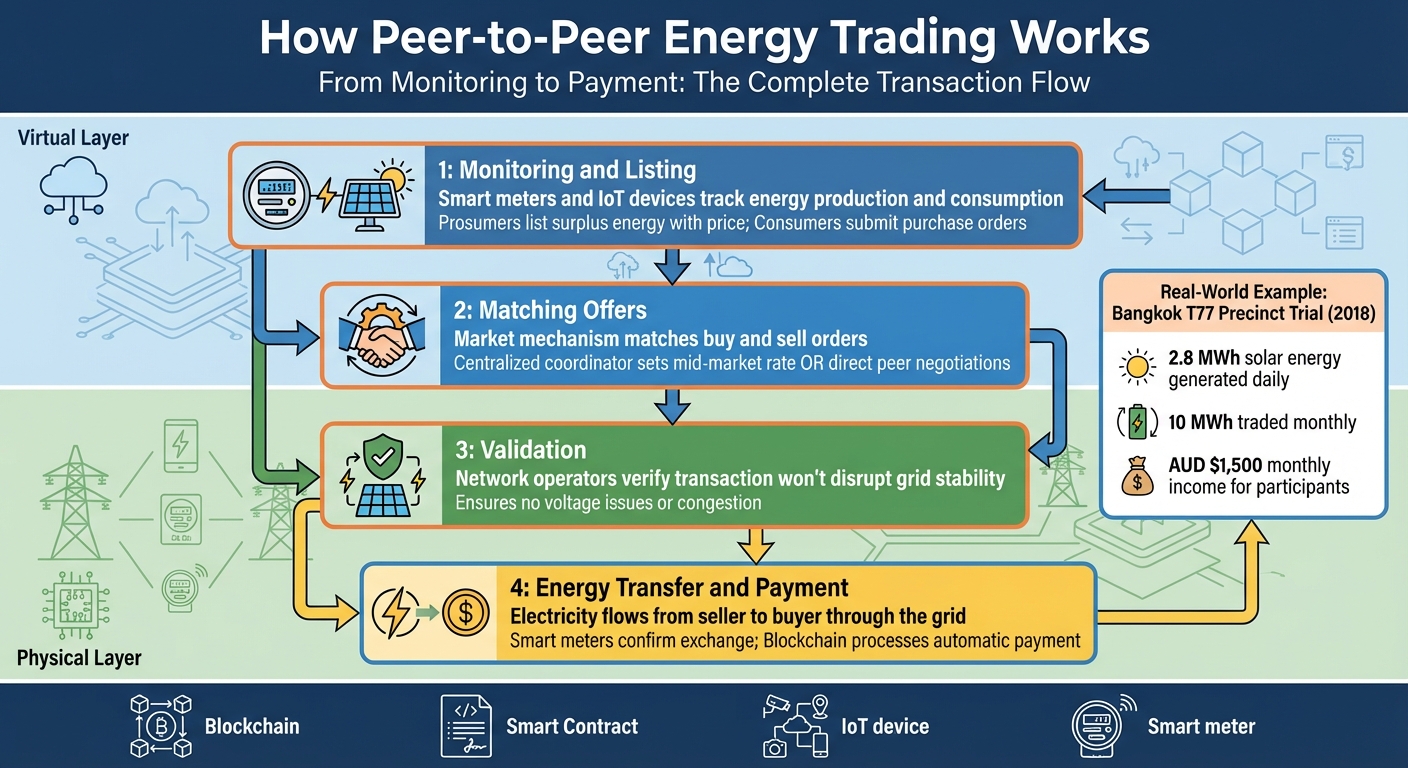
How Peer-to-Peer Energy Trading Works: 4-Step Process
Peer-to-peer (P2P) energy trading combines digital innovation with physical infrastructure to enable neighbors to exchange energy directly. This system relies on two interconnected layers that ensure both the efficiency of digital transactions and the reliability of physical energy delivery. Together, these layers create a seamless platform for decentralized energy sharing.
Core System Architecture
The architecture of P2P energy trading consists of two main components: the Virtual Layer and the Physical Layer.
- The Virtual Layer acts as the digital backbone, where prosumers (those who both produce and consume energy) and consumers interact. Think of it as an online marketplace for energy - users can exchange data, list energy for sale, place orders, and finalize transactions. Blockchain technology plays a key role here, providing secure, transparent, and tamper-proof records of every transaction. Smart contracts automate trading rules, ensuring payments and energy exchanges occur only when pre-set conditions are met. For example, a smart contract might release payment to the seller only after a smart meter confirms that the energy has been delivered.
- The Physical Layer is made up of the actual infrastructure, including the electrical grid, smart meters, and communication devices. These components enable the physical transfer of electricity between participants. Smart meters and Internet of Things (IoT) devices collect real-time data on energy production and consumption, while Energy Management Systems (EMS) help prosumers manage bids and maintain local energy security.
Energy Trading Process
With this architecture in place, the P2P energy trading process unfolds in a series of steps:
- Monitoring and Listing: Smart meters and IoT devices continuously track energy production and consumption, identifying any surplus or unmet demand. Prosumers list their excess energy on a digital platform, specifying the amount available and their desired price. Consumers, on the other hand, submit purchase orders based on their energy needs.
- Matching Offers: A market mechanism matches buy and sell orders. This could involve a centralized coordinator setting prices based on a mid-market rate or direct negotiations between participants.
- Validation: Before energy is transferred, network operators or automated systems verify that the transaction won’t disrupt the grid’s stability. This step ensures the grid can handle the proposed energy flow without voltage issues or congestion.
- Energy Transfer and Payment: Once validated, electricity flows from seller to buyer through the grid. Smart meters confirm the actual energy exchanged, and payments are processed automatically - often using blockchain to minimize costs and enhance transparency.
A real-world example of this system in action is the 2018 trial by Power Ledger and BCPG in Bangkok's T77 Precinct. During this trial, approximately 2.8 MWh of solar energy was generated daily, with about 10 MWh traded each month. This generated around AUD 1,500 in monthly income for participants.
Digital Platforms in Energy Trading
Digital platforms are the heart of P2P energy trading. These platforms serve as virtual marketplaces where users can list energy, set price preferences, and even select specific energy sources like solar. They simplify the trading process by handling everything from order matching to dispute resolution.
"Blockchain has a number of features including trustworthiness, transparency, redundancy, tamper-proof ability, and intermediary avoidance, which means it has good potential to be used for supporting P2P energy trading."
– Yue Zhou and Jianzhong Wu, Cardiff University
Market structures vary in how they balance control and privacy:
- Coordinated Markets: A centralized coordinator oversees transactions and information sharing, prioritizing grid stability.
- Community-Based Markets: These markets use decentralized trading methods while still relying on a central system for information sharing, striking a balance between privacy and collective goals.
- Fully Decentralized Markets: Prosumers trade directly without a central authority, maximizing autonomy but potentially sacrificing some efficiency.
Technological advancements have further refined these platforms. For instance, Layer 2 blockchain solutions like Polygon and Arbitrum can process thousands of transactions off-chain at lightning speeds, with costs as low as $0.001 per trade. Additionally, energy tokenization - converting kilowatt-hours into digital assets - has been shown to cut intermediary costs by 40–60% compared to traditional utility models. These innovations not only make trading more efficient but also strengthen the decentralized and community-focused nature of P2P energy systems.
Benefits of Peer-to-Peer Energy Trading
Peer-to-peer (P2P) energy trading brings three standout advantages: it cuts costs, optimizes the use of renewable energy, and strengthens community energy resilience. These benefits not only make energy more affordable but also help integrate renewable sources and improve local grid reliability.
Cost Savings for Prosumers
P2P energy trading offers a clear financial advantage. Traditionally, utilities buy surplus energy from producers (prosumers) at low rates and resell it at much higher retail prices. In some areas, retail rates can be as much as three times higher than what utilities pay for that energy. P2P trading sidesteps this markup by allowing neighbors to trade energy directly.
Local trading, supported by microgrid systems, also reduces transmission losses and infrastructure costs, adding to the economic appeal. Take the Mid-Market Rate (MMR) pricing model as an example: if a utility buys energy at $0.05 per kWh and sells it at $0.15 per kWh, P2P trading offers a middle ground at $0.10 per kWh. This setup lets sellers earn more while buyers save compared to retail rates. Real-world trials have shown this model can generate significant monthly earnings for participants.
Smarter Use of Renewable Energy
P2P trading is particularly effective at managing surplus renewable energy. Without such a system, excess energy from solar panels might be sold back to the grid at low rates - or worse, wasted if storage is full.
A local marketplace changes this dynamic. It ensures that surplus energy is used efficiently, preventing waste and boosting self-consumption. For instance, if one household's solar panels generate extra power at noon, nearby users can purchase that energy directly, aligning supply with demand in real time. This seamless connection between smart grids and local trading enhances both the digital and physical energy infrastructure.
"P2P energy trading is a promising approach to expanding the installation of renewable energy sources and achieving the system flexibility required for the shift to low-carbon energy." – Gaber Shabib, e-Prime - Advances in Electrical Engineering, Electronics and Energy
The numbers back this up as well. Residential solar installations are expected to grow globally by 11% between 2020 and 2026, while residential energy storage systems are forecasted to increase from 95 MW in 2016 to 3,700 MW by 2025. This growth makes P2P trading an increasingly appealing option for maximizing the value of renewable energy investments.
Building Community Energy Resilience
P2P trading doesn’t just save money and energy - it also helps communities become more self-reliant. By leveraging local renewable power, communities can create robust energy networks that remain functional even during grid disruptions. P2P microgrids, for example, can operate independently when the main grid goes down, proving crucial during natural disasters or outages. In fact, P2P frameworks have been shown to improve system resilience by up to 80%.
A great example is the Brooklyn Microgrid, where residents used blockchain technology to establish a self-sufficient energy network. Unlike centralized systems that are vulnerable to single-point failures, decentralized P2P markets distribute control across many participants. This setup ensures continued operation even if one part of the system encounters issues, while also optimizing resource use. Studies reveal that P2P trading can extend battery storage lifespans by 32%–37%.
Challenges and Solutions in P2P Energy Trading
P2P energy trading has a lot of potential, especially within microgrids, but turning this concept into reality isn't without its hurdles. For this decentralized energy system to work effectively, it must navigate both technical challenges and outdated regulatory frameworks. These difficulties range from managing the physical grid to addressing rules that don't align with peer-to-peer models.
Technical Constraints
One of the biggest technical challenges is managing reverse power flows. When numerous solar panels feed energy back into the grid, it can lead to voltage fluctuations and even overload grid components, especially during peak solar generation hours when many prosumers are exporting energy at the same time.
Scalability is another issue. As more participants join, the system must handle a growing number of bids and transactions in real time. This is further complicated by the unpredictable nature of renewable energy outputs, making it harder to maintain grid balance.
Cybersecurity is also a concern. P2P systems rely heavily on communication between devices connected to the grid, creating multiple points of vulnerability. These systems are at risk of cyberattacks, including data manipulation, transaction fraud, and privacy breaches.
Regulatory and Policy Barriers
The regulatory framework in the United States wasn't built with P2P energy trading in mind. For instance, FERC oversees wholesale electricity sales between utilities, while state and local authorities regulate retail sales to customers. This creates a gray area for prosumers, who act as both consumers and sellers.
FERC Order No. 2222, which allows distributed energy resource (DER) aggregations as small as 100 kW to participate in wholesale markets, is being rolled out at varying speeds across regions. For example, California's CAISO completed its implementation in November 2024, while the PJM region won't finish until February 2028, and the Southwest Power Pool (SPP) is scheduled for Q2 2030.
Another issue is how network charges are handled. Current utility rate structures don't accommodate P2P transactions, raising concerns that participants might avoid paying for grid maintenance, shifting the financial burden to non-participants. Additionally, licensing and bureaucratic hurdles designed for traditional power plants make it harder for small-scale distributed resources to gain traction.
Solutions to Overcome Challenges
Despite these challenges, several strategies are helping to bridge the gaps. Blockchain technology is a game-changer for P2P energy trading. It provides transparency and security, allowing transactions to occur without intermediaries. With distributed ledger technology and smart contracts, these systems can automate trades while reducing fraud risks. For example, the Brooklyn Microgrid project in New York used blockchain-based smart contracts to enable neighbors to trade solar energy directly. While the project highlighted the benefits of blockchain, it also revealed the complexities of balancing the grid.
Smart inverters offer another technical fix by automatically adjusting power output based on local grid conditions, helping to stabilize voltage levels. To efficiently match buyers and sellers, advanced algorithms based on matching theory can pair participants while factoring in transmission losses due to distance. Lyapunov optimization techniques also enable real-time energy control, even without perfect forecasts for renewable generation.
On the regulatory side, "regulatory sandboxes" provide a safe space for testing P2P projects without requiring full compliance upfront. These controlled environments give policymakers valuable insights before drafting long-term rules. Collaboration among RTOs, DER aggregators, utilities, and local regulators is also critical to ensure safety at the local level while enabling access to wholesale markets.
Another promising approach is hierarchical trading. By prioritizing local energy balancing within a microgrid before engaging in inter-microgrid trading, this strategy reduces the need for extensive transmission infrastructure and minimizes power losses. These solutions collectively lay the groundwork for energy systems that are both efficient and community-focused.
Real-World Applications and Examples
Case Study: Port of San Diego
In early 2024, the Port of San Diego introduced a renewable, solar-powered microgrid at its Tenth Avenue Marine Terminal. This system includes a 700-kW solar photovoltaic array and a 2,700-kWh lithium-ion battery storage system, spanning 96 acres. Spearheaded by Program Manager Renée Yarmy and backed by a $4.9 million grant from the California Energy Commission, the project secured a 20-year Power Purchase Agreement at approximately 10 cents per kWh. This is a significant drop from the previous rate of 20 cents per kWh, translating to an estimated $3.2 million in savings over two decades. On top of cost savings, the microgrid reduces greenhouse gas emissions by about 360 metric tons of CO2 equivalent annually.
"The microgrid will provide local reliability capacity, energy, and other benefits, reducing overall electricity costs, reducing outage times and providing backup power to an area that's pretty dense."
– Renée Yarmy, Program Manager of Energy and Sustainability, Port of San Diego
A key feature of this system is its ability to function in "islanded mode" during grid outages. As one of only 18 designated U.S. Strategic Ports, the Tenth Avenue Marine Terminal (TAMT) microgrid plays a critical role in supporting Department of Defense operations and essential infrastructure. This includes providing backup power for jet fuel storage used by San Diego International Airport, with a 48-hour notice capability and four hours of backup power for critical functions.
"We will soon be one of a few ports worldwide that will have a microgrid powered by renewable energy at a cargo terminal. We look forward to demonstrating a replicable model that can be used by other ports in California and around the world."
– Michael Zucchet, Vice Chair, Port of San Diego Board of Port Commissioners
These advancements pave the way for controlled simulations to further validate the performance of peer-to-peer (P2P) microgrid systems.
Simulations of P2P Microgrid Systems
Simulations conducted by the National Renewable Energy Laboratory (NREL) show that P2P algorithms can achieve energy welfare optimization within 0.1% of the ideal outcome in community microgrids. Tests involving up to 10 participants over 24-hour periods demonstrated that optimal welfare distribution could be reached in tens to hundreds of iterations, depending on factors like the number of agents and available storage capacity. This research highlights the efficiency gains and cost savings possible with P2P systems. However, the findings also revealed that optimal pricing alone cannot effectively coordinate battery storage. Specialized P2P algorithms are necessary to ensure batteries are used efficiently while maintaining privacy.
"Optimal pricing is insufficient to induce agents with batteries to take optimal actions."
– Jonathan Lee et al., IEEE Transactions on Smart Grid
Industrial and Community-Based Use Cases
Outside of the Port of San Diego, peer-to-peer energy trading is finding applications in both industrial settings and residential communities across the United States. One standout example is the Brooklyn Microgrid project in New York, developed by LO3 Energy. This initiative uses blockchain technology to enable homeowners to sell surplus solar energy directly to their neighbors.
Industrial facilities aiming for energy independence and lower costs are also exploring similar models. Academic research and community trials continue to highlight the potential benefits of these systems. The Port of San Diego's financing approach - combining a $4.9 million grant from the California Energy Commission, $4.2 million from the Port itself, and $200,000 from UC San Diego - offers a glimpse into how public entities can fund microgrid projects through Power Purchase Agreements.
However, implementing these systems in real-world scenarios comes with challenges. For instance, integrating diverse systems often requires extensive testing and adjustments. Mike Gravely, Research Program Manager at the California Energy Commission, emphasized the importance of hands-on experimentation:
"The only way to know what works is to do it. We have found that with PV and storage from two different vendors, software needs to be adjusted. There's some trial-and-error."
– Mike Gravely, California Energy Commission
This trial-and-error process highlights the complexities of ensuring interoperability between solar PV systems and storage solutions from different manufacturers.
Conclusion
Peer-to-peer (P2P) energy trading within microgrids is reshaping how Americans generate, use, and share electricity. This approach turns passive consumers into active prosumers - individuals who both produce and consume energy - giving them more control over their energy choices. By combining local energy generation, battery storage, and digital trading platforms, communities can create a resilient energy system that remains operational even during grid outages, all while cutting costs and reducing environmental impact.
The financial benefits of P2P trading are also hard to ignore. By removing intermediaries and focusing on local energy transactions, this model slashes costs and minimizes energy loss during transmission. Real-world examples have proven the feasibility of this system, though specific project outcomes have been discussed earlier in this article.
However, broader adoption hinges on addressing several technical and regulatory hurdles. Outdated policies must be modernized to support decentralized energy markets, allowing prosumers to participate without unnecessary barriers. Key reforms include unbundling energy generation and distribution, creating fair tax structures, and defining the roles of P2P coordinators. On the technical side, tools like blockchain, artificial intelligence, and IoT devices are critical for enabling secure, automated transactions while maintaining privacy and optimizing energy distribution. These technologies can seamlessly connect individual microgrids, nearby communities, and even the larger utility grid.
Emerging technologies like Vehicle-to-Grid systems and power-to-heat solutions further expand the potential for decentralized energy systems. With a growing number of residential solar installations and energy storage solutions, the physical infrastructure needed for this transformation is rapidly falling into place.
FAQs
Do I need solar panels to join P2P energy trading?
No, owning solar panels isn’t a requirement to join peer-to-peer energy trading. While those with solar panels (or other renewable energy sources) can sell their surplus energy, anyone without such systems can still participate by buying energy from others within the network.
How is my microgrid kept stable during P2P trading?
Microgrid stability during peer-to-peer (P2P) energy trading relies on systems that carefully balance supply and demand in real time. Energy management systems and market mechanisms play a central role in keeping everything running smoothly. Tools like hierarchical energy management models and frequency regulation are used to coordinate energy flows effectively. Advanced algorithms, including game-theoretic models, also come into play, helping to address fluctuations in energy generation and consumption. Together, these approaches ensure steady and reliable operation throughout trading activities.
Is P2P energy trading legal in my U.S. state?
Peer-to-peer energy trading faces legal hurdles in many parts of the U.S. Take New York, for instance - here, only licensed utilities are permitted to handle the buying and selling of electricity. Since regulations differ significantly from state to state, it's crucial to review the specific laws where you live. As of March 2026, this area of energy policy is still evolving.





