Natural Esters vs. Mineral Oils: Key Differences
Natural esters and mineral oils are both used as transformer insulating fluids, but they differ significantly in safety, environmental impact, and performance. Here's a quick breakdown:
- Natural Esters: Made from vegetable oils, they are biodegradable, have a higher fire point (662°F), and extend transformer insulation life by up to 12 times. They absorb more moisture, reducing insulation degradation, but their higher viscosity requires design adjustments.
- Mineral Oils: Derived from crude oil, they are cheaper upfront, have lower viscosity for better cooling, but degrade faster and pose environmental risks due to poor biodegradability and higher fire hazards.
Key Comparison Points
- Fire Safety: Natural esters are less flammable, meeting stringent safety standards.
- Environmental Impact: Natural esters break down faster (97%-99% in 21 days) compared to mineral oil (20%-30%).
- Thermal Performance: Natural esters tolerate higher temperatures but may increase operating temperatures slightly.
- Cost: Mineral oils are cheaper initially, while natural esters offer long-term savings through extended equipment life and reduced maintenance.
Quick Comparison
| Feature | Natural Esters | Mineral Oils |
|---|---|---|
| Source | Vegetable oils | Crude oil |
| Fire Point | >662°F | ~320°F |
| Biodegradability | 97%-99% in 21 days | 20%-30% in 21 days |
| Insulation Longevity | Up to 12x longer | Shorter lifespan |
| Moisture Absorption | Absorbs 10x more water | Limited moisture handling |
| Cost | Higher upfront, long-term savings | Lower upfront, higher maintenance |
| Applications | Urban, offshore, eco-sensitive | Rural, budget-sensitive areas |
Natural esters are ideal for high-safety, eco-sensitive projects, while mineral oils suit cost-sensitive installations with fewer restrictions. The choice depends on balancing upfront costs with long-term performance and safety needs.
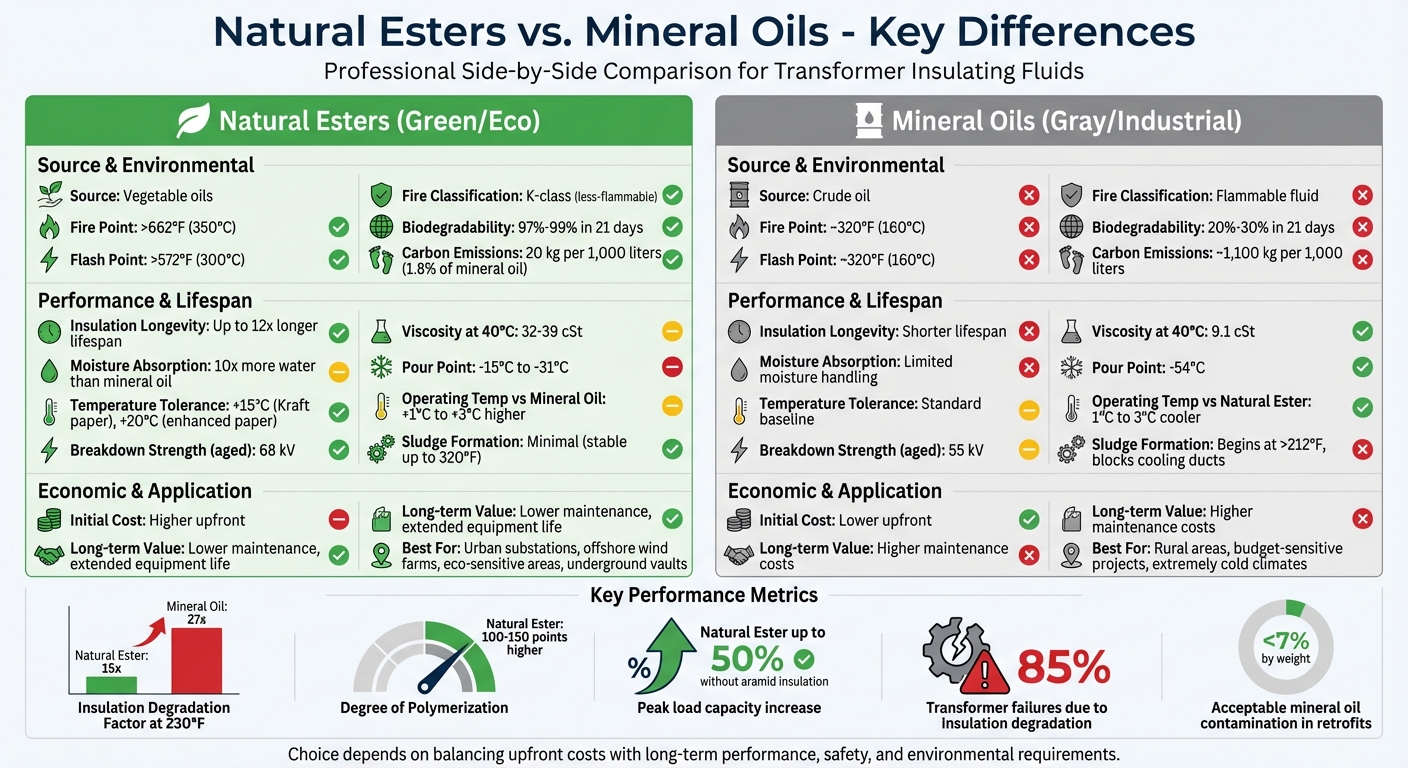
Natural Esters vs Mineral Oils: Complete Comparison Chart for Transformer Fluids
Fire Safety and Flammability
Fire Points and Flash Points
Natural esters boast fire points above 662°F (350°C) and flash points exceeding 572°F (300°C), which is significantly higher than mineral oil, with both measures sitting at around 320°F (160°C).
"Low fire point is a major disadvantage associated with typical mineral insulating oils, which increases the risk of subsequent fire in case of a transformer failure." – Energies (MDPI)
Even when mixed with up to 7% mineral oil, natural esters maintain their safety ratings. This makes it possible to upgrade existing systems on-site without needing a full oil replacement. These properties align well with stringent safety requirements.
Fire Classifications and Safety Standards
The National Electrical Code (NEC) mandates that insulating liquids must have a fire point of at least 572°F (300°C). Natural esters surpass this benchmark, earning a K-class or "less-flammable" classification. In contrast, mineral oil falls short and is categorized as a flammable fluid.
The IEEE Guide (C57.147-2018) outlines the standards for natural ester fluids, emphasizing the need to maintain fire points above 300°C to stay compliant with NEC regulations. Natural esters consistently meet this requirement, even after extended thermal aging.
Cost Savings from Improved Safety
The safety advantages of natural esters translate into real financial benefits. Their K-class rating allows transformers to be installed closer to buildings or in more compact substations, reducing the need for expensive fire suppression measures like fire walls and sprinklers. Lower fire risks can also lead to reduced insurance premiums, and avoiding pool fires minimizes cleanup and damage costs. For installations in urban areas or near sensitive locations, these safety benefits make natural esters a compelling choice, even with their higher initial price.
Transformer Oil - What it does and what kind to get (Mineral vs FR3) | Maddox Transformer

Environmental Impact and Biodegradability
After examining fire safety, it's worth exploring how natural esters outperform mineral oils in terms of environmental performance and biodegradability.
Biodegradability and Breakdown Rates
Natural esters break down at a much faster rate, achieving 97%–99% biodegradation within 21 days, according to CEC-L-33 standards. In comparison, mineral oil lags far behind, with only 20% to 30% biodegrading in the same timeframe. This stark difference is tied to their origins - natural esters come from renewable sources, whereas mineral oils are derived from fossil fuels.
The carbon emissions from natural esters are also drastically lower. Over their lifecycle, natural esters release 56 to 60 times less carbon than mineral oil. For instance, FR3 - a widely used natural ester fluid - produces roughly 20 kg of greenhouse gases per 1,000 liters, which is a mere 1.8% of the emissions generated by mineral oil. Kin Yu Lam, Regional Application Engineering Leader at Cargill Bioindustrial, highlights this advantage:
"The lifecycle greenhouse gas emission from FR3® Fluid... is only about 20kg per 1,000 liters, or just 1.8% that of mineral oil, making it effectively a carbon neutral fluid".
These differences in biodegradability and carbon emissions underscore the environmental benefits of natural esters.
Soil and Water Contamination Risks
The environmental consequences of spills vary significantly between natural esters and mineral oils. Mineral oil is classified as hazardous and non-biodegradable, meaning spills often require costly soil removal and remediation. On the other hand, natural esters are non-toxic and free from harmful substances like halogens, poly-nuclear aromatics, and volatile organics. This makes them far less likely to cause lasting contamination.
"The transformers using mineral oil could cause severe environmental damage during an uncontrolled oil spill due to poor biodegradable characteristics of mineral oil." – Energies Journal
Additionally, natural esters decompose naturally without forming dioxins or other hazardous byproducts, significantly lowering cleanup costs. This makes them particularly well-suited for installations near water sources or in areas where environmental sensitivity is a concern.
Regulations and Compliance in the United States
Regulatory frameworks in the U.S. further emphasize the environmental benefits of natural esters. Standards like ASTM D6871-17 outline the specifications for natural ester fluids in electrical equipment, while IEEE C57.147 provides guidelines for their acceptance and maintenance in transformers. These standards support utilities in shifting away from petroleum-based fluids toward greener alternatives.
The Stockholm Convention also plays a role, requiring the removal of PCB-contaminated sources by 2025 and their destruction by 2028. Natural esters serve as a compliant replacement for transformers that previously used PCB-contaminated mineral oil. Their biodegradability and non-toxic nature simplify spill management and can reduce the need for extensive secondary containment measures compared to mineral oil.
Thermal Performance and Equipment Longevity
When it comes to managing thermal stress and ensuring the longevity of transformer equipment, the choice of insulating fluid plays a crucial role. Natural esters bring distinct advantages over mineral oil in these areas.
Thermal Stability at High Temperatures
Natural esters allow transformers to handle higher operating temperatures without compromising insulation integrity. For instance, they increase the temperature tolerance of standard Kraft paper insulation by 15°C (27°F) and enhanced paper by 20°C (36°F) compared to mineral oil. This added thermal margin is especially valuable during peak demand periods, enabling utilities to push their equipment harder without accelerating wear and tear.
Additionally, natural esters significantly extend the lifespan of cellulose insulation - by as much as 12 times. Kin Yu Lam, Regional Application Engineering Leader at Cargill Bioindustrial, highlights this benefit:
"The useful lifespan of cellulose paper can be extended by up to 12 times in natural ester as compared to mineral oil because of its unique double moisture removal actions through absorption and hydrolysis."
While natural esters have a higher viscosity, which can lead to transformer temperatures being 2°F to 5°F higher, their superior insulation protection compensates for this minor drawback.
Moisture Absorption and Insulation Preservation
Moisture poses a serious threat to transformer insulation, but here, natural esters excel. They can absorb up to 10 times more water than mineral oil under similar conditions. This ability helps draw moisture away from the paper insulation, significantly preserving its integrity. For example, in aging tests under moderate moisture conditions (2.2%–2.4%), insulation life at 230°F drops by a factor of 27 in mineral oil, compared to only a factor of 15 in natural ester. This results in a Degree of Polymerization that remains 100–150 points higher with natural esters.
Even as natural esters age, they maintain a breakdown strength of 68 kV, which is 13 kV higher than mineral oil under identical conditions. Kin Yu Lam further explains:
"Natural ester's outstanding moisture handling properties therefore play an important part in enhancing the reliability of transformers and in reducing the maintenance needed for drying both paper and liquid insulations regularly."
These moisture-handling capabilities not only improve insulation reliability but also reduce the need for frequent maintenance.
Sludge Formation and Maintenance
Mineral oil begins to degrade at temperatures above 212°F, leading to sludge formation that can block cooling ducts and reduce efficiency. In contrast, natural esters remain stable up to 320°F, producing minimal sludge. Instead of forming solid deposits, natural esters primarily experience an increase in viscosity over time, ensuring that cooling pathways stay clear throughout the transformer's lifespan.
This resistance to sludge formation makes natural esters particularly effective for transformers exposed to high harmonics, such as those connected to solar inverters. The combination of higher temperature tolerance and reduced maintenance needs positions natural esters as a reliable choice for demanding applications.
sbb-itb-501186b
Cost Considerations and Application Suitability
Initial Investment and Long-Term Value
When deciding between natural esters and mineral oils, cost and application factors play a key role alongside thermal performance.
Mineral oil often stands out as the more affordable choice, thanks to its well-established refining process. On the other hand, natural esters come with a higher upfront cost, partly due to their viscosity, which can be up to four times greater than that of mineral oil. This increased viscosity impacts cooling efficiency, requiring additional radiators or heavier equipment. As noted in MDPI Energies:
"The use of ester fluids led to higher load-losses, larger masses, additional radiators and, consequently, higher manufacturing costs".
However, natural esters can offset their initial expense over time. They extend insulation life by as much as 12 times and support peak load increases of up to 50% without the need for costly aramid insulation. These long-term advantages, combined with their previously mentioned fire safety and environmental benefits, add to their overall appeal.
Cooling System Modifications
Natural esters' higher viscosity - around 32–39 cSt at 40°C compared to mineral oil’s 9.1 cSt at the same temperature - can lead to operating temperatures rising by 1°C to 3°C. To address this, transformers using natural esters often require larger cooling channels or additional radiators. For new transformer designs, these adjustments are essential to maintain efficient heat transfer.
In retrofit applications, natural esters offer flexibility. They can tolerate up to 7% mineral oil contamination without compromising their fire point, making them practical for field conversions.
Best Applications for Each Fluid Type
Natural esters shine in environments where fire safety and biodegradability are critical. They are particularly suited for urban substations, offshore wind farms, underground vaults, ships, and railway traction transformers, thanks to their fire point exceeding 350°C and their biodegradable nature. As Kin Yu Lam, Regional Application Engineering Leader at Cargill Bioindustrial, points out:
"natural ester, which is largely derived from vegetable seed oil, is by far the market leader now among alternative dielectric fluids, it being used in some 3 million transformers globally".
Mineral oil, meanwhile, is ideal for projects in rural areas, those with tight budgets, or locations with extremely cold climates. Its pour point of –54°C ensures it remains fluid in freezing conditions, whereas esters, with pour points ranging from –15°C to –31°C, may not perform as well. For cost-sensitive projects with fewer environmental restrictions, mineral oil remains a reliable and economical choice.
Operational Compatibility and Maintenance
Choosing the right fluid for a transformer goes beyond just safety and thermal properties - it also plays a key role in system maintenance and operational compatibility.
System Design and Gasket Compatibility
Natural esters perform effectively in standard transformer designs, especially at the distribution level, without requiring significant alterations to the system. They do not chemically corrode transformer tanks, which makes them a good fit for existing setups. However, it’s important to inspect gaskets on older transformers to ensure they are compatible with natural esters.
One factor to consider is the higher viscosity of natural esters. This property slows their flow and reduces the heat transfer coefficient, meaning cooling performance may differ. For new installations, adjustments in design can account for this. Retrofit projects, however, need to carefully address this thermal behavior to ensure optimal performance.
These design considerations lead naturally to a discussion about how oxidation and maintenance practices can further affect transformer lifespan.
Oxidation Stability and System Longevity
When considering retrofits, oxidation behavior becomes a critical factor. Natural esters and mineral oils react differently to oxygen exposure. While mineral oil forms sludge as it oxidizes, natural esters thicken and transition into a gel-like state. Samson Okikiola Oparanti from the Research Chair on the Aging of Power Network Infrastructure explains:
"vegetable-based liquids oxidize by thickening instead of forming sludge".
This thickening behavior makes natural esters particularly well-suited for sealed or hermetically sealed systems where oxygen exposure is minimal. However, in free-breathing transformers, natural esters are more prone to oxidation and gelling, which can reduce cooling efficiency and lead to thermal challenges. On the other hand, while mineral oil performs better in free-breathing systems, it accelerates the degradation of paper insulation due to its limited moisture management capabilities.
Another advantage of natural esters is their resilience during maintenance. Well-formulated versions allow repairs to be carried out even when parts are exposed to air for up to two weeks without significant oxidation concerns.
Mixing and Retrofitting Considerations
Natural esters are a practical choice for retrofitting, provided the residual mineral oil content remains below 7% by weight. This threshold is essential to maintaining the fluid’s fire point above 350°C (662°F).
For transformers contaminated with PCBs, natural esters offer a safer and more sustainable alternative. In October 2020, a 16 MVA 88 kV power transformer contaminated with PCBs underwent a successful retrofit. The mineral oil was replaced with natural ester fluid, meeting Stockholm Convention regulations. This process not only extended the transformer’s operational life but also enhanced safety and reduced environmental risks.
Conclusion
Natural esters and mineral oils each bring unique benefits to the table, making the choice largely dependent on operational goals and the surrounding environment.
Natural esters stand out for their fire safety and lower environmental impact. They meet K-class less-flammable standards and significantly reduce carbon emissions. Plus, they can extend the lifespan of cellulose insulation by up to 12 times.
Mineral oils, on the other hand, excel in initial thermal efficiency. Their lower viscosity allows transformers to operate 1–3°C (1.8–5.4°F) cooler compared to those using natural esters. This advantage simplifies cooling system designs and reduces initial manufacturing costs. Additionally, mineral oils offer better oxidation stability in free-breathing transformers, whereas natural esters tend to thicken when exposed to air for long periods.
Choosing the right transformer fluid boils down to balancing upfront costs with long-term benefits. While natural esters generally require a higher initial investment - due to the need for additional radiators and larger equipment to handle their higher viscosity - their ability to prolong insulation life can offset these costs over time. For applications in environmentally sensitive areas, renewable energy projects, or spaces where fire safety is critical, natural esters provide a strong case for long-term value.
Ultimately, the decision should align with your system's specific needs, weighing short-term expenses against performance, safety, and environmental considerations. With over 85% of transformer failures linked to insulation system degradation, selecting the right fluid is essential for ensuring both the longevity and safety of your equipment.
FAQs
What are the long-term cost advantages of using natural esters instead of mineral oils in transformers?
Natural esters come with long-term cost benefits that make them an appealing alternative to traditional mineral oils, especially in transformer applications. Their excellent insulation properties help improve transformer durability, potentially extending its lifespan and cutting down the need for frequent, expensive replacements. On top of that, natural esters have higher fire points and better moisture-handling capabilities, which enhance safety and reduce maintenance costs over time.
Although the initial investment in natural esters may be higher, their performance advantages and environmental perks often lead to noticeable savings over the transformer's lifetime. This makes them a practical and forward-thinking option for power distribution systems.
What makes natural esters more environmentally friendly than mineral oils?
Natural esters stand out as a more eco-conscious option because they’re derived from renewable plant-based resources like soybean, sunflower, and coconut oils. Unlike mineral oils, which come from non-renewable petroleum, these plant-based alternatives are biodegradable, meaning they break down faster in the environment. This characteristic helps lower the risk of long-lasting pollution, especially in cases of transformer leaks or improper disposal.
On top of that, natural esters are non-toxic and generate fewer harmful byproducts as they degrade, making them a safer option for surrounding ecosystems. Their renewable origins and reduced environmental footprint align with efforts to cut back on fossil fuel dependence and promote a healthier planet.
What design changes are needed when replacing mineral oil with natural ester fluids in transformers?
Switching from mineral oil to natural ester fluids in transformers involves some important adjustments due to differences in their physical and chemical characteristics. For instance, natural esters flow more slowly than mineral oil, which can affect how well heat is dissipated. To address this, you might need to upgrade the cooling system or increase the fluid flow capacity to maintain effective cooling.
Natural esters also come with higher fire points and distinct dielectric properties. These differences could influence insulation design and require a review of safety standards. If you're retro-filling a transformer that previously used mineral oil, it's a good idea to conduct compatibility tests. In some cases, updates to the insulation system may be needed to ensure the transformer continues to perform reliably.