

Load Testing vs. Load Bank Testing
When it comes to ensuring your generator is ready for an outage, two testing methods stand out: Load Testing and Load Bank Testing. Both serve critical roles, but they differ in approach, purpose, and application.
- Load Testing uses your building's actual electrical demand to assess the generator's performance within your facility's system.
- Load Bank Testing uses external devices to simulate controlled loads, pushing the generator to its full capacity without disrupting operations.
Key Differences:
- Load Testing evaluates the entire emergency power system, including the Automatic Transfer Switch (ATS), under real conditions.
- Load Bank Testing isolates the generator to test its maximum capacity and address issues like "wet stacking" in diesel engines.
Regulatory Standards: Both tests help meet NFPA 110 compliance, which requires regular testing to ensure generator reliability.
When to Use Each:
- Use Load Testing for routine checks and system integration.
- Use Load Bank Testing for capacity verification, regulatory compliance, and after repairs.
Quick Comparison:
| Factor | Load Testing | Load Bank Testing |
|---|---|---|
| Load Source | Facility's actual electrical load | External artificial load device |
| System Focus | Entire emergency power system | Generator performance only |
| Risk to Operations | May interrupt power briefly | No impact on operations |
| Testing Capacity | Limited to building's demand | Tests up to 100% generator capacity |
Both methods are essential for maintaining a reliable backup power system. The right choice depends on your facility's needs and testing goals.
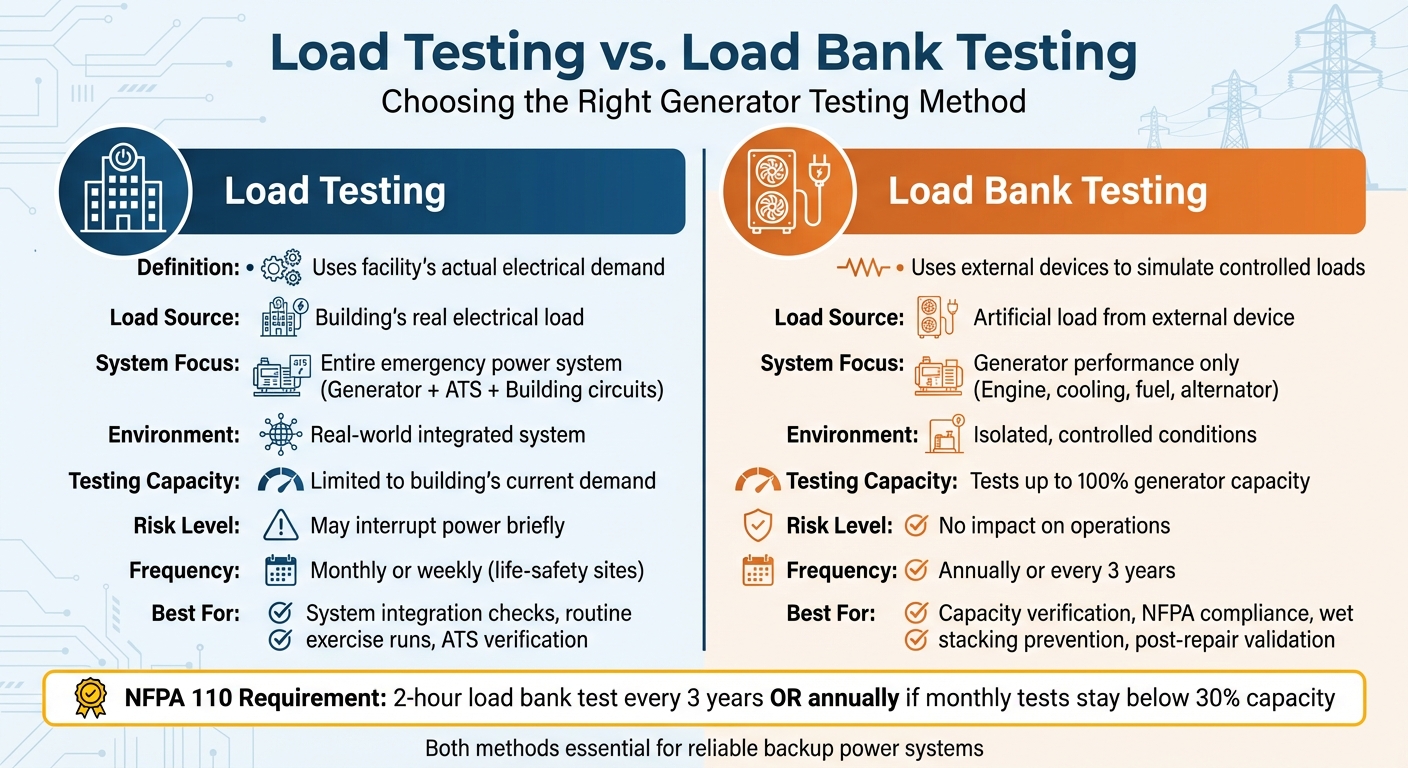
Load Testing vs Load Bank Testing Comparison Chart
Load Bank Basics! Generator Support Tools | Parker Systems
sbb-itb-501186b
What Is Load Testing?
Load testing, also known as building load testing, measures a generator's performance by connecting it directly to a facility's electrical system. This process uses the facility's actual loads - like lighting, HVAC systems, computers, and UPS equipment - to replicate real-world conditions. The aim is to ensure the generator can meet the specific power demands of the building during an outage.
How Load Testing Works
In a load test, a technician simulates a power failure by disconnecting utility power. This activates the Automatic Transfer Switch (ATS), which starts the generator and shifts the emergency circuit loads to it. Once the generator is running, technicians carefully monitor several factors, including startup time, kilowatt output, voltage, frequency, and any unusual sounds or vibrations.
Main Goals of Load Testing
The key purpose of load testing is to confirm that all system components work seamlessly together. It ensures the ATS detects the power loss and executes the correct transfer sequence - something that artificial testing methods can't fully replicate. Additionally, it helps identify any compatibility issues between the generator and the equipment it powers, ensuring the generator can maintain stable voltage and frequency under the building's actual, fluctuating demands.
For facilities requiring life safety systems, NFPA 110 standards generally mandate a more rigorous load bank test if the generator fails to reach at least 30% of its nameplate kilowatt rating during monthly tests.
Up next, we’ll look at load bank testing, which uses controlled artificial loads to assess generator performance.
What Is Load Bank Testing?
Load bank testing is a process where a generator, UPS, or battery system is tested under controlled conditions using artificial loads. Unlike load testing, which relies on a facility's actual electrical demands, this method isolates the equipment and applies a simulated load. Specialized electrical devices create this artificial load, allowing technicians to push the equipment to its rated capacity and evaluate its performance under maximum stress. The energy generated during testing is dissipated as heat through resistive elements or managed by reactive components that shift electrical phases.
How Load Bank Testing Works
The process begins by connecting a load bank directly to the generator's output terminals. Technicians then gradually increase the load in steps - usually 25%, 50%, 75%, and finally 100% of the generator's nameplate rating. During this progression, key metrics like voltage, frequency, oil pressure, and temperature are closely monitored to establish a baseline for performance.
Load banks come in three main types:
- Resistive Load Banks: These use high-power resistors to convert electrical energy into heat, simulating loads like lighting and heating systems.
- Reactive Load Banks: Using inductors or capacitors, these replicate equipment like motors and transformers where current and voltage are not perfectly aligned.
- Combined Load Banks: These integrate both resistive and reactive elements, enabling tests at the generator's full nameplate capacity, typically at a 0.8 power factor. This mirrors how most industrial generators are rated.
To achieve this 0.8 power factor, the test incorporates a mix of resistive and inductive loads, with 75 kVAr of inductive load for every 100 kW of resistive load. This setup ensures the test reflects realistic operating conditions, simulating the simultaneous support of resistive and reactive equipment. Beyond performance testing, this method helps verify that the generator can meet specific capacity requirements.
Main Goals of Load Bank Testing
The primary purpose of load bank testing is to confirm that a generator can achieve its rated kW or kVA capacity while maintaining stable voltage and frequency under full load. It also uncovers potential issues that may not appear during light-load operation, such as cooling failures, fuel delivery problems, or weaknesses in the alternator.
For diesel generators, load bank testing has the added benefit of addressing "wet stacking." This condition occurs when diesel engines run at low loads for extended periods, leading to unburnt fuel and carbon buildup in the exhaust system. High-capacity operation during testing burns off these deposits, protecting the engine from long-term damage and maintaining its efficiency.
Another key advantage is ensuring compliance with regulations. For instance, NFPA 110 mandates annual testing at meaningful load levels for life-safety systems in facilities like hospitals and data centers. Load bank testing provides a controlled environment to meet these standards, offering measurable proof of system reliability without disrupting critical operations.
Main Differences Between Load Testing and Load Bank Testing
The primary distinction lies in the source of electrical demand. Load testing, often referred to as a "Building Load Test", relies on the facility's actual electrical demand. In this case, the generator powers systems like HVAC, computers, and lighting that are actively drawing power. On the other hand, load bank testing uses an external device to create an artificial load.
This difference shapes how the tests are conducted. Building load tests examine the entire emergency power system, including how well the Automatic Transfer Switch (ATS) transfers power and how seamlessly the generator takes over during a power outage. In contrast, load bank testing focuses specifically on the generator, assessing components like the engine's cooling system, fuel delivery, air intake, and the alternator's ability to maintain stable voltage under varying loads.
"Building Load Tests offer realism and assess system integration, while Load Bank Tests provide controlled conditions for comprehensive testing across various loads." - Weld Power
The operational impact of these tests also varies. Building load tests can cause a brief power interruption as the system switches from utility power to generator power. This interruption might affect sensitive equipment, such as servers, but it provides a complete evaluation of the generator and the overall emergency power system. Load bank tests, however, are conducted independently of the building's systems, allowing the facility to remain on utility power while the generator undergoes rigorous testing.
Another important distinction is testing capacity. Building load tests are limited by the facility's current electrical demand, while load bank tests can incrementally reach 100% generator capacity. This capability helps meet NFPA 110 standards and prevents issues like wet stacking, which can occur when a generator operates below its optimal load for extended periods.
Comparison Table: Load Testing vs. Load Bank Testing
| Factor | Load Testing (Building Load) | Load Bank Testing |
|---|---|---|
| Load Source | Actual building electrical demand | External artificial load device |
| Environment | Real-world, integrated system | Isolated environment |
| System Focus | Evaluates ATS performance and system integration | Focuses on engine health (cooling, fuel, air intake) |
| Safety/Risk | Risk of power interruption to critical loads | No impact on building operations |
| Testing Scope | Limited to current building demand | Can test up to 100% of capacity |
| Frequency | Often monthly or weekly for life-safety sites | Typically annually or every three years |
Benefits of Each Testing Method
Benefits of Load Testing
Load testing provides a clear picture of how your emergency power system performs under real operating conditions. By connecting your facility's actual electrical circuits to the generator, this method tests the entire system - not just the generator, but also the Automatic Transfer Switch (ATS) and how all components work together harmoniously. This approach can uncover compatibility issues or inefficiencies that might go unnoticed during isolated tests.
It also identifies problems that visual inspections might miss. For instance, running the generator under a real load can expose issues like faulty fuel lines, cooling system problems, voltage fluctuations, and engine wear. Regular load testing also prevents a condition called wet stacking in diesel engines, where unburnt fuel and carbon build up in the exhaust system due to light-load operation. By addressing these issues, load testing ensures your backup power system is ready to perform reliably when it's most needed. While this method tests the system as a whole, load bank testing focuses on isolating and rigorously evaluating the generator's performance.
Benefits of Load Bank Testing
Unlike load testing, which replicates real-world conditions, load bank testing creates a controlled environment to precisely evaluate your generator's capacity. Technicians can test the generator at specific increments - such as 30%, 50%, 75%, and 100% of its capacity - to confirm it can handle peak loads without overheating or failing. This method is crucial for compliance with NFPA 110 standards, which typically require such testing every three years. A key advantage of load bank testing is that it keeps your facility on utility power, minimizing risks to operations.
During these tests, which usually last 1–4 hours, technicians meticulously record data like voltage, amperage, frequency, oil pressure, water temperature, and exhaust temperature. This performance data serves as a baseline for troubleshooting and maintenance planning.
Load bank testing also addresses wet stacking by bringing diesel engines up to full operating temperature, burning off unburnt fuel and carbon deposits. Ignoring this maintenance can lead to costly engine damage, with rebuilds ranging from $15,000 to $50,000. On the other hand, annual professional load bank testing costs between $500 and $2,000 - a relatively small expense compared to the potential downtime costs of $1,000 to $10,000 per hour during an emergency.
When to Use Load Testing vs. Load Bank Testing
Deciding between load testing and load bank testing depends on your specific goals. Each method plays a unique role in maintaining the reliability and compliance of backup power systems.
Best Uses for Load Testing
Load testing is the go-to method for verifying system integration. It’s particularly useful for regular exercise runs - whether weekly or monthly - to ensure the generator starts properly and that the Automatic Transfer Switch (ATS) detects a power failure and transfers the load within the required timeframe. These operational checks are vital for facilities like hospitals, where the entire power system - from utility to ATS to generator and building circuits - must function as a cohesive unit.
This method is also ideal when commissioning new systems or testing upgrades, such as ATS replacements or controller updates. To avoid disruptions, schedule these tests at times that won’t interfere with sensitive equipment operations.
However, when it comes to evaluating precise capacity or meeting regulatory standards, load bank testing is often the better choice.
Best Uses for Load Bank Testing
Load bank testing is essential for detailed capacity assessments and meeting compliance requirements. For example, NFPA 110 mandates a two-hour full-load test during initial commissioning. Since building loads rarely reach the generator’s full nameplate capacity, a load bank is typically necessary for this test.
For ongoing maintenance, NFPA standards recommend scheduling load bank tests every three years - or annually if routine tests consistently operate below 30% of the generator’s rated capacity. This helps prevent wet stacking, which occurs when building loads are too light. If routine logs show low kilowatt readings, a supplemental load bank test can help optimize engine temperature and clear carbon buildup.
Load bank testing is also valuable after major repairs or component replacements. It ensures the system performs as expected without putting facility operations at risk. In data centers, load banks are often used during commissioning to simulate both electrical and heat loads before IT equipment is installed.
"The only way to verify that a backup power system will perform during an outage is to periodically test it under load. Both generators and UPSs may appear to run fine when lightly loaded, but may fail to deliver full load power if they are not regularly tested."
– Consulting-Specifying Engineer
Regulatory Standards and Compliance
Understanding regulatory standards is essential when choosing between load testing and load bank testing, as compliance plays a major role in the decision-making process. In the United States, NFPA 110 sets the rules for emergency and standby power systems, dividing installations into two categories: Level 1, where failure could result in loss of life, and Level 2, which applies to less critical systems. This standard requires monthly exercise tests at a minimum of 30% of the generator's nameplate kW rating, along with a mandatory two-hour load bank test every three years for both levels. These guidelines form the foundation for all other regulatory requirements in emergency power systems.
For healthcare facilities, compliance is even more demanding. NFPA 99 and The Joint Commission outline additional requirements, including a 30-minute monthly exercise, a 90-minute annual continuous load test, and a four-hour continuous test every 36 months, all at 30% or more of the generator's nameplate rating.
The National Electrical Code (NEC) adds another layer of requirements. It mandates that emergency systems restore power within 10 seconds for life safety systems (Article 700), allows up to 60 seconds for legally required standby systems (Article 701), and enforces commissioning plans and baseline testing for critical infrastructure (Article 708).
"If a generator fails a monthly test, it should be tested annually for two continuous hours using a load bank." - NFPA 110
If a facility’s actual electrical load falls below the 30% threshold during routine testing, load bank testing becomes necessary to maintain compliance, avoid issues like wet stacking, and meet annual testing requirements when monthly tests fail. It's also crucial to consult your local Authority Having Jurisdiction (AHJ), as local building codes may impose stricter requirements than national standards.
Lastly, maintaining detailed records of all tests is essential. This includes tracking frequency, voltage regulation at various load levels (25%, 50%, 75%, and 100%), and documenting any corrective actions taken. These records help ensure smooth regulatory audits.
Conclusion
Knowing the distinct functions of each testing method is crucial for maintaining a reliable and compliant backup power system. Both load testing and load bank testing play an essential role in ensuring generator dependability. As GenServe explains, "Both the load bank and building load tests are important per NFPA110 safety standards and will ensure your generator is always ready to use". Together, these methods address system integration and generator capacity, offering a well-rounded approach to testing.
The right testing method depends largely on the specific requirements of your facility. For mission-critical sites like hospitals or data centers, combining regular building load tests with load bank tests is often the best approach. Building load tests confirm operational readiness, while load bank tests verify the generator's full capacity. If your monthly testing doesn't reach at least 30% of the generator's nameplate rating, load bank testing becomes a necessity.
"The real question is not 'Will it start?' The real question is 'Will it carry the load when the lights go out?' Load bank testing helps you answer that".
If you're purchasing load banks, generators, or power distribution equipment through Electrical Trader, having a solid testing plan is essential. It safeguards critical infrastructure and ensures your equipment performs when it’s needed most.
FAQs
Which test proves my generator can carry full rated load?
A load bank test conducted at 100% load capacity ensures your generator can handle its full rated load. By applying an artificial load that matches the generator's maximum capacity, this test confirms the generator's ability to sustain peak output over an extended period. It validates the generator's readiness to meet demanding conditions and proves its reliability under full load operation.
Do I need a load bank if my building load is under 30%?
If your building's load is below 30%, using a load bank is usually not needed. Diesel generators should operate at a minimum of 30% of their standby rating during monthly tests to prevent problems like wet stacking. For loads under 30%, a load bank is generally unnecessary unless specific standards or precise testing requirements dictate otherwise. If you're unsure, it's best to consult a qualified technician.
Can load testing damage or disrupt sensitive equipment?
Load testing, if not handled properly, can pose risks to sensitive equipment. Mistakes like applying too much load or testing in unfavorable conditions can lead to equipment damage or conceal underlying problems. To prevent these issues, it’s crucial to adhere to established testing protocols and stick to regular maintenance schedules. Conducting load bank tests correctly and routinely helps spot potential issues early, reducing the chance of unexpected failures.
Related Blog Posts
- Ultimate Guide to Standby and Prime Generators
- NFPA 110: Generator Safety Standards Explained
- Generator Maintenance Schedule Guide
- NFPA Standards for Generator Fire Safety Compliance