




How MIL-STD-810H Tests Electrical Equipment
MIL-STD-810H ensures electrical equipment can withstand harsh conditions by simulating real-world stresses like temperature extremes, shocks, vibrations, and moisture. Released in 2019, it tailors tests to match the specific environments equipment will face, helping manufacturers identify weaknesses before deployment. Key tests include:
- Temperature Testing: High (104°F–160°F) and low (-40°F to -95°F) extremes to detect failures in solder joints, batteries, and insulation.
- Shock and Vibration: Simulates impacts (up to 75g) and vibrations (5–2,000 Hz) to ensure durability of connectors and circuit boards.
- Moisture Tests: Rain and humidity tests expose equipment to water and high humidity (85–95%) to check for corrosion and water ingress.
MIL-STD-810 H Introduction Part 1
sbb-itb-501186b
Main Environmental Tests in MIL-STD-810H
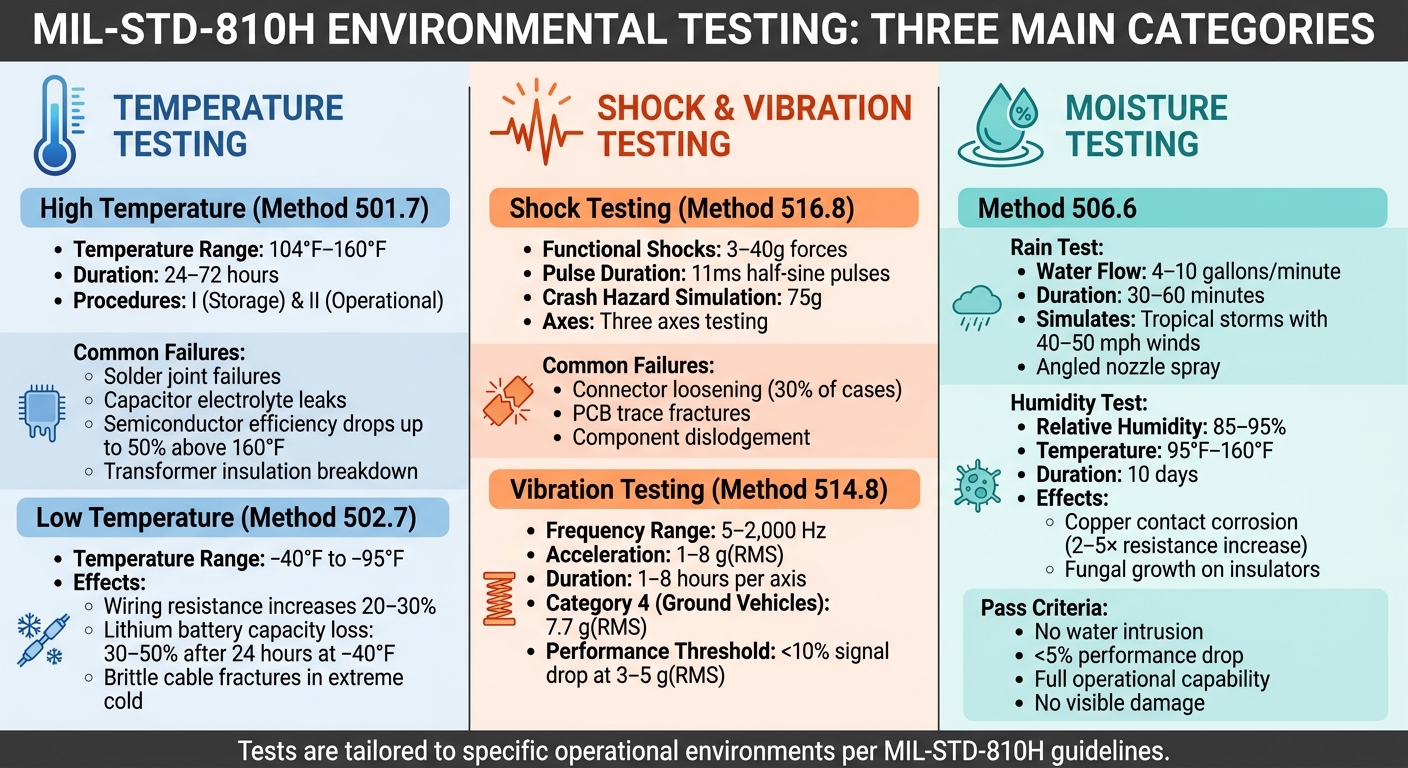
MIL-STD-810H Environmental Testing Methods for Electrical Equipment
MIL-STD-810H includes a broad range of environmental test methods designed to simulate real-world operational challenges. Among these, three areas are particularly important for electrical equipment: temperature extremes, mechanical stress, and moisture exposure. These tests replicate the conditions equipment might encounter during its lifecycle.
These methods serve as the basis for tailoring tests to meet specific operational needs.
Temperature Testing (Methods 501.7 and 502.7)
Method 501.7 focuses on high-temperature testing by exposing equipment to temperatures between 104°F and 160°F for 24 to 72 hours. Procedure I evaluates storage conditions, while Procedure II tests operational performance under heat. These tests often reveal problems like solder joint failures, capacitor electrolyte leaks, and semiconductor derating, which can lower efficiency by as much as 50% when temperatures exceed 160°F. For instance, transformers may suffer insulation breakdown if internal temperatures surpass their design limits.
Method 502.7 examines the effects of low temperatures, ranging from -40°F to -95°F. This testing looks at how cold impacts material flexibility and electrical conductivity. At these temperatures, wiring resistance can rise by 20–30%, and lithium batteries may lose 30–50% of their capacity after 24 hours at -40°F. However, performance often recovers once the temperature rises. Tests in Arctic conditions have also shown that extreme cold can lead to brittle cable fractures, especially in sensitive equipment like military radios.
These insights help in customizing tests to match the specific thermal requirements of each electrical component.
Shock and Vibration Testing (Methods 516.8 and 514.8)
Method 516.8 replicates mechanical shocks using drop tests and impact pulses. In Procedure I, functional shocks are applied at forces of 3–40g with 11ms half-sine pulses across three axes, while Procedure IV simulates crash hazards at 75g. These tests ensure that electrical connections remain secure and circuit boards stay intact. Common failures include connector loosening (seen in roughly 30% of cases), PCB trace fractures, and components becoming dislodged.
Method 514.8 subjects equipment to sustained vibration using random profiles between 5 and 2,000 Hz at accelerations of 1–8 g(RMS), with tests lasting 1–8 hours per axis. For ground vehicles, Category 4 tests simulate high-vibration conditions with levels reaching 7.7 g(RMS). Electrical connectors in mobile applications must endure vibrations of 3–5 g(RMS) without experiencing more than a 10% drop in signal performance. Sine sweeps are also conducted to identify resonance frequencies, which can lead to fatigue in enclosures or wire harnesses.
Next, we’ll explore moisture-related tests, which are essential for ensuring operational reliability.
Moisture and Humidity Testing (Method 506.6)
Method 506.6 evaluates how equipment handles moisture through rain and humidity tests. The rain test involves spraying water at rates of 4–10 gallons per minute from angled nozzles for 30–60 minutes, simulating tropical storm conditions with winds of 40–50 mph. The humidity test cycles equipment through relative humidity levels of 85–95% at temperatures between 95°F and 160°F for 10 days. These conditions can cause copper contacts to corrode, increasing electrical resistance by 2–5 times, and encourage fungal growth on insulators. Electrical components such as junction boxes and outdoor panels must maintain their ingress protection ratings, ensuring no water intrusion and less than a 5% drop in performance. To pass, the equipment must remain fully operational with no visible damage.
Customizing MIL-STD-810H Tests for Electrical Equipment
MIL-STD-810H emphasizes tailoring tests to reflect the specific conditions your electrical equipment will encounter. This ensures testing addresses practical challenges rather than adhering to generic standards. The core idea of this standard is to align test conditions with actual operational environments, influencing every step of the test planning process.
Setting Test Objectives
Start by analyzing the equipment's lifecycle to determine relevant environmental stress factors, their duration, and severity. Create a Test and Evaluation Master Plan (TEMP) that details your testing strategy and identifies applicable methods from Part Two of MIL-STD-810H. For instance, a circuit breaker panel designed for outdoor use might require high-temperature testing (Method 501.7) and vibration testing (Method 514.8). However, low-temperature tests might not be necessary if the equipment is only used in warm climates.
Establish clear performance benchmarks for key aspects like electrical continuity, structural durability, and functionality under stress. If a product is labeled "MIL-STD-810 compliant", verify the exact parameter limits and test methods used, as commercial vendors may apply their own criteria.
Once objectives are defined, focus on how combined stressors mimic real-world conditions.
Combining Environmental Stressors
In real-world scenarios, equipment often faces multiple stressors simultaneously. For example, a power distribution panel on a military vehicle might endure vibration, temperature shifts, and fluctuating electrical loads at the same time. Method 520.5 addresses these combined environments by simulating conditions like temperature, humidity, and vibration together. This approach can uncover vulnerabilities that might go unnoticed when testing stressors individually. For instance, while moderate vibration or heat alone might not cause damage, their combination could lead to thermal expansion, loosening connections and causing intermittent failures.
It's essential to test equipment under conditions that closely resemble real-world use. Define functional modes and simulate realistic scenarios, such as post-presoak evaluations, to ensure comprehensive testing.
How to Prepare for and Conduct MIL-STD-810H Tests
Getting accurate results from MIL-STD-810H tests requires careful planning and attention to detail. The process starts well before the equipment enters the test chamber and continues through post-test evaluations.
Pre-Test Inspections and Setup
Effective preparation ensures the tests reflect real-world conditions. Begin with a Standard Ambient Checkout to establish a performance baseline under normal conditions. This step is crucial for verifying that the equipment functions properly before subjecting it to environmental stressors. Document this baseline performance to ensure any failures can be linked directly to the test conditions.
Calibration is another key step. Make sure all sensors and testing facilities meet MIL-STD-810H standards for parameters like temperature, air velocity, and spectral power distribution. The "H" revision of the standard has updated guidelines for calibration intervals, so confirm that your chosen testing facility follows these latest requirements. For mechanical tests such as vibration and shock, it’s essential to clearly define the test axes and control inputs.
Some tests also require climatic conditioning, often called "presoaking", at specific temperatures or pressures before the main test cycle begins. For instance, temperature shock testing might involve stabilizing the equipment at an extreme temperature before rapidly exposing it to the opposite extreme. This simulates real-world scenarios, like moving equipment from freezing storage conditions into a hot operating environment.
Once the baseline checks and calibration are complete, the equipment is ready for environmental stress testing.
Post-Test Evaluations
After completing the tests, thoroughly inspect the equipment for any changes in functionality or physical condition. Evaluate its physical integrity, electrical continuity, and operational performance under functional mode conditions. Compare these results to the benchmarks outlined in your Test and Evaluation Master Plan (TEMP). Look for common issues such as loose connections, thermal damage, moisture ingress, or degraded insulation - problems that often arise when electrical equipment is exposed to extreme environments.
Keep in mind that passing lab tests doesn’t guarantee the equipment will perform flawlessly in the field. As MIL-STD-810H clearly states, "Users should not assume that an item that passes laboratory testing also will pass field/fleet verification tests". Use engineering judgment to interpret lab results in the context of real-world conditions, factoring in variables like maintenance schedules, user handling, and environmental differences that tests can’t fully replicate. These evaluations help confirm whether the equipment is ready to handle real-world challenges.
Conclusion
MIL-STD-810H testing ensures that electrical equipment can handle the extreme conditions it may face throughout its lifecycle. This standard serves as a critical quality checkpoint for manufacturers, helping them identify potential weaknesses in design, materials, or production before equipment is deployed in the field. For professionals in industrial and commercial sectors, this means dependable equipment that won’t fail during crucial operations.
By aligning tests with actual usage scenarios, the standard offers more than just durability. Brett Daniel from Trenton Systems highlights this well:
By establishing equipment consistency and compatibility, these standards safeguard against equipment incongruity, inefficiency and catastrophic failure in the field.
The result? Fewer failures, minimized downtime, and lower long-term costs. In high-risk environments, compliant equipment also enhances safety by reducing the chance of malfunctions. These practical advantages emphasize why independent, verified testing is essential when selecting equipment.
When assessing products, check which specific test methods were passed and ensure the testing was done by an independent third party. Not all "rugged" equipment undergoes the same rigorous evaluation.
For those sourcing electrical components and power distribution equipment, platforms like Electrical Trader offer products from manufacturers who prioritize environmental testing. Whether you're looking for breakers, transformers, or high-voltage systems, understanding MIL-STD-810H compliance equips you to make smarter choices that safeguard your investment and operations.
FAQs
Does MIL-STD-810H testing certify a product?
No, MIL-STD-810H testing does not provide certification for a product. Instead, it evaluates how well the product can handle environmental challenges like extreme temperatures, vibrations, and shocks. It’s a way to identify potential weaknesses. Achieving certification usually involves further compliance measures beyond these tests.
Which MIL-STD-810H test methods apply to my equipment?
The MIL-STD-810H test methods you’ll need to consider depend on the environmental conditions your equipment is likely to encounter. This standard covers tests for factors such as temperature, vibration, and shock, ensuring that devices can perform reliably even in harsh environments. To identify the right tests, take a close look at the specific conditions your equipment will face.
Can a product pass lab tests but still fail in the field?
Yes, a product might successfully clear lab tests, including those based on MIL-STD-810H standards, yet still fall short in real-world situations. Lab tests are controlled and structured, which means they can’t always account for the unpredictable and complex conditions products face in actual use - like sudden weather extremes or unforeseen stressors. This underscores the need to evaluate how a product performs outside the confines of a controlled environment.





