Checklist for Microgrid Permitting Compliance
A microgrid is not ready to energize until both the utility and local agencies sign off. In most U.S. projects, that means you need to clear two tracks at the same time: utility interconnection and local permits. Miss one item, and you can end up with failed inspections, rework, or an 8-to-12-week review delay before power-up.
Here’s the short version of what I need to track from day one:
- Define the project scope: behind-the-meter, front-of-the-meter, community, or utility-owned
- Confirm how it will run: grid-connected, non-export, export-limited, or islanding
- List every agency involved: utility, building, electrical, fire, zoning, and other permit offices
- Submit all filings early: interconnection forms, drawings, cut sheets, studies, and local permit applications
- Control design changes: equipment swaps often trigger another review cycle
- Get the site inspection-ready: labels, disconnects, relay settings, transfer-switch checks, and test plans
- Close out the job right: PTO, final signoffs, commissioning records, and as-builts
- Keep one master file: permits, utility records, engineering, commissioning, maintenance, and equipment documents
A few facts stand out. Utility technical review can take 8 to 12 weeks. PTO must be issued before energization. And the paperwork does not stop at startup: maintenance logs, test records, and approved as-builts need to stay on file for audits, repairs, and future changes.
If I want this process to stay on track, I need one checklist, one owner for each item, and one record set that matches the installed system.
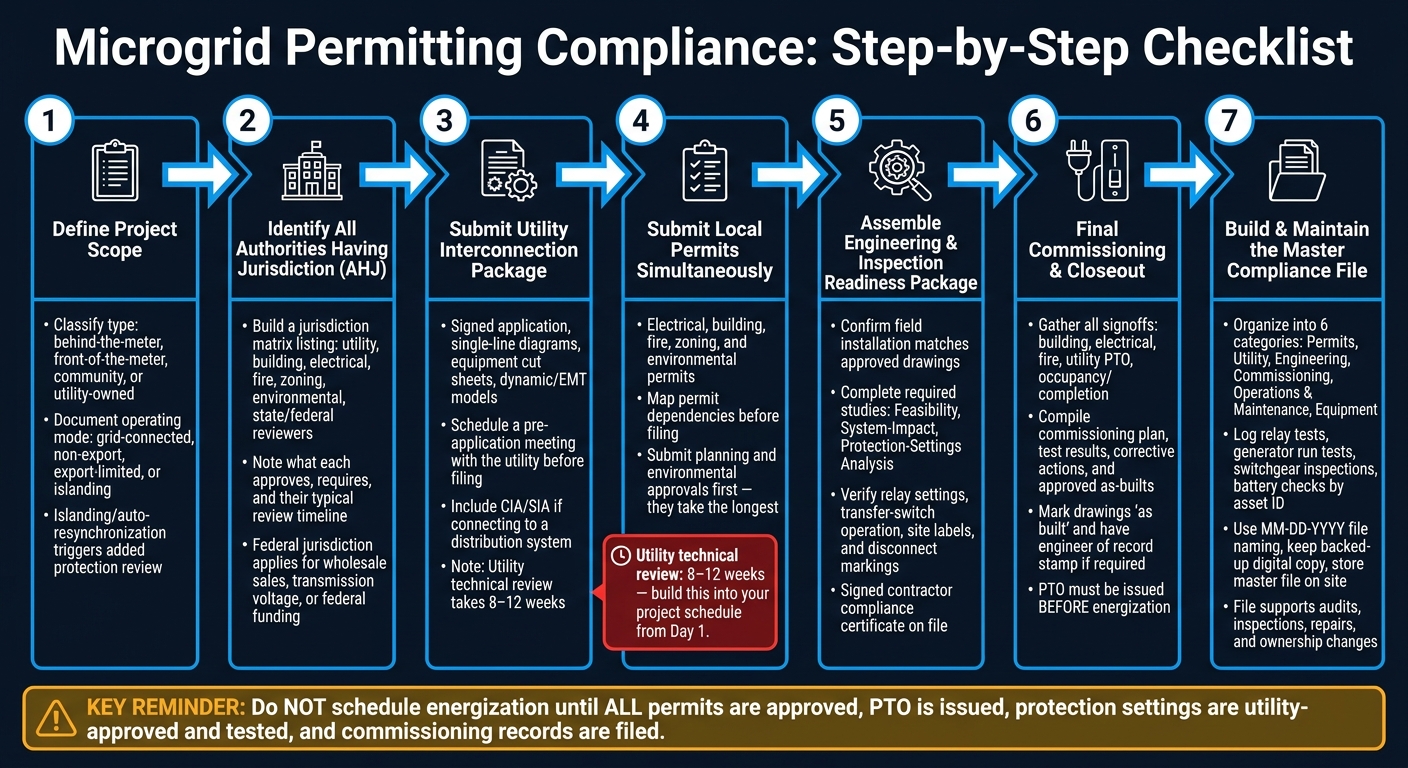
Microgrid Permitting Compliance: Step-by-Step Process
Define Project Scope and Regulatory Jurisdiction
Before you lock in the final design, pin down the microgrid setup and the agencies that need to sign off on it. Jurisdiction shapes the permit path. Get this clear early, and you can avoid painful redesigns once utility or AHJ review is already in motion.
Confirm the Microgrid Type and Operating Mode
Start by classifying the project based on ownership, who it serves, and where it interconnects:
- Behind-the-meter: serves a host customer’s on-site load; usually goes through local AHJ review and utility interconnection review only.
- Front-of-the-meter: connects on the utility side; may need ISO/RTO or wholesale market approval.
- Community microgrid: serves multiple customers or parcels; may trigger state Public Utility Commission review.
- Utility-owned: run by the utility; follows a separate internal approval path.
You’ll also want to document the operating mode: grid-connected, non-export, export-limited, or intentional islanding. That detail matters. Islanding and auto-resynchronization often bring added protection review.
Identify All Authorities Having Jurisdiction
For most projects, the review team is bigger than people expect. It often includes the serving utility, local building department, electrical inspector, fire marshal, zoning or planning office, and environmental agencies if the project involves land disturbance, fuel storage, stormwater, or wetlands.
Federal jurisdiction can also come into play when the microgrid sells power at wholesale, connects at transmission voltage, or uses federal funding that triggers environmental review.
A simple move here can save a lot of back-and-forth later: build a jurisdiction matrix. List the utility, building, electrical, fire, zoning, environmental, and any state or federal reviewer. Then note what each one approves, what each one requires, and the usual review timeline. Once that map is in place, you can shape the permit package around each reviewer’s separate demands.
Check Utility Territory Rules Before Final Design
Before the design is set, verify the utility’s interconnection rules. Focus on the adopted IEEE 1547 version, voltage level, protection scheme, metering, study requirements, and who pays for upgrades.
This is where teams often get tripped up. Pick equipment too early, before checking those rules, and you may end up reworking the design later. These items directly affect equipment selection, protection settings, and study scope.
With jurisdiction confirmed, move to the actual submittals.
sbb-itb-501186b
Complete Utility Interconnection and Permit Submittals
Submit utility and local permit packages at the same time. If even one item is missing, review can grind to a halt. Each permit and interconnection document also needs to go to the right agency, so use the jurisdiction matrix to send every filing to the correct reviewer.
Prepare the Utility Interconnection Package
At a minimum, the interconnection package should include:
- A signed interconnection application
- Single-line and circuit diagrams that show the interconnection point and site layout
- Equipment cut sheets and type-test certificates for major components
- Any required dynamic or EMT models for inverter-based resources
- A detailed site plan
- The project location
- The proposed in-service date
- The project size in MW
- A deposit receipt
Set up a utility pre-application meeting before you file anything. It’s the simplest way to confirm exactly what the utility wants in the package and avoid a preventable back-and-forth later.
If the project connects to a distribution system, work with the distributor early so any required Connection Impact Assessment (CIA) or System Impact Assessment (SIA) is included with the submittal.
Submit Electrical, Building, Fire, Zoning, and Environmental Permits
Based on the project, required permits may include electrical, building, fire, zoning, and environmental permits. Map out permit dependencies before filing so one approval doesn’t hold up another.
Planning and environmental approvals should go in early. Those reviews often take time and can hold up interconnection.
Track Revisions, Resubmittals, and Permission to Operate
Use one shared log for agency comments, revisions, resubmittals, and approvals. In that file, track the agency, submittal date, comment date, revision number, resubmittal date, and current status. One clean record beats chasing updates across emails and folders.
Permission to Operate (PTO), or the utility’s equivalent authorization, is required before energization. The utility issues it only after verifying the project’s technical specs, telemetry, and system integration requirements.
Any equipment change after initial registration will usually trigger a new approval request and a revised review cycle. After the connection offer is accepted, keep a close eye on infrastructure design, protection settings, and commissioning tests.
Use the approved submittal set as the control file for engineering and inspection readiness.
Assemble the Engineering and Inspection Readiness Package
Use the approved submittal set to put the inspection package together before energization. This package shows that the system installed on-site matches the design that was approved.
Treat the approved submittal set as the control file for inspection and commissioning. If the field condition, record set, and approved design drift apart, inspection gets messy fast.
Maintain Approved Drawings and Compliance Records
Every drawing used in the field needs to match the approved set. Inspectors check installed equipment against those drawings, so even small mismatches can slow things down.
Keep a signed compliance certificate in the inspection file. That document gives the inspector a clear record that the work meets the applicable requirements.
Complete Required Studies and Safety Documentation
Grid-tied projects need feasibility, system-impact, and protection-settings studies as part of the interconnection application. Keep the final signed study reports in the field-ready compliance file, along with the rest of the approval record.
| Study or Document | Purpose |
|---|---|
| Feasibility Study | Initial assessment of grid capacity and point of interconnection |
| System-Impact Study | Evaluates effects on voltage stability and fault levels |
| Protection-Settings Analysis | Confirms coordination across the distribution or transmission network |
| Manufacturer Datasheets | Manufacturer specs for generator sets and major components |
| Signed Contractor Compliance Certificate | Confirms compliance with applicable electrical standards |
Verify Site Labels, Disconnects, and Test Plans
Before inspection, confirm that protection-relay settings and transfer-switch schematics are final and match the physical installation. This is where paperwork meets the actual build.
Use this checklist to clear the site for final inspection and utility PTO review:
- [ ] Relay settings finalized and verified against approved drawings
- [ ] Transfer-switch operation confirmed
- [ ] Site labels installed and legible
- [ ] Disconnect markings complete
- [ ] Test plan reviewed and signed off
Verify final relay settings, transfer-switch operation, site labels, and disconnect markings before inspection. Use the checklist to make sure the site is ready for final inspection and utility PTO review.
Finalize Commissioning, Recordkeeping, and Ongoing Compliance
After final inspection, the job shifts from construction to documentation and day-to-day operation.
Closeout Inspections and As-Built Documentation
During closeout, gather every signoff needed to move the project from approval into operation. That includes final building, electrical, fire, utility PTO, occupancy/completion, and closed punch-list approvals.
The closeout package should also include the final commissioning plan, test procedures, functional and performance results, corrective actions, and approved as-builts. Provide the commissioning report to the owner and the relevant AHJs, and place it with the O&M manuals.
As-built drawings should be clearly marked "as built" and updated to show field changes from the permitted design. If required, they should be stamped or signed by the responsible engineer of record.
Track Operating Limits, Maintenance Logs, and Periodic Testing
Once closeout is done, the compliance file becomes the operating record. In plain terms, it turns into the file your team will keep coming back to. Use permit and utility limits as the baseline for operation.
Keep the signed interconnection agreement, export and import limits, non-islanding rules, voltage and frequency ride-through rules, and any curtailment provisions on file. Also retain any permits or approvals tied to air emissions, noise, operating hours, fuel storage, or land-use obligations.
Maintenance records need to be specific. Log relay tests, generator run tests, switchgear and transfer-switch inspections, and battery checks by asset ID. Time-stamp every maintenance entry in U.S. date/time format and link it to the same asset ID.
Build a Single Compliance File for Future Access
Use the closeout package and O&M logs to create one master compliance file. Keep a single file that can support audits, inspections, repairs, and ownership changes down the road. That one step can make audits and inspections much easier.
Organize the file into six clear categories:
- Permits
- Utility
- Engineering
- Commissioning
- Operations & Maintenance
- Equipment
Use MM-DD-YYYY file names, keep a backed-up digital copy, and store the master file on site.
The file should include final approved plans and as-built drawings, permits and approvals, utility documentation, commissioning reports and test data, maintenance logs and periodic testing reports, operating procedures, training records, change management records, and manufacturer documentation such as datasheets, manuals, warranties, and serial numbers. Add purchase records and datasheets for replacement components, then update the as-built drawings.
Conclusion: Final Microgrid Permitting Compliance Check
Every microgrid moves through the same path: define the scope, confirm jurisdiction, get permits, pass inspections, and finish commissioning before energization.
The compliance file you build along the way is your paper trail. It shows the system was designed, permitted, inspected, and commissioned the right way.
Before energizing, do one last review across every category. This is the final check that clears the project for energization. Make sure permits are approved and on file, the utility interconnection agreement is signed, all inspection signoffs are in hand, protection settings are utility-approved and tested during commissioning, and approved drawings and commissioning records are filed.
Technical review can take 8 to 12 weeks, depending on utility workload. That lead time matters. If you don’t bake it into the schedule, commissioning tests can get held up while you wait for approval.
Do not schedule energization until every item below is done.
| Pre-Energization Item | Status to Confirm |
|---|---|
| All permits (electrical, building, fire, zoning, environmental) | Approved and on file |
| Utility interconnection agreement | Signed |
| Permission to Operate (PTO) | Issued |
| Protection settings | Utility-approved and tested |
| Final inspection signoffs | All required signoffs on file |
| Commissioning test results | Documented and submitted |
| Approved drawings and commissioning records | Filed |
| Maintenance logs and periodic testing records | Filed on site and accessible |
Once every item is complete, the system is ready to energize, and the compliance file is audit-ready.
FAQs
Who must approve a microgrid before energization?
Before you energize a microgrid, you need sign-off from two groups: the local Authority Having Jurisdiction (AHJ) and your utility provider.
The AHJ checks that the project meets local building, fire, and safety codes. The utility handles approval for the grid interconnection.
It’s also smart to loop in your facility’s insurance carrier early. In some cases, the carrier may ask for added safety steps or physical separation measures that go beyond local code minimums.
What can delay microgrid permitting the most?
The biggest source of microgrid permitting delays is the utility interconnection application process. Send it in at the very start of the project. In many cases, the wait is longer than the actual build.
Here’s the rough timeline:
- Projects under 5 MW usually take 60–120 days
- Larger systems often run into 3–9 month delays
In some grid-scale cases, heavily saturated regions can lead to queue waits that stretch for multiple years. Delays also pop up when the AHJ isn’t brought in early to confirm which local code editions apply.
What documents should stay in the master compliance file?
Include as-built drawings that show field changes or redlines, along with panel directories, load calculations, and single-line diagrams. Keep equipment submittals, manufacturer cut sheets, and proof of listings.
Also keep records of tests, inspections, relay settings, controls mapping, commissioning results, warranty baselines, emergency procedures, training logs, and any required hazardous location classifications.