Medium Voltage Transformers for Heavy Industries
If you run large motors over long plant distances, medium voltage is usually the right fit. In heavy industry, I’d focus on 2.4 kV to 34.5 kV, size the transformer from a load study, check motor-start voltage drop, match impedance to the fault study, and pick dry-type or liquid-filled based on heat, dust, moisture, fire risk, and maintenance staff.
Here’s the short version:
- Why plants use MV: lower current than 480 V, which means less voltage drop and smaller feeders over long runs
- Common plant voltages: 4.16 kV, 13.8 kV, 24.9 kV, and 34.5 kV
- Large motor rule of thumb: motors above about 500 hp often move to 2.3 kV to 13.8 kV
- Sizing target: connected load, demand/diversity, plus about 10% to 25% room for growth
- Motor starting check: starting current is often 4x to 7x full-load current
- Common impedance range: about 5.5% to 7.5% for many MV units below 34.5 kV, but I’d only lock that in after the system study
-
Construction choice:
- Dry-type for indoor or fire-sensitive areas
- Liquid-filled for outdoor yards or higher MVA duty
- Cooling note: forced-air can add about 33⅓% up to 5,000 kVA and 25% above 5,001 kVA, but that extra capacity should not be your normal steady load
- Protection and upkeep: temperature sensors, alarms, relay coordination, grounding, infrared scans, and for liquid-filled units, annual oil testing
A quick side-by-side view:
| Topic | What I’d check first |
|---|---|
| Voltage | Utility feed, plant bus, largest load |
| Size | kVA/MVA from load study + growth margin |
| Performance | Motor-start sag, fault current, impedance |
| Construction | Dry-type vs. liquid-filled |
| Site fit | Dust, vibration, moisture, heat, corrosion |
| Installation | Ventilation, clearances, enclosure rating |
| Protection | Inrush, relays, arresters, temperature monitoring |
| Upkeep | Cleaning, infrared scans, terminations, oil tests |
Put simply, the right MV transformer is not just about nameplate rating. I’d treat it as a plant-system choice that affects losses, uptime, fault levels, motor starting, and service life from day one.
Medium Voltage Transformers - A Deep Dive!
sbb-itb-501186b
Why Heavy Industries Use Medium Voltage Transformers
Heavy industries lean on medium voltage for a simple reason: low-voltage distribution gets inefficient fast when you have large loads spread across long distances.
In places like steel mills, refineries, cement plants, and mining operations, equipment runs hard for long stretches. If those sites tried to serve the same loads at 480 V, they’d need much larger conductors. That leads to more voltage drop and puts extra strain on cables and switchgear. Move that same power to medium voltage - such as 4.16 kV or 13.8 kV - and the current drops a lot. The result is smaller conductors, lower losses, and less voltage drop on long feeders.
On large industrial sites, those cost and uptime gains add up fast. That’s why medium voltage often becomes the default for major plant loads.
Industrial Loads That Drive Medium Voltage Use
You can see this most clearly with high-horsepower equipment. Ore crushers, high-capacity conveyor systems, large process pumps, gas compressors, electric arc furnaces, and central chiller plants can pull hundreds or even thousands of horsepower.
In U.S. practice, motors above roughly 500 hp are often specified at medium voltage - usually 2,300 V, 4,160 V, 6,900 V, or 13,800 V - because starting current and cable ampacity become hard to manage at 480 V.
This isn’t just about the motor’s nameplate. It’s also about getting large equipment started without excessive current, voltage sag, or oversized cable runs. Put MV transformers near major process areas, and voltage tends to stay steadier during starts and load swings. That helps cut sags and nuisance trips.
Site Conditions That Affect Reliability
Heavy industrial sites are rough on equipment. Dust, vibration, moisture, corrosion, and high heat can shorten transformer life if the design doesn’t fit the site.
Those conditions shape almost every major spec choice:
- Dusty or corrosive areas often need NEMA-rated enclosures with protective coatings.
- High moisture or chemical exposure may push a site toward dry-type transformers with epoxy-resin encapsulated or cast-coil windings. They avoid flammable liquid and usually handle contamination better, though hot locations may still need derating.
- Outdoor substations in hot climates often use liquid-filled units with forced-air or forced-oil cooling sized for peak load.
- Vibration near heavy machinery may call for isolation foundations to help protect winding connections and core integrity over time.
In other words, site conditions don’t just affect maintenance. They shape transformer sizing and construction from the start.
How to Size and Specify the Right Transformer
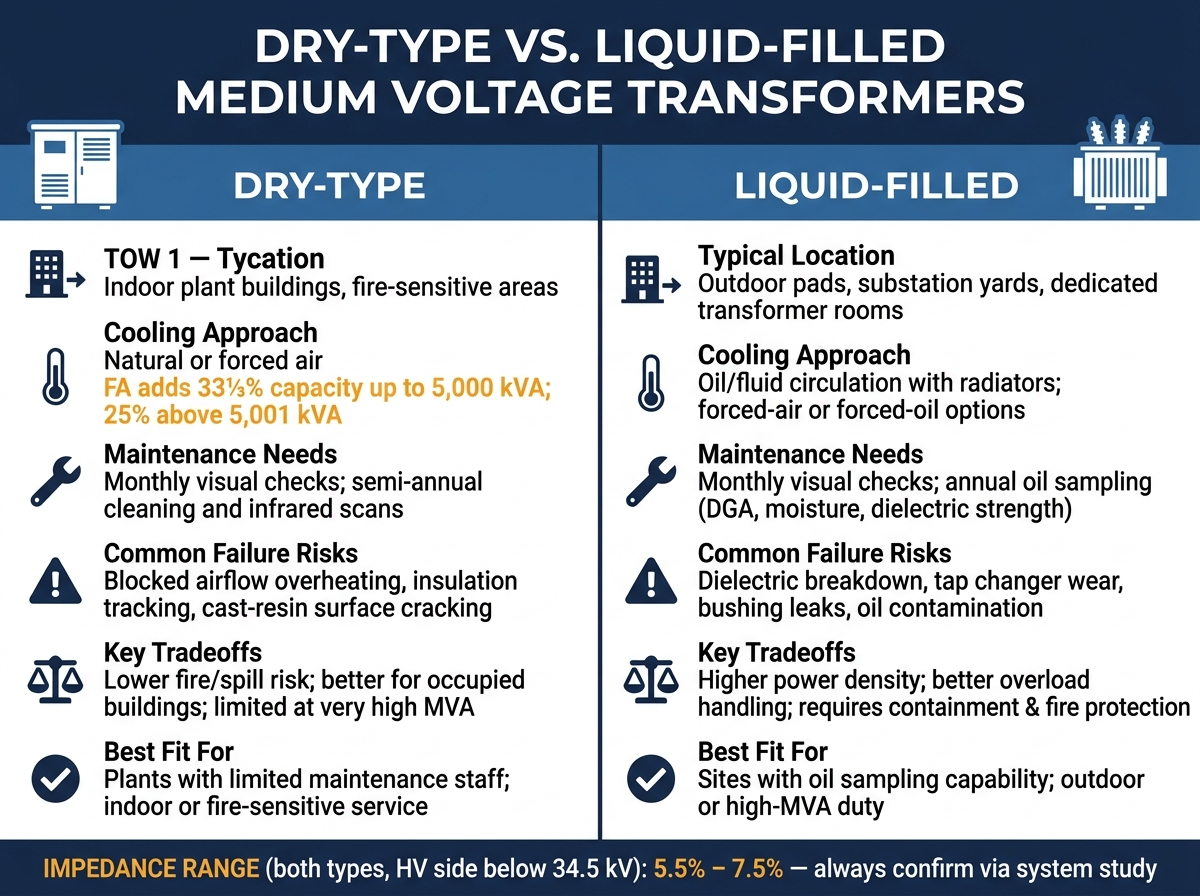
Dry-Type vs. Liquid-Filled Medium Voltage Transformers: Side-by-Side Comparison
Before you send out the RFQ, nail down the basics: voltage class, kVA or MVA, phase, frequency, impedance, and the load profile. The transformer has to fit all three at the same time: the utility feed, the plant bus, and the biggest process load. That’s what drives the final pick for voltage class, rating, construction, and protection.
Voltage Class, kVA Rating, and Load Profile
Start with the plant bus you have and the heaviest process start you expect. Then size the transformer around both. The primary winding should match the incoming service, and the secondary should match the plant bus or the load.
Build the kVA/MVA rating from a load study. Add up the connected loads, apply demand and diversity factors, then add a 10% to 25% growth margin. After that, check that the unit can handle the largest motor starting event while other loads stay online. Motor starting current usually runs 4 to 7 times full-load current, and that can cause major voltage sag if the transformer is too small.
Don’t treat impedance like a line item you pull from a catalog and move on. It needs to come from a system study. Lower impedance cuts voltage sag, but it also pushes fault current up. Higher impedance does the reverse. For medium voltage transformers with a high-voltage side below 34.5 kV, a common range is 5.5% to 7.5%. The right number depends on coordinated system results.
If the load includes VFDs, rectifiers, or arc furnaces, call for a K-rated transformer or apply harmonic derating. If you skip that step, extra heat can shorten insulation life.
Dry-Type vs. Liquid-Filled Construction
Once the electrical side is set, pick the construction that fits the site and how the equipment will be maintained. Here’s the short version:
| Construction Type | Typical Use Location | Cooling Approach | Maintenance Needs | Key Tradeoffs |
|---|---|---|---|---|
| Dry-type | Indoor plant buildings, fire-sensitive areas | Natural or forced air | Visual inspection, cleaning, fan checks | Lower fire and spill risk; better for occupied buildings; more limited at very high MVA ratings |
| Liquid-filled | Outdoor pads, substation yards, dedicated transformer rooms | Oil or fluid circulation with radiators | Oil testing (DGA), leak monitoring, spill containment | Higher power density, better overload handling; requires fire protection and containment infrastructure |
In plain terms, dry-type units make sense for indoor, fire-sensitive service. Liquid-filled units fit outdoor pads or dedicated substation spaces where higher density and overload headroom matter more.
Common Medium Voltage Classes and Ratings Reference Table
This table gives a quick U.S. reference for common voltage classes, usual transformer ratings, and where they tend to feed downstream.
| Primary Voltage Class | Typical Transformer Ratings | Typical Downstream Utilization |
|---|---|---|
| 2.4 kV | 500 kVA – 2.5 MVA | 480 V or 600 V motors; legacy plant distribution |
| 4.16 kV | 500 kVA – 5 MVA | 480 V MCCs, VFDs, plant distribution panels |
| 7.2–7.5 kV | 1 MVA – several MVA | 480 V or 600 V feeders; plant distribution |
| 12.47–13.8 kV | 1 MVA – 20 MVA | 4.16 kV motor buses; 480 V secondary substations |
| 24.9 kV | 5 MVA – 25 MVA | 480 V, 600 V, or 2.4 kV class distribution |
| 34.5 kV | 5 MVA – 40 MVA+ | 4.16 kV or 13.8 kV internal distribution grids |
After the electrical and mechanical choices are settled, lock them into the purchase spec. At a minimum, include kVA/MVA rating, phase configuration, 60 Hz frequency, primary and secondary voltage, percent impedance, vector group and grounding requirements, BIL, cooling class, temperature rise, insulation class, enclosure/environment rating, tap configuration, and future expansion margin.
Leave any of that out, and you open the door to substitutions that can throw off coordination or hurt performance.
Design and Installation Factors That Affect Performance
Once the transformer is specified, the next part is less glamorous but just as important: installation. On paper, a unit may meet the rating. In the field, heat, dust, and vibration decide how close it gets to that number.
Cooling, Insulation, and Enclosure Selection
After voltage, rating, and impedance are set, installation details decide whether the transformer can deliver that performance day after day.
Cooling sets the unit’s continuous load limit. Forced-air cooling (FA) can increase capacity by 33⅓% up to 5,000 kVA and 25% above 5,001 kVA, but that extra capacity is meant for peak or emergency loading, not nonstop service. In plain terms, FA capacity is a reserve. It should not be treated as the normal continuous rating.
Insulation class and temperature rise also need to fit the site. Many heavy-industry specs call for Class 220 °C insulation even when the stated temperature rise is only 80 °C, 115 °C, or 150 °C. That added margin helps in hot mechanical rooms, steel mills, foundries, and process plants, where high ambient temperature eats into thermal headroom.
Ventilation matters here too. If hot air gets trapped and pulled back through the unit, the transformer loses part of its cooling margin. Good airflow helps preserve the rated temperature rise. Clearances matter for the same reason. Follow the manufacturer’s spacing rules, which are often at least 6 inches at the front and rear of ventilated units, so heat can leave the enclosure as intended.
For enclosure choice, use ventilated NEMA 1 indoors and NEMA 3R or better outdoors. In dusty, corrosive, humid, or cold locations, add drainage and condensation control.
Those thermal decisions only hold up if the protection setup and enclosure details fit the actual site.
Protection and Monitoring Requirements
Once the enclosure is chosen, protection and monitoring keep the transformer inside its safe operating range.
Heavy-duty service usually calls for winding temperature sensors, thermal alarms, and automatic fan controls linked to winding sensors. For liquid-filled units, add pressure relief devices and dissolved gas analysis (DGA). Surge arresters, along with the right BIL rating, help guard against switching transients and lightning exposure.
Protection coordination has a direct effect on outage size. The goal is simple: the protective device closest to the fault should trip first. That means the transformer’s protection has to be coordinated with upstream breakers, feeder relays, and downstream motor control. At the same time, the design has to account for transformer inrush current, motor starting events, transformer impedance, and available fault current.
Before installation, verify the transformer’s short-circuit withstand against the facility’s available fault current. If fault energy goes past the unit’s design limit, it can damage windings, leads, and bushings. Bond the enclosure, neutral, and facility ground grid together to cut touch voltage and help faults clear properly.
Maintenance and Lifecycle Planning for Medium Voltage Transformers
After installation, maintenance becomes the main driver of uptime and service life. In steel mills and mines, transformers take a beating from thermal cycling, vibration, and contamination. And in heavy industry, where one critical transformer may support tens of millions of dollars in annual production, unplanned downtime hits hard. That’s why the best maintenance plan is scheduled, not reactive.
Inspection Priorities for Heavy-Duty Service
The top areas to watch are thermal performance, electrical connections, insulation condition, bushings, and site contamination. Use quarterly infrared scans under normal load to spot hot areas at terminations or windings before they turn into outages.
Inspect bolted connections and terminations once a year. In high-vibration or heavily cycled service, move that to every six months. Watch for discoloration, pitting, and signs of arcing. Those are often early clues that contact resistance is climbing.
In dusty or corrosive plants, check bushings and ventilation paths every month. Cracks, tracking, and blocked airflow can increase flashover and overheating risk. Gaskets, enclosure seals, and breather devices also need a quarterly look, especially at outdoor sites or in chemical-process areas.
For liquid-filled units, test the oil once a year for gas, moisture, and dielectric strength. That helps catch arcing, overheating, or insulation breakdown before the damage spreads.
Maintenance Demands by Transformer Type
Dry-type and liquid-filled units need different maintenance routines, as shown below.
| Feature | Dry-Type | Liquid-Filled |
|---|---|---|
| Inspection Focus | Dust and contamination on windings, air paths, and enclosure cleanliness | Oil quality (DGA), fluid levels, leaks, and moisture ingress |
| Service Frequency | Monthly visual checks; semi-annual cleaning and infrared scans | Monthly visual checks; quarterly to semi-annual breather and conservator checks; annual oil sampling |
| Common Failure Risks | Overheating from blocked airflow, insulation tracking, and surface cracking in cast-resin units | Dielectric breakdown, tap changer wear, bushing leaks, and oil contamination |
| Periodic Electrical Tests | Insulation resistance, turns ratio, winding resistance | Power factor, winding resistance, SFRA after fault events |
Dry-type units are often a better fit for plants with limited staff. Liquid-filled units make more sense for sites that can handle oil sampling and added diagnostic work.
Key Buying and Operating Takeaways
Match the voltage class and kVA rating to the plant’s actual load. Then use loading history to shape the maintenance plan. Site conditions matter more than many teams expect. Ambient temperature, dust, moisture, and vibration all affect how fast insulation and cooling systems wear.
Construction type should line up with fire and spill risk, available maintenance skills, and the plant’s ability to deal with oil sampling, cooling system repairs, or fluid replacement.
Structured lifecycle planning can add 20 to 30 years of service through inspections, condition-based testing, and midlife repairs such as oil reclamation or bushing replacement. In heavy industry, that has a direct effect on total cost of ownership. When it’s time to replace a unit, getting the right transformer matters just as much as maintaining the one already in service. Electrical Trader offers new and used medium voltage transformers and power distribution equipment in one place.
FAQs
When does medium voltage make more sense than 480 V?
Medium voltage (MV) is often the better fit when power has to travel long distances. Here’s why: a higher voltage lets you move the same load with less current. And less current means less voltage drop and lower I²R losses in the cable.
That can improve efficiency and, in many cases, make it possible to use smaller conductors and conduits. The result is lower material and labor costs.
MV equipment does cost more upfront than a 480 V system. But for large facilities, it can still make better financial sense over time.
How do I choose between dry-type and liquid-filled?
Choose the transformer type based on where it will be installed, the level of safety the site needs, and how much power the system must handle.
Dry-type transformers are a good fit for indoor use because they don't use flammable oil. That means lower fire risk and less maintenance. The tradeoff is cost: they usually cost more at the start, and their lifespan is often 15 to 25 years.
Liquid-filled transformers make more sense for high-voltage, large-scale outdoor setups. They can handle higher capacity and often last 25 to 35 years. But they also need more maintenance and tighter safety controls.
What should I check before buying an MV transformer?
Before you buy a medium voltage transformer, make sure the kVA rating, voltage, phase, frequency, and impedance line up with your system needs and load calculations. If those specs are off, even by a bit, you can run into trouble once the unit is in service.
You’ll also want to check the cooling class and environmental ratings. Site conditions matter more than people sometimes expect, especially when temperature, altitude, and humidity come into play.
If you’re buying used equipment, take a close look at its operating history. That includes maintenance records, oil testing results, and any fault history. Those details can tell you a lot about how the transformer was treated and what kind of shape it’s in.
Electrical Trader sells new and used transformers, along with other power distribution equipment.