

Step-Up and Step-Down Transformers: Buying Guide
Buy the wrong transformer, and you can end up with failed inspections, voltage mismatch, nuisance trips, or extra cost. When I look at a transformer, I start with just a few checks: voltage, phase, kVA, frequency, impedance, and listing/compliance. If those are wrong, price does not matter.
Here’s the short version:
- A step-up transformer increases voltage.
- A step-down transformer lowers voltage.
- In most U.S. jobs, I see 480 V → 208Y/120 V, 480 V → 120 V, 240 V → 120 V, and 240 V → 480 V.
- For sizing, I check:
- Single-phase: V × A ÷ 1,000
- Three-phase: 1.732 × V × A ÷ 1,000
- I usually leave room for load growth and startup current, often targeting about 80% load and adding 10% to 25% extra margin.
- If the load has VFDs, UPS systems, LED drivers, or IT gear, harmonics may force derating to 80% to 95%.
- For indoor installs, dry-type is common. For larger outdoor jobs, oil-filled can cost less per kVA, especially around 1,500 kVA and up.
- I also check UL 1561 for dry-type units, the right NEMA enclosure like NEMA 1 or NEMA 3R, and test records for used or refurbished units.
If you want a safe buying path, this is it: match the source and load first, size for actual demand plus margin, then verify fault current, enclosure, and paperwork before you compare prices.
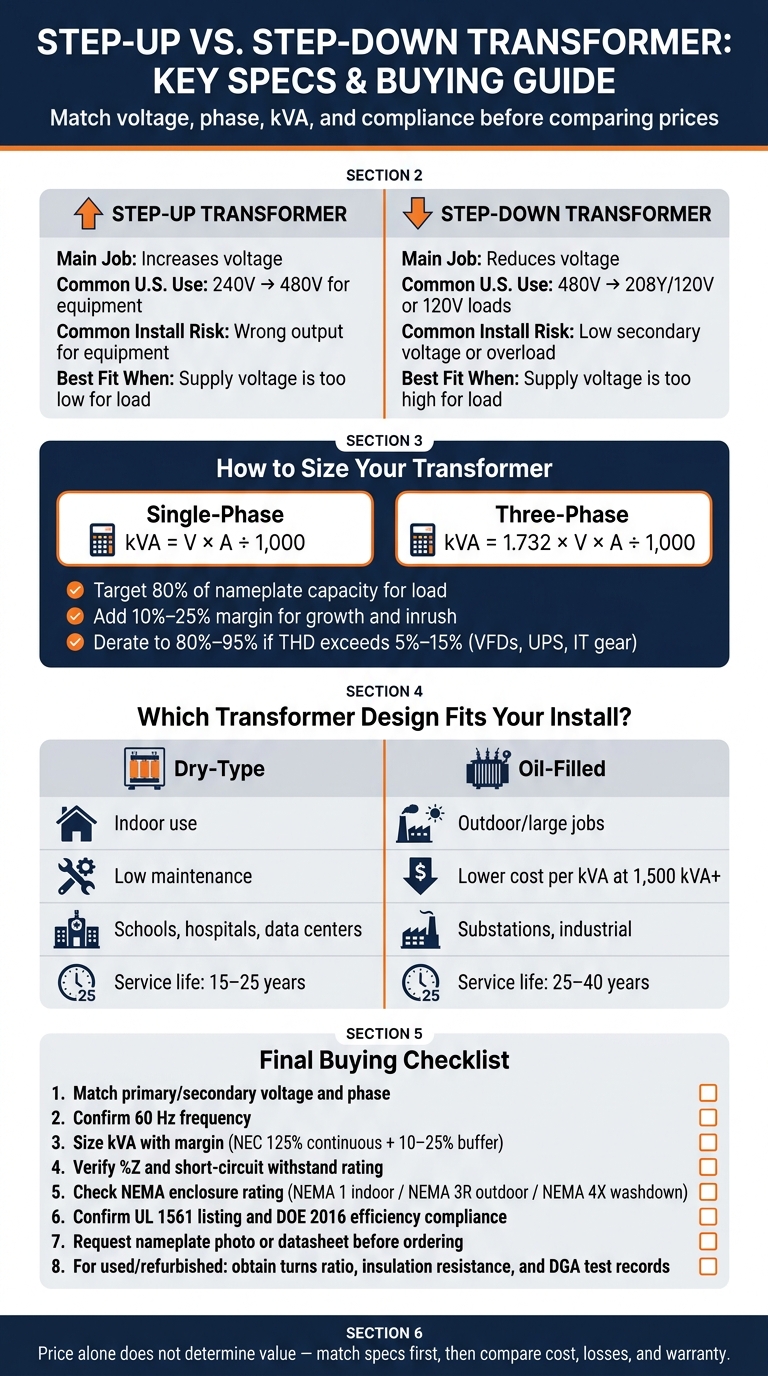
Step-Up vs Step-Down Transformer: Key Specs & Buying Checklist
Step-up and Step-down Transformers Explained
sbb-itb-501186b
Quick Comparison
| Item | Step-Up Transformer | Step-Down Transformer |
|---|---|---|
| Main job | Increases voltage | Reduces voltage |
| Common U.S. use | 240 V to 480 V for equipment | 480 V to 208Y/120 V or 120 V loads |
| First thing I check | Source voltage and required output voltage | Source voltage and required output voltage |
| Common install risk | Wrong output for equipment | Low secondary voltage or overload |
| Best fit when | Available supply is too low for the load | Available supply is too high for the load |
I’d use this guide to narrow options fast, avoid spec mistakes, and compare units on more than just the upfront price.
2. Core Specifications to Check Before You Buy
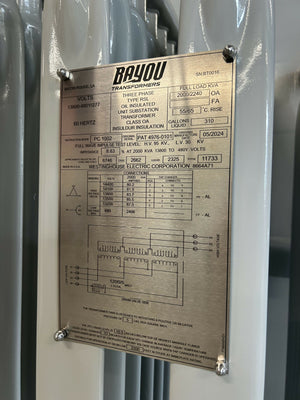
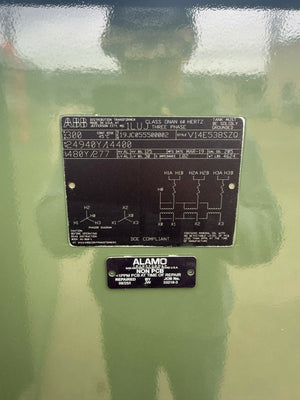
Once you’ve confirmed the voltage conversion direction and phase needs, check the nameplate. That’s where the key fit and operating details live. Before you ask for quotes or place an order, verify the kVA, voltage, frequency, phase, %Z, insulation class, temperature rise, and enclosure. Miss just one of these, and you can end up with an install mismatch, a failed inspection, or load trouble.
kVA Rating, Voltage, Frequency, and Phase
The kVA rating is the main sizing number on the nameplate. It tells you how much continuous apparent power the transformer can deliver without overheating.
For single-phase loads, calculate the needed kVA as V × I ÷ 1,000. For three-phase loads, use √3 × V(line-to-line) × I ÷ 1,000.
A good rule is to size the transformer at about 80% of nameplate capacity. That gives you some breathing room for inrush and future load growth.
You’ll also want to confirm that the phase and 60 Hz frequency match your system. If those don’t line up, the rest of the specs won’t save you.
Impedance, Regulation, Insulation Class, and Temperature Rise
Percent impedance (%Z) affects two big things: available fault current and voltage drop. Lower impedance means more fault current at the secondary terminals. Higher impedance limits fault current, but it also increases voltage drop.
You can estimate secondary fault current with:
- Full-load current × 100 ÷ %Z
Here’s a simple example. A 500 kVA, 480 V three-phase transformer with 5% impedance can theoretically deliver about 20 times rated current during a bolted fault.
Voltage regulation matters most when the load includes sensitive electronics, PLCs, or process controls. If regulation is too loose, normal system sag can push equipment outside its allowed voltage range. In those cases, look for transformers with low impedance and good regulation.
Insulation class and temperature rise show how hot the transformer can run and how much life margin it has. Common modern insulation systems include Class 220. Typical dry-type temperature rise ratings are 80°C, 115°C, or 150°C, usually based on a 40°C ambient (104°F).
Lower temperature rise designs run cooler and usually last longer. That’s why they’re often the pick for critical sites like hospitals and data centers.
Protection, Short-Circuit Coordination, and Compliance
Before you buy, confirm the available fault current at both the transformer primary and secondary. Then make sure the transformer’s %Z and short-circuit withstand capability fit that fault level. Also check that upstream and downstream breakers or fuses have interrupting ratings that meet or exceed the calculated current.
Time-current coordination matters too. If there’s a fault on a 120 V branch circuit, the branch breaker should trip first - not the main service breaker. That kind of selectivity can save a lot of hassle.
For compliance, U.S. commercial and industrial buyers should check for a UL listing such as UL 1561 for dry-type transformers. You should also confirm the right NEMA enclosure rating for the install location, like NEMA 1 for indoor use or NEMA 3R for outdoor use. CSA markings matter too if the equipment will cross into Canada.
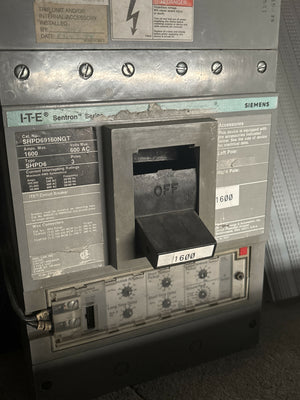
Authorities Having Jurisdiction and insurance carriers often want those markings in place before they approve anything. So don’t just take a seller’s word for it. Ask for a nameplate photo or data sheet before you commit.
Once the nameplate and protection details check out, match the transformer design to the install itself. Use listing photos and datasheets to confirm ratings before you compare enclosure, mounting, and cooling options.
3. Matching Transformer Type to the Installation
Once the nameplate specs check out, the next step is simple: pick the transformer type that fits the space and the load.
Dry-Type vs. Oil-Filled Designs
Dry-type transformers are the go-to option for indoor use - offices, schools, hospitals, data centers, and light industrial sites. Because there’s no liquid inside, they cut spill risk and lower fire risk. They also avoid oil containment rules. Day-to-day upkeep is usually limited to inspection, cleaning, and checking electrical connections.
Oil-filled transformers are a better fit for outdoor use and larger-capacity jobs. At about 1,500 kVA and up, they often cost less per kVA. They also handle short overloads better because the liquid carries heat away more well. Service life is usually longer too - about 25 to 40 years, compared with 15 to 25 years for dry-type units. The tradeoff is more upkeep: oil testing, DGA, moisture checks, and leak monitoring.
| Feature | Dry-Type | Oil-Filled |
|---|---|---|
| Typical Cost per kVA | Higher at medium/large kVA | Lower at higher kVA |
| Maintenance | Low: inspections, cleaning, tightening | Higher: oil testing, DGA, leak checks |
| Installation Environment | Primarily indoor; also sheltered outdoor enclosures | Outdoor yards, pad mounts, vaults, and some special rooms |
| Spill/Fire Risk | No oil; reduced fire load | Oil leaks possible; containment needed |
| Common Applications | Commercial buildings, schools, hospitals, data centers | Substations, feeder step-down, large industrial loads |
Once you’ve picked the cooling medium, the next job is matching the winding type and phase setup to the load.
Single-Phase, Three-Phase, Isolation, and Autotransformer Options
Single-phase transformers work well for smaller or separate loads, such as residential-style 120/240 V service, small commercial spaces, or dedicated single-phase equipment. For whole-building or industrial distribution, three-phase transformers are the standard because they take up less space and cost less per kVA than an equal bank of single-phase units.
On a wye-connected secondary with a grounded neutral, 208Y/120 V gives you 120 V phase-to-neutral for receptacles and lighting, plus 208 V phase-to-phase for smaller motors. A 480Y/277 V system works the same way: 277 V phase-to-neutral for lighting and 480 V phase-to-phase for larger motors and HVAC equipment. If the load includes 120 V branch circuits, the secondary needs an accessible neutral that’s grounded the right way.
After phase selection, winding type answers a different question: do you need isolation, or do you just need to change voltage? An isolation transformer uses separate primary and secondary windings. That gives galvanic isolation for safety, noise control, or equipment requirements. An autotransformer uses part of the same winding for both primary and secondary, so it’s smaller and costs less for simple voltage changes like 480 V to 240 V when isolation isn’t needed.
Enclosure, Mounting, and Cooling Requirements
The enclosure has to match the setting. NEMA 1 is the usual choice for clean indoor electrical rooms. NEMA 3R is used outdoors where rain and sleet are factors. NEMA 4X makes more sense in washdown areas, coastal sites, or other corrosive locations.
Mounting style comes down to size and placement. Smaller dry-type units in the 15–75 kVA range are often wall-mounted in tenant spaces or mechanical rooms. Larger units are usually floor-mounted in electrical rooms or plant areas with the needed clearances. Pad-mounted oil-filled transformers are ground-mounted units used for outdoor service.
Site conditions matter more than people sometimes think. Heat, dust, moisture, corrosion, and airflow all change how a transformer performs. High ambient temperature or blocked ventilation can mean derating or using a forced-air design, especially in dusty places like woodworking or textile plants.
With the installation fit nailed down, the next step is sizing for load, inrush, harmonics, and future growth.
4. Sizing, Pricing, and Total Cost of Ownership
How to Size for Load, Inrush, Harmonics, and Expansion
kVA is the first sizing call. Once you’ve locked in transformer type, the next job is picking the right size and looking at lifecycle cost.
Start with the actual load after voltage, phase, and frequency are confirmed. Convert kW to kVA using power factor, then add room for continuous load, near-term growth, and load cycling. NEC guidance points to sizing at 125% of continuous load, and it also makes sense to add an expansion buffer of about 10% to 25%. After that, round up to the next standard catalog size, such as 3, 6, 9, 15, 30, 45, 75, 112.5, 150, 225, or 300 kVA.
Some loads need more breathing room. Motors can pull several times their running current at startup. If the transformer is sized too close to the line, that startup surge can cause voltage dip or nuisance tripping. Non-linear loads can do something similar in a different way. VFDs, rectifiers, UPS systems, LED drivers, and IT equipment add harmonics, and those harmonics can heat the transformer more than steady-state current alone would suggest.
If system THD is above 15%, derate to 80% to 90% of nameplate capacity. For 5% to 15% THD, a derating factor of 0.90 to 0.95 is common.
For quick load checks, use these formulas before adding your safety margin:
- Single-phase: kVA = (Volts × Amps) ÷ 1,000
- Three-phase: kVA = (Volts × Amps × 1.732) ÷ 1,000
The table below shows common voltage and current combinations with suggested sizing margins.
| Voltage | Current | Calculated kVA | Suggested Margin |
|---|---|---|---|
| 120 V, single-phase | 20 A | 2.4 kVA | ~25% |
| 240 V, single-phase | 50 A | 12 kVA | ~25% |
| 480 V, single-phase | 30 A | 14.4 kVA | 15%–25% |
| 208Y/120 V, three-phase | 100 A | ~36 kVA | ~25% |
What Drives Transformer Price in the United States
In the U.S. market, kVA rating and voltage class are the two biggest price drivers. Bigger kVA means higher cost, and moving from 600 V-class gear to medium-voltage equipment pushes pricing up fast because insulation and engineering demands get tougher.
A few other specs can move price around too. Three-phase units cost more than single-phase. Enclosure upgrades from NEMA 1 to NEMA 3R or NEMA 4X add cost, but those upgrades are often needed for outdoor or washdown settings. Multiple tap positions, low-noise design, and DOE 2016 efficiency compliance also add to the base price. And if you need a special-application unit, such as one with on-load tap changers or tertiary windings, expect a 20% to 50% premium over a standard model.
Condition matters too, especially when a procurement team is comparing listings. Used or reconditioned units often sell for 30% to 60% of new, while warrantied refurbished units usually land at 50% to 75% of new price. That gap can help on capital budget, no doubt. But it needs to be weighed against testing cost, remaining service life, and any oil processing the unit may need.
Upfront price gets attention first. Still, losses and maintenance often end up telling the bigger story.
Operating Costs, Losses, and Maintenance Expectations
The purchase price is only one part of transformer cost. Every transformer has no-load (core) losses and load (copper) losses. No-load losses happen any time the unit is energized, even if little or no load is connected. Load losses climb with current and increase with the square of the load. Over the life of the transformer, both show up as wasted energy.
A common total cost of ownership formula puts that into plain view:
TCO = purchase price + A × no-load loss + B × load loss
Here, A and B are multipliers tied to local electricity rates, expected run hours, and discount rate. In a facility that runs 24/7, even a small cut in no-load loss can add up over years of service. That’s why more engineering and utility buyers are using TCO-based procurement instead of just picking the lowest sticker price.
The table below shows how major spec choices affect upfront price, operating cost, and maintenance side by side.
| Specification | Upfront Price | Operating Cost | Maintenance Burden |
|---|---|---|---|
| Dry-type vs. oil-filled (same kVA) | Dry-type generally higher per kVA | Similar; depends on efficiency rating | Dry-type lower: inspections, cleaning, tightening |
| Standard efficiency vs. premium efficiency | Premium efficiency higher | Premium efficiency lower over time | No difference |
| Single-phase vs. three-phase (equivalent load) | Three-phase higher | Similar | Similar |
| NEMA 1 vs. NEMA 3R / 4X enclosure | NEMA 3R/4X higher | No direct impact | Slightly higher for outdoor units |
| Fixed taps vs. multiple tap positions | Multiple taps slightly higher | No direct impact | Minor: periodic tap verification |
Dry-type units usually keep maintenance pretty light. Oil-filled units add oil testing, DGA, leak checks, and gasket inspections, which increases lifecycle cost.
5. Buying Through Electrical Trader and Final Checklist
Using Electrical Trader to Compare Transformer Listings
Once you’ve locked in the specs and budget, the next step is sourcing. At this stage, stick to listings that match the nameplate. On Electrical Trader, that means filtering by kVA, primary and secondary voltage, and phase so you’re only looking at units that fit the job.
After that, don’t jump straight to price. Go line by line and confirm the listing matches your design. The primary and secondary voltages need to be exact. For example, a common U.S. commercial step-down setup would use a 480 V primary and 208Y/120 V secondary. You’ll also want to check for 60 Hz service, the right enclosure rating, and confirm UL listing and DOE compliance when those apply.
Used and refurbished transformers need extra attention. The listing should clearly state the unit’s condition and include test records, such as:
- turns ratio
- insulation resistance
- DGA for oil-filled units
If any of that is missing, ask for it before you buy.
That’s the part many buyers rush past. A low price can look good at first glance, but condition, test reports, and warranty often tell you far more about risk. Compare those items side by side instead of judging the unit by list price alone.
Final Buying Checklist and Key Takeaways
Before placing an order, run every shortlisted transformer through the same checklist. It keeps engineering, field, and purchasing teams on the same page and helps catch mismatches before they turn into costly problems.
| Checklist Category | Key Items to Verify |
|---|---|
| Voltage, frequency, phase, kVA, impedance, load margin | Primary/secondary voltage, 60 Hz, phase, kVA with margin for inrush and future expansion, impedance |
| Indoor/outdoor fit, NEMA rating, cooling, mounting, dimensions | NEMA enclosure rating, indoor vs. outdoor suitability, cooling type (dry-type vs. oil-filled), mounting style, physical dimensions |
| UL/ANSI/IEEE/DOE, condition, test reports, warranty | UL listing, ANSI/IEEE references, DOE efficiency where applicable, condition (new/refurbished/used), test reports, warranty terms |
| Purchase price, losses, maintenance, shipping, commissioning | Purchase price, efficiency losses, maintenance intervals, shipping, and commissioning costs |
One detail deserves extra attention: impedance and short-circuit data. These numbers don’t just describe the transformer. They also affect how upstream breakers and fuses react during a fault. If a listing leaves out impedance, ask for the manufacturer datasheet or a clear nameplate photo before approval. Price and voltage by themselves don’t tell the whole story.
FAQs
How do I know if I need step-up or step-down?
You need a transformer when your utility or generator voltage doesn’t match the voltage your equipment needs. A step-up transformer increases voltage. A step-down transformer lowers it.
Check your equipment nameplates and facility wiring diagrams. Then compare your incoming power voltage with the operating voltage of your machinery or lighting systems.
How much extra kVA margin should I add?
Add a 15%–25% safety margin to your total load calculation. That buffer helps cover load swings and keeps the transformer in the sweet spot: about 60%–80% of its capacity.
If you expect future growth, like EV charging, a 30%–40% margin can make more sense. You’ll also want to factor in continuous loads at 125% and motor starting current, which often calls for a 125% start factor.
When should I choose dry-type over oil-filled?
Choose dry-type transformers for indoor spaces like offices, schools, and light industrial sites, where safety and low upkeep matter most. These units use ambient air for cooling and rely on dry or gaseous insulation, which makes them a better fit for indoor use and simpler to maintain.
Use oil-filled transformers for high-capacity jobs, such as large industrial sites or outdoor substations. In harsh indoor settings, go with encapsulated or non-ventilated dry-type models, which can stand up better to dust and corrosion.