Autotransformers: Types and Applications
Autotransformers are compact electrical devices that adjust voltage levels using a single winding shared by the input and output. They are efficient, lightweight, and economical for voltage changes within a 3:1 ratio. However, they lack electrical isolation, which can pose safety risks in certain applications. Common uses include power transmission, industrial motor startups, and precise voltage control in labs.
Key Points:
- Design: Single winding for input and output; smaller and more efficient than two-winding transformers.
- Efficiency: High efficiency due to reduced copper and core losses.
- Applications: Voltage matching, motor starters, and grid interconnections.
- Limitations: No galvanic isolation; unsuitable for sensitive electronics or high voltage ratios.
- Types: Fixed ratio (e.g., 480V to 600V), variable (e.g., Variacs for labs), single-phase, and three-phase designs.
Autotransformers are ideal for specific voltage adjustments but require careful consideration of safety and application needs.
All about Autotransformers
sbb-itb-501186b
How Autotransformers Work
Autotransformer vs Two-Winding Transformer: Key Differences
Core Construction and Operation
An autotransformer is built with a single continuous winding, divided into two key sections: the series winding and the common winding. The series winding manages the voltage difference between the input and output, while the common winding is shared between both circuits. This setup allows power to be transferred through a combination of magnetic induction and direct conduction.
One advantage of this design is that the magnetic core only needs to handle the portion of power transferred inductively. The formula for the equivalent power rating is:
Load VA × |Vin − Vout| / Vin
For instance, when an autotransformer increases voltage by 10%, only 10% of the total power is transferred inductively.
"Since the size of a unit is proportional to the power that it transforms, the equivalent transformer rating of the autotransformer will be only 10% of the power rating [if it boosts voltage by 10%]." - Waldemar Ziomek, PTI Manitoba Inc.
However, as the voltage transformation ratio increases beyond 3:1, the size and cost benefits of autotransformers become less pronounced.
Electrical Characteristics and Safety
Due to the shared conductor between the primary and secondary circuits, autotransformers lack galvanic isolation. This means electrical noise and transient surges on the input side can pass directly to the output. Additionally, if the common winding fails or its insulation degrades, the full primary voltage may appear at the output, posing a significant safety risk.
Proper grounding is essential. If the primary neutral is not grounded, the output neutral will also float, increasing the risk of shocks or equipment damage. The safest approach is grounding both the transformer neutral and the system neutral. Without this, transient surges could exceed the insulation's safety limits.
Autotransformers also have lower leakage impedance compared to two-winding transformers. While this improves voltage regulation, it leads to much higher short-circuit currents. These currents can cause severe mechanical stress on the windings during faults.
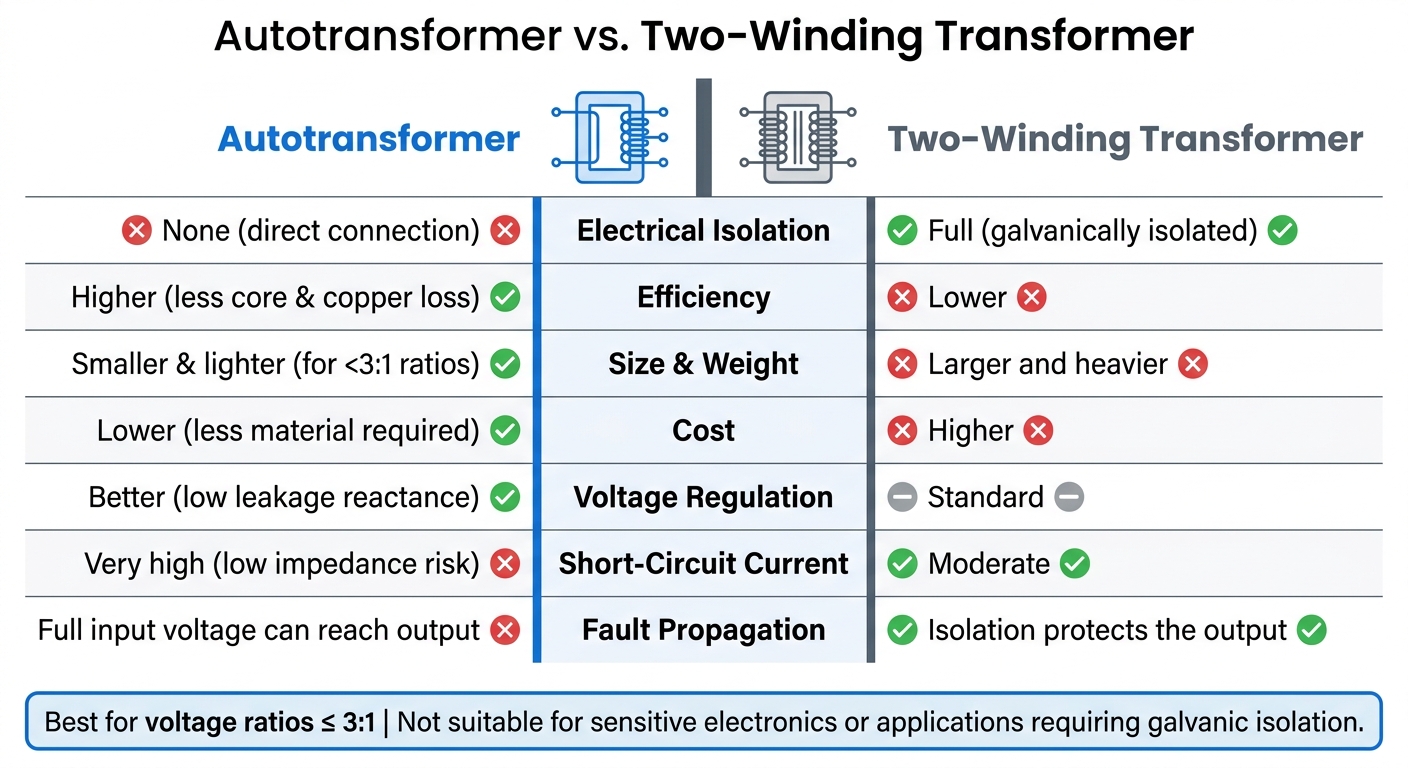
Autotransformers vs. Two-Winding Transformers: Comparison Table
| Feature | Autotransformer | Two-Winding Transformer |
|---|---|---|
| Electrical Isolation | None (direct connection) | Full (galvanically isolated) |
| Efficiency | Higher (less core and copper loss) | Lower |
| Size & Weight | Smaller and lighter (for < 3:1 ratios) | Larger and heavier |
| Cost | Lower (less material required) | Higher |
| Voltage Regulation | Better (low leakage reactance) | Standard |
| Short-Circuit Current | Very high (due to low impedance) | Moderate |
| Fault Propagation | Full input voltage can reach output | Isolation protects the output |
Next, we’ll look at how autotransformers are utilized in various industries.
Types of Autotransformers
Autotransformers, designed based on their operational principles, come in various types, each suited for specific uses.
Fixed Ratio Autotransformers
Fixed ratio autotransformers have a single winding with fixed tap points. For step-down applications, the source spans the entire winding, and the load connects to a portion of it. For step-up applications, the source connects to part of the winding, while the load utilizes the full winding. This simple design allows these autotransformers to be up to 50% smaller than isolation transformers, making them a practical choice for industrial machinery with voltage mismatches.
These are commonly used for tasks like stepping 480 V up to 600 V to power motors, compressors, and CNC machines, or stepping 208 V to 240 V for commercial HVAC systems. Additionally, in commercial solar installations, Maddox autotransformers reduce the 600 V output from PV inverters to 380 V, 400 V, or 480 V for auxiliary equipment.
"We have used Maddox autotransformers on several ground-mount solar installations. It is quite common for commercial-scale PV inverters to produce 600 volts, but the auxiliary equipment requires lower voltages such as 380, 400, or 480 volts." - Maddox Customer Review
For situations that demand more flexibility in voltage control, variable autotransformers offer a different solution.
Variable Autotransformers
Known as Variacs, variable autotransformers use a sliding carbon brush on a toroidal coil to provide continuously adjustable output voltage. This setup allows for voltage adjustments from zero to about 117% of the input voltage, without fixed steps or taps.
Their ability to deliver precise voltage control makes them essential in laboratories and testing environments. Engineers rely on Variacs to simulate unusual line conditions, test equipment at voltage limits, and control motor speeds. For larger applications, typically above 5 kVA, induction regulators - specialized variable autotransformers that function like wound-rotor induction motors - are used instead of brush-contact Variacs.
For broader applications, single-phase and three-phase designs cater to specific power needs.
Single-Phase and Three-Phase Autotransformers
Single-phase autotransformers are suited for lighter loads, often found in residential and light commercial settings. A common use is converting 120 V to 230 V to power foreign appliances or small electronics. Their affordability and portability make them a go-to choice for these purposes.
Three-phase autotransformers, on the other hand, are designed for heavier-duty applications. They are used for grid interconnections and to provide soft-start capabilities for large induction motors. Induction motors typically draw starting currents 6 to 10 times their full-load current, which can damage equipment or trip breakers. Three-phase autotransformer starters, such as those based on the Korndörfer design, address this issue by offering taps at 50%, 65%, and 80% of line voltage to gradually ramp up motor operation. On a larger scale, three-phase autotransformers connect high-voltage transmission networks, such as linking 400 kV and 275 kV systems in the UK's National Grid.
A unique variation is the zigzag (grounding) transformer, a three-phase autotransformer configuration that provides a neutral ground path for ungrounded delta systems. This design is crucial for meeting industrial grounding requirements, highlighting the wide-ranging capabilities of autotransformers.
Autotransformer Applications by Industry
Power Transmission and Distribution
Autotransformers play a key role in high-voltage grid systems, thanks to their efficient design. They are often used to connect different high-voltage networks, such as 500 kV to 345 kV or 500 kV to 230 kV, ensuring smooth power flow across the grid.
"Most typically the autotransformer is used as a system tie unit, connecting pairs of different high voltage transmission systems, e.g. 500kV and 345kV, 500kV and 230kV etc." - Waldemar Ziomek, PTI Manitoba Inc.
On rural power lines, autotransformers equipped with automatic tap changers help maintain consistent voltage levels. For ultra-high voltage systems like 500 kV and 765 kV, utilities often prefer using banks of three single-phase autotransformers instead of a single three-phase unit. This approach simplifies transportation and replacement in case of equipment failure.
These grid-level applications highlight the versatility of autotransformers, which extend their utility beyond the electrical grid.
Industrial and Commercial Facilities
In industrial environments, autotransformers are used to resolve voltage mismatches and manage motor startup currents. Autotransformer starters effectively reduce the surge of current during motor startup, preventing issues like tripped breakers. In commercial settings, such as HVAC systems, buck-boost autotransformers are commonly employed to adjust voltages - for instance, stepping 208 V up to 240 V for better compatibility.
"Autotransformers are great because they're less expensive than regular isolation transformers while getting the same exact job done." - Alpha, Hydraulic Elevator Controls Manufacturer
Their ability to provide efficient voltage adjustments makes autotransformers indispensable in both industrial and commercial applications.
Laboratories and Testing Environments
In laboratories and repair shops, variable autotransformers - often referred to as Variacs - are a go-to tool. These devices allow for precise voltage control, ranging from 0% to about 117% of the input voltage, without causing switching transients. This makes them perfect for testing equipment performance at various voltage levels, helping engineers push devices to their limits and identify failure points. They're also used to simulate low-voltage conditions, enabling technicians to observe how equipment behaves under such stress.
Variacs have another advantage: they don’t generate electromagnetic interference (EMI), unlike thyristor-based controllers. This feature is especially important in environments with sensitive instruments. However, since autotransformers lack electrical isolation, it’s crucial to ground the input neutral to avoid a floating output.
Autotransformers' adaptability and precision make them an essential tool in controlled testing scenarios.
Selecting an Autotransformer: Benefits, Limits, and Key Criteria
Selection Criteria
When choosing an autotransformer, start by identifying the supply voltage you need - whether it's 120V, 240V, or 480V - and whether the system is single-phase or three-phase. Match the kVA rating to your load, but for motor loads, only allocate 60% of the transformer's capacity to account for startup surges.
There are two additional factors to consider. First, if your system requires a neutral connection, keep in mind that autotransformers cannot generate one. In such cases, you'll need an isolation transformer for a four-wire system. Second, check the voltage ratio. Autotransformers are most cost-effective when the primary-to-secondary voltage ratio is 3:1 or lower. For ratios exceeding this, a two-winding transformer is the better option. Additionally, if the transformer will be used in harsh environments, such as marine settings, copper windings are preferable because they resist corrosion better than aluminum. For standard dry industrial or commercial locations in the U.S., a NEMA 3R ventilated enclosure is typically recommended to ensure adequate airflow.
Advantages of Autotransformers
Once you've nailed down the specifications, compare cost and performance. Autotransformers stand out for their high efficiency, compact size, and lower cost. Because they use a shared winding for the primary and secondary circuits, they are often 50% smaller and lighter than equivalent two-winding transformers. This reduced footprint can be a big advantage in tight spaces, like electrical rooms or panels.
Autotransformers also operate with greater efficiency than isolation transformers. This is partly due to their lower impedance and reduced energy losses, and partly because they are not subject to DOE 2016 efficiency mandates, which apply to two-winding transformers. Another key benefit is better voltage regulation. Since the primary and secondary circuits are directly connected, the output voltage remains more stable even when loads fluctuate.
| Feature | Autotransformer | Isolation Transformer |
|---|---|---|
| Size & Weight | Smaller and lighter | Bulkier and heavier |
| Cost | Lower | Higher |
| Efficiency | Higher (DOE-exempt) | Lower (DOE-regulated) |
| Voltage Regulation | Better | Standard |
| Galvanic Isolation | None | Full |
| Harmonic Mitigation | None | Possible (delta-wye) |
Limitations and Safety Considerations
The main drawback of autotransformers is the lack of galvanic isolation. Since the primary and secondary circuits share the same winding, a failure in the insulation could result in the full input voltage being applied to the output.
"A failure of the isolation of the windings of an autotransformer can result in full input voltage applied to the output." - Wikipedia
This makes autotransformers unsuitable for sensitive electronics, non-linear loads like solar inverters, or situations where the two circuits must remain electrically separate. For these applications, a delta-wye isolation transformer is the safer choice.
Proper wiring is also critical. Avoid using a "3 wires in, 4 wires out" configuration. Stick to approved setups such as 3-to-3, 4-to-4, or 4-to-3. When grounding, only bond the metal enclosure to the ground. Bonding the neutral point of the windings can create unwanted ground current paths. For specific industrial applications in the U.S., the NEC allows autotransformer installations without a grounded conductor when stepping between 208V and 240V or 480V and 600V.
Conclusion
Autotransformers offer an efficient way to handle voltage conversion in both industrial and commercial power systems. Thanks to their single-winding design, they are smaller, lighter, and more affordable than traditional two-winding transformers. These features are especially beneficial in environments where space and budget are limited.
Fixed-ratio autotransformers work well for steady loads, such as adapting 480 V equipment to operate on 600 V systems. On the other hand, variable autotransformers (often called Variacs) allow precise voltage adjustments, making them ideal for laboratory settings and repair work. For three-phase systems, autotransformers are often used to link grid networks like 132 kV to 66 kV. They are cost-efficient when the voltage ratio is 3:1 or less. However, for higher ratios, two-winding transformers are typically a better choice financially.
While autotransformers shine in terms of efficiency and compactness, they do come with limitations. The lack of galvanic isolation between primary and secondary circuits means they are unsuitable for applications requiring electrical separation, such as those involving sensitive electronic devices.
"Autotransformers have the advantages of often being smaller, lighter, and cheaper than typical dual-winding transformers, but the disadvantage of not providing electrical isolation between primary and secondary circuits." - Wikipedia
For those looking to purchase an autotransformer, Electrical Trader offers a wide selection of transformers and power distribution equipment. Whether you need specific voltage, phase, or kVA configurations, they can provide a solution tailored to your requirements.
FAQs
When should I choose an autotransformer instead of an isolation transformer?
When deciding between the two, autotransformers are a smart choice if you're looking for a more affordable way to adjust voltage levels and don’t need electrical isolation between circuits. They work well for tasks like voltage regulation, controlling motor inrush currents, or minimizing energy losses.
On the other hand, isolation transformers are the better option when safety is a priority. They are also ideal for reducing electrical noise or eliminating ground loops since they completely separate the primary and secondary circuits. The main factor to consider is whether electrical isolation is essential for your application.
How do I size an autotransformer (kVA) for a motor load?
To properly size an autotransformer for a motor load, start by identifying the motor's voltage and current requirements. Once you have those numbers, use this formula:
kVA = (Voltage × Current) ÷ 1,000
After calculating the kVA, it's important to include a safety margin to account for inrush currents. This is typically done by dividing the calculated kVA by 0.8, which ensures the transformer can handle the higher demands during motor startup.
Finally, always double-check the motor's specific starting and running current needs. If you're unsure or dealing with a complex setup, it's a good idea to consult an electrical engineer for guidance.
What grounding is required to use an autotransformer safely?
Proper grounding is essential for the safe operation of an autotransformer. This usually means connecting a grounded neutral or chassis, which helps protect against electric shock and improves overall reliability. Grounding is particularly critical because autotransformers do not provide galvanic isolation.