

How to Choose a Single-Phase Transformer
If I get four things right - load, voltage, type, and install site - I’m much less likely to buy the wrong transformer. For most U.S. jobs, that means checking 60 Hz, matching primary and secondary voltage, sizing in kVA, and leaving about 20% to 25% extra capacity instead of cutting it too close.
Here’s the short version:
- I start with the load and use kVA = (Volts × Amps) / 1,000
- I round up to the next standard size
- I check whether I need isolation or just voltage conversion
- I match the unit to the install location: indoor/outdoor, heat, dust, moisture, flood risk
- I confirm the nameplate, DOE/UL/IEEE rules, and NEC Article 450
A few numbers matter right away:
- Large motors may draw 6 to 8 times running current at startup
- Continuous loads often need sizing at 125%
- Standard units are often based on 104°F (40°C) ambient and 3,300 feet elevation limits
- A common loading target is about 80% of transformer rating
If I’m dealing with electronics, LED drivers, or VFDs, I also check whether a K-factor rated transformer is needed. And if the voltage only needs a small correction, a buck-boost transformer may make more sense than a full-size unit.
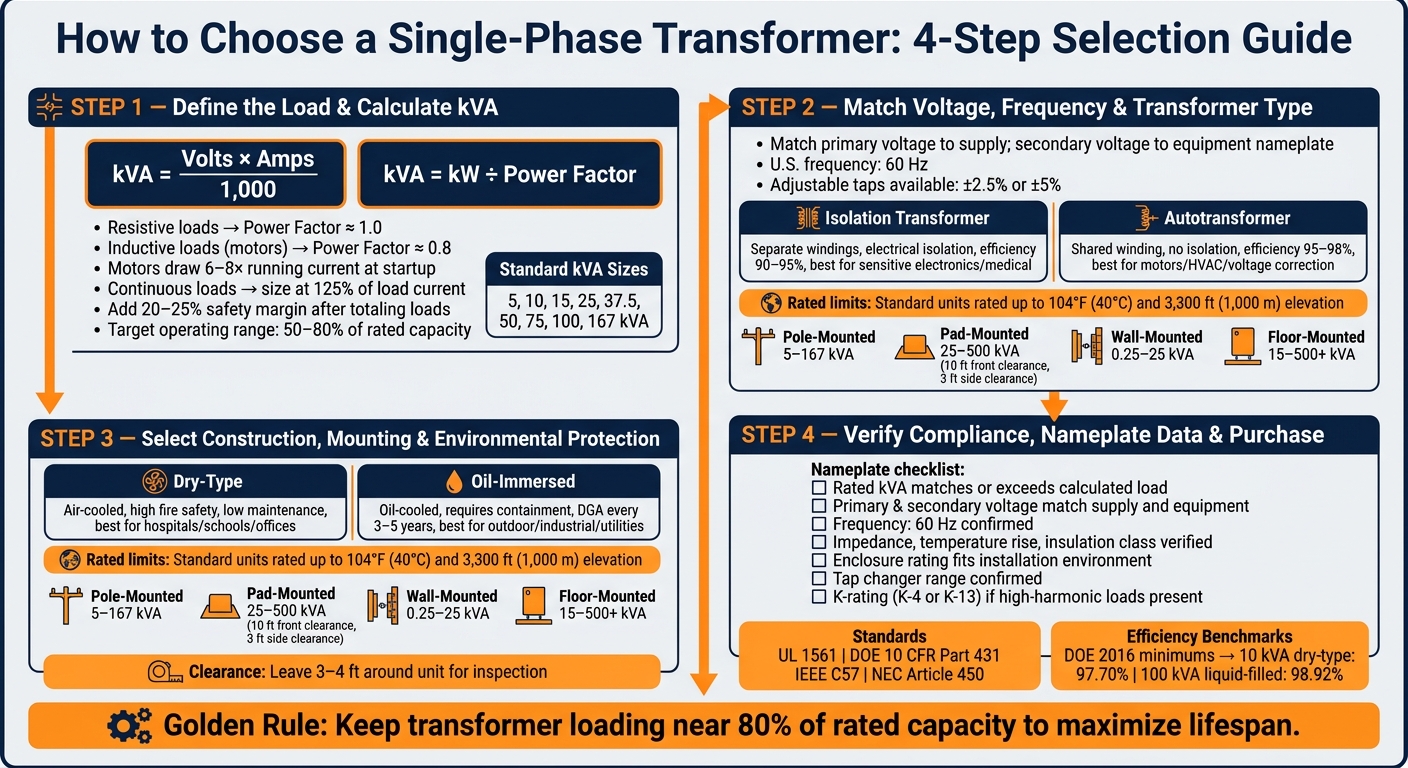
How to Choose a Single-Phase Transformer: 4-Step Selection Guide
How to Select a Single Phase Transformer
sbb-itb-501186b
Quick Comparison
| What I check | What I’m looking for | Why it matters |
|---|---|---|
| Load | kVA, watts, amps, duty cycle | Prevents undersizing or oversizing |
| Voltage | Primary, secondary, 60 Hz | Matches supply and equipment |
| Transformer type | Isolation vs. autotransformer | Changes safety, size, and cost |
| Build | Dry-type or oil-filled | Fits indoor or harsher outdoor use |
| Mounting | Pole, pad, wall, or floor | Must fit space and service access |
| Compliance | Nameplate, UL, DOE, IEEE, NEC | Helps avoid code and purchase issues |
So before I compare listings, I make sure the math, voltage match, site conditions, and code checks are already nailed down.
Step 1: Define the Load and Calculate the Required kVA
Identify Load Type and Duty Cycle
Before sizing a transformer, get clear on what it will actually power. That part sets the tone for everything that follows.
Resistive loads - like electric heaters and lighting - are the simplest to size. Their power factor is usually close to 1.0, so kVA ends up close to kW. Inductive loads - motors, compressors, and HVAC equipment - are a different story. They often run near a 0.8 power factor and can draw a big burst of current at startup. Large motors can pull 6 to 8 times their normal running current for several seconds when they first turn on. If the load leans heavily on electronics, such as LED drivers or VFDs, use a K-factor rated transformer to deal with harmonic distortion.
Duty cycle matters too. If a load runs for 3+ hours, size the transformer at 125% of load current.
Apply the Single-Phase kVA Formula and Add a Safety Margin
Once you know the load, you can size the transformer from the connected current. For single-phase sizing, use this formula:
kVA = (Volts × Amps) / 1,000
If the load is listed in watts instead of amps, convert it with:
kVA = kW ÷ Power Factor
For resistive loads, the power factor is about 1.0. For a motor-heavy setup, 0.8 is a practical starting point.
Add up all connected loads, then apply the right demand factor. After that, add a 20% to 25% safety margin. That extra room helps with startup surges, keeps the transformer running in the 50% to 80% range of rated capacity, and leaves space for future load growth.
Go too big, and you spend more than you need to. Go too small, and you risk heat, nuisance trips, and early failure.
The kVA you calculate is the minimum before rounding. Always round up to the next standard kVA size. In the U.S., common single-phase ratings include 5, 10, 15, 25, 37.5, 50, 75, 100, and 167 kVA.
| Total Load (kW) | Recommended Transformer Size (kVA) |
|---|---|
| 0 – 1.5 | 2 – 3 |
| 1.5 – 3 | 5 |
| 3 – 4.5 | 7.5 |
| 4.5 – 6 | 10 |
| 6 – 9 | 15 |
| 9 – 15 | 25 |
With kVA set, the next step is to match the transformer's voltage, frequency, and type to the supply and the load.
Step 2: Match Voltage, Frequency, and Transformer Type
With kVA set, the next step is to narrow your options by voltage, frequency, and transformer type.
Match Primary and Secondary Voltage to Your Supply and Equipment
After you size the kVA, match the transformer to the power source, the load, and the site.
Set the primary voltage to match the incoming supply, and set the secondary voltage to match the equipment nameplate.
In a 120/240V split-phase system, a center-tapped secondary gives you two 120V legs and one 240V circuit. Always verify the input voltage at the main distribution panel, then check the equipment nameplate for the exact voltage and amperage it needs.
If your site has long cable runs or noticeable voltage drop, look for a transformer with adjustable taps - often ±2.5% or ±5% - so you can fine-tune the output. If you only need a small voltage correction, a buck-boost transformer usually makes more sense.
You also need to match the transformer to the site frequency, which is usually 60 Hz in the U.S..
Once the voltage and frequency line up, you can decide whether you need electrical isolation or just voltage conversion.
Isolation Transformer vs. Autotransformer: Which to Choose
Transformer type changes the safety profile, footprint, and price.
An isolation transformer has two separate windings with no direct electrical connection between them. That separation gives you electrical isolation, which can help cut noise and reduce transient coupling. An autotransformer uses one winding with a tap. It takes up less space for voltage conversion, but it does not provide electrical isolation.
| Feature | Isolation Transformer | Autotransformer |
|---|---|---|
| Electrical Isolation | Yes - separate windings | No - shared winding |
| Size & Weight | Larger and heavier | Compact and lightweight |
| Efficiency | 90–95% | 95–98% |
| Cost | Higher upfront | Lower; uses less material |
| Best For | Sensitive electronics, medical equipment, noise reduction | Motor starting, HVAC, simple voltage correction |
Use an isolation transformer when the load includes sensitive electronics, lab instruments, or medical equipment. If you just need plain voltage conversion and isolation is not part of the job, an autotransformer is usually the better fit.
Step 3: Select Construction, Mounting, and Environmental Protection
Once you've matched the voltage and picked the transformer type, the next move is to choose the unit's construction, mounting method, and level of protection against site conditions.
Dry-Type vs. Oil-Immersed: Choosing Based on the Site
Construction affects how a transformer deals with heat, moisture, and fire risk. In many cases, the install location makes the choice for you.
Dry-type transformers use air for cooling and don't contain flammable liquid. That's why they're often the go-to option for indoor spaces. At the same kVA rating, they tend to be larger and cost more than oil-immersed units. The upside is simpler upkeep, which usually comes down to dusting or cleaning the vents.
Oil-immersed transformers use mineral oil or natural ester for cooling and insulation. They shed heat better and take up less space at the same rating. But there's a catch: they need oil containment and routine oil testing. A Dissolved Gas Analysis (DGA) every 3–5 years helps check internal condition.
Standard transformers are rated for use up to 104°F (40°C) and altitudes up to 3,300 feet (1,000 meters). If your site goes beyond either limit, you'll need a derated unit or one built for those conditions.
Site conditions matter here too:
- In coastal or salt-spray areas, use a NEMA 4X stainless steel enclosure to cut corrosion risk.
- In dusty industrial spaces, a NEMA 12 dust-tight enclosure helps keep debris out of the windings.
| Feature | Dry-Type | Oil-Immersed |
|---|---|---|
| Cooling Medium | Air | Mineral oil or natural ester |
| Fire Safety | High - self-extinguishing | Lower - requires containment |
| Maintenance | Low (dusting/vent cleaning) | Moderate (oil testing and leak checks) |
| Typical Site | Hospitals, schools, data centers, offices | Outdoor grids, industrial sites, utilities |
After you settle on construction and mounting, the next check is the nameplate and code rules before purchase.
Mounting Style and Enclosure Rating
Once the enclosure is set, match the mounting style to the space you have and the access your service team will need.
Pole-mounted units are used for overhead distribution when ground space is tight. Ratings usually run from 5 to 167 kVA. Installation and service need a bucket truck.
Pad-mounted units fit underground distribution in suburban and urban areas, with capacities up to 500 kVA. They also need clearance: at least 10 feet in front and 3 feet on the sides.
Wall-mounted units help save floor space indoors and usually serve loads from 0.25 to 25 kVA. Most weigh between 50 and 200 lbs, so the wall has to handle the load.
Floor-mounted units are used for larger-capacity jobs, where ratings can go beyond 500 kVA.
| Mounting Style | Typical kVA Range | Installation Setting | Complexity |
|---|---|---|---|
| Pole-Mounted | 5–167 kVA | Rural/residential overhead | High (requires bucket truck) |
| Pad-Mounted | 25–500 kVA | Suburban/urban underground | Moderate (requires concrete pad) |
| Wall-Mounted | 0.25–25 kVA | Indoor offices, labs, electrical rooms | Low (weight-bearing wall required) |
| Floor-Mounted | 15–500+ kVA | Industrial plants, substations | Low to moderate |
No matter which mounting style you choose, leave 3–4 feet of clearance around the unit for routine inspection and cleaning. If the site is in a flood-prone area, set pad-mounted units above the 100-year flood level.
With construction and mounting decided, Step 4 is checking nameplate data and compliance.
Step 4: Verify Compliance, Nameplate Data, and Buying Details
Once the transformer is built and mounted, check the nameplate before you place the order. This is the last reality check. You’re making sure the exact unit still fits the load, voltage, and site conditions you already worked out.
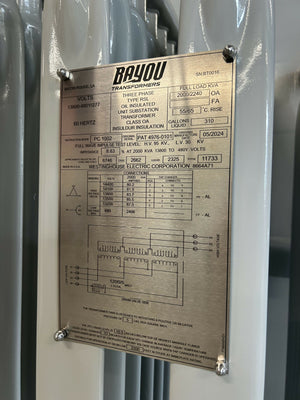
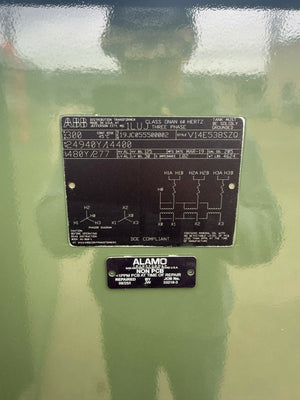
What to Check on the Nameplate and Which Standards Apply
Use the nameplate to confirm the transformer’s main ratings before you buy:
- Rated capacity (kVA) - It should match or be higher than your calculated load.
- Primary and secondary voltage - These need to match your supply voltage and equipment voltage.
- Frequency - For U.S. use, confirm a 60 Hz rating.
- Impedance - This affects voltage drop and fault current.
- Temperature rise - Make sure the rating fits the site temperature.
- Insulation class - This shows the winding insulation limit.
- Enclosure rating - It should fit the installation environment.
- Cooling class - Check that the cooling method fits the installation conditions.
- Tap changer range - Confirm the available voltage adjustment.
For compliance, check UL 1561 for dry-type units, DOE 10 CFR Part 431, and IEEE C57 documents. In the U.S., federal efficiency rules do not allow the sale of non-DOE-compliant distribution transformers. For a quick benchmark, DOE 2016 minimum efficiency levels are 97.70% for a 10 kVA dry-type transformer and 98.92% for a 100 kVA liquid-filled transformer.
Installation also falls under NEC Article 450, which covers clearances, overcurrent protection, and transformer placement. On top of that, your local Authority Having Jurisdiction (AHJ) and utility may have extra rules. It’s smart to confirm those details before you lock in the order.
If you’re dealing with high-harmonic loads, check that the nameplate shows the K-rating you need, such as K-4 or K-13.
How to Use Electrical Trader to Find the Right Transformer
At this stage, the job is simple: use the specs you already chose to cut through listings fast. On Electrical Trader, you can filter single-phase transformer listings by voltage, kVA, application, impedance, temperature rise, frequency, and enclosure.
When you open a listing, look past the headline. Check whether the unit is new or used, review the lead time, and confirm the shipping configuration and warranty terms. If the seller includes CAD files or dimensional drawings, download them before you buy. That extra minute can save a lot of pain later if the unit doesn’t fit the space you planned for.
Also review no-load and load losses. If the transformer will run for long stretches, lower losses can make a noticeable difference. Use those details to trim your shortlist before you order.
Conclusion: A Quick Checklist for Choosing a Single-Phase Transformer
Start with the load. Then check the electrical specs, confirm the physical fit, and review compliance before you buy. If you skip a step, you increase the odds of undersizing the transformer, running it too hot, or ending up with the wrong unit.
Use this checklist before you compare listings.
Quick checklist:
| Step | Action | Key Detail |
|---|---|---|
| 1. Load and kVA | Define the load and peak demand | Size for the connected load, then round up |
| 2. Voltage and type | Match input/output voltage and frequency | Pick isolation only when electrical separation matters |
| 3. Construction and environment | Choose dry-type or oil-immersed | Choose dry-type for indoor use; oil-immersed for outdoor or harsher sites |
| 4. Compliance and purchase | Check the nameplate and listing details | Verify nameplate ratings and required standards before buying |
A good rule of thumb: keep loading near 80% of the transformer’s rating to help extend its lifespan.
You can use these specs to compare listings on Electrical Trader and pick the unit that fits your load, voltage, site, and compliance needs.
FAQs
How do I size a transformer for motor startup current?
Account for the motor’s startup inrush. In many cases, it pulls 2 to 3 times its normal running current when it first kicks on. That short burst can trip a system if the transformer is too small.
For motors, pumps, and compressors, it’s smart to pick a transformer rated at 1.5 to 3 times the motor’s running power. That gives you more room during startup and helps cut down on overloads or nuisance trips.
After that, total up all running loads, add the motor surge, and leave a 20% to 30% margin for peak demand and future growth.
When should I choose a K-factor transformer?
Choose a K-factor transformer when your system serves non-linear loads, such as LED lighting or variable frequency drives (VFDs).
These transformers are built to handle the extra heat caused by the harmonic distortion this kind of equipment creates.
What happens if I oversize or undersize a transformer?
Choosing the right transformer size matters for both reliability and cost.
An undersized transformer can run too hot, struggle during peak demand, and put extra stress on the system. That can lead to damaged sensitive electronics, frequent outages, and a shorter lifespan for connected equipment.
An oversized transformer has its own downside. It can cost more upfront and waste energy, especially when loads stay low. That’s because larger units tend to be less efficient under light use and often come with higher no-load losses.