




Magnet-Free vs. Traditional Motors: Key Differences
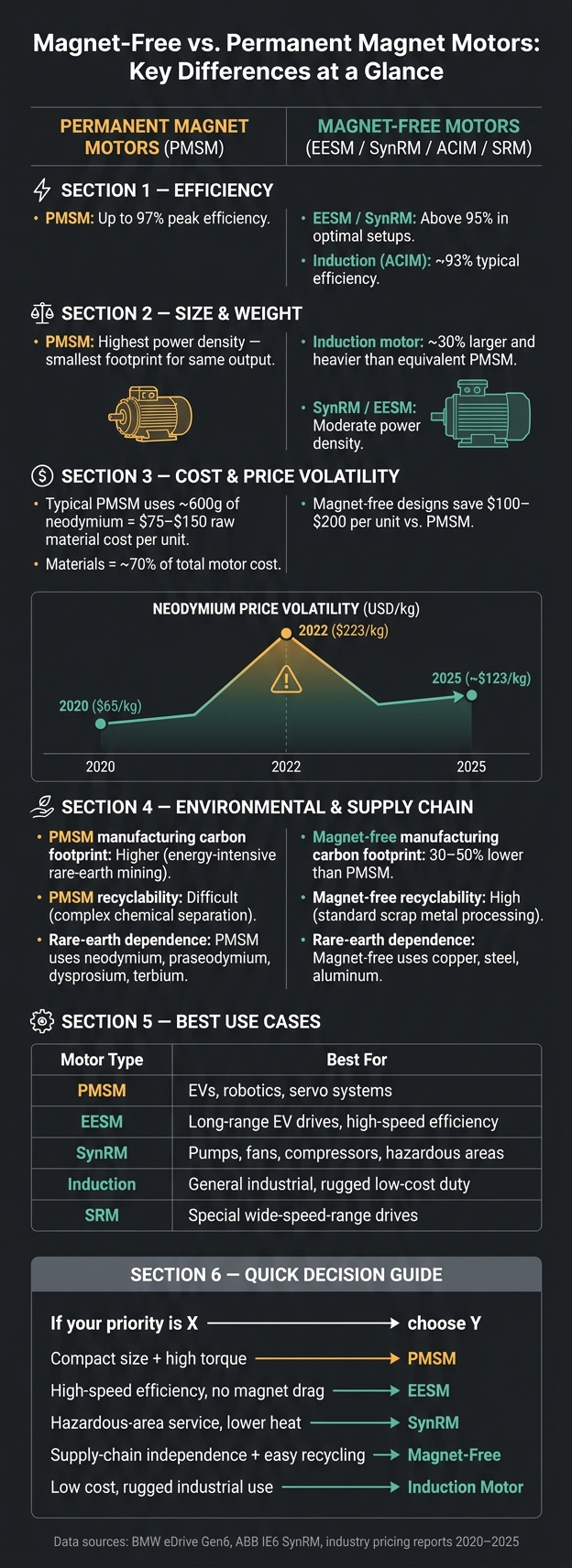
If you want the short answer: permanent-magnet motors are usually smaller and more power-dense, while magnet-free motors cut rare-earth risk, can lower lifecycle cost, and may perform better in some duty cycles.
When I compare these motor types, I look at four things first:
- Efficiency: PMSMs can reach about 97% peak efficiency, while magnet-free designs such as EESM and SynRM can also go above 95% in the right setup.
- Size and weight: An induction motor can be about 30% larger and heavier than a similar PMSM.
- Cost risk: Permanent-magnet motors often use about 600 grams of neodymium, and rare-earth pricing has moved from $65/kg in 2020 to $223/kg in 2022, then near $123/kg in 2025.
- Supply and end-of-life: Magnet-free motors avoid rare earths, use more common metals, and are often easier to recycle.
So the choice is pretty simple:
- Pick PMSM when you need small size and high torque density
- Pick EESM when you want high-speed efficiency without magnet drag
- Pick SynRM for long-duty industrial work, especially where heat matters
- Pick induction motors for rugged, lower-cost industrial use
Magnet-Free vs. Permanent Magnet Motors: Full Comparison Guide
Magnet-Free EV Motors Explained: SynRM, EESM, & Ferrite Technology
Quick Comparison
| Motor type | Main strength | Main trade-off | Best fit |
|---|---|---|---|
| PMSM | High efficiency and top power density | Rare-earth cost and supply risk | EVs, robotics, servo systems |
| Induction | Simple, rugged, common | Larger size and lower power density | General industrial duty |
| EESM / WRSM | High efficiency, no permanent magnets | More control and rotor-field hardware | Long-range EV drive systems |
| SynRM | Low losses, lower heat, no rare earths | Lower torque density than PMSM | Pumps, fans, compressors |
| SRM | Very wide speed range, no magnets | More control complexity and noise concerns | Special drive uses |
If I had to boil it down to one point, it’s this: motor design is a trade-off between compact performance and material risk. The right pick depends on whether you care more about footprint, uptime cost, speed range, or supply stability.
Performance and Efficiency: How the Two Compare
Efficiency changes with duty cycle, speed, and load. So there isn't one winner in every case. The main trade-offs look like this:
| Motor Type | Typical Efficiency | Torque Density | Speed Range | Control Complexity |
|---|---|---|---|---|
| PMSM | Very High (up to 97%) | Highest | Moderate to High | High |
| Induction (ACIM) | Moderate (~93%) | Low | Wide | Low to Moderate |
| SynRM | Very High (IE5/IE6) | Moderate | Wide | Moderate to High |
| EESM / WRSM | High (>95%) | Moderate to High | Very Wide | High |
| Switched Reluctance | Moderate to High | Moderate | Very Wide | Very High |
Why Magnet-Based Motors Often Have Higher Power Density
PMSMs have a simple edge here: the rotor field doesn't need excitation current. That means they avoid rotor copper losses and can stay smaller for the same power output.
In practice, an induction motor is usually about 30% larger and heavier than a similar PMSM. That's a big deal when space is tight, like in robotics or compact EVs. If you're trying to fit more performance into a small package, size and weight add up fast.
There is a catch, though. PMSMs also carry drag losses while coasting because the magnetic field is always there.
Where Magnet-Free Motors Stand Out
Magnet-free motors shine in a different part of the job. Externally excited synchronous motors can turn off the rotor field during coasting, which cuts drag losses and helps highway efficiency. BMW's sixth-generation EESM drives put out 140 to 360 kW, go past 95% efficiency, and use no permanent magnets.
You see the same pattern in industrial drives, where heat and efficiency across a broad speed range can matter just as much as raw power density. ABB's IE6 SynRM motor for hazardous areas cuts energy losses by up to 60% versus standard IE3 induction motors and may lower heat-related enclosure needs.
So no, magnet-free motors aren't better across the board. They tend to make more sense when runtime behavior matters more than peak power density, especially in long highway driving, wide-speed use, and thermally constrained industrial setups.
These performance gaps also affect purchase price and lifetime operating cost.
sbb-itb-501186b
Cost Breakdown: Purchase Price, Energy Use, and Ownership
Motor cost comes down to three things: purchase price, energy use, and maintenance. And once you look at total cost of ownership, efficiency can change the math in a big way. That’s where the gap between a permanent magnet motor and a magnet-free design starts to show.
| Cost Factor | Traditional Magnet-Based (PMSM) | Magnet-Free (SynRM / EESM) |
|---|---|---|
| Upfront Purchase Price | Higher - rare-earth magnets add cost | Lower - uses standard steel and copper |
| Price Stability | Volatile - tied to rare-earth markets | More stable - tied to base metal prices |
| Energy Use | Higher energy use | Lower energy use in continuous-duty service |
| Total Cost of Ownership | Often higher over the lifecycle | Often lower thanks to price stability and energy savings |
How Rare-Earth Materials Drive Price Volatility
Materials account for roughly 70% of motor cost. In permanent magnet motors, rare-earth pricing drives much of the movement. Neodymium and dysprosium do most of the damage here, and their pricing can swing hard.
Neodymium moved from $65/kg in 2020 to a peak of $223/kg in 2022, then settled near $123/kg in 2025. A typical PM traction motor uses about 600 grams of neodymium, which puts the raw material cost for that one element at about $75 to $150 per unit, depending on the market.
That kind of spread makes planning harder, especially for fleets and industrial buyers scaling up purchases. One year the numbers look fine. The next year, the budget gets hit from a direction no one likes.
Magnet-free designs avoid that issue. By removing rare-earth magnets, manufacturers can save $100 to $200 per unit. BMW also committed more than €1 billion ($1.08 billion) through 2030 to scale magnet-free EESM production at its Steyr, Austria plant, which started series production of its sixth-generation drives in July 2025.
When Energy Savings Offset a Higher Purchase Price
A higher upfront price doesn’t always mean a higher overall bill. If a motor runs for long hours each year, lower energy use can make up the gap.
In May 2026, ABB launched the world's first IE6-certified magnet-free SynRM motor for hazardous areas. Compared with a standard IE3 induction motor, it cuts energy losses by 60% and delivers long-term energy savings, with a payback period of just eight months.
For pumps, fans, compressors, and other long-duty loads, lifecycle cost matters more than the sticker price. That’s the part buyers can’t afford to skip.
Environmental Impact and Supply Chain Risk
Motor choice shapes more than efficiency. It also affects sourcing, carbon footprint, and what happens at end of life.
| Factor | Traditional Magnet-Based (PMSM) | Magnet-Free (SynRM / WRSM / Induction) |
|---|---|---|
| Rare-Earth Dependence | High - uses rare earths such as neodymium, praseodymium, dysprosium, and terbium | None - uses copper, steel, and aluminum |
| Manufacturing carbon footprint | Higher - driven by energy-intensive rare-earth mining and refining | 30%–50% lower than PMSM |
| Recyclability | Difficult - requires complex chemical separation of rare earths | High - conventional scrap metal processing |
Those material choices don't just shape supply risk. They also affect disposal and recycling.
Why Rare-Earth-Free Designs Matter for Sourcing
Rare-earth-free designs matter because they cut out a major supply headache. China's 2025 export controls tightened access to critical rare earths. On top of that, rare-earth mining and refining use a lot of energy and involve hazardous chemical processing.
Magnet-free motors avoid that dependency altogether instead of trying to manage around it. In May 2025, SGEM licensed AEM's rare-earth-free traction motors for manufacture in India after China's export curbs.
End-of-Life and Recycling: Key Differences
When a permanent magnet motor reaches the end of its service life, getting the rare-earth content back isn't simple. It requires chemical separation, and rare-earth recovery rates remain low.
Magnet-free rotors are much more straightforward. Copper windings in a wound-rotor design, aluminum bars in an induction motor, and electrical steel in a SynRM can all move through standard scrap recycling streams without special processing. That simpler material mix makes end-of-life handling easier.
Those lifecycle differences also shape which motor fits each application.
Choosing the Right Motor for the Job
There’s no one-size-fits-all motor. The best pick comes down to what the project needs most: a small footprint, steadier costs, long life, or fewer supply chain headaches.
Best Applications for Each Motor Type
Those trade-offs show up pretty clearly once you look at the use case.
Magnet-based motors (PMSM) are still the go-to option when space and weight matter most. Urban EVs, robotics, and precision servo systems get a lot from their high power density.
Magnet-free SynRM designs fit better when equipment runs nonstop, works in hazardous-area settings, or needs to avoid exposure to rare-earth supply risk. They operate at lower temperatures and work well in pumps, fans, and compressors used in chemical and oil & gas settings.
For long-haul EV use, externally excited synchronous motors (EESM) are getting more attention. They can exceed 95% efficiency and remove dependence on neodymium and dysprosium.
Key Takeaways for Buyers and Project Teams
This table makes the match-up simple:
| Priority | Best Motor Choice |
|---|---|
| Compact size, high torque density | Magnet-based (PMSM) |
| High-speed efficiency, no magnet drag | Magnet-free EESM |
| Hazardous-area service, lower heat | Magnet-free SynRM |
| Supply-chain independence, easier recycling | Magnet-free |
| Low-cost, rugged industrial duty | Induction motor |
FAQs
Which motor type is best for EVs?
PMSMs are still the most common choice in EVs. The reason is pretty simple: they pack a lot of power into a small package, and they run with strong efficiency. That mix helps car makers save space and get more range from the battery.
At the same time, magnet-free motors are starting to get more attention. They don’t rely on rare-earth materials, they can cut drag losses at highway speeds, and they may come with a lower impact on the planet. Which one makes more sense comes down to the vehicle’s range target, performance needs, and cost goals.
When is a magnet-free motor the better choice?
A magnet-free motor makes more sense when avoiding rare earth supply-chain risk is a top priority. It can also outperform permanent magnet motors at high speeds, especially during long highway trips, because it can be switched off and avoid drag losses.
It’s also a lower-cost option for industrial use in hazardous areas, including chemical plants and oil and gas processing.
How do rare-earth prices affect motor costs?
Rare-earth prices can have a big impact on motor costs. That’s because materials like neodymium, dysprosium, and terbium are key parts of the high-performance permanent magnets used in many motors.
When those prices climb, motor production gets more expensive. And that can happen for a few clear reasons:
- supply chain concentration
- export controls
- processing bottlenecks
Once costs start moving up, manufacturers often add risk premiums on top. That extra cushion can make their products less competitive, especially in price-sensitive markets.
This kind of price swing is also pushing many companies to look harder at magnet-free motor designs. The main draw is simpler: better long-term cost stability.





