




Why ASTM F2413 Matters for Electrical Safety
If you work near electricity, the right boot can help lower shock risk - but only if the label, condition, and jobsite all line up.
I’d sum it up like this:
- ASTM F2413 is the U.S. footwear standard for safety boots
- For electrical work, the key marking is EH = Electrical Hazard
- EH-rated footwear is tested at 18,000 volts, 60 Hz, for 1 minute
- To pass, leakage current must stay at or below 1.0 mA
- EH protection applies only in dry conditions
- It helps through the sole and heel only
- It does not replace lockout/tagout, insulated tools, gloves, or arc-rated PPE
That last point matters most. EH boots are a backup layer, not your main control.
I’d also check three things before trusting any pair:
- The label - look for ASTM F2413 and EH
- The condition - no cracks, thin soles, punctures, metal debris, or moisture
- The match - the boot has to fit the task and surface you work on
One mistake I’d avoid: mixing up EH and conductive footwear. EH resists current. Conductive footwear does the opposite.
Here’s the short version:
| Item | What it means |
|---|---|
| ASTM F2413 | Safety footwear standard |
| EH | Footwear tested to help reduce shock risk |
| Dry use only | Wet or dirty boots can lose insulating ability |
| Sole and heel only | No hand, tool, or full-body protection |
| Inspection before use | Damage can cancel out the rating |
So when I look at ASTM F2413, I don’t see a simple boot label. I see a pass/fail check on whether the footwear was tested, marked, and kept in a condition that still helps on the job.
The rest of this article breaks down what the marking means, where EH footwear helps, where it stops, and how to choose and inspect boots the right way.
ASTM & EH Ratings Explained | Nicks Handmade Boots
sbb-itb-501186b
What ASTM F2413 Covers and How to Read the Markings
ASTM F2413 sets the minimum design, performance, testing, and labeling rules for protective footwear. To comply, every pair has to pass impact resistance (I) and compression resistance (C) first. Only after that can any extra hazard ratings be added.
Core Protection Categories in ASTM F2413
The extra ratings cover hazards beyond basic toe protection. For electrical work, EH is the one that matters most. It uses non-conductive soles and heels to help resist current in dry conditions. Other common ratings include:
- PR = Puncture Resistance
- Mt = Metatarsal protection
- SD = Static Dissipative
- Cd = Conductive
EH and Cd mean opposite things. EH resists current. Cd conducts it. On a jobsite, mixing those up is a bad mistake.
The marking has to match the hazard. That label is the fastest way to confirm what the footwear was actually tested for. For electrical jobs, this matters even more, because the label tells you exactly what the boot is built to handle.
How to Read ASTM F2413 Labels
Each compliant boot has a permanent, legible label on at least one shoe. You’ll usually find it on the tongue, gusset, shaft, or lining. The label has three lines: the standard, the size designation, and the protection codes.
Read it one line at a time.
| Label Line | Example | What It Means |
|---|---|---|
| Line 1 | ASTM F2413-18 | The standard and year of issuance |
| Line 2 | M I/75 C/75 | Gender designation (M = Male, F = Female), impact rating (75 ft-lbs), compression rating (2,500 lbs) |
| Line 3 | EH PR Mt | Additional protections: Electrical Hazard, Puncture Resistant, Metatarsal |
Line 1 tells you which revision of the standard the boot was tested under. If you’re buying for a crew, that small detail can save a lot of trouble by helping you avoid footwear tested to an older version.
One more thing: aftermarket insoles or footbeds can void the rating.
The EH marking helps reduce shock risk only in dry conditions. The next section explains where that protection applies and where it stops.
Electrical Hazards the EH Rating Helps Reduce
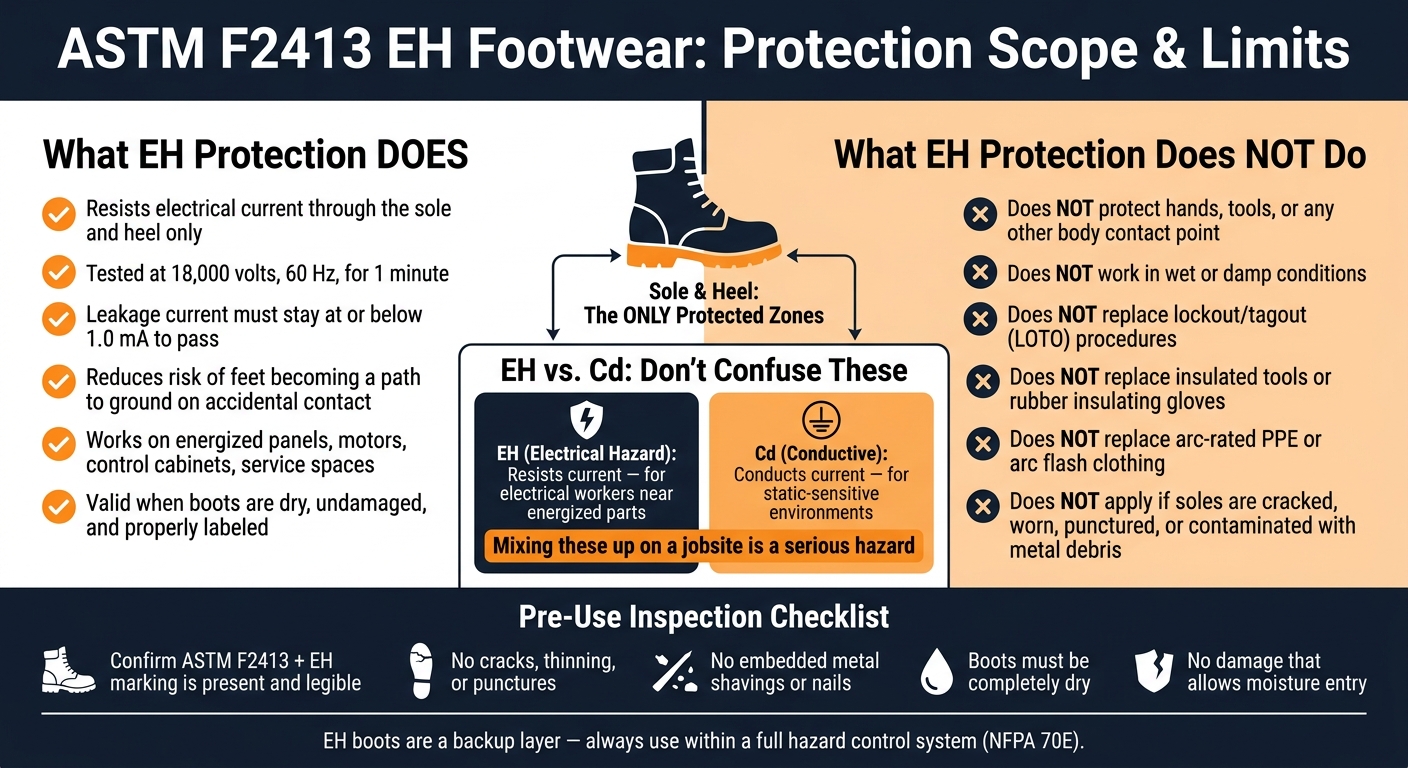
ASTM F2413 EH Boot Rating: What It Protects and What It Doesn't
EH footwear is built to lower one specific risk: your feet becoming part of an electrical path to ground after accidental contact with energized parts. That’s the job it’s meant to do.
Once you confirm the EH mark on the label, the next step is simple but important: check whether the conditions on the job still allow that protection to work as intended.
Common Jobsite Situations Where Shock Exposure Can Occur
Shock exposure isn’t limited to high-voltage substations. It can show up in everyday work areas too, including:
- Energized panels
- Service spaces
- Motors
- Control cabinets
- Field equipment
In each of these settings, accidental contact can turn the body into a path to ground.
What EH Protection Does and Does Not Do
EH boots are rated for accidental contact in dry conditions. They are not meant for working on live parts. Moisture, wear, and conductive contamination can reduce insulation and weaken protection.
There’s another limit that matters: EH protection works only through the sole and heel. It does not protect your hands, tools, or any other point of contact. That’s why it needs to be used alongside LOTO, insulated tools, and insulating gloves.
So even if the label checks out, that doesn’t mean you’re automatically covered. Selection and inspection are part of the safety check, not something to tack on later.
Why Compliance Matters and How to Choose the Right Footwear
Once you know what EH can and can’t do, the next step is checking the boot’s certification and condition. The wrong pair can leave a clear safety gap on electrical jobsites. If the boot isn’t certified, its electrical protection hasn’t been verified.
Noncompliant Footwear vs. ASTM F2413-Aligned Footwear
Compliance isn’t always obvious at a glance. A boot can look tough and still offer no verified electrical protection.
The simple check is this: the boot either has valid ASTM F2413 markings or it doesn’t.
| Footwear Status | Characteristics | Associated Risks |
|---|---|---|
| Noncompliant | Missing ASTM labels, casual work-style boots, unverified "safety" claims | No verified EH protection; increased shock risk |
| Damaged | Worn-down soles, embedded metal debris, cracks in the heel, or punctures | Compromised insulation; current can bypass the protective sole |
| ASTM F2413-Aligned | Permanent ASTM label with EH designation and intact, nonconductive sole and heel | Tested to withstand 18,000 volts in dry conditions |
How to Choose Footwear for Electrical Work Conditions
Once you confirm the label, the next move is matching the boot to the work. Check for a permanent EH label before you buy. After that, look at the job conditions.
Composite toes are a better fit for electrical work than steel toes. For flat surfaces, wedge soles make more sense. For ladders or uneven ground, go with a defined heel. And one rule matters most: use EH boots only in dry conditions.
Inspection, Maintenance, and the Limits of ASTM F2413
Picking the right boot is only the first step. After that, the day-to-day checks matter just as much. A boot can start out meeting the standard and later lose that protection through wear, damage, or moisture.
What to Inspect Before Use
Inspect every pair before each shift. If boots are worn or damaged, they no longer provide verified protection.
| Inspection Point | Risk if Neglected |
|---|---|
| Sole, heel, and upper condition | Wear, cracks, or moisture reduce insulation and shorten service life |
| Embedded metal debris | Metal shavings or nails create a conductive path through the sole, defeating EH protection |
| Moisture present | Wet boots reduce shock resistance |
| Upper damage | Lets moisture in and weakens overall boot integrity |
| ASTM label legibility | If the label is missing or unreadable, compliance can't be verified |
Store boots in a dry place. If the soles are thin, cracked, or punctured, replace the boots right away.
That said, even a well-kept EH boot has limits. You still need to match footwear to the full job hazard assessment.
When ASTM F2413 Is Not Enough
EH footwear is just one control in the system. The EH rating is a backup layer, not a stand-in for LOTO, insulated tools, gloves, and training.
Lockout/tagout (LOTO) procedures, rubber insulating gloves, insulated tools, and arc-rated clothing all belong in the mix. If the hazard assessment shows voltages above the 18,000-volt EH test threshold, dielectric over-boots add another layer of insulation. NFPA 70E lays out the broader framework for choosing the right mix of controls, and footwear is only one part of that system.
Conclusion: Key Reasons ASTM F2413 Matters
ASTM F2413 gives workers a clear benchmark for footwear selection. EH boots help reduce shock risk only when they are inspected, matched to the job, and used along with other controls.
FAQs
How do I verify an EH boot label?
Check the permanent label on the tongue, gusset, shaft, or quarter lining. It should clearly show ASTM F2413 or ASTM F2892 and include the EH mark, such as ASTM F2413-24 I/75 C/75 EH.
If the ASTM version, the EH mark, or the certification line is missing, treat the footwear as unverified. And make it a habit to inspect the soles every day for damage or metal debris.
When should EH boots be replaced?
Inspect EH-rated boots every day for signs of damage. Check for cracks in the soles, thinning leather, worn tread, or conductive dirt and debris. Their protection relies on the condition of the soles and heels, so visible wear can lower electrical resistance.
Some recommendations suggest replacing them every 6 to 12 months. But if you spot wear or damage that could affect safety standards, replace them right away.
Do EH boots protect in wet conditions?
No. Electrical Hazard (EH) boots are tested only under dry lab conditions, so you can't count on them in wet settings.
Water, sweat, and wet ground can weaken their insulating properties and cut down how much protection they provide. If you're working in wet areas with step-potential hazards, use specialized dielectric (DI) footwear instead.





