

Electrical Glove Testing: What to Know
Electrical glove testing ensures worker safety by verifying that insulating gloves can protect against electric shock and arc flash hazards. These gloves are mandatory for tasks involving live circuits over 50 volts, as per OSHA regulations. Neglecting proper testing can lead to glove failure, exposing workers to life-threatening risks.
Here’s what you need to know:
- Testing Frequency: Gloves must be tested before first use and every six months thereafter. Unused gloves must be retested if not put into service within 12 months.
- Inspection: Daily visual and air-inflation checks are required to identify visible damage or leaks.
- Standards: OSHA 1910.137 and ASTM D120 set the rules for glove safety, while ASTM F496 outlines retesting and maintenance protocols.
- Voltage Ratings: Gloves are classified into six classes (00 to 4), each designed for specific voltage levels, with higher classes offering greater protection.
- Storage: Store gloves in a cool, dry place, away from sunlight, ozone, and chemicals to prevent degradation.
Proper testing, inspection, and storage are essential for maintaining glove reliability and protecting workers from electrical hazards. Regular compliance with these guidelines can save lives and prevent workplace injuries.
Testing Electrical Rubber Gloves and Tips For a Successful Glove Safety Program
sbb-itb-501186b
Testing Requirements and Standards
In the United States, electrical glove safety relies heavily on two main regulatory pillars: OSHA workplace safety rules and ASTM technical standards. Together, they create a robust framework for testing and maintaining gloves to shield workers from electrical risks.
OSHA Testing Frequency
OSHA enforces a six-month retesting cycle for all rubber insulating gloves once they’re put into service. This schedule is designed to catch any wear or damage before it poses a threat. Mike Enright from Enespro PPE explains:
Once in use, the rubber voltage rated gloves must be retested every 6 months and, if they pass, the gloves are stamped with the new test date or expiration date and put back into service for another 6 months.
The clock starts ticking even before the gloves are used. New gloves must enter service within 12 months of their initial test date, or they’ll need to be retested. There’s a slight exception for the telecommunications industry - gloves used as precautionary protection can stretch the interval to nine months between issue and retesting.
Insulating sleeves follow a different rule, requiring retesting every 12 months once they’re in service. Beyond these formal schedules, OSHA also emphasizes the importance of a daily visual and air-inflation inspection before each use. This simple step is critical for catching issues like tears or punctures that could lead to failure.
While OSHA sets the testing frequency, ASTM standards dive deeper into the technical details of glove manufacturing and testing.
ASTM Standards for Compliance
ASTM standards complement OSHA’s requirements by defining the technical specifications for both glove production and maintenance. ASTM D120 lays out the essential properties - electrical, chemical, and physical - that rubber insulating gloves must meet to provide effective voltage protection.
Building on this, ASTM F496-23 focuses on ongoing care, inspection, and retesting protocols. A key feature of this standard is the "margin of safety" it enforces, requiring retest voltages to far exceed the gloves’ maximum use voltage. For instance, Class 0 gloves rated for 1,000 volts must handle 5,000 volts during alternating current (AC) retesting.
ASTM standards also classify gloves into Type I (non-ozone resistant) and Type II (ozone resistant), with six voltage classes ranging from Class 00 to Class 4. During testing, gloves must endure the retest voltage for a continuous period of at least one minute but no more than three minutes. Additionally, air-drying temperatures during testing cannot exceed 150°F (65°C).
Strict labeling rules are another cornerstone of ASTM standards. Every glove must feature a permanent, color-coded label displaying the manufacturer, ANSI/ASTM standard, class, type, and maximum use voltage. This labeling ensures workers can quickly confirm they’re using gloves suited for the voltage they’ll encounter on the job.
How to Inspect and Test Electrical Gloves
Testing electrical gloves involves both daily inspections and biannual laboratory dielectric tests. These steps are essential for identifying damage that might not be visible during a simple visual check.
Visual and Air Inflation Inspection
Start with a visual inspection before each use. Look for any obvious signs of damage, such as tears, punctures, cuts, embedded debris, or discoloration caused by chemicals. These issues could compromise the glove's safety.
Next, perform an air inflation test to detect leaks that aren’t visible. Here's how: roll the glove cuff inward to trap air inside, creating pressure. Then, gently squeeze the glove and check for any air escaping or swelling that could indicate a leak. This quick test takes less than a minute per glove and can prevent serious risks, like electrical shock.
Dielectric Strength Testing
While daily checks are essential, they only catch surface-level issues. Laboratory dielectric testing, on the other hand, goes deeper, identifying hidden faults that could pose serious dangers.
The testing process begins with a 16-hour immersion of the gloves in water to condition the rubber. Afterward, each glove is filled with water and submerged in a water tank, where the water serves as an electrode to ensure even electrical contact across the glove’s surface.
The lab then conducts a proof test, measuring leakage current for three minutes with AC power or one minute with DC power. Following this, a withstand test applies a higher voltage to confirm the glove can handle stress without electrical punctures. This thorough process can uncover microscopic defects, chemical damage, or ozone-related wear - issues that visual inspections might miss.
If a glove shows any physical defects, do not attempt repairs. Gloves with such issues will fail laboratory testing and must be removed from use.
Glove Classes and Voltage Ratings
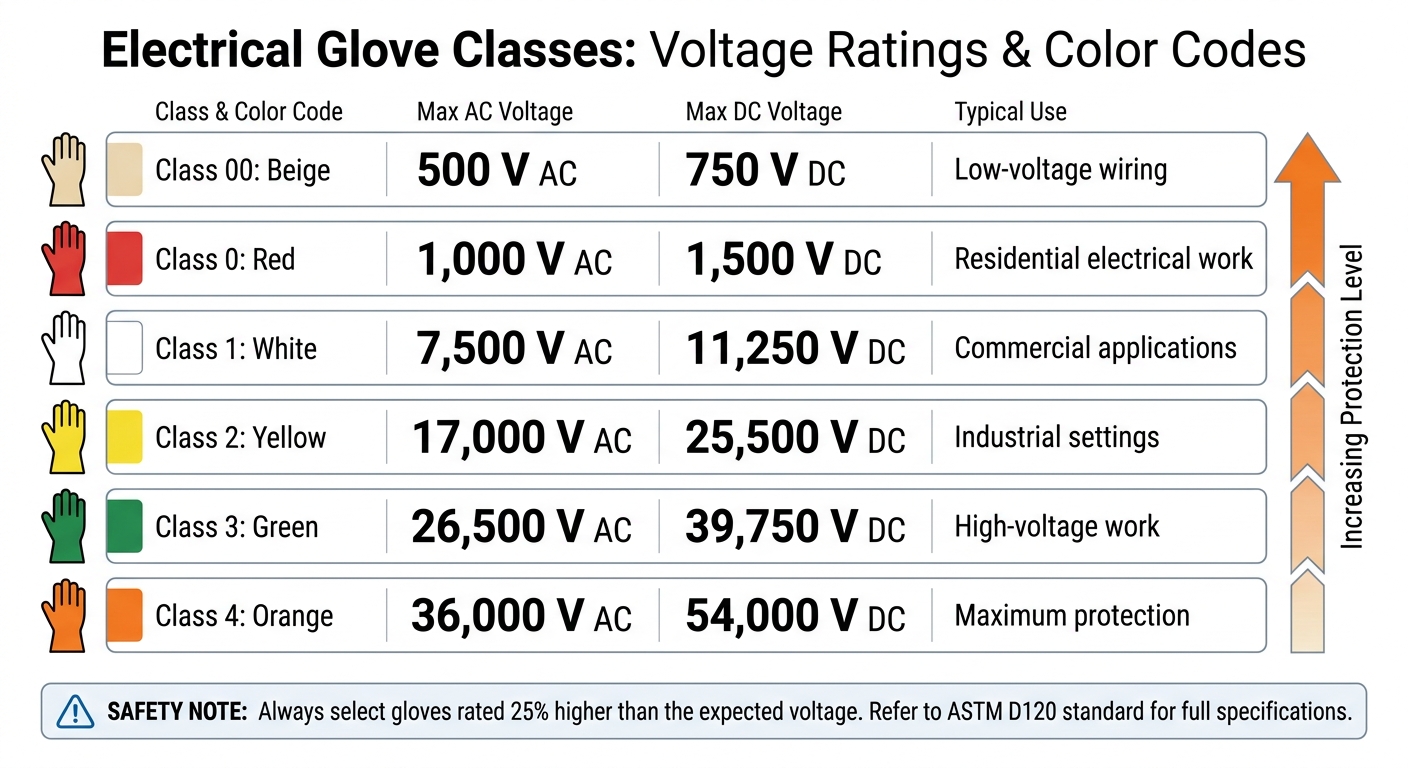
Electrical Glove Classes and Voltage Ratings Chart
When it comes to electrical safety, knowing the right glove class is just as important as regular inspections. The correct gloves ensure you're properly equipped for the electrical demands of your work.
Understanding Glove Classes
Electrical gloves are categorized into six classes - 00, 0, 1, 2, 3, and 4 - based on the maximum voltage they can handle safely. These classifications are set by ASTM D120 standards in the U.S., ensuring consistent protection across different brands.
Each class is identified by a specific color-coded label:
- Class 00 (Beige): Protects against up to 500 V AC and 750 V DC, ideal for low-voltage wiring.
- Class 0 (Red): Handles up to 1,000 V AC and 1,500 V DC, commonly used in residential electrical work.
- Class 1 (White): Rated for up to 7,500 V AC and 11,250 V DC.
- Class 2 (Yellow): Suitable for up to 17,000 V AC and 25,500 V DC.
- Class 3 (Green): Protects against up to 26,500 V AC and 39,750 V DC.
- Class 4 (Orange): Designed for up to 36,000 V AC and 54,000 V DC.
To ensure safety, these gloves undergo proof testing at voltages much higher than their rated maximum use. This extra layer of testing provides a critical safety margin.
Once you're familiar with these classifications, choosing the right glove for your task becomes straightforward.
Selecting the Right Glove for the Job
Choosing the correct glove starts with knowing the maximum voltage you'll encounter. OSHA regulation 29 CFR 1910.37 mandates that all equipment must be rated for the specific electrical exposure you're working with. As a rule of thumb, always go for gloves rated at least 25% higher than the expected voltage.
The work environment also plays a key role. Gloves come in two types:
- Type I: Made from natural rubber, these gloves are not ozone-resistant.
- Type II: Made from synthetic rubber, they resist ozone, oil, and acid.
In wet conditions, always use leather protectors over rubber gloves. This not only helps maintain a firm grip but also prevents the leather from becoming a conductor. Additionally, ensure proper cuff gap clearance to avoid electrical tracking: 0.5 inches for Classes 00 and 0, and up to 4 inches for Class 4.
"Rubber insulating gloves are the first line of defense, providing protection against shock and electrocution when contacting energized electrical parts and equipment." – Rich Gojdics, Enespro PPE
Storage and Retesting Guidelines
Maintaining the safety and performance of gloves goes beyond just selecting and testing them. Proper storage and regular retesting are key to ensuring their reliability over time.
Proper Glove Storage
Where and how you store gloves can significantly affect their durability and safety. According to ASTM F496, gloves should be kept in a cool, dark, and dry environment, away from ozone, chemicals, oils, solvents, and electrical discharges. The temperature in the storage area should never exceed 95°F (35°C).
"Proper storage extends the service life of linemen's gloves and sleeves. Folds and creases strain rubber and cause it to crack from ozone prematurely." – Honeywell/Salisbury
To prevent unnecessary wear, always store gloves in their natural shape with the right side out. Placing them in a storage bag? Make sure to insert them gauntlet first and only store one pair per bag, ensuring they lie flat. Also, remember to remove leather protectors before bagging rubber insulating gloves.
Keep gloves away from sunlight, heat, and moisture. Avoid prolonged storage in recovery vehicles, as extreme temperatures and humidity in these settings can drastically reduce their lifespan.
While proper storage is essential, periodic retesting is equally important for continued safety.
Periodic Retesting Requirements
The frequency of retesting depends on how often the gloves are used and their overall condition. For gloves that have been stored unused for long periods, retesting is necessary before returning them to service. At a minimum, gloves should be retested every six months. If there are signs of deterioration - such as hardening, brittleness, loss of elasticity, or discoloration - remove them from service immediately.
Manufacturers often suggest replacing gloves entirely every 1 to 2 years, as exposure to ozone and UV rays leads to unavoidable degradation over time.
Here’s a quick summary of key storage and retesting guidelines:
| Storage Factor | Requirement |
|---|---|
| Temperature | Below 95°F (35°C) |
| Light | Dark location; no direct sunlight |
| Orientation | Natural shape; gauntlet first; no folds |
| Contaminants | Free from ozone, oils, solvents, vapors |
| Retesting | Minimum every 6 months once in service |
Conclusion
Thorough testing, careful inspections, and consistent maintenance are key to protecting workers from high-voltage dangers. These practices, as outlined in this article, play a critical role in improving safety for electrical workers who face considerable risks. Electrical accidents are responsible for nearly half of all fatal and serious injuries among utility workers, with approximately 74 fatalities and 444 serious injuries occurring each year in electric power generation, transmission, and distribution work.
"The risk of electric shock to an electric power line worker or cable repairer performing his or her routine duties is far greater than that faced by any other occupational group." - Occupational Safety and Health Administration (OSHA)
Following OSHA 1910.137 and ASTM F496 standards is crucial to ensuring gloves retain the dielectric strength needed to shield against high-voltage hazards. While visual and air-inflation inspections can identify visible defects, only regular dielectric testing can detect tiny punctures or deterioration that might otherwise go unnoticed but could lead to catastrophic failure.
Proper storage and scheduled retesting are equally important in preventing injuries and saving lives, ensuring that equipment functions reliably when it's needed most. OSHA estimates that preventing a single workplace fatality saves $8.7 million, while avoiding an injury saves an average of $62,000. These figures highlight not just the financial impact but also the profound human importance of adhering to safety standards. By staying compliant, electrical industry professionals safeguard both lives and livelihoods.
FAQs
Can I test electrical gloves in-house or only at a lab?
You can test electrical gloves yourself if you have the right equipment and follow the proper steps. That said, most gloves are sent to specialized labs for testing to ensure they meet safety and compliance standards. Lab testing follows strict regulations and offers a more dependable level of accuracy.
What should I do if a glove fails the air-inflation check?
If a glove doesn't pass the air-inflation check, take it out of service right away. Carefully inspect it for any signs of damage and decide whether it needs to be repaired or replaced, following all necessary compliance guidelines. Make sure the gloves meet safety standards before putting them back into use.
How do I choose the right glove class for my job voltage?
To pick the right glove class, make sure the gloves have been tested and rated for the voltage level you'll be working with. Each glove class is designed to handle a specific maximum voltage safely, as outlined by established standards. Always verify that the gloves are rated to cover at least the voltage in your work environment and meet all required safety standards for adequate insulation and protection.