Top Challenges in Battery Recycling for Grid Storage
Recycling grid-scale batteries is becoming a pressing issue as demand for renewable energy storage rises. By 2030, over 318 GWh of lithium-ion batteries will reach their end-of-life, but only 10% are recycled today, leaving 90% to contribute to waste fires and environmental damage. Here's a quick breakdown of the main challenges and potential solutions:
Key Challenges:
- Diverse Designs: Lack of standardization in battery formats and chemistries makes recycling complex and inefficient.
- Limited Facilities: Current recycling infrastructure can't handle the growing volume of retired batteries.
- High Costs: Recycling is often more expensive than mining new materials, especially for low-value chemistries like LFP.
- Safety Risks: Handling and transporting used batteries involves risks like fires and toxic leaks.
- Environmental Impact: Current recycling methods, such as pyrometallurgy and hydrometallurgy, are energy-intensive and generate waste.
Potential Solutions:
- Standardization: Industry collaboration to create uniform designs and labeling (e.g., battery passports).
- Government Support: Regulations, grants, and mandates for recycled content to boost recycling capacity and profitability.
- Process Innovation: Direct recycling and closed-loop systems to reduce costs and waste.
- Safety Protocols: Improved handling practices, monitoring systems, and fire-resistant storage for used batteries.
If the industry doesn't act quickly, the growing wave of retired batteries could lead to a waste crisis. By addressing these challenges with a mix of collaboration, regulation, and technology, recycling can become a key part of renewable energy's future.
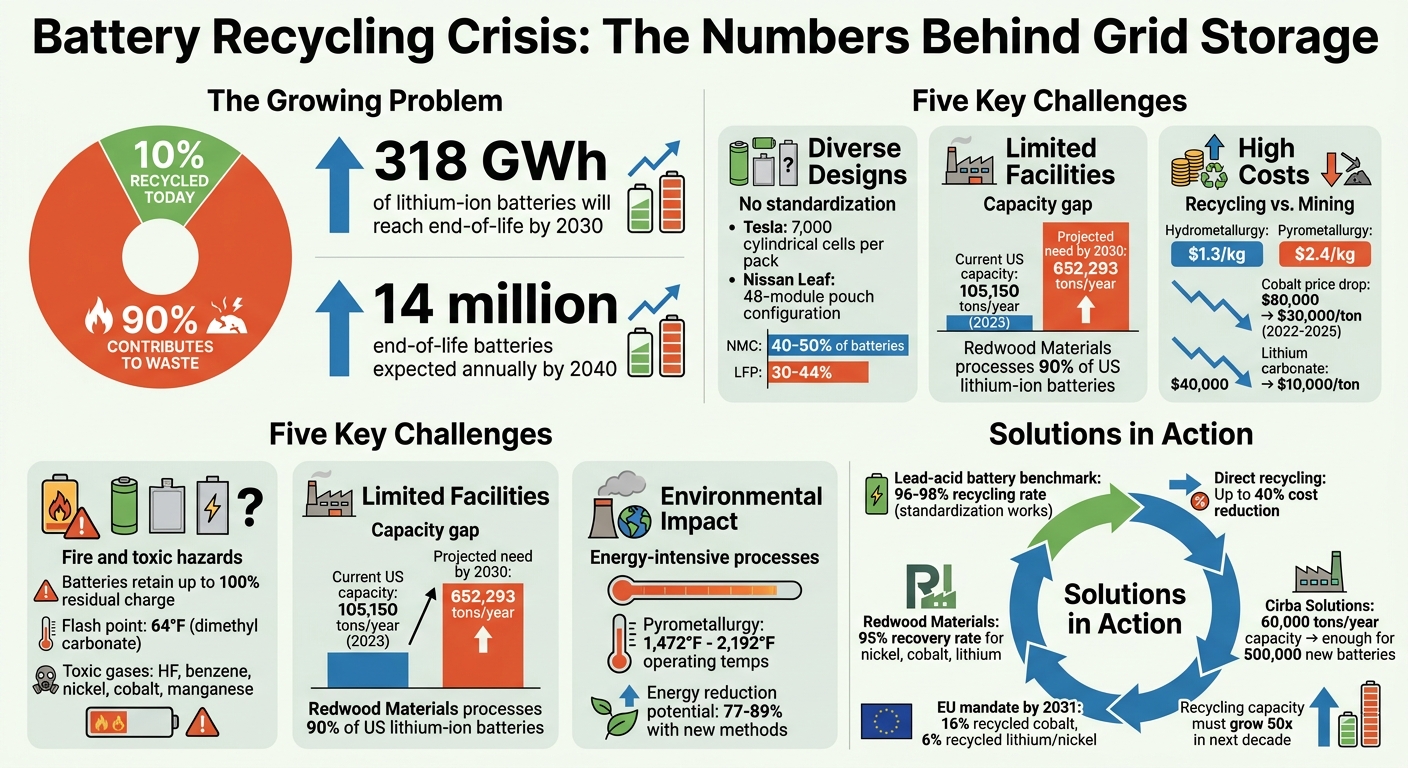
Battery Recycling Crisis: Key Statistics and Challenges for Grid Storage by 2030
Battery Forum: Direct Recycling a Shorter Path to New Batteries with Argonne National Laboratory
sbb-itb-501186b
Challenge 1: Different Battery Designs and No Standard Format
Battery manufacturers prioritize performance over recyclability, leading to a major issue: the sheer variety in battery designs. Each manufacturer uses unique pack architectures, cell formats, and chemical compositions, making recycling a logistical headache.
The physical differences are striking. For instance, some manufacturers rely on cylindrical cells, like Tesla's 2170 format, which can include up to 7,000 individual cells per battery pack. Others use pouch cells, such as the Nissan Leaf’s 48-module configuration, or prismatic formats. Each type demands its own disassembly process, which becomes even more complicated when you factor in the added reinforcements, thermal systems, and electronics. These components are often held together by welding, wire bonding, or adhesives, making them incredibly difficult to separate.
Then there’s the chemical diversity. By 2024, NMC-based cathodes make up about 40–50% of lithium-ion batteries, while LFP accounts for 30–44%. Recycling processes must be tailored to each chemistry, as mixing them can lower material purity and reduce economic returns. A process designed for cobalt-rich NMC batteries, for example, won’t work as effectively for LFP chemistries, which have lower material value.
To make things worse, the lack of standardized labeling adds another layer of complexity. Without clear identification protocols, recyclers often struggle to determine a battery’s chemistry, health, or residual charge. This not only creates inefficiencies but also increases safety risks. As manufacturers shift toward lower-value chemistries with less cobalt, recyclers face added challenges, as their profitability depends on recovering high-value materials.
Standardizing battery design would go a long way in reducing waste and improving recycling efficiency, especially for large-scale storage systems. Tackling this fragmentation is key to making recycling more practical, as discussed in the next section.
Solution: Create Industry Standards Through Collaboration
The solution lies in industry-wide collaboration to establish design standards. Lead-acid batteries, for example, achieve a recycling rate of 96–98% because their design and chemistry have been standardized for over a century. Lithium-ion batteries need a similar approach to achieve comparable results.
One major step is incorporating "design-for-disassembly" principles into battery architecture. This involves modular designs with mechanical fasteners instead of permanent adhesives or welds, making disassembly safer and more cost-effective. Additionally, standardized labeling and digital identification systems - often referred to as "battery passports" - can help recyclers quickly identify a battery’s chemistry and condition, reducing sorting errors and safety risks.
Regional cooperation is also crucial. Building recycling facilities near manufacturing hubs can cut down on transportation costs and emissions associated with handling hazardous, non-standardized battery waste. Sharing Battery Management System (BMS) data, such as state of health, temperature history, and charging patterns, can further streamline the recycling process. This data sharing could significantly lower testing costs, which currently range from $10 to $40 per kWh for detailed sorting.
Challenge 2: Not Enough Recycling Facilities
The U.S. is grappling with a major shortfall in battery recycling infrastructure. By late 2023, the country’s total recycling capacity was around 105,150 tons per year - far below what's needed to handle the growing number of end-of-life batteries. While planned projects could increase capacity to over 652,293 tons per year by 2030, most facilities are underperforming due to diverse battery designs and operational inefficiencies. This gap poses a significant challenge as the volume of retired batteries begins to climb.
The problem is compounded by a vicious cycle in facility development. Recycling companies need large volumes of batteries to justify the high costs of building facilities, but those volumes are still years away. Most grid-scale and EV batteries sold in the last decade are still in use, meaning that today’s recycling feedstock primarily comes from manufacturing scrap, such as offcuts and defective cells, instead of actual end-of-life batteries. This reliance on scrap is expected to persist until around 2030, when retired battery volumes are projected to surge.
The financial side doesn’t make things any easier. Hydrometallurgical plants require 7,000 tons per year, and pyrometallurgical plants need 17,000 tons per year to break even, making it hard to sustain operations with low volumes. For example, Redwood Materials currently processes about 90% of lithium-ion batteries recycled in the U.S., underscoring how concentrated - and limited - the industry is.
"Building a battery recycling industry, when the Western battery manufacturing industry is still in its infancy, is very difficult." - Luke Sweeny, Senior Battery Recycling Analyst, Fastmarkets
The shift to LFP (lithium iron phosphate) batteries adds another layer of difficulty. Unlike other batteries, LFP cells don’t contain high-value metals like cobalt and nickel, which recyclers depend on to make a profit. Without subsidies, recycling LFP batteries in the U.S. is financially unsustainable, leaving China as the dominant player in this area. At the same time, fierce competition among shredders for limited materials has driven up acquisition costs, further squeezing refiners’ already thin margins.
Solution: Government Regulations and Financial Incentives
To overcome these economic and capacity challenges, government intervention is critical. Regulatory mandates paired with financial incentives can help close this gap. The lead-acid battery industry offers a proven example. With a 99% recycling rate in the U.S., lead-acid batteries operate in a closed-loop system supported by decades of regulations and efficient collection infrastructure.
Government funding has already started to expand recycling capacity. In August 2025, Cirba Solutions expanded its lithium-ion battery recycling facility in Columbia, South Carolina, with the help of a $200 million DOE grant. This plant is capable of processing 60,000 tons of used batteries annually, producing enough battery-grade salts for about 500,000 new batteries each year. Similarly, Redwood Materials secured a $2 billion conditional loan from the DOE to grow its 32-acre recycling facility in Sparks, Nevada. This site processes 60,000 metric tons of material annually and achieves a 95% recovery rate for nickel, cobalt, and lithium.
"I think that battery recycling is a phenomenal tool to provide support for enhancing national security and the critical mineral supply, and it's also a job creator." - Danielle Spalding, Vice President of Communications and Public Affairs, Cirba Solutions
In addition to grants, mandates for recycled content can create a stable market. The European Union has set a benchmark requiring that by 2031, all new batteries must include at least 16% recycled cobalt and 6% recycled lithium and nickel. The U.S. is following suit through the Inflation Reduction Act, which ties up to $7,500 in EV tax credits to sourcing minerals domestically, including those recovered through North American recycling. These policies ensure demand for recycled materials, making it easier for facilities to invest in expansion.
Reclassifying lithium-ion batteries as "universal waste" - similar to lead-acid batteries - could also simplify federal and state requirements for collection, storage, and transport. This would reduce administrative hurdles and liability risks. Combined with financial support during this low-volume period, such changes could help bridge the gap until end-of-life battery volumes are high enough to sustain profitable operations.
Challenge 3: Recycling Costs More Than Mining New Materials
Recycling lithium-ion batteries is more expensive than extracting new materials. For instance, hydrometallurgical recycling costs about $1.3 per kilogram of battery processed, while pyrometallurgy - operating at extreme temperatures between 1,472°F and 2,192°F - runs around $2.4 per kilogram due to its high energy demands. These costs eat into profit margins, especially during periods of falling commodity prices, which makes the economics of recycling even tougher.
The volatility of commodity prices further complicates the situation. Between April 2022 and May 2025, cobalt prices dropped dramatically from over $80,000 per ton to roughly $30,000 per ton. Similarly, lithium carbonate prices fell from more than $40,000 per ton to around $10,000 per ton. Such steep declines make it challenging for recyclers to compete with cheaper virgin materials, as their operational costs remain high.
The shift to cobalt-free battery chemistries also reduces the financial incentive to recycle. Historically, cobalt has been the primary driver of recycling profitability due to its high value and ease of recovery. However, with manufacturers moving toward lithium iron phosphate (LFP) or high-nickel chemistries like NMC 811, the value of recoverable materials has significantly decreased. Lithium extraction is more complex and less lucrative, and materials like manganese and graphite often lack economic viability unless mandated by regulations.
Transportation and disassembly costs add another layer of complexity. End-of-life batteries are often classified as hazardous waste, requiring specialized handling to prevent risks like thermal runaway or toxic leaks. Once at a facility, batteries must be manually dismantled - a process that is both labor-intensive and dangerous. Adding to the challenge, batteries are designed for performance and energy density, not for easy disassembly, which drives up labor costs. For batteries repurposed for grid storage, additional steps like sorting and certification can cost between $50 and $120 per kWh.
Another hurdle is the low volume of retired batteries, which limits the ability of recycling facilities to achieve economies of scale. Hydrometallurgical processes require a minimum of 7,000 tons per year to break even, while pyrometallurgy needs around 17,000 tons annually. Until the volume of end-of-life batteries increases - which is expected to happen around 2030 - recyclers face financial strain as they compete with cheaper, newly mined materials.
Solution: Make Recycling More Profitable
Boosting the profitability of recycling requires innovation and smarter market strategies. One promising approach is direct recycling, which restores cathode functionality and can cut costs by up to 40%. This makes recycled materials far more competitive with mined alternatives.
Process improvements are already making a difference. In 2021, Redwood Materials developed an industrial-scale method that combines reductive calcination, mechanical separation, and hydrometallurgy. This approach reduced energy use by 77.1% to 88.7% compared to traditional mining refinement, while converting mixed lithium-ion batteries into battery-grade salts like Li₂SO₄ and (Ni,Co)SO₄. These advancements show that recycling, when done efficiently, can rival or even outperform the economic and environmental impact of conventional mining.
Another strategy is upcycling. Instead of producing basic salts that require multiple processing steps, recycling facilities can focus on generating precursor cathode active material (pCAM) directly. This reduces chemical treatment steps and improves profit margins. Additionally, using organic acids like citric or malic acid in hydrometallurgical processes can lower equipment corrosion and cut hazardous waste treatment costs.
Regulatory measures are also helping to stabilize the market for recycled materials. Policies like those in the U.S. Inflation Reduction Act ensure consistent demand, even during periods of fluctuating commodity prices. As the volume of retired batteries grows, recycling costs are expected to decrease, following Wright's Law, with a projected 10% cost reduction for every doubling of capacity. Advances in automation and strategically locating facilities near collection hubs further improve the economics of recycling. While these innovations boost profitability, challenges like safe handling and disassembly still need to be addressed to make recycling a fully viable solution.
Challenge 4: Safety Risks in Handling and Transport
Transporting spent batteries from collection points to recycling facilities is a risky process. Even when labeled as unusable, end-of-life batteries often retain a residual charge - sometimes up to 100%. This leftover energy poses constant risks, including uncontrolled discharges, localized overheating, and internal short circuits during handling or transit. These risks become even greater as batteries degrade over time.
One of the most serious threats is thermal runaway. This is a self-sustaining reaction that generates extreme heat, potentially leading to fires or explosions. Older batteries are especially prone to this due to internal micro-cracks, damaged separators, and weakened cells - issues that may not be visible externally. Mechanical shocks, punctures, or rough handling during loading can further increase the risk by triggering internal short circuits. Adding to the danger, many lithium-ion batteries contain flammable electrolyte solvents like dimethyl carbonate, which has a flash point as low as 64°F, making it highly flammable at room temperature.
If a battery catches fire, it releases toxic gases that are harmful to health. For example, hydrogen fluoride (HF) is both corrosive and highly toxic. Fires can also emit benzene and harmful fumes containing nickel, cobalt, and manganese. When stored or transported in large quantities, the danger escalates. A single failing cell can ignite neighboring units, causing a chain reaction that spreads fire through an entire warehouse or shipment. Amy Lestition Burke, CEO of SWANA, highlighted the urgency of addressing this issue:
The rise in lithium-ion battery fires is one of the most urgent safety issues facing the waste and recycling sector.
Even after being discharged, batteries can regain voltage over time, creating a persistent electrical hazard that requires ongoing monitoring.
Solution: Better Safety Protocols
To reduce these risks, implementing strict safety protocols is essential. The first step is deactivating batteries before any mechanical handling begins. This can be achieved through electrical discharge to remove residual power or by using saltwater immersion, a cost-effective alternative that generates manageable toxic wastewater. These methods directly address the risks of thermal and electrical hazards. Additionally, thermal monitoring systems with continuous sensors can detect abnormal temperature rises, giving operators time to isolate problematic units before thermal runaway occurs.
Damaged batteries - those showing swelling, leaks, or signs of impact - should be immediately isolated in fire-resistant zones equipped with lithium-ion-specific fire blankets. These precautions help contain potential fires and give workers critical time to respond. Manual dismantling should only be performed in dry conditions and with proper personal protective equipment, as moisture can react with electrolyte salts to produce toxic HF gas.
In January 2026, SWANA, NWRA, and ReMA introduced a joint "Guide for Developing Lithium-Ion Battery Management Practices at Materials Recovery Facilities" to tackle the dangers posed by improperly discarded batteries. Robin Wiener, President of ReMA, emphasized the growing challenge:
Recycling operations are seeing more lithium-ion batteries than ever before, often hidden inside everyday items and placed in the wrong recycling streams, where they pose significant fire risks.
Standardized labeling and identification protocols are also crucial. These measures can simplify sorting processes and minimize errors during transport.
Challenge 5: Current Recycling Methods Harm the Environment
On the surface, recycling batteries for grid-scale storage seems like a win for the planet. But the two main industrial methods - pyrometallurgy and hydrometallurgy - come with serious environmental drawbacks.
Pyrometallurgy, for instance, relies on extreme heat, usually between 1,472°F (800°C) and 2,192°F (1,200°C), which consumes massive amounts of energy. This process burns off organic materials like electrolytes, plastics, and graphite anodes, releasing harmful greenhouse gases and toxic fluoride compounds into the air. On top of that, valuable resources such as lithium and aluminum often end up in slag, effectively wasted. This loss means industries must continue mining raw materials, which further harms the environment.
Hydrometallurgy, on the other hand, uses lower temperatures (below 392°F or 200°C) but has its own set of challenges. It generates large amounts of acidic, metal-contaminated wastewater, which requires extensive treatment. Plus, this method consumes strong inorganic acids like sulfuric, hydrochloric, and nitric acids, adding to its carbon footprint. Researchers Marja Rinne, Heikki Lappalainen, and Mari Lundström explained:
Pyrometallurgical recycling of Li-ion batteries has been deemed energy-intensive and thought to result in poor recoveries, and it is typically considered disadvantageous in environmental terms in comparison to hydrometallurgical and direct recycling.
Both methods prioritize recovering high-value metals like cobalt and nickel but ignore non-metallic materials such as graphite, fluorinated salts, organic electrolytes, and binders. These components are often incinerated or sent to landfills, permanently removing them from the recycling loop. This approach undermines sustainability by increasing reliance on mining virgin resources. For example, the Umicore pyrometallurgical facility in Belgium employs a shaft furnace that operates at up to 2,642°F (1,450°C) to recover cobalt and nickel. While the process is commercially viable, it is incredibly energy-intensive and results in significant material losses. These limitations make it clear that traditional recycling methods need an overhaul.
Solution: New Recycling Technologies That Reduce Environmental Impact
To tackle these environmental challenges, researchers and companies are exploring new recycling technologies. One promising approach is direct recycling, which restores the electrochemical functionality of cathode materials without fully breaking them down. This method preserves the original crystal structure of the materials and could cut recycling costs by as much as 40%. As researchers J. Liu, R. Wu, J. Liu, and C. Fang noted:
Direct recycling emerges as a promising alternative to conventional pyrometallurgy and hydrometallurgy, restoring valuable electrode materials while preserving the original crystal structure and minimizing energy consumption.
Another innovative solution is closed-loop hydrometallurgy, which reuses and recirculates wastewater instead of discarding it. This dramatically reduces the need for fresh water and new chemical inputs. Researchers Binnemans and Jones highlighted the importance of this approach:
Closing the water loop is not only a technical challenge but also a strategic imperative for achieving sustainable and economically viable recycling systems.
Other advancements include organic acid leaching, which replaces harsh inorganic acids with biodegradable options like citric or malic acid, and ultrasound-assisted leaching, which speeds up metal extraction while cutting chemical use by over 50%. Companies like Fortum and Northvolt are also introducing mechanical pre-treatment processes to recover aluminum and copper before further refining, reducing the metal losses typically associated with traditional smelting.
Although many of these technologies are still in the experimental or pilot stages, they offer a glimpse into a future where recycling systems are more efficient and less harmful to the environment. Such advancements are crucial for supporting the growth of grid storage and ensuring the sustainable management of renewable energy infrastructure.
Conclusion
Grid-scale battery recycling presents a complex challenge that requires collaboration across the entire industry. From inconsistent designs and insufficient infrastructure to economic and safety concerns, these issues cannot be tackled in isolation - they demand a coordinated, unified approach.
Manufacturers, regulators, and recycling companies must come together to establish standardized frameworks, enforce safety protocols, and create financial incentives that make battery recycling both practical and scalable. As Taylor Curtis, an analyst at NREL, aptly put it:
The transition to a circular economy for energy materials will require widescale collaboration, new policy and business operations, and a systemic shift to benefit all stakeholders from consumers to manufacturers.
The stakes are high. By 2040, the world is expected to see over 14 million end-of-life batteries annually - a figure that could lead to a waste crisis if not addressed. Current recycling efforts fall far short, with only 10% of lithium-ion batteries being recycled today, while projections indicate that global recycling capacity must grow 50 times larger within the next decade to meet demand. These numbers highlight the urgency for transformative solutions.
Implementing standardized practices and embracing advanced technologies like design-for-disassembly, direct recycling, and closed-loop systems can turn these challenges into opportunities. By aligning incentives, streamlining regulations, and fostering data-sharing, the industry can unlock the potential of a circular battery economy - one that supports renewable energy growth while safeguarding the environment.
The choices made today will shape the future of grid-scale energy storage. Only through collective action can we scale the solutions needed to ensure a sustainable and efficient battery recycling ecosystem.
FAQs
Why is recycling LFP batteries so hard to make profitable?
Recycling LFP batteries comes with steep challenges, especially when it comes to making the process financially viable. The costs for essential materials like black mass and reagents are high, and the ever-changing prices of lithium add another layer of complexity. To tackle these hurdles, significant advancements in technology are needed, particularly in areas like Europe, where turning a profit remains a tough goal.
What is a battery passport, and how would it help recyclers?
A battery passport is essentially a digital record that provides verified information about a battery’s composition, history, and lifecycle. It includes key details such as the chemical makeup, manufacturing process, and how the battery has degraded over time.
For recyclers, this tool is a game-changer. It enhances safety by clearly identifying any hazardous materials within the battery. Plus, it simplifies sorting and material recovery, making recycling more efficient. By lowering costs and improving the recovery of valuable materials, battery passports not only streamline the recycling process but also help ensure compliance with regulatory requirements.
Which recycling method is best for grid batteries: pyro, hydro, or direct?
The right approach hinges on your specific objectives and limitations. Pyro-hydro technology stands out for its efficiency, scalability, and adherence to environmental regulations, making it well-suited for large-scale recycling operations. On the other hand, direct recycling uses less energy and produces fewer emissions, offering a greener alternative with the potential for effective material recovery. While pyro-hydro remains the most thorough option available today, direct recycling is gaining traction as a sustainable and forward-looking choice.