

Lithium-Ion vs. Flow Batteries: Environmental Impact Comparison
Which battery is better for the planet? Here's the quick answer:
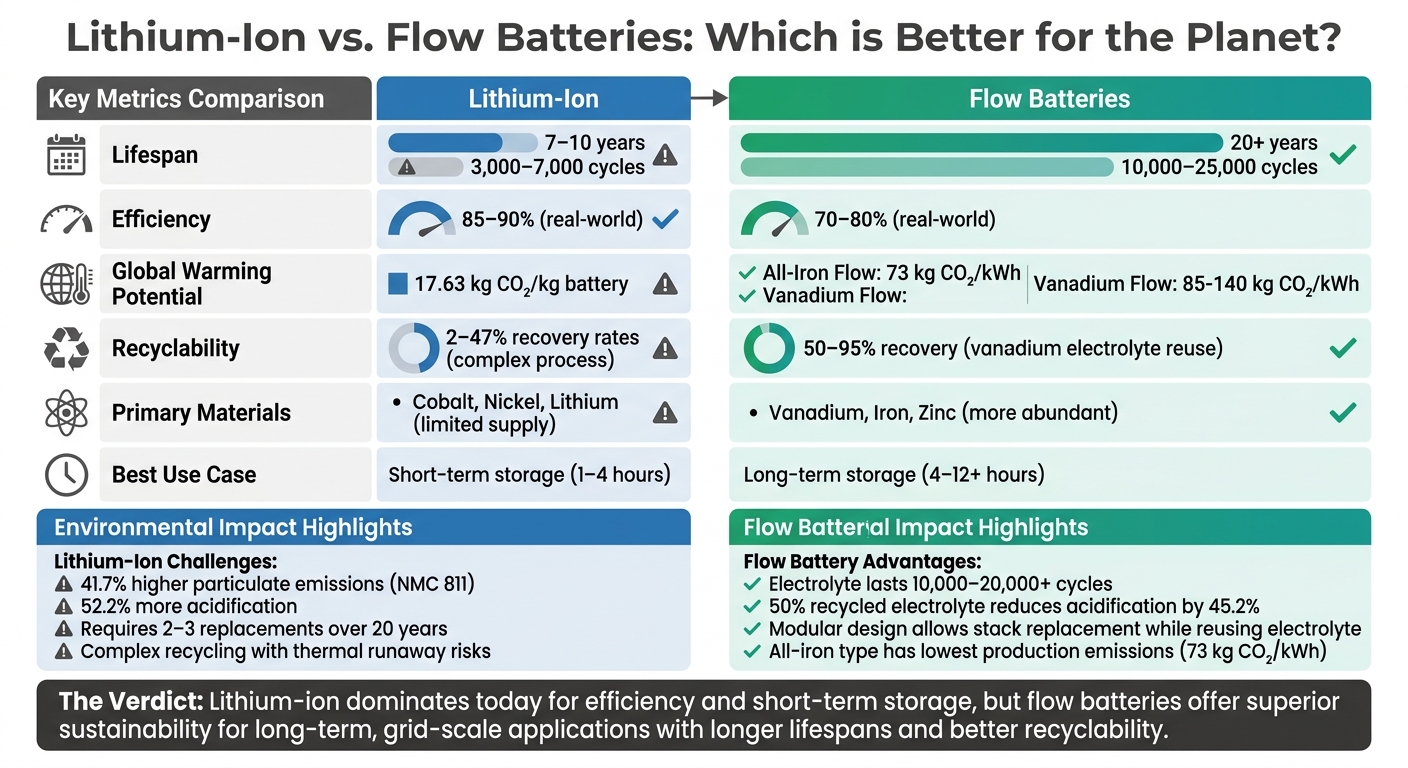
- Lithium-ion batteries are efficient and widely used but come with high emissions during production and depend on limited resources like cobalt and nickel. They last 7–10 years, require frequent replacements, and are difficult to recycle.
- Flow batteries, especially vanadium and all-iron types, have a larger initial footprint but last over 20 years with minimal degradation. They use more abundant materials, and their electrolytes can be reused or recycled, reducing waste.
Key differences:
- Lithium-ion batteries are better for short-term storage (1–4 hours) with 85–90% efficiency but need replacements every decade.
- Flow batteries are ideal for long-term storage (4–12+ hours), have lower efficiency (70–80%), but last decades with fewer replacements.
Quick Comparison
| Feature | Lithium-Ion | Flow Batteries (Vanadium/All-Iron) |
|---|---|---|
| Lifespan | 7–10 years | 20+ years |
| Efficiency | 85–90% | 70–80% |
| Recyclability | Complex, 2–47% rates | Easier, 50–95% for vanadium |
| Materials | Cobalt, Nickel, Lithium | Vanadium, Iron, Zinc |
| Global Warming Potential | 17.63 kg CO₂/kg battery | 73–140 kg CO₂/kWh |
Lithium-ion batteries dominate now, but flow batteries may be the better choice for long-term, eco-conscious energy storage. Let’s dive into why.
Lithium-Ion vs Flow Batteries Environmental Impact Comparison
Resource Extraction and Environmental Impact
The environmental footprint of battery production often begins at the mines. Lithium-ion batteries rely on materials like lithium, cobalt, nickel, and manganese for cathodes, with graphite for anodes and aluminum and copper for structural parts. Extracting these materials is energy-intensive and environmentally taxing, particularly for resources like lithium, cobalt, and nickel. On the other hand, flow batteries use a variety of chemistries. For instance, Vanadium Redox Flow Batteries (VRFBs) depend heavily on vanadium, while all-iron and zinc-bromine systems utilize more abundant resources like iron and zinc.
Lithium-Ion Battery Materials
The production of lithium-ion batteries has a global warming potential (GWP) of 17.63 kg CO₂-eq per kg of battery. The extraction of cobalt and nickel contributes significantly to acidification and particulate emissions. While newer cathode chemistries, such as NMC 811 (nickel-manganese-cobalt), aim to reduce cobalt reliance, they come with trade-offs, including 41.7% higher particulate emissions and 52.2% more acidification compared to older designs.
The environmental impact is further compounded by the geographic concentration of lithium, cobalt, and nickel resources. In countries with cleaner electricity grids, like Sweden or Norway, material extraction dominates the battery's lifecycle emissions, surpassing manufacturing contributions. Additionally, lithium extraction from brine, particularly in South America, requires extensive water use and disrupts large areas of land, further increasing the overall environmental burden.
Flow Battery Materials
For flow batteries, the environmental impact depends on the chemistry. Vanadium extraction accounts for up to 95% of resource depletion in VRFBs, with GWPs ranging from 85 to 140 kg CO₂-eq per kWh. Nafion membranes, a common component, contribute 76–90% of ozone depletion potential.
However, not all flow batteries share the same challenges. All-iron flow batteries, for example, use widely available iron, resulting in a lower GWP of 73 kg CO₂-eq per kWh. Zinc-bromine systems fall in between, with moderate material availability but higher resource depletion. A notable advantage of flow batteries is their electrolyte longevity; electrolytes can last for 10,000–20,000+ cycles, spreading the initial resource impact over a longer lifespan. Additionally, using 50% recycled electrolyte in vanadium systems can reduce acidification by 45.2% and GWP by 11.1%.
Resource Extraction Comparison Table
| Battery Type | Primary Materials | Resource Availability | Key Environmental Impact |
|---|---|---|---|
| Lithium-Ion (NMC) | Lithium, Cobalt, Nickel, Graphite, Aluminum | Limited/Concentrated supply chains | 17.63 kg CO₂-eq/kg; high acidification and particulate matter |
| Vanadium Flow (VRFB) | Vanadium, Nafion membranes | Moderate; high depletion risk | 85–140 kg CO₂-eq/kWh; 95% depletion from vanadium |
| All-Iron Flow | Iron, Carbon-based materials | Highly abundant and widely distributed | 73 kg CO₂-eq/kWh; lowest impact among flow types |
| Zinc-Bromine Flow | Zinc, Bromine, Titanium (some designs) | Moderate availability | High abiotic resource depletion; variable toxicity |
This lays the groundwork for evaluating how manufacturing emissions further shape the environmental profiles of these batteries.
sbb-itb-501186b
Production and Manufacturing Emissions
Producing batteries involves significant energy use and greenhouse gas emissions, though the extent varies depending on the battery's chemistry and where it's made.
Lithium-Ion Manufacturing
Making lithium-ion batteries is energy-intensive, with emissions largely driven by cell assembly and cathode processing. For NMC 811 lithium-ion batteries, the median global warming potential is 17.63 kg CO₂-eq per kg of battery. Emissions also depend on the production location. For example:
- Manufacturing in China results in approximately 17.33 kg CO₂-eq per kg.
- In Sweden, emissions drop to about 16.47 kg CO₂-eq per kg.
This difference is tied to the carbon intensity of local electricity grids. Regions that rely on coal for energy see higher emissions compared to areas with cleaner energy sources. Additionally, scaling up production in large facilities, like giga-factories, leads to efficiency improvements, gradually reducing the energy and emissions needed per battery. These regional and operational factors highlight how production practices shape environmental outcomes.
Flow Battery Manufacturing
Flow batteries have distinct manufacturing requirements based on their chemistry. For instance:
- All-iron flow batteries require 1,090 MJ per kWh of energy and emit around 73 kg CO₂-eq per kWh.
- Vanadium redox flow batteries (VRFBs) demand 5,200 MJ per kWh and generate emissions between 85–184 kg CO₂-eq per kWh.
Material choices can significantly lower emissions. For example, optimizing VRFB materials can cut emissions by up to 40%. Nafion membranes, commonly used in VRFBs, are a major contributor to ozone depletion, accounting for 76–90% of the potential. Replacing titanium-based bipolar plates with carbon-based options and improving vanadium recovery rates (50–95%) can reduce the global warming potential to as low as 61 kg CO₂-eq per kWh. These adjustments underscore how material and design decisions impact the overall environmental footprint.
Lifecycle Assessment Data
Here’s a breakdown of manufacturing emissions and their role in the broader lifecycle impacts:
| Battery Type | Global Warming Potential (GWP) | Total Energy Consumption (CED) | Primary Emission Driver |
|---|---|---|---|
| Lithium-Ion (NMC 811) | 17.63 kg CO₂-eq/kg (median) | High (cell/cathode processing) | Cell assembly & cathode processing |
| All-Iron Flow | 73 kg CO₂-eq/kWh | 1,090 MJ/kWh | Polymer resins & assembly |
| Vanadium Flow (VRFB) | 85–184 kg CO₂-eq/kWh | 5,200 MJ/kWh | Vanadium extraction & processing |
While manufacturing emissions are a crucial piece of the puzzle, the efficiency of the battery during its operational life also plays a major role in determining its environmental impact.
Energy Efficiency and Operating Impact
Energy lost during charge–discharge cycles has a direct effect on the environmental footprint of battery systems. Greater efficiency means less primary energy needs to be produced, which helps lower the carbon emissions tied to grid operations.
Round-Trip Efficiency
Lithium-ion batteries generally achieve round-trip efficiencies between 90% and 95% in controlled lab settings. However, in real-world installations, this figure usually drops slightly to around 85% to 90%. On the other hand, flow batteries reach efficiencies of 65% to 85% in the lab, with actual deployments typically falling between 70% and 80%. The difference stems from how these technologies manage energy: lithium-ion systems are designed to store and release electricity with minimal energy loss, whereas flow batteries experience losses due to heat, side reactions, and the energy needed for pumping. For example, iron–chromium flow batteries often operate below 65% efficiency. To put it simply, for every 100 kWh stored, lithium-ion systems return about 85–90 kWh, while flow batteries deliver around 70–80 kWh. This efficiency gap directly affects both operating costs and grid-related emissions.
Grid Operation Implications
These efficiency differences lead to tangible economic and environmental consequences in grid operations. For instance, a 50 MW/50 MWh system that experiences a 10% efficiency loss could waste approximately $250,000 annually, assuming an electricity cost of $0.10 per kWh. If the additional energy required comes from fossil fuels or a partially decarbonized grid, the environmental footprint grows even larger. Lower efficiency forces flow batteries to pull more energy from the grid, increasing dependence on its energy mix.
That said, flow batteries bring a key advantage: their long cycle life. They can handle between 10,000 and 20,000+ cycles with little capacity loss, far surpassing the 3,000 to 7,000 cycles typical of lithium-ion systems. Over a lifespan exceeding 20 years, this extended durability can offset the efficiency disadvantage by reducing the overall environmental cost per megawatt-hour delivered.
Lifespan and Replacement Cycles
A battery's lifespan has a direct impact on how often it needs to be replaced and its overall environmental footprint. Frequent replacements mean more resource extraction, higher manufacturing emissions, and increased waste.
Lithium-Ion Battery Lifespan
Grid-scale lithium-ion batteries typically last between 7 and 10 years or handle 3,000–7,000 cycles. Once their capacity drops to 70–80%, the entire battery pack needs replacement, driving up resource use and emissions. This decline happens as the solid electrodes degrade over time due to both aging and cycling. Eventually, the battery's capacity falls below functional levels, requiring a full replacement. Compared to these, flow batteries provide a much longer operational life.
Flow Battery Longevity
Flow batteries are designed to last over 20 years and can achieve 10,000–25,000 cycles before their capacity drops to 70–80%. One of their key advantages is the minimal degradation of the electrolyte. Additionally, their modular design allows for replacing the cell stacks while reusing the electrolyte, which reduces the demand for new resources. Vanadium redox flow batteries, in particular, stand out because vanadium can be recovered at rates of 50–95%, cutting their global warming potential by up to 40%.
Environmental Cost of Replacement
The differences in lifespan between battery types have a significant impact on their environmental costs. Over 20 years, lithium-ion systems may need to be replaced two or three times. Each replacement involves extracting materials like lithium, cobalt, and nickel. Producing just 1 kg of lithium-ion battery material consumes 193.9 MJ of energy, 77.3 liters of water, and emits 14.5 kg of CO₂-equivalent. Even with recycling reducing these impacts by 58% or more, global recycling rates for lithium-ion batteries remain low - ranging from 2% to 47%, compared to 99% for lead-acid batteries.
Flow batteries, on the other hand, maintain their capacity for decades. Their primary environmental cost is tied to the initial extraction of vanadium, which can account for up to 95% of the mineral resource depletion in these systems. However, because this cost is spread over a much longer lifespan, flow batteries present a clear advantage in sustainability. For applications like grid congestion management or solar energy storage over 15–20 years, their extended lifespan and reduced replacement needs make them a more environmentally responsible choice. By spreading the initial resource and manufacturing impacts over many more cycles, flow batteries reinforce their position as a more sustainable option for long-term grid applications.
End-of-Life Management and Recyclability
What happens to a battery when it reaches the end of its life is just as important as how it performs while in use. The challenges involved in disposal and recycling differ significantly between lithium-ion and flow batteries, with notable consequences for environmental impact and resource recovery.
Lithium-Ion Recycling Challenges
Recycling lithium-ion batteries is no simple task. Their design is intricate, with cells encased in sturdy modules equipped with thermal management systems, making disassembly both time-consuming and hazardous. Risks like thermal runaway, fires, and exposure to toxic emissions are particularly concerning when batteries still hold a charge.
Adding to the complexity, lithium-ion batteries come in a variety of chemistries - such as NMC, LFP, and LCO - and formats like pouch, prismatic, and cylindrical designs. This lack of standardization complicates efforts to streamline recycling processes. As noted by npj Materials Sustainability:
"LIB disassembly is recognized as a critical bottleneck for industrial-scale recycling, underscoring the need for breakthroughs in robotics, automation, and design-for-disassembly approaches".
Current recycling methods have their drawbacks. Pyrometallurgical processes, which involve heating materials to over 1,832°F (1,000°C), consume a lot of energy and result in the loss of valuable materials like lithium and aluminum. Hydrometallurgical methods, while less energy-intensive and capable of recovering up to 93% of metals like lithium, nickel, and cobalt, generate acidic wastewater that requires further treatment. Despite these options, lithium-ion recycling rates remain low compared to lead-acid batteries.
There is progress, though. Redwood Materials in Nevada demonstrated in 2021 that refining cathode materials from recycled batteries uses 77.1% to 88.7% less energy than traditional mining. Their process also reduces CO₂-equivalent emissions by 80.9%. While promising, scaling such solutions across the industry remains a significant challenge. These obstacles highlight the need for more sustainable battery designs to reduce their overall environmental impact.
Flow Battery Electrolyte Reuse
Flow batteries take a different approach to end-of-life management. Their liquid electrolytes typically do not degrade, allowing for reuse without the need for extensive processing. Maintenance often involves replacing the cell stack while keeping the original electrolyte, effectively restoring the system's capacity.
Vanadium redox flow batteries stand out for their potential in resource recovery. Vanadium recovery rates can range from 50% to 95%, which can lower global warming potential by as much as 40%. Additionally, using a mix of 50% recycled electrolyte in these systems reduces acidification by 45.2% and global warming potential by 11.1% compared to using entirely new materials.
To leverage these benefits, some flow battery manufacturers have introduced an electrolyte leasing model. In this arrangement, the producer retains ownership of the electrolyte, reducing upfront costs for buyers and ensuring the material is returned for reuse at the end of the battery's life. Key concerns for flow batteries include managing potential electrolyte spills and maintaining the quality of materials over time.
The contrasting approaches between lithium-ion and flow batteries are summarized in the table below.
End-of-Life Impact Comparison Table
| Feature | Lithium-Ion Batteries | Flow Batteries (Vanadium/Zinc-Bromine) |
|---|---|---|
| Recycling Complexity | High (complex disassembly, varied chemistries) | Low (liquid electrolyte is easily extracted) |
| Primary End-of-Life Hazard | Thermal runaway, toxic fire, acidic waste | Chemical spills, material compatibility |
| Material Recovery Rate | 2%–47% (current global average) | 50%–95% (for vanadium electrolyte) |
| Recovery Focus | High-value metals (cobalt, nickel, lithium) | Electrolyte (vanadium, iron, zinc) |
| Material Circularity | Moderate (requires intensive refinement) | High (electrolyte is largely non-degrading) |
| Energy Intensity of Recovery | High (pyrometallurgy/hydrometallurgy) | Low (direct reuse or mild reconditioning) |
Environmental Impact Summary and Key Takeaways
Key Findings by Battery Type
When examining environmental impacts across extraction, production, and disposal, lithium-ion batteries stand out for their high energy density and efficiency. However, they come with notable environmental challenges. Newer cathode chemistries increase particulate matter by 41.7% and acidification by 52.2% compared to flow batteries. Additionally, their recycling processes are complex, which limits their potential for sustainability.
Flow batteries, on the other hand, have a different environmental footprint. Among these, all-iron flow batteries have the smallest production-phase impact, with a global warming potential of about 73 kg CO₂ eq/kWh. Vanadium redox flow batteries (VRFBs) range between 85 and 140 kg CO₂ eq/kWh but stand out for their electrolyte recyclability. For instance, using 50% recycled electrolyte can cut acidification by 45.2% and reduce global warming potential by 11.1%. However, VRFBs face challenges like vanadium extraction, which can account for up to 95% of mineral resource depletion, and Nafion membranes, responsible for 76% to 90% of ozone depletion impacts.
Chemistry-Specific Insights
All-iron flow batteries excel in sustainability, outperforming in six out of eight environmental impact categories. They rely on widely available materials, avoiding intensive mining. However, iron-chromium systems fall short with energy efficiency often below 65%, leading to higher operational emissions. Zinc-bromine batteries have the lowest ozone depletion and freshwater ecotoxicity but face high abiotic resource depletion. Their capital costs range from $819 to $2,953 per kW, compared to $1,173 to $3,846 per kW for VRFBs.
Actionable Considerations for Sustainability
To improve sustainability in battery applications, consider these steps:
- Opt for all-iron flow batteries when reducing global warming potential is a priority, as they have the lowest production-phase emissions at 73 kg CO₂ eq/kWh.
- Introduce electrolyte leasing or recycling programs for vanadium systems. Recovery rates of 50% to 95% can cut global warming potential by up to 40%.
- Explore alternatives to Nafion membranes, which significantly contribute to ozone depletion in flow battery systems.
- Use 1 kWh of delivered energy as the functional unit to fairly compare efficiency and replacement cycles across different technologies.
FAQs
Which battery has lower CO2 per kWh delivered over 20 years?
Over two decades, iron flow batteries prove to have a much lower carbon footprint per kilowatt-hour (kWh) delivered compared to lithium-ion batteries. Research highlights that iron flow batteries stand out among flow battery types for having the lowest global warming potential (GWP). This is largely due to their more sustainable production methods and ease of recyclability.
On the other hand, lithium-ion batteries are associated with significantly higher emissions. Manufacturing a lithium-ion battery generates approximately 100 kilograms of CO2 per kWh, leading to greater cumulative emissions over time. This stark difference underscores the environmental advantages of iron flow batteries in long-term energy storage solutions.
How does the local power grid affect battery emissions?
The local power grid has a major impact on battery emissions. Grids that depend heavily on fossil fuels, such as coal or natural gas, contribute to higher emissions during both the manufacturing process and the energy usage of batteries. This is due to the larger carbon footprint associated with these energy sources. On the other hand, grids powered by renewable energy sources like wind or solar significantly reduce emissions, enhancing the environmental advantages of batteries. Ultimately, battery emissions are influenced by two key factors: the manufacturing process and the energy mix of the grid they draw power from.
What happens to each battery at end-of-life?
At the end of their life cycle, lithium-ion batteries are usually recycled to reclaim valuable materials like lithium, cobalt, and nickel. This process helps cut down on the need for extracting new resources, as these recovered components can often be reused in new manufacturing processes.
Flow batteries, meanwhile, tend to last longer and have simpler end-of-life options. Their electrolytes and cell components can often be refurbished or recycled. However, the recycling processes for flow batteries are not as standardized as those for lithium-ion batteries.