Advancements in Iron Flow Battery Systems
Iron flow batteries are emerging as a promising solution for large-scale energy storage. These systems use liquid electrolytes to store energy, offering flexibility in capacity and power output. Recent research has improved their efficiency, durability, and safety, making them suitable for grid-level applications. Key developments include:
- Neutral-pH Electrolytes: Safer operation with reduced fire risks and corrosion.
- Improved Efficiency: Up to 98.7% capacity retention over 1,000 cycles and nearly 100% coulombic efficiency.
- Cost-Effectiveness: Iron costs less than $0.10 per kilogram, making these batteries affordable.
- Commercial Use: Projects like SMUD’s 200 MW storage system and SRP’s 50 MWh system highlight real-world applications.
Challenges remain, such as low energy density (9 Wh/L vs. 25 Wh/L for vanadium systems) and hydrogen evolution reactions. However, advancements in electrodes, membranes, and electrolyte formulations continue to address these issues. With a 25-year lifespan and over 20,000 cycles, iron flow batteries are on track to meet the Department of Energy’s cost target of $0.05/kWh by 2030.
This iron flow battery could power a more renewable grid
sbb-itb-501186b
Recent Progress in Electrolyte Formulations
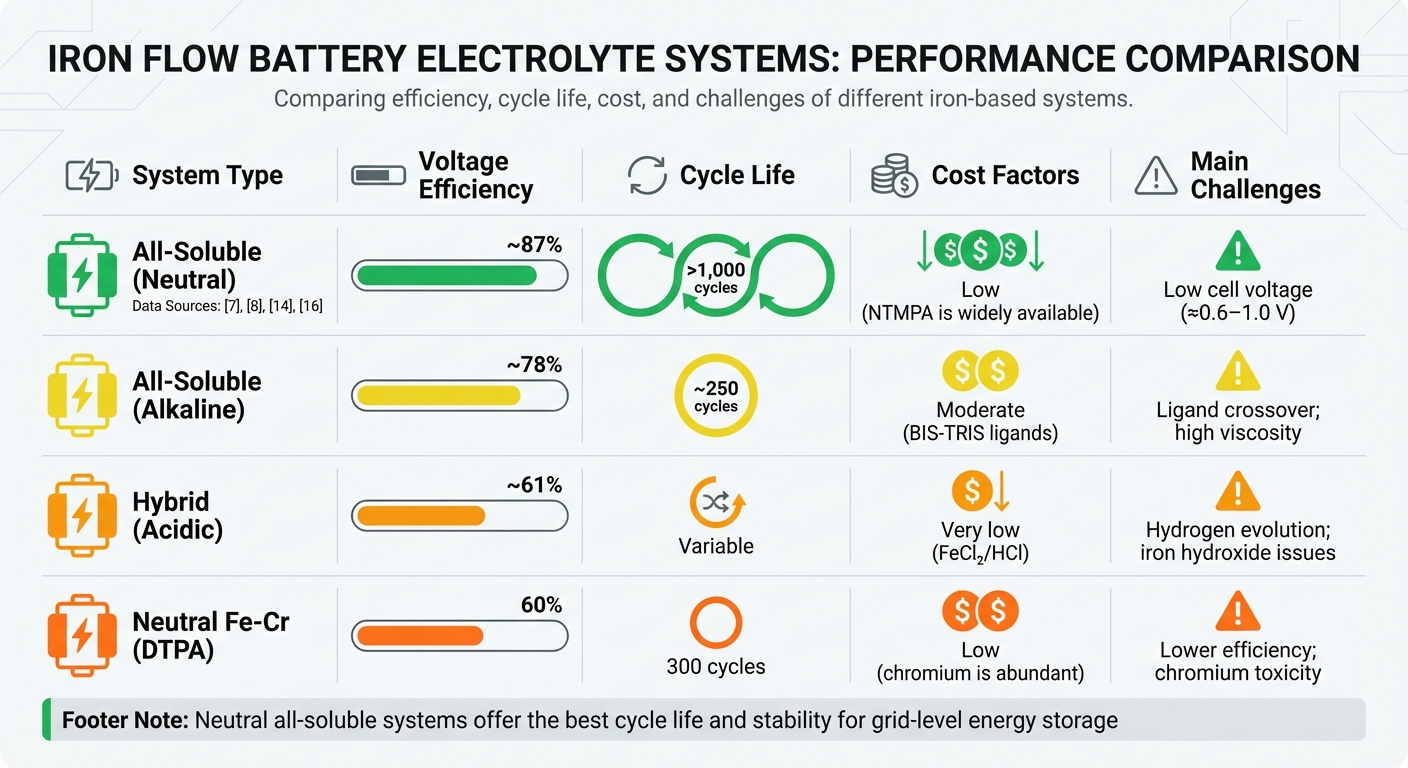
Iron Flow Battery Electrolyte Systems Performance Comparison
In recent years, researchers have moved away from deposition-type systems toward all-soluble electrolyte formulations. This shift eliminates dendrite formation and allows power output to function independently of energy capacity.
One notable advancement comes from the team at PNNL, led by Guosheng Li. In March 2024, they introduced an NTMPA-based system that achieved impressive results: 98.7% capacity retention over 1,000 cycles, 87% energy efficiency at 20 mA/cm², and a capacity fade rate of just 0.0013% per cycle.
"We were looking for an electrolyte that could bind and store charged iron in a liquid complex at room temperature and mild operating conditions with neutral pH." – Guosheng Li, Senior Scientist, PNNL
Acidic and Alkaline All-Iron Systems
Traditional acidic iron systems have long struggled with hydrogen evolution reactions, which alter pH levels and cause iron hydroxide precipitation. To counter this, researchers have explored strategies like using a slightly higher pH or employing recombination cells to react evolved hydrogen with ferric ions, helping to stabilize the electrolyte.
On the alkaline side, systems using ligands like triethanolamine (TEOA) operate at high pH levels but often face challenges like ligand crossover, which leads to capacity decay. Recent formulations using BIS-TRIS ligands have shown promise. For instance, in May 2024, researchers at Queen's University Belfast and the University of Calgary demonstrated that Fe-BIS-TRIS systems could achieve 78% energy efficiency at 80 mA/cm², thanks to optimized carbon paper electrodes. By adjusting the ligand-to-metal ratio to 1.5:1, they increased iron solubility to 2.0 M.
The trend toward near-neutral pH electrolytes is particularly promising. Operating at around pH 8 reduces both hydrogen and oxygen evolution reactions while minimizing corrosion. Phosphonate-based ligands, like NTMPA, enable this approach and benefit from being commercially available chemicals commonly used in water treatment.
These innovations are laying the groundwork for exploring other metal combinations.
Fe-Zn and Fe-Cr Systems
Beyond all-iron systems, hybrid chemistries involving metals like zinc and chromium are being investigated to boost energy density and voltage. Fe-Cr systems, for example, have historically faced issues like corrosion and hydrogen evolution. However, in January 2026, researchers introduced neutralized Fe-Cr batteries using symmetric DTPA ligands. These systems achieved a discharge energy density of 12.1 Wh/L, surpassing the typical 9 Wh/L of all-iron systems, with a capacity decay rate of 0.13% per cycle over 300 cycles.
Fe-Zn systems, on the other hand, use zinc as an additive to improve performance. These systems typically reach around 61% energy efficiency, but challenges like dendrite growth during zinc plating remain a limitation. While hybrid chemistries offer interesting possibilities, all-iron systems remain attractive for their straightforward chemistry, low toxicity, and strong long-term stability.
Comparison of Electrolyte Systems
A side-by-side comparison showcases the strengths and weaknesses of these electrolyte strategies:
| System Type | Voltage Efficiency | Cycle Life | Cost Factors | Main Challenges |
|---|---|---|---|---|
| All-Soluble (Neutral) | ~87% | >1,000 cycles | Low (NTMPA is widely available) | Low cell voltage (≈0.6–1.0 V) |
| All-Soluble (Alkaline) | ~78% | ~250 cycles | Moderate (BIS-TRIS ligands) | Ligand crossover; high viscosity |
| Hybrid (Acidic) | ~61% | Variable | Very low (FeCl₂/HCl) | Hydrogen evolution; iron hydroxide issues |
| Neutral Fe-Cr (DTPA) | 60% | 300 cycles | Low (chromium is abundant) | Lower efficiency; chromium toxicity |
Neutral all-soluble systems stand out for their excellent cycle life and stability, even though they lag in energy density. Alkaline systems show moderate performance but require careful management of ligand behavior. Meanwhile, hybrid systems, while cost-effective, face operational hurdles that may limit their scalability for grid-level energy storage.
Electrode and Membrane Improvements
Advancements in electrolyte chemistry are only part of the puzzle when it comes to improving iron flow batteries for large-scale energy storage. Refining electrodes and membranes is equally important, as these components play a critical role in determining the battery's efficiency and lifespan.
Electrode Surface Modifications
One promising development in electrode technology is the coating of carbon electrodes with conductive polymers. Between September 2024 and February 2025, a team at Eindhoven University of Technology, led by Dr. Emre B. Boz and Dr. Antoni Forner-Cuenca, made significant progress in this area. They developed coatings using PPy/PSS and PEDOT/PSS, each serving a unique purpose:
- PPy/PSS: This coating effectively suppresses hydrogen evolution at high overpotentials, preventing pH shifts and iron hydroxide precipitation, which extends the battery's lifespan.
- PEDOT/PSS: Acts as a redox shuttle, improving round-trip efficiency by facilitating iron stripping reactions.
Thermal activation of carbon materials has also proven effective. By thermally treating carbon paper and graphite felt, researchers have reduced activation overpotentials, making the electrodes more responsive to iron-based reactions. In July 2025, the Fraunhofer Institute for Chemical Technology introduced 3D-printed ABS spacers in the negative half-cell. These spacers ensured uniform electrolyte flow and stabilized iron deposition. When paired with a hydrogen recombination cell, this setup achieved a 95% coulombic efficiency over 25 cycles.
The architecture of the cell is another critical factor. In May 2024, researchers from Queen's University Belfast and the University of Calgary compared two designs: "flow-through" (FT) setups using graphite felt and "flow-over" (FO) configurations with carbon paper. The FO design outperformed the FT setup, achieving 86% energy efficiency at current densities ranging from 10 to 100 mA/cm². In contrast, the FT design struggled with higher overpotentials and capacity fade. These advancements in electrode technology pave the way for further progress in membrane design.
Membrane Enhancements
While improved electrodes are essential, membranes play an equally important role in boosting battery performance. Membranes must balance two competing needs: allowing charge-carrying ions to pass through while blocking larger redox-active molecules. Traditional Nafion membranes fall short in this regard, as they permit too much crossover of redox molecules.
A promising solution comes from ion-sieving microporous polymers. Sulfonated polymers of intrinsic microporosity (PIMs), specifically spirobifluorene-based (sPIM-SBF), feature subnanometer channels (less than 1.0 nm) that allow small salt ions to pass while blocking larger molecules. These membranes achieved a selectivity of 30 to 550 for chloride over sulfate ions, far surpassing Nafion's selectivity of just 5.4. During testing, sPIM-SBF membranes maintained an energy efficiency of around 80% and exhibited a capacity decay rate of only 0.0335% per day over 2,100 charge-discharge cycles.
Another innovative approach involves using chelating agents like diethylenetriaminepentaacetic acid (DTPA). These agents increase the effective size of metal ions, creating a "steric hindrance" effect that makes it harder for ions like iron and cerium to cross the membrane. An iron-cerium battery using DTPA ligands achieved nearly 100% coulombic efficiency and retained 95.3% of its initial capacity after 500 cycles. In July 2025, researchers at Purdue University demonstrated permselective cation exchange membranes with disordered sidechain structures, which improved species retention by two orders of magnitude compared to Nafion.
These advancements in both electrodes and membranes represent significant steps forward in refining iron flow batteries for grid-scale energy storage. Each innovation addresses specific challenges, bringing us closer to creating more efficient and durable battery systems.
System Design and Commercial Applications
Flow-Cell Engineering Improvements
Optimizing the internal architecture of iron flow batteries is just as important as refining their chemical components. Researchers have discovered that switching from flow-through designs (using graphite felt) to flow-over designs (using carbon paper) enhances maximum power density, energy efficiency, and electrolyte utilization. It also helps reduce capacity fade.
Other advancements include integrating recombination cells with Pt/C-coated membranes to recycle hydrogen and using 3D-printed ABS spacers for uniform deposition and improved mechanical stability. Implementing CCCV charging protocols boosts voltage efficiency and cycling performance. Furthermore, the use of NTMPA enables neutral pH operation, which minimizes corrosion.
These engineering improvements have paved the way for successful commercial applications.
Commercial Installations and Cost Projections
Iron flow batteries are now powering projects across the United States. In September 2023, the Sacramento Municipal Utility District (SMUD) deployed six Energy Warehouse systems as part of a larger agreement to deliver up to 200 MW / 2 GWh of long-duration storage. By July 2024, the project secured a $10 million grant from the California Energy Commission to expand with an additional 3.6 MW, eight-hour system to support grid distribution. David Hochschild, Chair of the California Energy Commission, remarked:
"It's a technology that's needed to harness excess renewables for use during peak demand and overnight, especially as we work toward a goal of 100 percent clean electricity."
In October 2025, the Salt River Project (SRP) collaborated with ESS on "Project New Horizon", located at the Copper Crossing Energy and Research Center in Florence, Arizona. This 5 MW / 50 MWh system can power 1,125 average-sized homes for 10 hours and serves as a pilot project for non-lithium long-duration energy storage. Kelly Goodman, Interim CEO of ESS Tech, Inc., commented:
"This project is a significant validation in both the LDES industry and ESS as a technology provider. We are thrilled to be working with SRP to deliver more hours of clean energy to its customers."
In January 2024, the US Army Corps of Engineers commissioned an Energy Warehouse system at Fort Leonard Wood, Missouri. Integrated into a tactical microgrid, this system showcased iron flow technology's ability to reduce fuel consumption in contingency bases and disaster relief scenarios. Similarly, Sycamore International in West Grove, Pennsylvania, paired an ESS Energy Warehouse with a 115 kW DC solar array to provide backup power and manage peak demand for its industrial recycling facility.
Manufacturing advancements have significantly reduced costs. ESS Tech, Inc. has reported a nearly 60% drop in the cost of building its Energy Warehouse system and a 73% reduction in overall production time. In May 2024, the company secured a $50 million financing package from the Export-Import Bank of the United States under the "Make More in America Initiative" to expand its manufacturing operations in Wilsonville, Oregon. Iron flow systems now offer over 20,000 cycles with a 25-year design life and no capacity loss. The Department of Energy has set a target of $0.05/kWh for long-duration energy storage by 2030, and iron flow technology is on track to achieve this goal.
Alan Greenshields, Director EMEA at ESS Tech, Inc., emphasized one of iron flow batteries' main advantages:
"As the technology is inherently safe, this allows for stacking containers and a greater energy density on the system level. Stacked vertically, iron flow batteries can exceed the density of standard lithium-ion batteries on the same footprint."
Current Challenges and Research Directions
Technical Limitations
Iron flow batteries have made strides, but several technical challenges persist. One major issue is the hydrogen evolution reaction (HER) at the negative electrode. This reaction reduces coulombic efficiency and causes capacity loss by disrupting the electrolyte balance. In hybrid systems, dendrite formation can lead to short circuits, cutting down the battery's cycle life. As Shawn Belongia from Pacific Northwest National Laboratory highlighted:
"Progress in improving aqueous all-iron RFBs is at its infant stage, and new strategies must be introduced, such as the utilization of nanoparticles, which can limit dendrite growth while increasing storage capacity."
Another hurdle is species crossover through membranes, which gradually depletes capacity. Kara Rodby, a Technical Analyst at Volta Energy Technologies, explained:
"The membrane is designed to allow small supporting ions to pass through and block the larger active species, but in reality, it isn't perfectly selective."
Additional concerns include ligand crossover in alkaline systems and low energy density. Current iron systems typically reach about 9 Wh/L, far below the 25 Wh/L achieved by commercial vanadium batteries. The low solubility of iron complexes compounds the problem. For instance, some formulations max out at 1.03 M (yielding a theoretical energy density of 27.6 Ah/L), compared to vanadium systems, which can achieve 42.9 Ah/L.
Kinetic challenges add another layer of complexity. A 2024 Nature Communications study revealed that Fe-NTMPA2 complexes require molecular reorientation during charging, causing voltage spikes at high current densities. Furthermore, material degradation, membrane fouling, and electrode clogging drive up maintenance costs and shorten the system's lifespan.
These obstacles underscore the need for focused research and innovation.
Research Priorities
To address these challenges, researchers are zeroing in on electrolyte formulations, materials, and system designs. Efforts in electrolyte development are moving toward all-soluble chemistries. These eliminate dendrite risks and enhance iron solubility through advanced chelation and mixed-ligand approaches. On the materials front, work is underway on size-selective membranes, heat-treated carbon electrodes, and additives like In³⁺ or Bi³⁺ to suppress hydrogen evolution.
System design is another area of focus. Flow-over cell architectures, which outperform traditional flow-through designs in capacity retention, are gaining attention. Additionally, integrated recombination cells are being developed to manage hydrogen byproducts more effectively. Researchers are also leveraging interdisciplinary approaches, combining molecular engineering with in-situ characterization and density functional theory modeling to better understand electron transfer kinetics.
These efforts aim to bridge performance gaps while maintaining the cost advantages of iron flow batteries. For context, iron's affordability - less than $0.10 per kilogram - remains a key selling point.
Conclusion
Lab-scale iron flow batteries have demonstrated impressive durability, retaining 98.7% of their capacity over 1,000 cycles. This shows that materials abundant on Earth can meet the reliability needs of the grid. A major breakthrough has been the adoption of neutral-pH phosphate-based electrolytes, leveraging chemicals like NTMPA - originally designed for water treatment - which has made these systems safer and more practical for use in densely populated areas. Combined with iron's affordability, the potential for large-scale deployment looks promising.
That said, there are still hurdles to overcome. Current iron flow batteries deliver an energy density of about 9 Wh/L, which falls short compared to the 25 Wh/L achieved by vanadium-based systems. Guosheng Li from Pacific Northwest National Laboratory highlighted the path forward:
"Our next step is to improve battery performance by focusing on aspects such as voltage output and electrolyte concentration, which will help to increase the energy density".
Addressing challenges like hydrogen evolution, membrane crossover, and instability at high currents will be essential for scaling these batteries to utility-level applications.
Encouragingly, commercial progress is already underway. For instance, the upcoming launch of PNNL's Grid Storage Launchpad in 2024 aims to bring lab-tested reliability to practical use. In regions like Germany, where solar and wind already account for 41.6% of electricity generation, the need for cost-effective, long-duration energy storage is pressing. Iron flow batteries, with their non-toxic and locally sourced materials, could provide the backbone for renewable energy grids in the years to come.
Closing the technical gaps while maintaining the cost benefits of iron will be critical to establishing these batteries as a cornerstone of grid energy storage.
For more updates on electrical components and cutting-edge grid solutions, check out Electrical Trader.
FAQs
How do iron flow batteries work for grid storage?
Iron flow batteries work by storing and releasing energy through redox reactions involving iron in a liquid electrolyte. These reactions occur in a neutral-pH, water-based solution containing charged iron compounds, allowing for efficient energy transfer during charging and discharging.
What sets these batteries apart is their combination of safety, affordability, and environmental friendliness. They boast impressive durability, maintaining performance over 1,000+ cycles with only minimal capacity loss. Thanks to their stability and reliance on widely available materials, iron flow batteries are particularly well-suited for large-scale energy storage. This makes them a strong candidate for supporting renewable energy sources like wind and solar power.
What’s holding iron flow batteries back from higher energy density?
Iron flow batteries have traditionally struggled with lower energy storage capacity, mainly due to constraints in their electrochemical performance and cell architecture. However, recent progress is tackling these hurdles by enhancing cycling stability and improving capacity retention. These advancements are positioning iron flow batteries as a stronger contender for large-scale energy storage solutions.
How do neutral-pH electrolytes reduce hydrogen and corrosion issues?
Neutral-pH electrolytes play a key role in addressing hydrogen and corrosion challenges in iron flow batteries. By limiting the production of hydrogen gas and corrosion byproducts, these electrolytes enhance the batteries' stability and cycling performance. This leads to more efficient and dependable energy storage solutions.