

Grain-Oriented vs. Non-Grain-Oriented Steel: Key Differences
When it comes to electrical steel, the choice between Grain-Oriented (GO) and Non-Grain-Oriented (NGO) steel depends on your application’s magnetic flux direction, efficiency needs, and budget. Here’s a quick breakdown:
- Grain-Oriented (GO) Steel: Crystal grains are aligned in one direction, making it ideal for stationary devices like transformers. It offers lower core loss and higher magnetic permeability along the rolling direction but comes with higher manufacturing costs.
- Non-Grain-Oriented (NGO) Steel: Grains are randomly oriented, providing uniform magnetic properties in all directions. This makes it perfect for rotating machinery like motors and generators. It’s more affordable and easier to produce than GO steel.
Quick Comparison
| Feature | Grain-Oriented (GO) Steel | Non-Grain-Oriented (NGO) Steel |
|---|---|---|
| Grain Structure | Aligned in one direction | Randomly oriented |
| Magnetic Properties | Directional (anisotropic) | Uniform in all directions (isotropic) |
| Core Loss | Lower in rolling direction | Higher compared to GO steel |
| Cost | Higher | Lower |
| Applications | Transformers | Motors, generators, EV motors |
Choosing the right steel ensures better performance and energy efficiency for your specific needs. GO steel excels in reducing energy loss in transformers, while NGO steel is the go-to for rotating equipment where magnetic flux changes direction.
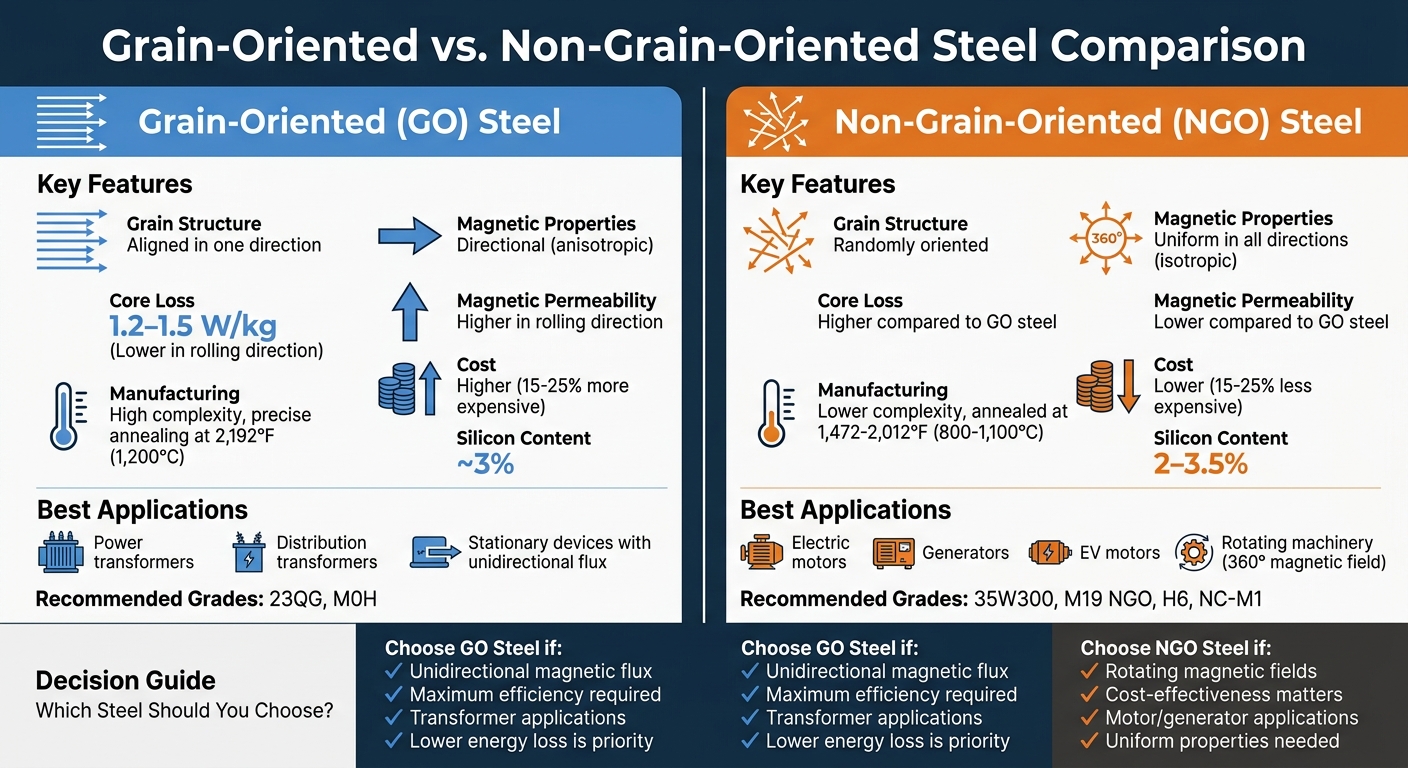
Grain-Oriented vs Non-Grain-Oriented Steel Comparison Chart
Grain-Oriented vs. Non-Grain-Oriented Steel: Key Differences
Grain Structure and Magnetic Directionality
Grain-Oriented (GO) steel undergoes controlled annealing and rolling processes to align its crystal grains, maximizing magnetic performance in a single direction. In contrast, Non-Grain-Oriented (NGO) steel has a random grain structure, which provides uniform magnetic properties across all directions. While NGO steel doesn't deliver peak performance in any one direction, its uniformity makes it ideal for applications where the magnetic flux changes direction frequently. These differences in grain alignment play a significant role in determining core loss and efficiency.
Core Loss and Efficiency
GO steel's aligned grain structure leads to much lower core losses and higher magnetic permeability along its rolling direction. This design reduces resistance to magnetic flux flow, cutting down on energy losses as heat. On the other hand, NGO steel, with its isotropic nature, experiences higher core losses in any given direction. This makes GO steel the preferred choice for applications with unidirectional magnetic flux, while NGO steel shines in scenarios where magnetic flux rotates or changes direction.
For a quick overview, the table below highlights these key differences:
| Feature | Grain-Oriented (GO) Steel | Non-Grain-Oriented (NGO) Steel |
|---|---|---|
| Grain Structure | Aligned/Controlled grains | Random/Uncontrolled grains |
| Magnetic Properties | Directional (anisotropic) | Uniform in all directions (isotropic) |
| Core Loss | Lower in rolling direction | Higher compared to GO steel |
| Magnetic Permeability | Higher in rolling direction | Lower compared to GO steel |
| Manufacturing Complexity | High (requires precise processes) | Lower (simpler production) |
| Cost-Effectiveness | More expensive due to specialized processing | More affordable and widely available |
sbb-itb-501186b
Applications and Benefits of Grain-Oriented Steel
Transformer Applications
Grain-oriented (GO) steel plays a crucial role in transformer applications by efficiently directing magnetic flux, which helps reduce energy losses and the need for high magnetizing currents. In power and distribution transformers, where the magnetic flux moves in a stationary, unidirectional path, the aligned crystal grains in GO steel minimize resistance to this flux. This alignment leads to lower energy losses and improved efficiency.
Manufacturing Process and Performance
GO steel undergoes a specialized manufacturing process involving precise annealing and rolling techniques to enhance its magnetic properties. The addition of approximately 3% silicon further improves its ability to conduct magnetic flux while reducing energy losses. While this meticulous production process makes GO steel more expensive and less commonly available, its superior performance justifies the cost. This is why it’s often the material of choice for stationary transformer cores, where the magnetic flux path is predictable and stable. Its reliability and efficiency make it indispensable for industrial transformer designs.
Applications and Benefits of Non-Grain-Oriented Steel
Rotating Equipment Applications
Non-grain-oriented (NGO) steel plays a key role in electric motors and generators due to its uniform magnetic properties. Its random grain structure ensures consistent performance across the entire sheet, making it ideal for rotating machinery where the magnetic field spans a full 360°.
With a silicon content between 2% and 3.5%, NGO steel enhances electrical resistivity, reducing eddy currents and core loss. For example, Nippon Steel's H6 and NC-M1 grades have shown core losses of 2.20 watt/kg (0.50 mm) and 1.93 watt/lb (0.47 mm), respectively.
The material's smooth surface and excellent flatness allow for tighter lamination stacking in motor stators and rotors, improving magnetic density and overall system performance. Standard lamination thicknesses range from 0.23 mm to 0.35 mm, with thinner grades increasingly used in higher-frequency applications to cut energy losses.
These benefits, combined with a straightforward and cost-efficient manufacturing process, make NGO steel a strong choice for high-volume production.
Cost-Effectiveness and Manufacturing Ease
NGO steel is 15%–25% less expensive than grain-oriented steel, avoiding the need for complex secondary recrystallization and high-temperature annealing processes. It is annealed at temperatures between 1,472°F and 2,012°F (800°C–1,100°C), compared to the 2,192°F (1,200°C) required for grain-oriented steel.
Manufacturing simplicity further adds to NGO steel's appeal.
"NGOES is generally more affordable and easier to obtain than GOES. The production process for NGOES is less complex, making it a cost-effective choice for various electrical applications." - Gnee Steel
This straightforward production process makes NGO steel a go-to material for appliances, industrial motors, and electric vehicle motors. The growing EV motor market, in particular, is driving demand for high-performance NGO steel grades that strike a balance between efficiency and ease of manufacture. Additionally, NGO steel is a practical choice for relays, solenoids, and small transformers when cost savings take precedence over achieving the lowest possible core loss.
Selecting the Right Steel for Industrial Applications
Key Selection Criteria
When deciding between grain-oriented (GO) and non-grain-oriented (NGO) steel, it all comes down to the magnetic flux direction, energy efficiency needs, and budget. If your application involves unidirectional magnetic flux, GO steel is the way to go. It significantly increases magnetic flux density, which helps reduce energy losses - typically achieving core losses between 1.2 and 1.5 W/kg. On the other hand, if the magnetic field rotates or efficiency isn't the top priority, NGO steel is a practical option. It's less expensive thanks to a simpler production process and provides consistent performance across all directions. These factors play a crucial role in determining the right fit for specific industrial uses.
Industry-Specific Recommendations
Choosing the right steel grade for your industry can make a big difference in performance and cost. For power distribution transformers, high-grade GO steel, like 23QG or M0H, is highly recommended. These grades are perfect for stationary applications with a clear magnetic flux path, as they minimize energy waste and align with the transformer's core design.
"Grain-oriented electrical steel is best for transformer cores because it has low core loss and high efficiency." - Sheraxin Electrical Steel
For industrial motors and generators, low-loss NGO steel, such as 35W300 or M19 NGO, is the better choice. Its isotropic properties ensure smooth operation and energy efficiency across a full 360° rotation, making it ideal for applications involving rotating magnetic fields. Electric vehicle motors, in particular, benefit from these grades, as they strike a balance between efficiency and ease of manufacturing.
In smaller-scale applications like transformers, relays, and solenoids, NGO steel is a practical option. These setups often can't fully utilize the directional properties of GO steel due to space constraints, making the uniform performance of NGO steel a valuable advantage, especially when cost savings are a priority.
Electrical Steel: a new and competitive material
Conclusion
Grasping the differences between grain-oriented and non-grain-oriented steel plays a key role in improving performance and managing costs in electrical equipment. Grain-oriented steel, known for its low core losses (1.2–1.5 W/kg) and directional magnetic properties, is ideal for transformer cores. On the other hand, non-grain-oriented steel, with its uniform magnetic performance, is better suited for motors and generators where the magnetic flux changes direction frequently.
The choice between these materials depends on factors like the direction of magnetic flux, efficiency requirements, and budget constraints. Using the wrong type of steel can result in excessive heat, wasted energy, and reduced equipment lifespan, making the selection process critical for ensuring long-term functionality.
For power and distribution transformers, grain-oriented steel is the go-to option due to its low core losses and high magnetic permeability. In contrast, non-grain-oriented steel is the practical choice for industrial motors and generators, offering dependable and cost-effective performance in rotating machinery. For smaller-scale applications, non-grain-oriented steel often proves more economical and easier to work with, especially when the directional benefits of grain-oriented steel are unnecessary.
Selecting the appropriate steel type for your specific application helps lower operating costs while enhancing system reliability.
FAQs
How do I know if my design needs GO or NGO steel?
To make the right choice between grain-oriented (GO) steel and non-grain-oriented (NGO) steel, think about your specific application and the magnetic characteristics you need.
- GO steel is perfect for transformer cores because it provides excellent magnetic permeability and minimizes core loss along a single direction.
- NGO steel, on the other hand, is better suited for motors, generators, and other rotating machinery, as it delivers consistent magnetic performance in all directions.
Your decision should hinge on whether your design prioritizes directional magnetic efficiency or uniformity across all directions.
What happens if I use the wrong steel in a motor or transformer?
Using the wrong type of steel in motors or transformers can lead to higher energy losses, lower efficiency, and even equipment failure. For instance, grain-oriented steel is specifically designed for transformer cores because it helps reduce core losses. Substituting it with non-grain-oriented steel can significantly increase losses and harm efficiency. On the flip side, using grain-oriented steel in applications requiring non-oriented steel can cause issues like poor performance, overheating, and a shorter lifespan for the equipment.
How does lamination thickness affect core loss and efficiency?
Lamination thickness is a key factor in determining core loss and efficiency in transformer cores. Using thinner laminations helps to cut down on eddy currents, which in turn reduces core loss. This happens because thinner laminations increase resistance to these currents. On the other hand, thicker laminations allow more eddy currents to flow, resulting in higher energy losses and less efficiency. Opting for thinner laminations is crucial when aiming to minimize energy loss and boost transformer performance.