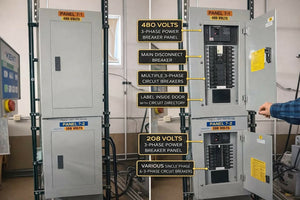
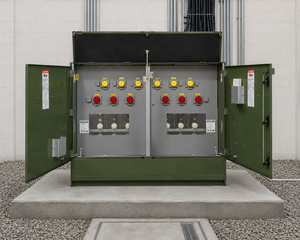
Low-Voltage Certification Labeling Rules
Low-voltage equipment in the U.S. refers to devices operating at 600 volts or less, like control panels and transformers. Proper labeling ensures safety, compliance, and traceability, with strict rules set by OSHA, NEC, and NRTLs. Key labeling requirements include:
- Mandatory Details: Manufacturer name, voltage, current, and safety warnings.
- Durability: Labels must resist fading, peeling, and environmental wear.
- Certification Marks: Only authorized suppliers can print UL or ETL logos.
- Placement: Labels must be visible and accessible without disassembly.
Failing to comply can result in OSHA fines of up to $165,514 for repeated violations. Use durable materials and follow standards like NEC 110.21 and UL 969 to avoid penalties and ensure safety.
General Labels and Markings Required by the NEC
sbb-itb-501186b
Primary Labeling Standards for Low-Voltage Equipment
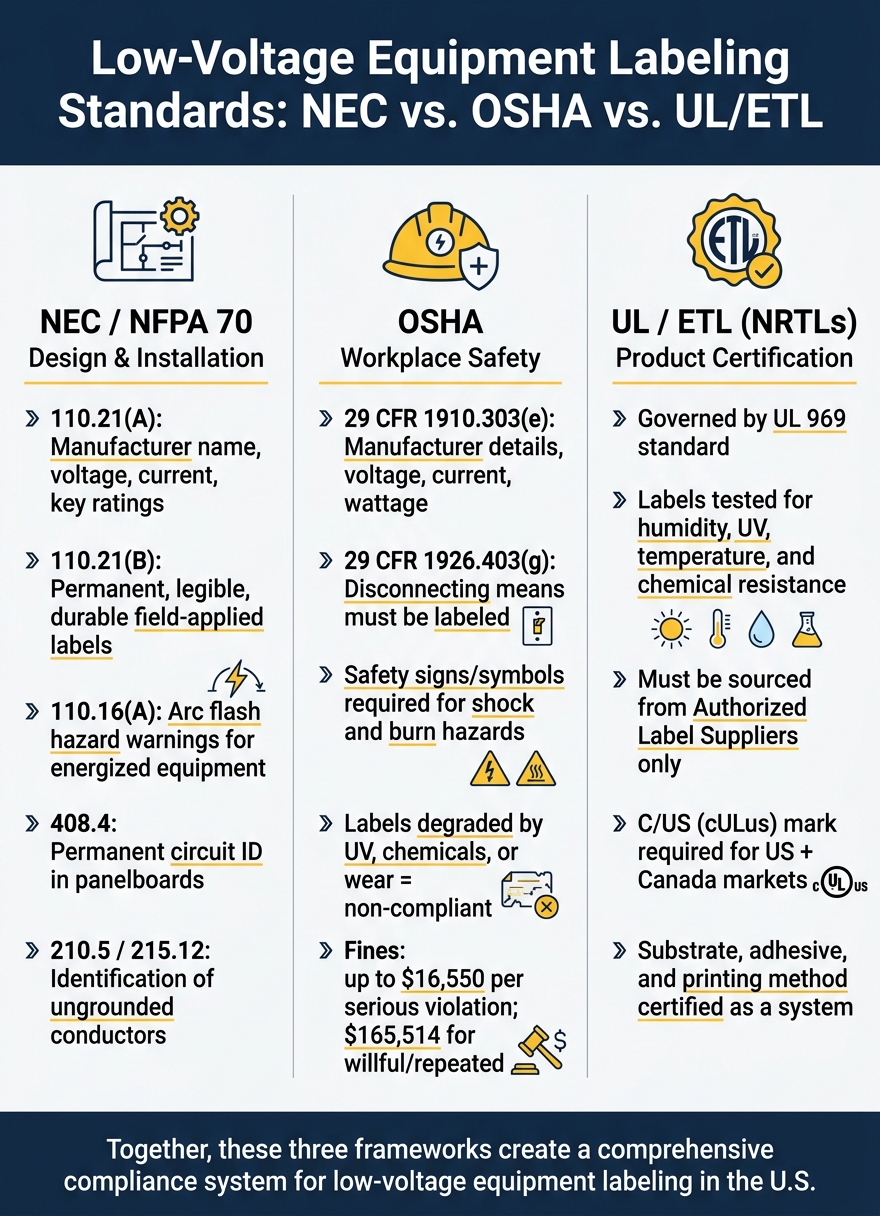
Low-Voltage Equipment Labeling Standards: NEC vs OSHA vs UL/ETL
In the U.S., three organizations - NEC, OSHA, and NRTLs - set the rules for low-voltage equipment labeling. Each focuses on a specific area: NEC covers design and installation, OSHA emphasizes workplace safety, and NRTLs handle product certification. Together, these standards create a well-rounded framework for safety and compliance.
NEC Labeling Requirements
The National Electrical Code (NEC), published as NFPA 70 by the National Fire Protection Association, provides detailed guidelines for labeling electrical equipment. According to NEC 110.21(A), all equipment must include the manufacturer's name or trademark and essential electrical ratings like voltage, current, and wattage. For safety, NEC 110.16(A) mandates arc flash hazard warnings on equipment that may be worked on while energized, such as panelboards and motor control centers.
Field-applied labels must meet strict standards outlined in NEC 110.21(B): they must be permanent, legible, and resistant to environmental conditions. Handwritten labels are not acceptable for permanent hazard markings. Additionally, specific labeling rules apply to certain equipment:
- Panelboards: NEC 408.4 requires that every circuit be clearly and permanently labeled in the circuit directory.
- Ungrounded Conductors: NEC 210.5 and 215.12 mandate that these conductors are identified at all termination points.
| NEC Section | Requirement |
|---|---|
| 110.21(A) | Manufacturer name, voltage, current, and key ratings. |
| 110.21(B) | Permanent, legible, and durable field-applied labels. |
| 110.16(A) | Arc flash hazard warnings for energized equipment. |
| 408.4 | Permanent circuit identification in panelboards. |
| 210.5 / 215.12 | Identification of ungrounded conductors at termination points. |
While NEC focuses on proper equipment design and labeling during installation, OSHA takes it further by addressing workplace safety.
OSHA Workplace Safety Label Requirements
OSHA builds on NEC’s groundwork by enforcing additional labeling rules specific to workplace environments. Under 29 CFR 1910.303(e) and 1926.403(g), equipment must be clearly marked with the manufacturer’s details, voltage, current, and wattage. Disconnecting means for motors, appliances, and branch circuits must also be labeled to indicate their purpose unless it’s obvious from their location.
To protect workers, OSHA requires the use of safety signs, symbols, or tags to warn about potential hazards like electrical shocks or burns. Former OSHA Assistant Secretary Edwin G. Foulke, Jr. highlighted the importance of these markings:
"OSHA believes that [descriptive markings], along with the training requirements for qualified persons, will provide employees the necessary information to protect themselves from arc-flash hazards."
Labels that degrade due to environmental factors like UV exposure, chemical cleaners, or wear are considered non-compliant. This is particularly problematic in industrial settings, where common cleaning agents like isopropyl alcohol can weaken adhesives, potentially leading to inspection failures.
UL and ETL Certification Standards

UL and ETL certifications add an extra layer of assurance by ensuring labels can withstand harsh conditions. UL 969, the primary standard for labeling systems, governs the durability and performance of labels used on certified electrical equipment.
"Many electrical, electronic and related technology products are required to be permanently marked with specific safety-related information including hazards, warnings, cautionary markings, installation instructions and electrical ratings."
Labels undergo rigorous tests for resistance to humidity, UV exposure, temperature changes, and chemicals before receiving certification. Both UL and ETL operate as Nationally Recognized Testing Laboratories (NRTLs), meaning their certification standards are equivalent. However, if a label combines the UL Certification Mark with safety information, the supplier must be an Authorized Label Supplier. If not, the equipment manufacturer must handle compliance through an "Unlisted Component" evaluation.
Required Label Content for Certified Low-Voltage Equipment
This section outlines the mandatory details that must appear on labels for certified low-voltage equipment, based on NEC, OSHA, and NRTL standards. Missing even one of these elements can lead to compliance issues during inspections.
Identification and Electrical Rating Information
Labels must clearly display key details, including the manufacturer's name, model number, voltage, frequency, current, and a unique identifier (such as a UL file or control number). This identifier connects the equipment to its approved design. If an inspector cannot trace the label back to a recognized source, the equipment may be deemed non-compliant, even if all other aspects are correct.
Safety and Hazard Warnings
Safety warnings must be permanently affixed and remain legible throughout the product’s lifespan to meet regulatory requirements. UL evaluates labels as a complete system, taking into account the substrate, adhesive, and printing method. For example, the inks or ribbons used to print warnings like "CAUTION" or "WARNING" must be compatible with the label material and approved as part of the recognized system.
Labels are tested to withstand real-world conditions, including high humidity, UV exposure, extreme temperatures, and chemical exposure (e.g., oils or solvents). If a label fades or detaches under such conditions, it fails compliance - no matter how well it was initially printed. For equipment used in outdoor or industrial environments, checking the label's environmental rating before installation can save time and prevent costly rework.
How to Display Certification Marks and Symbols
Displaying certification marks, such as UL or ETL logos, involves more than just printing the symbols. Suppliers must be Authorized Label Suppliers. For products sold in both the U.S. and Canada, a "C/US" indicator (e.g., cULus) must be included to meet the standards of both markets. You can verify a supplier’s authorization through the UL Product iQ database by searching for their company name and confirming their inclusion in the Marking and Labeling Systems program and the Authorized Label Supplier program.
| Label Category | CCN (US) | CCN (Canada) | Typical Use |
|---|---|---|---|
| Marking and Labeling Systems | PGDQ2 | PGDQ8 | Pre-printed, die-cut labels for OEMs |
| Printing Materials | PGJI2 | PGJI8 | Labels for in-house secondary printing |
| In-Mold Labels | PGIM2 | PGIM8 | Labels embedded into plastic during molding |
| Flag/Wrap-Around Labels | PGCT2 | PGCT8 | Flexible cord or hose labels |
If your facility adds variable data, such as serial numbers, using thermal transfer or laser printing, the printer models and ink ribbons must match the UL-recognized construction. Using unapproved materials can invalidate certification during FUS inspections.
Next, we’ll dive into the importance of label placement, visibility, and durability to ensure compliance over time.
Label Placement, Visibility, and Durability
These guidelines work alongside NEC, OSHA, and UL/ETL standards to ensure that approved labels stay visible and legible in practical installations. Proper placement and durability are just as important as the label's content for maintaining compliance and ensuring safety.
Where to Place Labels
Labels should be positioned on the main exterior of the equipment, ensuring they remain visible after installation and can be read without needing to disassemble any components. In cases where external placement isn't feasible - like with very small or remotely installed components - an internal duplicate label can be used, but only as an exception.
"Marking to be on the main part of the equipment and visible on exterior of apparatus when installed." - Hazardex
For extremely small components, condensed information (such as a certificate number or notified body code) is acceptable when a full label won’t fit legibly. Ideally, labels should be placed near areas technicians are likely to inspect first, such as terminals, disconnects, or panel doors.
Label Durability Requirements
A label that fades, peels, or detaches during use can invalidate a piece of equipment’s certification during an inspection. Durability depends on the entire labeling system - this includes the substrate, adhesive, and printing method, all of which must be certified together.
"The certification bodies don't just approve the product - they approve the entire labeling system including substrate, adhesive and printing method." - Taylor Corporation
Choosing the right materials for the operating environment is critical. Standard vinyl labels, for instance, typically withstand temperatures up to 176°F (80°C), which might not be sufficient for high-heat environments like motor control centers. For corrosive or extreme conditions, such as chemical plants, outdoor settings, or food processing facilities, materials like chemically etched stainless steel or photo-anodized aluminum (e.g., Metalphoto) are far more reliable. Etched stainless steel provides recessed graphics between 0.005 and 0.010 inches deep, ensuring readability even under heavy wear. Additionally, low-surface-energy plastics like polyethylene require specialized adhesives to prevent labels from lifting, and curved surfaces demand flexible materials to avoid failure.
Readability and Accessibility Standards
NEC Article 110.21 establishes a basic requirement: "Markings shall be of sufficient durability to withstand the environment involved". OSHA 29 CFR 1910.303 further specifies that equipment cannot be used unless it is marked to identify the manufacturer and its ratings. During inspections, an unreadable label is treated the same as a missing one.
To ensure proper adhesion, surfaces must be cleaned thoroughly to remove oil, dust, or other contaminants. For cables and wires, self-laminating wrap labels offer added protection by sealing the printed area under a clear tail, guarding against abrasion, moisture, and chemicals. In enclosed or high-risk locations, such as tunnels or offshore platforms, Low Smoke Zero Halogen (LSZH) labels are often required to minimize toxic gas release in case of fire. These steps help maintain label effectiveness throughout the equipment’s operational life.
How to Stay Compliant with Labeling Rules
Following proper labeling standards is just the beginning. To maintain certification compliance, manufacturers, installers, and contractors must follow specific steps.
Manufacturer Compliance Steps
Compliance starts at the design phase. The first task is identifying the relevant standards for your equipment. For example, UL 969 applies to labeling systems, NFPA 79 to industrial machinery, and ANSI Z535 to safety signs. The choice depends on the equipment type and target market. Choosing the wrong standard early on can result in expensive rework.
Once the correct standards are identified, manufacturers must submit their products to a Nationally Recognized Testing Laboratory (NRTL) for certification. This process includes a technical design review, sample testing (covering electrical, thermal, and mechanical aspects), and an initial factory audit. Labels should only be sourced from an Authorized Label Supplier since the substrate, adhesive, and ink are tested as a single system - not just the printed content.
"In regulated industries, the label isn't just decoration - it's a compliance-critical component. Each label must be treated with the same rigor as the product itself." - Taylor
Manufacturers also need to create and retain a Declaration of Conformity (DoC) alongside a complete technical file. These documents must typically be kept for 10 years after the product hits the market. Even minor changes to the product or its labeling require a re-evaluation.
Finally, it's crucial for installers and contractors to confirm that the labels perform as intended in real-world conditions.
Installer and Contractor Responsibilities
Installers and contractors play a critical role in ensuring compliance before equipment is operational. Before installation, they must verify that each nameplate includes essential details like the manufacturer’s name, voltage, amperage, phase, frequency, and Short Circuit Current Rating (SCCR). For instance, a label that only states "480V" without phase or frequency information is inadequate and could lead to an OSHA citation.
Arc Flash and Shock Hazard labels must be visible and in place before any servicing begins. Disconnects should clearly indicate what they control and where they are fed from. A clear format like "DISCONNECT FOR [Load] – FED FROM [Panel/Feeder]" eliminates confusion during inspections. A good practice is to test labeling by having someone unfamiliar with the system verify equipment identification and shutdown procedures. If they can't, the labeling needs improvement.
Cross-referencing physical labels with as-built documentation, including one-line diagrams and Bills of Materials, is also essential. NEC Article 409 requires that every conductor be marked to match the wiring diagram.
Record-Keeping and Common Compliance Mistakes
Good documentation isn’t optional - it’s mandatory. Starting in January 2025, OSHA penalties for labeling violations can reach $16,550 per serious violation and $165,514 for willful or repeated violations. Poor record-keeping makes it harder to defend against citations if an inspector flags an issue. On the flip side, detailed records from installers help ensure ongoing compliance.
Many compliance mistakes stem from cutting corners during production or installation. Common errors include using uncertified label stock, failing to include the "C" prefix for Canadian markets (e.g., cUL), applying the wrong ink for thermal transfer printing, and mislabeling hazards - like using "CAUTION" instead of "DANGER". Other frequent issues include vague circuit directories (e.g., labeling a breaker as "Bob’s Office") and labels that no longer match the wiring after field modifications.
To avoid these pitfalls, implement a "Redline + Photo" rule for every field change. This means updating the drawing, photographing the modification, and immediately replacing the physical label. Providing a pre-inspection packet that includes one-line diagrams, Bills of Materials, component datasheets, and installation instructions can also help prevent delays.
Conclusion: Keeping Low-Voltage Equipment Safe and Compliant
Certification labeling plays a key role in maintaining safety. These labels provide technicians with critical information about voltage levels, potential hazards, and which components can be safely replaced.
Starting in January 2025, OSHA penalties will reach $16,550 for serious violations and $165,514 for willful or repeated offenses. Beyond these hefty fines, non-compliant equipment may face rejections from insurers, fail to meet building codes, or even be removed from the market. These risks highlight the importance of durable, reliable labeling.
"The certification marks on equipment nameplates aren't decorative - they represent third-party testing and impose strict controls on who can print them." - Red Safety IDs
Compliance is not a one-time effort; labels must remain legible for the entire lifespan of the equipment. Regular inspections are essential to identify issues like fading, peeling, or damage caused by chemicals before they lead to compliance failures. Choosing the right materials - both substrate and adhesive - ensures labels can withstand tough environments.
For anyone sourcing low-voltage equipment, whether new or used, verifying the condition of certification labels is a must. Platforms such as Electrical Trader provide access to a variety of electrical components, allowing buyers to inspect equipment details before making a purchase. Ensuring that certification marks and nameplates are intact and readable before installation can help avoid delays and failed inspections. This proactive approach ensures compliance and safety throughout the equipment's operational life.
FAQs
Which label details do inspectors check first on low-voltage equipment?
Inspectors begin by examining the manufacturer and model or serial number to ensure the equipment can be traced back to the vendor or relevant testing records. Next, they verify markings that indicate energy source ratings - such as voltage, current, phase count, and frequency - to confirm compatibility and safe connections. Lastly, they check for certification marks like UL or CSA and confirm the presence of required safety warnings in compliance with NEC or ANSI standards.
How can I confirm a UL or ETL mark is authorized and traceable?
To confirm a UL or ETL mark, start by finding the unique identifier or file number on the product's certification label. Then, use this number or the manufacturer’s name to search in the UL Product iQ database. If the product features Enhanced or Smart Marks, simply scan the QR code on the label to view its certification details. While the mark signals compliance, proper verification requires connecting the unique ID to the official UL record.
What label materials are best for heat, UV, and chemical exposure?
For low-voltage equipment, polyester stands out for its resistance to chemicals, abrasion, and high temperatures. Polyimide works best in environments with extreme heat, while vinyl provides flexibility and UV resistance - making it a great choice for outdoor or curved surfaces. To boost longevity, applying an overlaminate can shield materials from fading, cracking, and chemical exposure.