

Low Voltage Safety: OSHA vs. NFPA Standards
Low voltage systems can be dangerous if not managed properly. To ensure safety, OSHA and NFPA 70E provide guidelines, but their approaches differ. Here's what you need to know:
- OSHA enforces federal regulations with legal penalties for non-compliance. It defines low voltage as 50 volts or higher and focuses on guarding live parts, safe practices, and training requirements.
- NFPA 70E offers detailed technical guidance, defining low voltage as 50V to 600V. It emphasizes risk assessments, PPE selection, and creating an Electrically Safe Work Condition (ESWC).
- OSHA's rules are mandatory, while NFPA 70E is voluntary but often referenced by OSHA during inspections.
Key Differences:
- OSHA sets legal requirements; NFPA 70E provides technical methods.
- OSHA has general PPE rules; NFPA 70E specifies PPE based on incident energy levels.
- OSHA updates infrequently; NFPA 70E revises every three years.
Both standards aim to reduce risks like arc flashes and electric shocks in low voltage systems. Following OSHA ensures compliance, while NFPA 70E helps achieve best practices.
OSHA Standards for Low Voltage Electrical Safety
Key OSHA Requirements for Low Voltage Safety
OSHA's electrical safety guidelines for general industry are outlined in 29 CFR 1910 Subpart S. These regulations cover both installation (Sections 1910.302–308) and work practices (Sections 1910.331–335). A key requirement is guarding live parts operating at or above 50 volts to ensure worker safety.
For systems operating below 50 volts, OSHA does not require deenergizing as long as there is no increased risk of burns or explosions caused by electric arcs. OSHA 29 CFR 1910.333 explains:
"Live parts that operate at less than 50 volts to ground need not be deenergized if there will be no increased exposure to electrical burns or to explosion due to electric arcs." - OSHA Standard 1910.333(a)
When working near energized parts in low voltage systems (typically 300 volts or less), OSHA emphasizes maintaining safe approach distances. For such systems, the guideline is straightforward: avoid physical contact with energized components.
Training and Competency Requirements Under OSHA
According to 29 CFR 1910.332, any employee exposed to electric shock risks beyond those mitigated by standard installation practices must receive proper safety training. This includes a wide range of workers, such as electricians, welders, mechanics, engineers, and supervisors operating near exposed parts at 50 volts or more. OSHA differentiates between two categories of workers:
| Feature | Qualified Workers | Unqualified Workers |
|---|---|---|
| Hazard Recognition | Must identify exposed live parts and determine nominal voltage | Must recognize general hazards like arcing and high voltage |
| Technical Skills | Required to understand specific approach distances for different voltages | Not required to perform voltage determinations |
| Energized Work | Allowed to work on energized parts with proper PPE and techniques | Prohibited from working on energized parts |
The term "qualified" is specific to the equipment an individual is trained to handle. OSHA Instruction STD 1-16.7 clarifies:
"It is possible and, in fact, likely for an individual to be considered 'qualified' with regard to certain equipment in the workplace, but 'unqualified' as to other equipment."
This means a technician certified on one system may need additional training for different equipment. OSHA considers improper training a serious violation, underscoring the importance of proper worker preparation.
How OSHA Handles Compliance and Enforcement
When conducting inspections, OSHA compliance officers examine written energy control procedures, review training records, and observe workers in action. They also document the voltage levels involved in any violations, as this can influence how citations are classified.
OSHA's safety guidelines are performance-based, meaning employers are responsible for achieving specific safety outcomes, but they have flexibility in how they meet these requirements. In practice, many employers use NFPA 70E as a reference. As Tom Galassi, OSHA's Director of Enforcement Programs, explained:
"NFPA 70E is an industry consensus standard, and is generally not enforced by OSHA. Although, compliance with NFPA 70E is an acceptable means of hazard abatement."
If no specific OSHA standard addresses a recognized hazard, the agency can cite employers under the General Duty Clause (Section 5(a)). To stay compliant, employers should prioritize thorough documentation of training, follow lockout/tagout procedures, and use NFPA 70E as a practical framework for safety, even though it is not legally mandated. The next section will compare OSHA's approach with NFPA standards, focusing on differences in training, PPE, and enforcement.
NFPA Standards for Low Voltage Electrical Safety
Key NFPA Documents for Low Voltage Safety
While OSHA establishes legal standards, NFPA provides the technical guidelines that ensure safety in electrical work. Two critical documents stand out: NFPA 70E (Standard for Electrical Safety in the Workplace) and NFPA 70 (better known as the National Electrical Code, or NEC). The NEC focuses on the proper installation of electrical systems, while NFPA 70E emphasizes safe work practices when dealing with energized systems. For instance, if you're troubleshooting a 480V panel or maintaining a commercial switchboard, NFPA 70E lays out the safety measures you need to follow.
One of NFPA 70E's key messages is that low-voltage systems are not automatically safe. Even systems operating at 120V to 277V can generate incident energy levels exceeding 8 cal/cm², which is enough to cause severe burns if proper PPE isn't used. Beyond this, NFPA also provides detailed guidelines on training and competency requirements.
Training and Competency Requirements Under NFPA
NFPA 70E defines a qualified person as someone who has not only received training but has also demonstrated the skills and knowledge needed to understand the construction, operation, and hazards of electrical equipment. Attending a class alone isn’t enough - workers must prove their competence through practical application.
Training programs must cover critical areas such as approach boundaries, PPE selection, risk assessment procedures, and the proper use of insulating tools. Supervisors, too, are required to undergo the same level of training as their workers. After all, a supervisor who can't identify an arc flash boundary won't be effective in enforcing safety protocols. This focus on competency ensures that NFPA's technical standards translate into real-world safe practices, complementing OSHA's regulatory framework.
Retraining is another essential component. NFPA 70E mandates that workers undergo retraining at least every three years. However, this schedule can be accelerated if there are changes in job responsibilities, the introduction of new equipment, or instances where safety practices are not being followed.
How NFPA 70E Guides Low Voltage Safety Practices
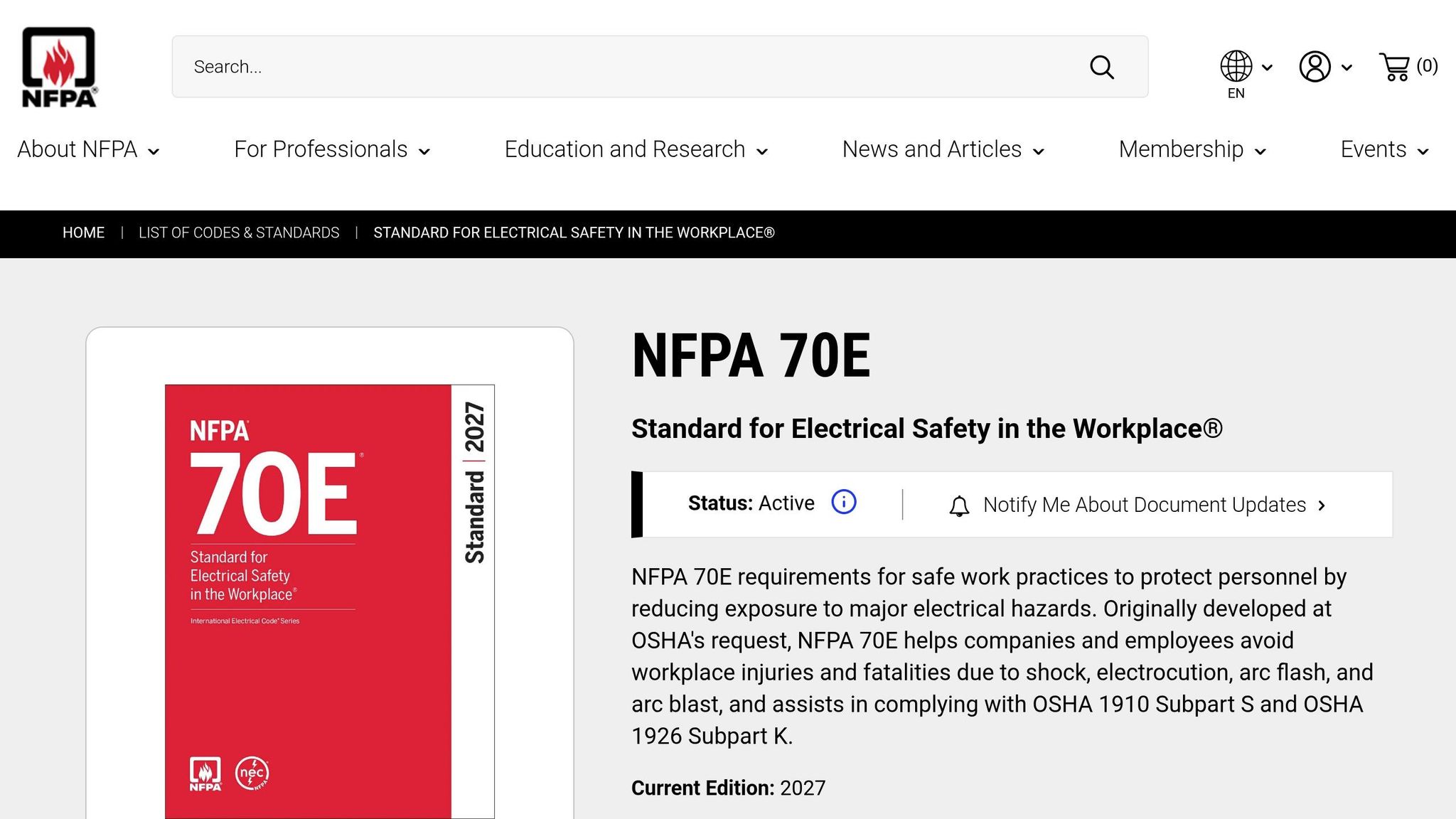
At the heart of NFPA 70E is the principle of de-energization, which involves creating an Electrically Safe Work Condition (ESWC). This is achieved by disconnecting power, locking out the source, and verifying that no voltage is present. However, energized work is allowed in specific cases - such as when de-energizing would create a greater hazard or is impractical due to equipment design.
For situations where energized work cannot be avoided, NFPA 70E Article 130.5 requires an arc flash risk assessment before approaching equipment operating at 50V or higher. This six-step process, guided by IEEE 1584-2018, includes everything from collecting data to selecting appropriate PPE. The assessment calculates incident energy levels (measured in cal/cm²), which dictate the exact PPE requirements for the task.
NFPA 70E provides two methods for determining PPE:
- Incident Energy Analysis Method: This calculates a precise incident energy value for the task, offering detailed and auditable results.
- PPE Category Method: This uses predefined tables based on the type of equipment.
Most facilities lean toward the analysis method due to its accuracy and reliability. Here's a quick breakdown of PPE categories and their requirements:
| PPE Category | Minimum Arc Rating | Typical Equipment | Required PPE |
|---|---|---|---|
| Category 1 | 4 cal/cm² | 120/240V light commercial panels | Arc-rated shirt/pants, safety glasses, hard hat |
| Category 2 | 8 cal/cm² | Commercial panelboards, switchboards <600V | FR shirt/pants, arc-rated face shield, leather gloves |
| Category 3 | 25 cal/cm² | Medium commercial switchgear, large MCCs | 25 cal/cm² arc suit and hood, leather gloves |
| Category 4 | 40 cal/cm² | Medium-voltage switchgear, large industrial | 40 cal/cm² arc suit and hood, leather gloves/boots |
In addition to PPE, equipment must be field-labeled with key details such as nominal system voltage, arc flash boundary, and either the available incident energy or the applicable PPE category. Arc flash studies should be updated every five years or sooner if significant changes occur, like the installation of a new transformer or a load increase exceeding 10%. The upcoming 2026 NEC update will also require the study date to be clearly visible on arc flash labels.
"NFPA 70E is more than just a set of compliance requirements - it offers practical tools that employers can apply directly to reduce electrical hazards in the workplace." - R.W. Hurst, Editor, Electricity Forum
Electrical Safety Training: What OSHA & NFPA 70E Require
sbb-itb-501186b
OSHA vs. NFPA: A Direct Comparison for Low Voltage Safety
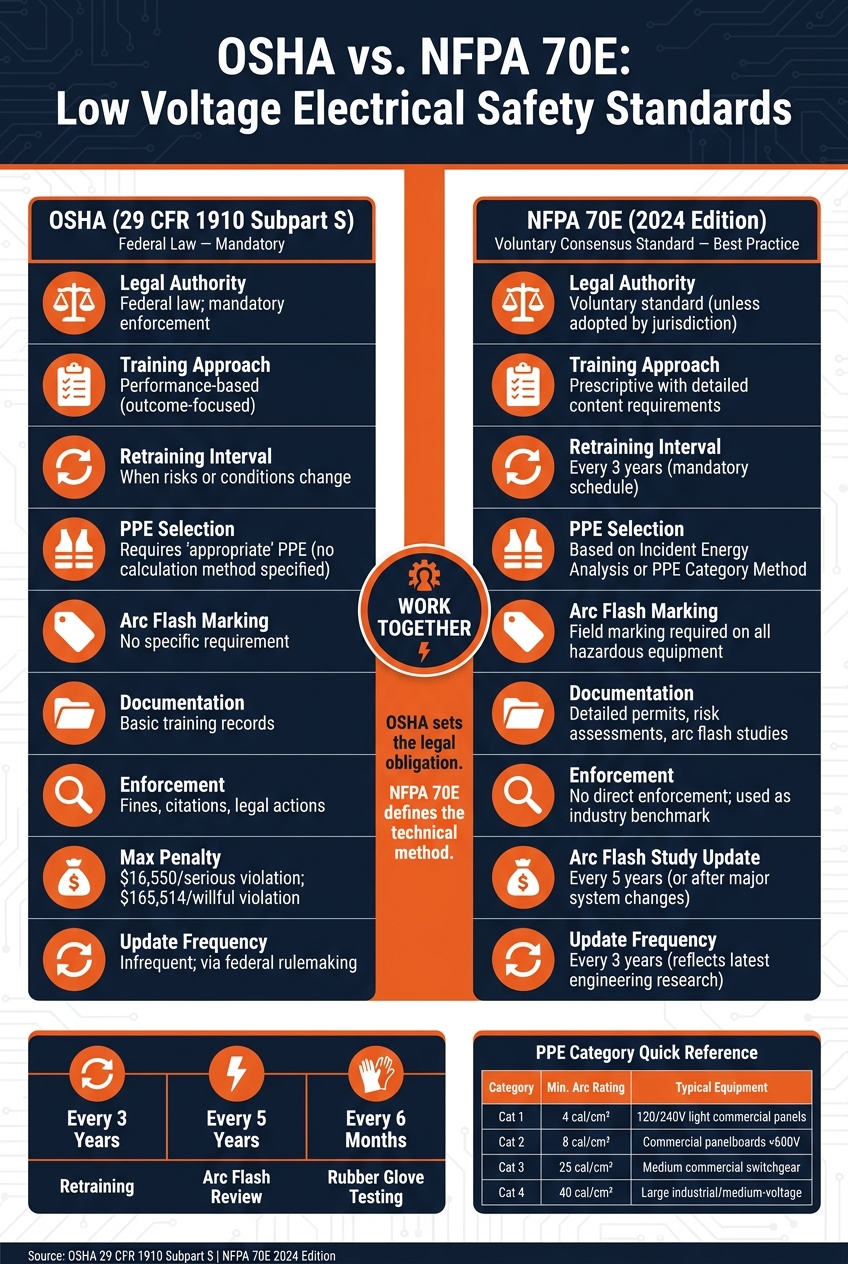
OSHA vs. NFPA 70E: Low Voltage Electrical Safety Standards Compared
How OSHA and NFPA Standards Work Together
OSHA and NFPA 70E complement each other in creating a safer workplace. OSHA establishes the legal requirements, while NFPA 70E provides the technical guidance needed to meet those requirements. As Bowtie Engineering explains:
"OSHA sets the legal obligation, and NFPA 70E defines the technical method for meeting it."
This connection becomes especially relevant during OSHA inspections. While OSHA cannot directly cite a facility for not following NFPA 70E - since it’s not an OSHA standard - they often use it as evidence of a "recognized hazard" under the General Duty Clause (Section 5(a)). For example, if an employer fails to follow NFPA 70E’s guidelines on arc flash boundaries or PPE and an incident occurs, OSHA may hold the employer accountable.
One key difference is how these standards evolve. OSHA’s rules are updated through a lengthy federal process, while NFPA 70E is revised every three years, reflecting the latest engineering research. This distinction shapes how training, PPE, and enforcement are approached under each standard.
Training and PPE Requirements: OSHA vs. NFPA
When it comes to training and PPE, OSHA and NFPA 70E take different approaches, which influence how employers implement safety measures in low voltage work environments. OSHA’s training requirements, outlined in 29 CFR 1910.332, are performance-based. They require workers to be trained to recognize and avoid electrical hazards but don’t specify exactly what that training should include. NFPA 70E, on the other hand, provides a detailed framework in Article 110, listing specific topics, skills, and a mandatory retraining schedule every three years.
Similarly, OSHA’s PPE rules in 1910.132 and 1910.335 require "appropriate" protective equipment but don’t detail how to calculate the level of protection needed. NFPA 70E fills this gap with its Incident Energy Analysis and PPE Category methods, offering precise calculations to ensure proper protection.
| Feature | OSHA (29 CFR 1910 Subpart S) | NFPA 70E (2024 Edition) |
|---|---|---|
| Legal Authority | Federal law; mandatory enforcement | Voluntary standard (unless adopted) |
| Training Approach | Performance-based | Prescriptive with detailed content |
| Retraining Interval | When risks or conditions change | Every 3 years |
| PPE Selection | Requires "appropriate" PPE | Based on Category or Incident Energy |
| Arc Flash Marking | No specific requirement | Field marking required for hazards |
| Documentation | Basic training records | Detailed permits and risk assessments |
A notable difference is in arc flash labeling. OSHA doesn’t mandate specific markings on equipment, but NFPA 70E does. These labels play a critical role in meeting OSHA’s requirement to warn employees about hazards. Former OSHA Assistant Secretary Edwin G. Foulke, Jr. highlighted this connection:
"Industry consensus standards, such as NFPA 70E, can be used by OSHA and employers as guides in making hazard analyses and selecting control measures."
Compliance and Enforcement: OSHA vs. NFPA
OSHA has direct enforcement power, including fines and legal actions, while NFPA 70E serves as a reference standard without enforcement authority. OSHA violations can lead to serious financial penalties - up to $16,550 per violation for serious offenses and up to $165,514 for willful or repeated violations. In cases where a willful violation results in a worker’s death, criminal charges and prison time may apply. Employers have 15 working days to contest a citation.
NFPA, as a private organization, cannot issue fines or conduct inspections. Instead, NFPA 70E acts as the industry benchmark for what constitutes reasonable electrical safety practices. OSHA inspectors and courts often refer to NFPA 70E to evaluate whether an employer has taken sufficient steps to protect workers.
| Feature | OSHA (29 CFR 1910/1926) | NFPA 70E |
|---|---|---|
| Nature | Federal law; enforceable | Voluntary consensus standard |
| Enforcement | Fines, citations, legal actions | No direct enforcement |
| Update Frequency | Infrequent; via federal rulemaking | Every 3 years |
| Role in Audits | Sets the legal baseline | Serves as the benchmark |
| Primary Goal | Enforce minimum safety outcomes | Provide detailed technical guidance |
As the National Fire Protection Association puts it:
"You don't technically have to use NFPA 70E to protect employees from electrical hazards, but not using the recognized American National Standard will not satisfy an OSHA investigator or the victim's family."
- National Fire Protection Association
Recognizing these differences is essential for building a comprehensive low voltage safety program that meets both legal and practical safety expectations.
Building a Low Voltage Safety Program: Equipment and Training
How to Build a Low Voltage Safety Program
Creating a low voltage safety program involves turning OSHA and NFPA standards into actionable steps for daily operations. The cornerstone of this process is a written Electrical Safety Program (ESP). Both OSHA and NFPA 70E emphasize the importance of a documented plan that identifies hazards, assesses risks, and outlines safe work practices. Without this, the likelihood of accidents and regulatory penalties increases.
"Missing or incomplete records are among the most cited causes of OSHA violations in the electrical category." - Lance Roux, CSP, Founder of SafetyPro Resources
Your ESP should focus on three primary areas: hazard assessments, lockout/tagout (LOTO) procedures, and personnel qualifications. Conducting arc flash and shock hazard assessments is a critical step, as it helps determine the appropriate personal protective equipment (PPE) and defines safety boundaries. LOTO procedures, on the other hand, must be specific to each piece of equipment - generic approaches often fail to meet compliance standards. Additionally, the ESP should verify that all personnel working near energized parts above 50 volts are properly trained and qualified.
Training should go beyond the classroom. OSHA highlights the importance of hands-on learning:
"The purpose of hands-on training... is two-fold: first, to ensure that workers have an opportunity to learn by experience; and second, to assess whether workers have mastered the necessary skills." - OSHA
This means workers must not only pass written tests but also demonstrate their ability to safely use PPE, perform voltage tests, and maintain proper approach distances.
Selecting and Sourcing Compliant Low Voltage Equipment
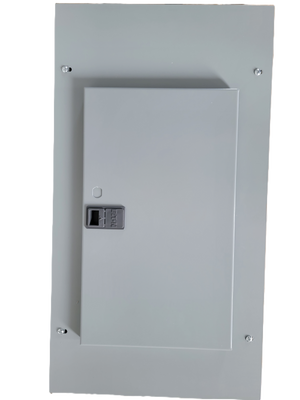
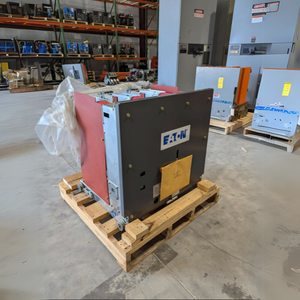
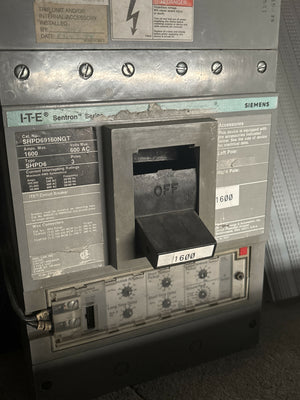
The safety of your facility depends heavily on the equipment you choose. From breakers to panelboards, every component must align with the requirements of your ESP. For instance, components need to match the nominal voltages in your system, and panelboards should allow for proper arc flash labeling, including details like incident energy levels, safety boundaries, and required PPE categories. Features like finger-safe terminals and disconnects with visual verification windows can further enhance safety.
For LOTO compliance, OSHA (1910.147) mandates that locks and tags be uniquely identifiable and used exclusively for isolating energy sources. Similarly, PPE must meet the latest ASTM standards for electrical insulation and arc resistance.
When it comes to sourcing compliant equipment like breakers and panelboards, platforms such as Electrical Trader offer both new and used options with quick delivery times. Once installed, maintaining safety requires regular training and periodic assessments to ensure ongoing compliance.
Keeping Compliance Current Through Retraining and Updates
A safety program isn't static - it evolves. NFPA 70E mandates retraining for qualified personnel at least every three years, or sooner if there are changes to equipment, procedures, or job roles. Additionally, arc flash risk assessments must be reviewed at least once every five years, and rubber insulating gloves in use should be retested and certified every six months.
Auditing field practices is another critical step. As Lance Roux points out:
"A written program that fails to mirror field practices can lead to serious compliance issues." - Lance Roux, CSP, Founder and Principal Consultant, SafetyPro Resources
Regularly compare documented procedures to actual on-site practices. Any gaps between the two can result in OSHA violations. To stay compliant, routinely update your ESP in line with OSHA and NFPA guidelines. When NFPA 70E releases a new edition - typically every three years - review your program and make the necessary adjustments. Regular audits and updates are essential for ensuring both safety and compliance.
Conclusion: Key Takeaways on OSHA and NFPA Low Voltage Standards
OSHA establishes the legal requirements, while NFPA 70E provides the technical guidelines for implementing those rules. Together, they form a comprehensive approach to electrical safety - one tells you what to do, and the other explains how to do it.
Even low-voltage systems, such as 120V/208V, pose serious risks. These systems can lead to severe arc flash injuries, highlighting the importance of adhering to safety protocols.
The consequences of non-compliance are steep. OSHA penalties can reach $16,550 per serious violation and soar up to $165,514 for willful or repeated violations. As the National Fire Protection Association warns:
"Not using the recognized American National Standard [NFPA 70E] will not satisfy an OSHA investigator or the victim's family." - National Fire Protection Association
Here’s a quick look at key compliance timelines every safety program should monitor:
| Requirement | Frequency |
|---|---|
| Electrical safety retraining | Every 3 years (max) |
| Arc flash risk assessment review | Every 5 years (max) |
| Dielectric testing for rubber gloves | Every 6 months |
FAQs
When does OSHA expect us to follow NFPA 70E?
OSHA doesn't directly enforce NFPA 70E because it's an industry consensus standard rather than a federal regulation. However, OSHA often uses NFPA 70E as a reference point to support its own electrical safety standards.
In the event of workplace incidents, OSHA might cite NFPA 70E under the General Duty Clause to demonstrate that the hazards were known and that practical safety measures were available. Adhering to NFPA 70E can also help ensure compliance with OSHA's safety program and PPE requirements.
Do 120V and 240V circuits really need arc-flash PPE?
Yes, you need arc-flash PPE for 120V and 240V circuits if there's potential exposure to live components. According to OSHA, even low-voltage systems can lead to serious injuries. NFPA 70E requires safety assessments for equipment operating at 50 volts or more. If lockout/tagout procedures don’t fully eliminate the risk, arc-rated PPE is essential to reduce the dangers.
What records should we keep to pass an OSHA inspection?
To successfully navigate an OSHA inspection, it's essential to keep your safety program records clear and well-organized. Key documents to have on hand include your written Electrical Safety-Related Work Practices program, Lockout/Tagout (LOTO) procedures, and arc flash hazard assessments complete with equipment labels.
Additionally, maintain training records for all employees, annual safety audits, energized work permits, and maintenance logs such as breaker test results. Ensure every record is timestamped and properly associated with the relevant personnel and equipment for easy reference.