Load Balancing in Low Voltage Distribution Networks
Load balancing in low voltage networks is essential to maintain system efficiency and safety. It involves redistributing single-phase loads across three phases to reduce energy losses, voltage imbalances, and neutral current overloads. Here's how it's done:
- Two-Stage Stochastic Programming with V2G Integration: Uses EVs for energy storage and redistribution, addressing long-term planning and daily load adjustments. Reduces energy loss and neutral current but requires significant infrastructure investment.
- Sparrow Search Algorithm (SSA): A software-based method to optimize phase configurations without physical rewiring. Cost-effective but may face challenges in large networks.
- Practical Reconfiguration with PRD Control: Employs physical devices to switch phase connections in real-time. Effective for immediate corrections but costly to scale.
Each method suits different scenarios based on network size, available data, and infrastructure. For urban areas with high EV use, V2G systems excel. Rural networks benefit from SSA's low-cost optimization, while PRDs are ideal for areas with limited smart meter data.
Key takeaway: The right approach depends on your network's needs, balancing cost, scalability, and performance.
1. Two-Stage Stochastic Programming with V2G Integration
This method breaks load balancing into two separate decision levels. The first stage focuses on long-term planning, deciding which loads connect to specific access nodes. The second stage operates on a daily basis, scheduling when electric vehicles (EVs) charge or discharge. Unlike static methods that rely on limited historical data, this approach uses advanced optimization techniques to align strategic planning with daily operations.
One of its standout features is how it tackles uncertainty. Factors like EV charging patterns, weather changes, and customer demand are inherently unpredictable. Instead of ignoring these variables, stochastic programming incorporates them through scenario-based simulations. Vehicle-to-Grid (V2G) technology plays a critical role here, transforming EVs into distributed energy storage systems. With bidirectional energy flow, EVs can store surplus energy during low-demand periods and supply it back during peak times. This dynamic adjustment helps correct phase imbalances without requiring physical rewiring. Together, these two stages create a more flexible and responsive load balancing system.
Effectiveness in Reducing Power Loss
The two-layer structure directly addresses energy inefficiencies. By redistributing loads at feeder endpoints and factoring in electrical topology alongside street layouts (RGCN), the model identifies cost-effective routes for line installation and load connections. Studies reveal that V2G-enabled demand-side management can lower the peak-to-average ratio in total load consumption by up to 26.46%. This "peak shaving" effect reduces current flow during high-demand times, which is critical because energy losses increase with the square of the current.
Neutral Current Minimization
Another benefit is minimizing current in the neutral conductor, a significant source of energy loss in four-wire low-voltage (LV) networks. The second stage of the framework continuously adjusts EV charging rates, ensuring balance across all three phases even as loads fluctuate. These real-time adjustments complement the long-term planning stage, ensuring that operational decisions align with broader load distribution goals. Unlike static physical reconfigurations, this system adapts dynamically to changing conditions.
Scalability for Different Network Sizes
Scaling this approach to larger networks introduces computational challenges. Scenario-based problem-solving becomes increasingly complex as network size grows. To address this, researchers have developed solutions like neural network approximations for the second-stage model, achieving over 50 times faster processing compared to traditional solvers in a 123-bus system, while keeping the optimality gap below 0.30%. For areas without smart meters, "pseudo load profiles" estimate consumption based on typical usage patterns, reducing the need for extensive data without sacrificing accuracy. These advancements help make the system more affordable and practical to implement.
Implementation Cost
Costs include installing low-voltage overhead lines and deploying smart meters. Frequent V2G cycling can impact battery life, so this must be carefully modeled to maintain user participation. However, optimizing the use of existing resources, such as EVs and PV inverters, offers a lower-cost solution compared to hardware-based devices that require significant investment. Additionally, variable energy pricing within this framework can reduce energy costs for commercial fleets by 31.6%, and optimize battery use to lower total EV fleet ownership costs by up to 3.9%.
2. Sparrow Search Algorithm (SSA) for Phase Balancing

The Sparrow Search Algorithm (SSA) offers a smart way to rebalance electrical phases without requiring physical load shifting, unlike two-stage stochastic programming with V2G systems. SSA uses a nature-inspired approach to assign single-phase consumers to one of three phases (A, B, or C). Instead of relying on costly hardware upgrades, it focuses on reassigning phase connections, making it a practical and economical solution for load balancing.
Effectiveness in Reducing Power Loss
SSA stands out for its ability to find optimal phase configurations that significantly cut down energy losses. Real-world tests have shown that its optimization approach brings measurable improvements in phase balance and reduces energy waste. Thanks to its multi-directional search capabilities, SSA performs exceptionally well in large-scale optimization tasks, often surpassing methods like Particle Swarm Optimization in terms of accuracy for complex engineering challenges. This precision can help utilities lower operational costs when managing low-voltage networks.
Neutral Current Minimization
One of SSA's strengths is its ability to minimize neutral current by evenly distributing loads across all three phases. In four-wire systems, the neutral current equals the vector sum of the phase currents. When phases are well-balanced, this sum approaches zero. SSA achieves this by reducing the squared deviation from the average hourly phase current, ensuring no phase carries an excessive load.
Scalability for Different Network Sizes
While the standard SSA can sometimes struggle with larger networks due to premature convergence on suboptimal solutions, the TS-SSA variant addresses these challenges. This enhanced version has been tested on problems involving 300 to 2,000 decision variables and 3 to 20 objectives, showing strong results across various scales. For networks with multiple supply nodes, a multistage approach - optimizing individual branches before tackling the main feeder - helps manage complexity without compromising the quality of the solution. This adaptability makes SSA a viable option for networks of varying sizes.
Implementation Cost
SSA's reliance on existing infrastructure makes it a cost-efficient choice. The primary expense involves installing smart meters to monitor consumption. However, utilities can minimize data requirements by using "pseudo load profiles" based on typical usage patterns. By focusing on reassigning phase connections, SSA avoids the need for expensive new transformers or additional distribution lines. Its compatibility with standard computing hardware ensures that utilities of all sizes can implement it effectively. For those requiring distribution equipment during network upgrades, platforms like Electrical Trader offer access to essential items like breakers, transformers, and low-voltage equipment to maintain balanced configurations.
3. Practical Reconfiguration and PRD Control
Building on earlier discussions about software-based techniques, practical reconfiguration using PRD control provides a hardware-focused solution for managing phase imbalances. Unlike digital methods that reassign loads via software, this approach uses physical devices to directly tackle imbalances.
Phase-reconfiguration devices (PRDs) are central to this method. They dynamically adjust the phase connections of residential customers, offering a tangible solution for networks with limited smart metering infrastructure. Unlike software-based load reassignment, PRDs physically switch connections to address issues like high rooftop solar output during the day or peak EV charging at night. This approach is particularly effective in networks that lack extensive smart meter data, as the system relies on the PRDs themselves for control.
Effectiveness in Reducing Power Loss
PRD control has proven its ability to enhance energy efficiency through direct intervention. By physically reconfiguring phase connections at distribution points, PRDs significantly reduce power losses in networks where software solutions fall short due to data constraints. This hardware-focused strategy often surpasses energy storage systems in managing imbalances caused by distributed generation. Its ability to provide immediate, physical corrections makes it a go-to solution for networks with high penetration of renewable energy sources.
Neutral Current Minimization
Another key benefit of PRD control is its ability to reduce neutral current by balancing loads across all three phases. By directly switching phases, PRDs lower the vector sum of phase currents, which prevents unnecessary circuit breaker trips. Additionally, this balancing reduces excess heat in machine windings, extending the lifespan of three-phase equipment.
Scalability for Different Network Sizes
For larger networks with numerous supply nodes, a multistage optimization approach is often employed. This method divides the reconfiguration process between the main distribution feeder and its branches, making it easier to handle the computational demands without compromising results. The difference in loss reduction between various multistage algorithms is typically minimal - usually within 1.3%.
Bin Liu highlighted the operational challenges of network imbalances in IEEE Transactions on Power Delivery:
"The unbalance issue can cause lots of operational problems, e.g., increased power loss and stressed/light phases in the network that may worsen the under/over-voltage issue".
As networks grow, centralized control becomes more complex, adding to the challenges of deploying PRDs on a large scale. This raises the need to carefully weigh the costs of widespread implementation.
Implementation Cost
Although individual PRDs are relatively affordable, scaling up their deployment can be a significant expense for Distribution Network Operators. Available hardware options include static transfer systems, magnetic latching relays with high-speed data transmission for remote control, and microcontroller-based devices equipped with three relays. These solutions, while cost-effective compared to network reinforcement or cable upgrades, still represent a considerable investment. For utilities planning such upgrades, platforms like Electrical Trader offer essential components such as breakers, transformers, and low-voltage equipment to support reconfiguration projects.
sbb-itb-501186b
Strengths and Weaknesses
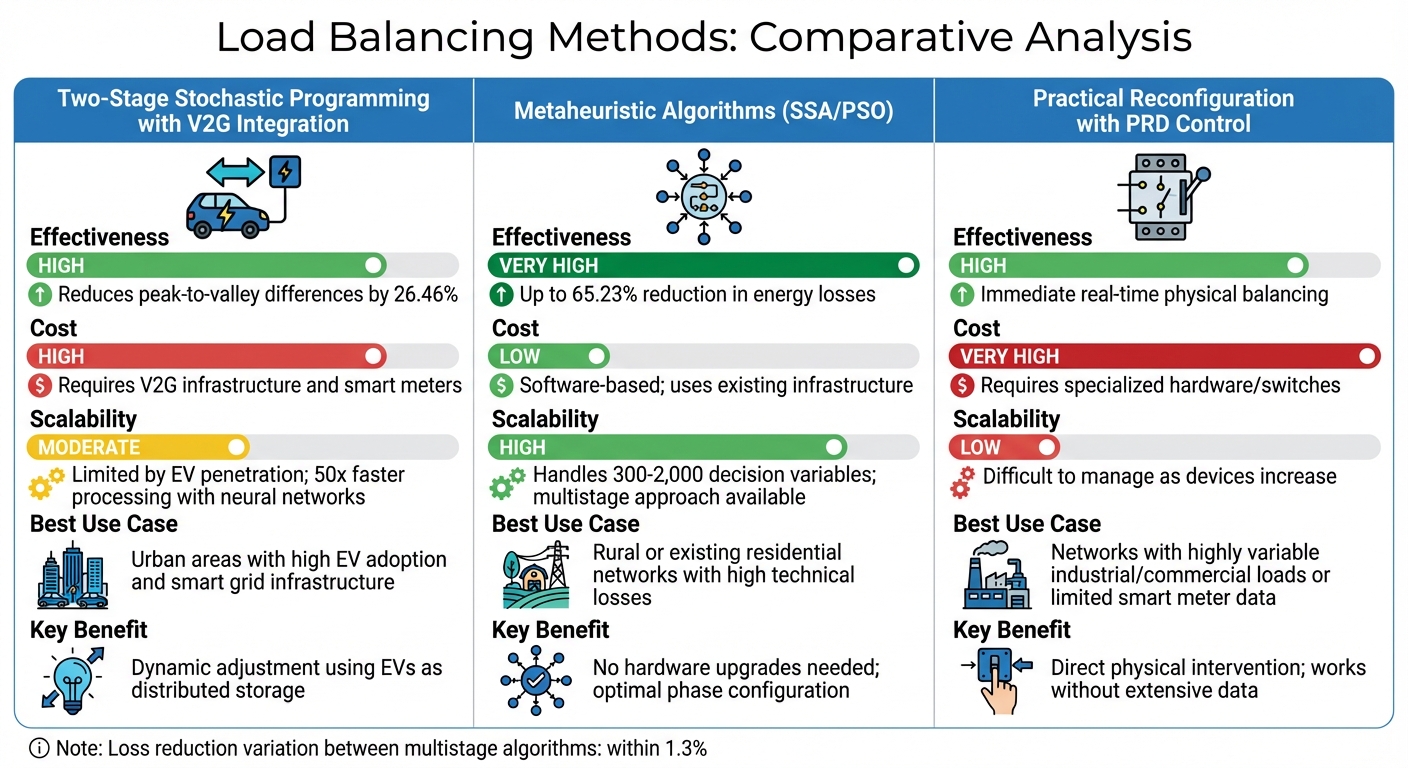
Comparison of Three Load Balancing Methods for Low Voltage Distribution Networks
This section breaks down the strengths and weaknesses of the discussed methods, focusing on how they perform in different scenarios.
Each technique has its own set of advantages and challenges, depending on the network's setup and operational demands. Two-Stage Stochastic Programming with V2G stands out for its ability to combine long-term planning with short-term operational adjustments. However, it does require a hefty investment in V2G-compatible chargers and smart metering systems. Metaheuristic algorithms like SSA and PSO excel at minimizing energy losses - up to a 65.23% reduction in practical applications - by optimizing phase configurations using existing infrastructure. On the other hand, Practical Reconfiguration with PRD Control offers quick physical balancing but struggles to scale effectively as the number of devices grows.
Here’s a quick comparison of the techniques based on key performance metrics:
| Technique | Effectiveness | Cost | Scalability | Best Use Case |
|---|---|---|---|---|
| Two-Stage Stochastic (V2G) | High (reduces peak-to-valley differences and imbalance) | High (requires V2G infrastructure and smart meters) | Moderate (limited by EV penetration) | Urban areas with high EV adoption and smart grid infrastructure |
| Metaheuristic (SSA/PSO) | Very High (significant reduction in energy losses) | Low (software-based; utilizes existing infrastructure) | High (especially with multistage approaches) | Rural or existing residential networks with high technical losses |
| Practical Reconfiguration (PRD) | High (immediate, real-time physical balancing) | Very High (requires specialized hardware/switches) | Low (difficult to manage as devices increase) | Networks with highly variable industrial or commercial loads |
For networks lacking widespread smart meter coverage, PRD control remains a practical option by relying solely on device-level data. Urban areas with a growing number of EVs can benefit significantly from V2G systems, as these vehicles act as distributed storage units, helping to balance demand peaks. Meanwhile, rural networks dealing with high technical losses should consider metaheuristic approaches. These software-driven solutions can pinpoint optimal configurations without requiring costly hardware upgrades.
For operators planning infrastructure upgrades, platforms like Electrical Trader offer essential components, including breakers and transformers, to support these improvements.
Conclusion
Selecting the best load balancing technique depends on your network's unique conditions and the infrastructure you have in place. For networks with significant EV use and renewable energy sources, two-stage stochastic programming with V2G integration is a strong choice. This method treats EVs as distributed storage units, making it ideal for urban areas with high EV adoption and advanced smart grid systems.
On the other hand, metaheuristic algorithms can deliver notable energy savings, especially in rural networks. These software-based methods are effective at reducing energy losses. Research shows that multistage optimization in large radial networks achieves energy loss variations within 1.3% when compared to more complex simultaneous methods.
For networks with limited access to smart meter data, sensitivity-based PRD control is a practical option. It relies on locally measurable data, making it suitable for areas where data collection is a challenge. In remote rural grids dealing with voltage issues or flicker caused by solar integration, hardware phase balancers offer a cost-effective and quick solution without requiring a complete overhaul of network data. This approach is particularly useful when advanced optimization isn't feasible due to data constraints.
The key is to align your strategy with your network's topology, data availability, and load characteristics. For example, networks with highly variable loads can benefit from real-time PRD control, while large radial configurations may require multistage methods to handle complexity effectively. When planning upgrades to support these strategies, resources like Electrical Trader can supply essential components such as breakers and transformers.
The most effective approach combines software-based optimization for managing consumer allocation with hardware solutions for real-time adjustments. This combination ensures both immediate improvements and long-term benefits, highlighting the importance of tailoring load balancing strategies to meet the specific needs of each network.
FAQs
How do I choose between V2G, SSA, and PRD for my LV feeder?
To decide between V2G (Vehicle-to-Grid), SSA (Static Synchronous Series Compensator), and PRD (Phase Reconfiguration Device) for your low-voltage (LV) feeder, it’s essential to evaluate the specific needs of your network:
- V2G: Perfect for managing load balancing and enhancing grid stability by utilizing EV batteries. This is particularly useful in areas with a high penetration of electric vehicles.
- SSA: A solid choice for tackling power quality problems, such as voltage imbalance.
- PRD: Works well for minimizing phase imbalance and improving load distribution, all without relying on energy storage systems.
Each option serves a distinct purpose, so the right choice depends on your system's challenges and priorities.
What data is needed to run SSA or two-stage stochastic balancing?
To implement SSA or two-stage stochastic balancing in low-voltage distribution networks, you’ll need a variety of data sources. These include phase reclosers (PRDs), street-level information, V2G (Vehicle-to-Grid) technology data, customer meter readings, transformer neutral wire current, and metrics on load distribution and unbalance. Each of these inputs plays a key role in performing precise analysis and achieving effective load balancing within the network.
Will V2G phase balancing shorten EV battery life?
Vehicle-to-Grid (V2G) phase balancing can have an effect on EV battery health, potentially contributing to degradation over time. That said, employing well-thought-out strategies can significantly reduce this impact, helping maintain battery life and performance. The key lies in proper load management and careful execution, ensuring that the process minimizes strain on the battery while still delivering the benefits of V2G technology.