3-Phase Load Balancing Techniques Explained
Balancing three-phase electrical loads is all about distributing power evenly across the three conductors (phases) in a system. When done correctly, it reduces energy losses, stabilizes voltage, and extends the life of equipment like motors and transformers. However, imbalances can lead to overheating, insulation damage, and safety risks.
Here’s a quick breakdown of key techniques for load balancing:
- Manual Phase Swapping: Redistribute loads across phases using a power quality analyzer. Effective for stable systems but requires regular inspections.
- Automated Balancing Devices: Use sensors and controllers to adjust loads dynamically. Ideal for systems with variable demands but involves higher costs.
- Load Shedding & Compensators: Disconnect non-critical loads during emergencies or use compensators to manage reactive power and stabilize voltage.
- Delta vs. Wye Configurations: Wye systems handle imbalances better with a neutral wire, while Delta systems are more reliable for industrial applications.
For implementation, measure phase loads, choose the right method, and monitor regularly to maintain balance. Tools like power loggers and smart meters are essential for identifying and correcting imbalances. Whether you opt for manual or automated solutions depends on your system's complexity and budget.
Calculating Load Schedules and Balancing Three Phase Systems
sbb-itb-501186b
Why Load Balancing Matters in 3-Phase Systems
Balanced three-phase systems are key to reducing energy losses in conductors. When current flows evenly across all three phases, resistive losses (calculated using I²R) stay low. On the flip side, unbalanced systems force extra current through certain phases, leading to excess heat generation. In fact, about 30% of energy losses in industrial settings are tied directly to phase imbalances. This makes it clear why maintaining balanced loads is so important.
Keeping equipment cool and running efficiently also depends on proper load balancing. Motors, transformers, and generators that operate under balanced conditions face less mechanical and thermal stress, which helps them last longer. Voltage imbalances, however, create negative sequence components in motors - essentially, magnetic flux that spins in the opposite direction of the motor’s intended rotation. This not only generates internal heat but also adds mechanical strain. To put it into perspective, running a motor 10°C (50°F) above its recommended temperature can cut its lifespan in half and cause phase current imbalances up to ten times the percentage of the voltage imbalance.
"The benefits – increased efficiency, extended equipment life, improved safety and operational reliability, and reduced neutral current – are well worth the effort."
– Jake Green, Head of Technical Engagement, Scolmore Group
Safety risks also rise when loads are unbalanced. Neutral conductors, which are often designed to handle only 50% of the phase capacity, can overheat due to unbalanced return currents. This overheating can lead to insulation failure and even fire hazards. In extreme cases, particularly with triplen harmonics, the neutral current can actually surpass the current in the line conductors.
Voltage stability is another critical factor. Balanced systems maintain consistent voltage across all phases, ensuring sensitive electronics operate reliably. But in imbalanced systems, heavily loaded phases may experience significant voltage drops, while lightly loaded phases can see overvoltage. This instability can cause equipment malfunctions, unnecessary tripping of protective relays, and unplanned downtime. Real-time monitoring systems have shown to reduce phase imbalances by as much as 20%, helping facilities avoid these costly problems. These issues highlight the importance of adopting effective load balancing strategies, which are explored in the next section.
Load Balancing Techniques
Managing load distribution effectively is crucial for maintaining system stability and efficiency. The techniques outlined below address a variety of operational needs, offering both manual and automated solutions.
Balancing three-phase loads can be done either manually or automatically, depending on factors like facility size, budget constraints, and how often load demands change throughout the day.
Manual Phase Swapping
This method involves physically redistributing single-phase loads across L1, L2, and L3 to achieve even current distribution. An electrician uses a power quality analyzer to measure phase currents and then shifts heavier loads to less utilized phases. While this approach is relatively inexpensive, it requires periodic audits to maintain balance. For facilities with steady loads, the simplicity of this method can make it a practical choice.
Manual phase swapping has been shown to reduce low-voltage network imbalances by up to 35%. However, maintaining these improvements demands regular inspections and skilled labor. For operations with consistent load patterns, this straightforward solution can be more appealing than automated alternatives.
Automated Balancing Devices
Automated systems take a more advanced approach by using real-time sensors and programmable controllers to dynamically adjust load distribution. A 2023 prototype developed by researchers Abbas Khan and Muhammad Ali utilized PZEM 004T modules and relays to monitor six residential loads. Their system leveraged a switching algorithm with 36 configurations to redistribute loads in real time based on current measurements.
"Autonomous and real-time balancing of the distribution system becomes the ultimate solution for avoiding the... shortcomings of the conventionally adopted load distribution systems."
– Abbas Khan and Muhammad Ali, Department of Electrical Engineering, University of Engineering and Technology Mardan
The key advantage of automated systems is their ability to respond instantly to load fluctuations, reducing neutral current and mitigating voltage drops that could harm equipment. For example, fuzzy logic algorithms have been shown to cut power losses from 108.6 kW to just 3.33 kW. However, these systems come with higher costs and increased complexity. Failures in the central controller or switching mechanisms can disrupt operations, making them better suited for facilities with highly variable loads, such as manufacturing plants. Despite the challenges, these systems can extend equipment life and lower energy costs over time.
Load Shedding and Compensators
Load shedding is a protective measure that disconnects non-critical loads when frequency or voltage drop below safe levels, preventing system failures. For instance, in 50 Hz systems, Under Frequency Load Shedding (UFLS) is often triggered at 49.3 Hz - a 1.4% reduction from normal. Modern controllers can prioritize up to 128 load groups and execute disconnections in under 15 milliseconds. GE Vernova's PowerNode Load Shedding solution, introduced in 2023, integrates with existing protection relays using IEC 61850 GOOSE messaging, helping industrial facilities avoid unexpected shutdowns and revenue loss.
Compensators, such as capacitor banks and Static VAR Compensators, manage reactive power to stabilize voltage. These devices are particularly effective during "Alert" states, where bus voltages approach critical thresholds but have not yet reached emergency levels. By injecting or absorbing reactive power, compensators ensure voltage stability across all three phases, reducing stress on transformers and motors. While load shedding is a last-resort measure during crises, compensators provide ongoing support to keep systems operating within normal ranges.
Delta vs Wye Configurations
In three-phase systems, wiring configurations like Delta and Wye play a key role in balancing loads and ensuring efficient operation. These setups determine how the system handles imbalances and impacts overall performance. Let’s break them down:
Wye (Star) configurations connect one end of each phase winding to a common neutral point, creating a "Y" shape with four wires - three phases and one neutral. On the other hand, Delta configurations connect the windings in a closed triangle, using only three wires and omitting a neutral point. These structural differences influence how each system manages load balancing and handles imbalances.
The neutral wire in Wye systems is essential for balancing loads. If the system becomes unbalanced, the neutral provides a return path for excess current, helping to stabilize phase voltages and prevent voltage drift. Delta systems, however, rely on their closed-loop design to circulate currents internally, which works well for mild imbalances. But significant imbalances can cause overheating and inefficiencies. Because of this, Wye configurations are often used in commercial and residential settings where single-phase loads (like lighting or office equipment) coexist with three-phase systems.
"Wye connections provide the flexibility of both line-to-line and line-to-neutral voltages, but they are more susceptible to voltage imbalances."
– William Conklin, Technical Editor, Electricity Forum
Wye systems offer two voltage levels: line-to-line and line-to-neutral. For example, a Wye configuration might provide 480V line-to-line and 277V line-to-neutral, thanks to the √3 (1.732) relationship between these voltages. In contrast, Delta systems only provide a single voltage level (line-to-line), which limits flexibility but makes them ideal for industrial applications where high starting torque is critical. Motors wired in Delta deliver 100% starting torque, compared to 58% in Wye setups.
Delta systems also shine in industrial environments due to their reliability. They can operate in "open-delta" mode if one coil fails, maintaining about 66.7% of their original capacity. Additionally, Delta configurations trap triplen harmonics within their closed loop, preventing these distortions from affecting the supply line, which is especially beneficial for sensitive equipment. On the other hand, Wye systems are generally safer because their grounded neutral provides a low-impedance path for fault currents, enabling protective devices to trip faster.
Comparison Table: Delta vs Wye Configurations
| Configuration Type | Neutral Presence | Load Balancing Suitability | Voltage Flexibility | System Stability |
|---|---|---|---|---|
| Wye (Star) | Yes (4-wire) | High: Neutral handles unbalanced current. | High: Offers both line-to-line and line-to-neutral voltages. | High: Grounded neutral improves safety and fault handling. |
| Delta (Δ) | No (3-wire) | Moderate: Internal circulation for mild imbalances. | Low: Only single (line-to-line) voltage available. | Moderate: No neutral; requires careful fault management. |
How to Implement Load Balancing
To implement load balancing effectively, you need to measure phase loads accurately and verify the results on an ongoing basis. This process requires the right tools and a structured approach.
Begin by measuring your current phase loads using a power logger at the service entrance. Let the power logger run for at least one full billing cycle - usually around 30 days - to capture how loads fluctuate during regular operations. Set the logger’s averaging interval (commonly 15 or 30 minutes) to ensure peak demands are recorded accurately. Over this 30-day period, document each phase’s load (kW/kVA), calculate the average, and aim for a deviation of less than 5–10%, in line with NEC recommendations. This careful measurement process supports both manual and automated balancing strategies.
Once you’ve gathered your data, choose a balancing method that suits your system’s specific needs. For systems with steady, predictable loads - like those in residential or small commercial settings - manual phase swapping is often sufficient. This involves redistributing single-phase circuits (like lighting or outlet loads) evenly across the three phases during installation or maintenance. For industrial systems with more dynamic loads, automated solutions such as smart meters or active phase balancers can adjust in real time to handle shifting demands.
After implementing your chosen method, verify the balance by monitoring the neutral current, which should ideally be close to zero as phase currents cancel each other out. Use power quality analyzers to break down phase voltage into positive, negative, and zero sequences. Negative sequences can signal potential issues like motor or transformer overheating, while zero sequences indicate current losses through the neutral. Additionally, if any phase voltage deviates by more than 1% from the calculated average, corrective action is necessary.
"You can find significant energy-saving opportunities through load balancing and load scheduling when using power logging test tools" – Randy Barnett, Training Director, American Trainco, Inc.
Even after achieving balance, maintain continual monitoring to address any changes that might disrupt the system. Equipment upgrades, seasonal variations, or shifts in operations can create new imbalances over time. Smart meters are invaluable here, offering real-time alerts to help you address problems before they escalate into costly repairs or energy inefficiencies. To make future adjustments easier, label circuits clearly and keep records updated.
Manual vs Automated Methods
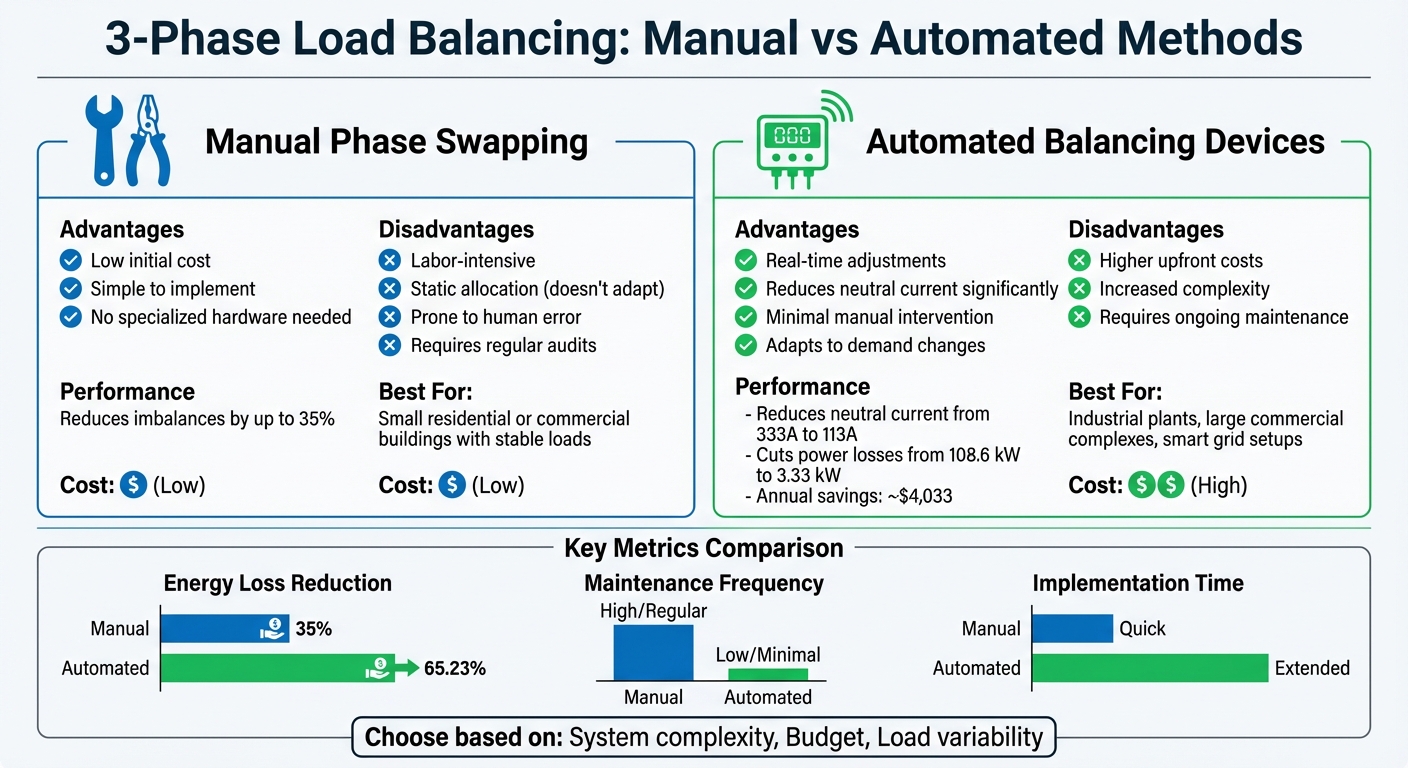
Manual vs Automated 3-Phase Load Balancing Methods Comparison
When it comes to load balancing, deciding between manual and automated methods often boils down to factors like system complexity, budget constraints, and the frequency of load fluctuations. Manual phase swapping is typically a better fit for smaller setups, such as residential or small commercial buildings, where loads remain relatively steady. This method is appealing due to its low upfront costs - there’s no need for specialized hardware. However, it relies on static calculations that don’t adapt to changing demands. Regular audits and adjustments are necessary, which not only make it labor-intensive but also increase the likelihood of human error.
On the other hand, automated methods bring a level of sophistication and efficiency that manual approaches simply can’t match. By using real-time monitoring sensors like the PZEM 004T or ADE7758, paired with switching matrices (using TRIACs or relays), these systems dynamically adjust load distribution in response to demand changes. This eliminates the manual guesswork and significantly reduces maintenance efforts. For example, an Iranian study demonstrated that an automated BF-PSO algorithm reduced neutral current from 333 A to 113 A and cut power losses from 308 kW to 289 kW, resulting in annual savings of around $4,033. Another simulation using fuzzy logic showed an even more dramatic reduction in power losses, from 108.6 kW to just 3.33 kW.
While automation does come with higher initial costs - controllers, sensors, and switching hardware aren’t cheap - it’s particularly effective for larger, more complex systems. Industrial facilities, large commercial buildings, and setups with highly variable loads or renewable energy sources benefit the most from this approach.
"Autonomous and real-time balancing of the distribution system becomes the ultimate solution for avoiding the... shortcomings of the conventionally adopted load distribution systems" – Abbas Khan and Muhammad Ali, Department of Electrical Engineering, University of Engineering and Technology Mardan
Below is a quick comparison of the two methods:
Comparison Table: Manual vs Automated Balancing
| Method | Advantages | Disadvantages | Best Use Cases |
|---|---|---|---|
| Manual Phase Swapping | Low initial cost; simple to implement. | Labor-intensive; static allocation; prone to human error. | Small residential or commercial buildings with stable loads. |
| Automated Balancing Devices | Real-time adjustments; reduces neutral current and power losses. | Higher upfront costs; increased complexity; requires ongoing upkeep. | Industrial plants, large commercial complexes, and smart grid setups. |
Conclusion
Balancing three-phase electrical loads is key to reducing power losses, avoiding overheating, and extending the lifespan of equipment. Studies show that phase swapping techniques can cut unbalancing in low-voltage networks by about 35%, while heuristic load balancing methods have achieved a 65.23% reduction in energy losses during rural network tests. These results highlight how vital precise monitoring and tailored solutions are for effective load management.
To get started, use tools like power quality analyzers or smart meters to pinpoint imbalances. Once identified, redistribute loads manually or implement automated systems, depending on the complexity of your setup. Regular system audits are equally important to maintain balance as energy demands evolve.
"Balancing electrical loads across three phases is both an art and a science, requiring careful planning, monitoring, and a proactive approach to maintenance and system design." – Jake Green, Head of Technical Engagement, Scolmore Group
For practical implementation, investing in high-quality components is non-negotiable. Reliable distribution boards, circuit protectors, and smart monitoring devices are essential for achieving optimal load balance. If you're looking for dependable equipment, Electrical Trader offers a wide range of electrical components, such as breakers, transformers, voltage regulators, and monitoring tools, to suit your needs and budget.
FAQs
How do I know my three-phase system is unbalanced?
To spot an unbalanced three-phase system, start by measuring the voltage and current on each phase. An imbalance shows up when the phase voltages or currents vary in size or aren't spaced evenly by 120°. Keeping an eye on these values and calculating the percentage of current imbalance can highlight problems, ensuring the system runs efficiently, stays safe, and extends the life of your equipment.
When should I choose manual phase swapping vs an automatic phase balancer?
Manual phase swapping works well for smaller systems or when occasional adjustments are needed, such as during maintenance or installation. However, it involves physical intervention, making it less practical for continuous management.
On the other hand, automatic phase balancers shine in larger, more complex systems. These devices continuously monitor power loads in real time and automatically adjust distribution. This ensures safer operation, better efficiency, and longer equipment life - all without requiring manual input.
What level of load imbalance is acceptable in the U.S.?
In the United States, ANSI standards suggest that a voltage imbalance of up to 3% is acceptable. Anything beyond this can cause motors to overheat and lead to operational problems.