Inverter Generator Buying Guide
Looking for a generator that’s efficient, quiet, and safe for sensitive electronics? Inverter generators are a top choice for home backup, camping, RVs, and job sites. They offer clean power, fuel savings, and lower noise levels compared to conventional models. Here's why they stand out:
- Power Quality: Delivers stable electricity with less than 3% Total Harmonic Distortion (THD), perfect for laptops, smartphones, and appliances.
- Fuel Efficiency: Adjusts engine speed to match power demand, saving 20%–40% on fuel.
- Noise Levels: Operates at 48–65 dB(A), much quieter than traditional generators.
- Portability: Lightweight (30–60 lbs for smaller models) and easy to move.
- Versatility: Suitable for home use, outdoor activities, and job sites.
While they cost more upfront ($500–$800 per kilowatt), their efficiency and performance make them a worthwhile investment. Keep reading for tips on choosing the right inverter generator, key specs to consider, and a comparison of popular models.
Top 10 Best Inverter Generators in 2026 ⚡ Quiet, Portable & Fuel-Efficient Picks
sbb-itb-501186b
How Inverter Generators Work
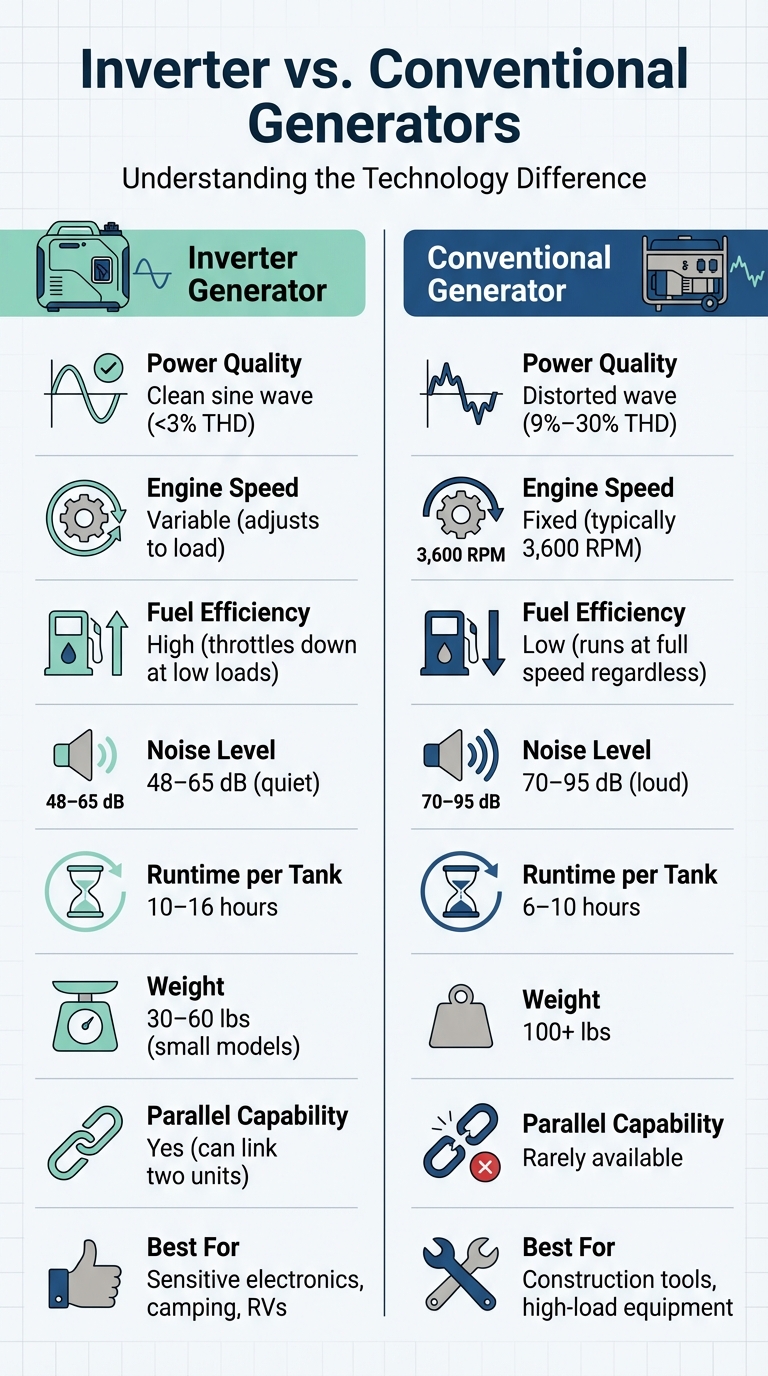
Inverter vs Conventional Generators: Key Differences Comparison
Inverter generators stand out for their ability to provide clean, stable power thanks to a three-step conversion process. Here's how it works: the engine powers an alternator to produce high-frequency AC electricity. This AC is then converted to DC using a rectifier. Finally, an inverter module, equipped with a microprocessor and switching devices like IGBTs or MOSFETs, transforms the DC back into AC electricity at the desired voltage and frequency.
This process ensures electricity with a stable sine wave and Total Harmonic Distortion (THD) below 3%. For comparison, traditional generators often produce THD levels ranging from 9% to 30%, which can harm sensitive electronics. This clean power output is a cornerstone of inverter generator performance.
Another key feature is electronic throttling, which allows the engine to adjust its speed based on the electrical load. Clement Feng, Vice President of Product Management at Briggs & Stratton Energy Solutions, explains:
"A key reason why inverter generators operate more efficiently and quieter than conventional generators is because they adjust their engine running speed based on the electrical load. It's similar to how a car engine revs up when it needs to provide more power. Conventional generators always run at the same speed, typically 3,600 RPM, no matter the electrical demand."
Thanks to this variable speed control, inverter generators maintain voltage regulation within ±2% and frequency stability within 0.5%, while operating at noise levels between 48 and 65 dB(A) - quiet enough for a normal conversation. They also achieve up to 90% efficiency, compared to about 30% for conventional models, resulting in 20% to 40% fuel savings.
Here's a side-by-side comparison of inverter and conventional generators:
Inverter vs. Conventional Generators
| Feature | Inverter Generator | Conventional Generator |
|---|---|---|
| Power Quality | Clean sine wave (<3% THD) | Distorted wave (9%–30% THD) |
| Engine Speed | Variable (adjusts to load) | Fixed (typically 3,600 RPM) |
| Fuel Efficiency | High (throttles down at low loads) | Low (runs at full speed regardless) |
| Noise Level | 48–65 dB (quiet) | 70–95 dB (loud) |
| Runtime per Tank | 10–16 hours | 6–10 hours |
| Weight | 30–60 lbs (small models) | 100+ lbs |
| Parallel Capability | Yes (can link two units) | Rarely available |
| Best For | Sensitive electronics, camping, RVs | Construction tools, high-load equipment |
Key Specifications to Consider
When you're in the market for an inverter generator, focus on three main factors: power output, noise level, and fuel options. These details will help you choose a generator that fits your needs, whether you're using it for emergencies, camping trips, or other activities.
Power Output: Running and Starting Watts
Inverter generators come with two power ratings: running watts and starting watts (also called surge or peak watts). Running watts indicate the steady power the generator provides to keep your devices running, while starting watts represent the extra boost needed to start appliances with electric motors.
This difference is crucial because appliances like refrigerators or air conditioners can require 2 to 3 times more power to start than they need to run. For instance, a refrigerator that uses 600 watts while running might need 1,200 to 1,800 watts to start its compressor. If the generator can't meet this demand, it could stall, trip its breaker, or fail to start the appliance.
To figure out your power needs, add up the running watts of all the devices you plan to use and include the highest starting wattage among them. For reference, a typical home during an outage might require about 5,000 watts to keep essential appliances running. Here's a breakdown of common devices and their power needs:
- Refrigerator: 600 watts (running)
- Sump pump: 750 to 1,500 watts
- Portable heater: 1,500 watts
- Window air conditioner: 1,000 watts
When starting your generator, always begin with no load and add devices one by one, starting with the appliance that requires the most starting watts. Once you've got the power sorted, it's time to think about how noise levels could impact your experience.
Noise Level (dBA)
The noise level of an inverter generator plays a big role in where and how comfortably you can use it. These generators typically operate between 48 and 65 dB(A), which is quiet enough for a normal conversation nearby. David Trezza, an engineer at Consumer Reports, explains:
Inverter generators are generally quiet enough not to drown out nearby conversation.
This quiet performance is thanks to features like variable-speed engines and enclosed designs with advanced exhaust systems.
Low noise output is especially important for places like campgrounds, RV parks, or residential neighborhoods where loud machinery isn't welcome. With U.S. households experiencing an average of 5.5 hours of power interruptions in 2022, many people now prioritize quieter options for home backup generators.
To reduce noise even further, place the generator at least 20 feet from your home or campsite, with the exhaust directed away from people and buildings. Avoid running it at full capacity, as the engine will rev higher and become louder under heavy loads. After noise, fuel options are another key factor to consider.
Fuel Options and Runtime
Inverter generators typically run on gasoline, propane (LPG), or both in dual-fuel models. Each fuel type has its pros and cons:
- Gasoline: Easy to find and high in energy density, but it degrades over time and requires stabilizers for storage.
- Propane: Cleaner burning, stores indefinitely, and produces fewer emissions, though it offers slightly less power per gallon.
Thanks to variable RPM technology, inverter generators adjust engine speed to match the load, unlike traditional models that run at full speed all the time. This feature allows them to save 20% to 40% on fuel compared to conventional generators.
Runtime depends on factors like fuel type, tank size, and load. Generators running at lower loads (where the engine doesn't have to work as hard) can last much longer on a single tank. Check the manufacturer's specs for runtime at both 25% and 100% load to get a clearer picture of what to expect. If you're dealing with extended outages or need flexibility, dual-fuel models let you switch between gasoline and propane based on availability.
Prices for inverter generators range widely, from $400 to $5,000, depending on wattage and features. Smaller models often fall between $250 and $1,000, while larger, more powerful units are on the higher end.
Common Applications for Inverter Generators
Inverter generators are versatile tools, commonly used for home backup power, outdoor activities, and job sites. Each scenario demands specific wattage levels and features to meet its unique requirements.
Home Backup Power
When the power goes out, inverter generators provide a reliable solution. For basic needs, models up to 2,000 watts can handle essentials like lights and small appliances. If you need to power more, generators in the 2,000–5,000-watt range can support larger items like refrigerators, while models exceeding 5,000 watts are suitable for whole-home backup setups. These larger units can run hardwired systems - such as well pumps, sump pumps, or furnaces - when paired with a transfer switch.
Midsized inverter generators, running on just 2–3 gallons of fuel, can power a refrigerator and lights for 8–25 hours. For whole-home setups, a transfer switch installed by a licensed electrician (costing $500–$900) is essential for safe operation. Additionally, the clean power output of inverter generators makes them ideal for running sensitive electronics.
These efficient and quiet machines are not just for emergencies - they shine in outdoor and recreational settings as well.
Recreational Use: Camping, RVs, and Tailgating
With noise levels between 50 and 60 decibels, inverter generators are perfect for campgrounds and RV parks. Compact models, weighing around 30–40 pounds, typically produce about 1,000 watts - enough to power a small TV, lights, phone chargers, or a laptop. For example, the Honda EU2200i operates at an impressively quiet 48 decibels, making it a favorite among campers.
RV owners should look for generators with built-in 30-amp or 50-amp receptacles for direct connection to shore power cords. A 30-amp RV system usually requires 3,400–4,000 continuous watts, while 50-amp systems may need anywhere from 6,000 to 12,000 watts to run multiple air conditioners. Dual-fuel models are especially convenient for RV use since propane, which burns cleaner than gasoline, is often already onboard. Features like "Eco Mode" can adjust engine speed based on demand, extending runtimes to 10–20 hours on a single tank.
The same flexibility that makes inverter generators great for recreation also makes them invaluable on job sites.
Job Sites and Industrial Applications
Inverter generators provide the pure sine wave power required by modern tools and battery chargers. As David Bush, Generators Marketing Manager at Honda Power Equipment, explains:
"The ability for contractors to generate the power needed without sacrificing portability is a major shift in how generators are being used on job sites."
For light construction tasks, a generator producing 2,000–3,000 watts is sufficient for charging batteries and powering basic tools. More demanding job sites typically require 3,400–4,500 watts, while heavy-duty applications may call for 5,000–10,000+ watts. Open-frame inverter models are particularly useful in these settings, offering the ruggedness of traditional generators along with fuel efficiency and high-quality power. Many are designed to be mounted in work trucks, making them even more convenient. Additionally, models with GFCI-protected outlets are a must for generators over 5,000 watts to meet OSHA safety requirements.
Important Features to Look For
When choosing an inverter generator, certain features can make a big difference in performance and usability. These include parallel capability, RV readiness, fuel efficiency, CO sensors, portability, and warranty. Each of these plays a role in ensuring your generator works well for everything from home backup to camping trips.
Parallel Capability and RV Readiness
Parallel capability allows you to connect two compatible inverter generators and combine their power output. This is especially handy when you need extra wattage for larger appliances or tools. For this to work safely, make sure both units are approved by the manufacturer for parallel operation - this prevents potential electrical issues.
If you're an RV owner, look for RV-ready generators that include a standard 30-amp (TT-30R) outlet. This feature lets you plug your RV's power cord directly into the generator without needing an adapter. Popular models like the Westinghouse iGen8200TFc and WEN DF680iX are designed for quick and easy RV setup.
Now, let’s dive into how fuel efficiency and safety systems can further enhance your generator's performance.
Fuel Efficiency and CO Sensors
Generators equipped with Eco-Mode (sometimes called Smart Throttle) automatically adjust engine speed based on the power demand. This helps save fuel compared to traditional generators that run at a constant 3,000–3,600 RPM. For example, the GT4800Ei can run for up to 11 hours at 50% load, while the GT4000ESi offers over 8 hours of runtime on a single 12-liter fuel tank.
Carbon monoxide (CO) sensors, often branded under names like "CO Secure" or "CO Guard", are a crucial safety feature. These sensors detect dangerous CO levels and shut down the generator automatically to prevent harm. While this technology is essential, it doesn’t replace safe operating practices. Always use generators outdoors, at least 20 feet away from any building, with the exhaust directed away from windows and doors. In fact, Consumer Reports now only recommends generators that include automatic CO shutoff technology.
These features, combined with practical design elements, ensure both safety and efficiency in everyday use.
Portability and Warranty
How easily you can move your generator depends on its weight and transport features. Smaller inverter generators usually weigh around 30 lbs, while larger models with 4,000 watts or more can reach up to 250 lbs. For heavier units, look for built-in wheels and a telescoping handle, as they’re often too bulky for one person to carry comfortably. For instance, the Honda EU2200i weighs just 47.4 lbs and remains portable without wheels. On the other hand, heavier models like the Champion 201532 (105.4 lbs) include wheels for easier mobility.
A good warranty is also key to protecting your investment. Most well-known brands provide coverage ranging from 1 to 3 years, which is especially important given the cost of inverter generators, which can range from $400 to $5,000. To keep your warranty valid and ensure your generator lasts, stick to the recommended maintenance schedule. This typically includes oil changes every 100–200 hours and spark plug inspections every 200–300 hours.
Popular Inverter Generator Models Compared
Finding the right inverter generator means weighing power, portability, and price. Options range from small 1,500W generators perfect for camping trips to heavy-duty models delivering 5,000W or more, capable of powering major home appliances through 220V outlets.
Noise levels, measured from 23 feet away, are a key factor when comparing models. Smaller units tend to be quieter, but even among inverter generators - known for their quieter operation - decibel ratings can vary widely depending on the brand and size.
Cost is another consideration, as inverter generators use advanced technology and fuel-saving features, which makes them more expensive upfront compared to conventional portable generators. However, they can offset these initial costs with lower operating expenses by adjusting engine speed to match your power needs.
Most well-known brands offer warranties of 2 to 3 years for their inverter generators. Warranty terms, however, may differ depending on the specific model and where you purchase it. Below is a detailed comparison of popular models, highlighting key specs like power output, weight, noise levels, runtime, fuel type, and price range.
Model Comparison Table
| Model | Rated/Peak Watts | Weight | Noise Level | Runtime (at 25% load) | Fuel Type | Price Range |
|---|---|---|---|---|---|---|
| Honda EU2200i | 1,800W / 2,200W | 47.4 lbs | 48-57 dBA | 8.1 hours | Gasoline | $1,100-$1,300 |
| Westinghouse iGen8200TFc | 6,500W / 8,200W | 192 lbs | 64 dBA | 17 hours | Tri-Fuel | $1,800-$2,200 |
| Champion 201423 | 3,100W / 3,400W | 95.7 lbs | 58 dBA | 8 hours | Dual-Fuel | $700-$900 |
| WEN DF680iX | 6,800W / 8,500W | 210 lbs | 63 dBA | 14.5 hours | Dual-Fuel | $1,400-$1,700 |
| Predator 3500 | 3,000W / 3,500W | 99 lbs | 57 dBA | 11 hours | Gasoline | $600-$800 |
Buying Tips on Electrical Trader
Calculating Your Wattage Requirements
Before diving into listings, take a moment to figure out your total wattage needs. Start by listing all the appliances you plan to run at the same time. Check the data plate on each device to find its wattage or amperage.
If the appliance only lists amps, you can easily convert it to watts using the formula: Amps × Volts (in North America, this is usually 120V). Keep in mind that appliances with motors often require extra power when starting up. Add up the running watts for everything you’ll use at once, and then include the highest starting wattage from that group.
For instance, let’s say you’re running a refrigerator (700W running, 2,200W starting), a sump pump (1,050W running, 2,150W starting), and a laptop (50W running, no surge). Your total would come to 1,800W running plus 2,200W starting. In this case, you’d need a generator with at least 4,000W peak capacity. To keep the generator from overworking and to extend its lifespan, aim for a model with 10–20% more capacity than your calculated total. Proper wattage planning not only prevents overloading but also helps ensure your generator lasts longer.
Once you’ve figured out your wattage needs, you’ll be ready to explore Electrical Trader’s listings and find the right generator.
Using Electrical Trader's Listings
With your power requirements in hand, Electrical Trader’s filters make it simple to find a generator that fits your needs. The site allows you to sort inverter generators by wattage, fuel type, and brand, so you can quickly narrow down your options. For example, if you’re thinking ahead and want the flexibility to expand your power output later, look for models with "Parallel Capability." This feature lets you link two identical units to double the power. For added safety, prioritize models with CO shutoff sensors, which automatically stop the engine if carbon monoxide levels get too high.
Fuel type is another key factor to consider. If you’re looking for easier storage options than gasoline, check out "Dual-Fuel" or "Tri-Fuel" models that can run on propane or natural gas. Electrical Trader also highlights new arrivals and featured collections, showcasing everything from compact 2,000W units for camping to heavy-duty 7,000W models for home backup. The platform’s organized categories make it easy to compare new and used options side by side, with clear specs and pricing to help you make an informed decision.
Conclusion
Selecting the right inverter generator starts with knowing your power requirements and focusing on the features that matter most to you. Use your wattage calculations to prevent overloading, and look for models that provide clean power with low Total Harmonic Distortion (THD) to protect sensitive electronics. Features like automatic carbon monoxide (CO) shut-off and parallel compatibility can enhance safety and versatility.
Whether you’re after a compact generator for camping, a midsized option with RV-ready outlets, or a larger 5,000-watt model for home backup, matching the specifications to your needs is key. Inverter generators are up to 40% more fuel-efficient than traditional models and run at a comfortable noise level of 50–60 dBA, making them perfect for longer use. These advantages - fuel savings and quieter operation - highlight why inverter generators are a top choice for many scenarios.
At Electrical Trader, you can easily filter options by wattage, fuel type, and brand, comparing both new and used models. This makes it simple to find a generator that fits your specific needs.
Take the time to review specifications, weigh your budget against long-term value, and consider both new and pre-owned units. A well-chosen inverter generator ensures dependable, quiet power whenever you need it. Explore the full range of options at Electrical Trader by visiting https://electricaltrader.com.
FAQs
How do I size an inverter generator for my home essentials?
To figure out the right size for an inverter generator, start by listing all the appliances you plan to power. Then, calculate their combined wattage. Once you have that number, add an extra 20% to cover startup surges and leave room for any future needs. Select a generator with a capacity slightly higher than this total to ensure it runs smoothly and reliably. Don’t forget to think about fuel options as well - choose one that aligns with your usage habits and preferences.
Can an inverter generator run an RV air conditioner?
Yes, an inverter generator can power an RV air conditioner, but only if it supplies enough starting wattage. Typically, most RV air conditioning units demand anywhere from 4,000 to 5,000 watts to manage the initial surge of power needed when the motor kicks on.
Do I need a transfer switch for home backup power?
Yes, using a transfer switch is essential when connecting a home backup generator to your home's electrical system. It ensures safe operation by preventing backfeeding, which can be hazardous to utility workers and your household. Additionally, it helps distribute power correctly, making it a crucial component for standby generators to operate safely and efficiently.