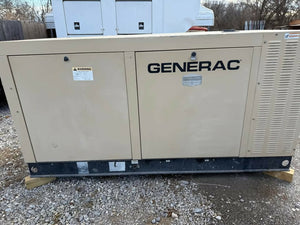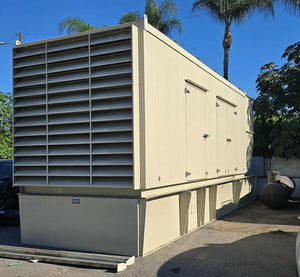


5 Noise Reduction Features in Modern Generators
Generators have come a long way in reducing noise, making them more suitable for homes, workplaces, and noise-sensitive areas. Traditional models often produced sound levels of 80–100 dB, which posed health risks and regulatory challenges. Modern generators, however, operate at quieter levels of 50–70 dB, thanks to advanced noise reduction features. Here's a quick overview of these key technologies:
- Soundproof Enclosures: Reduce noise by 10+ dB using layered materials that block and absorb sound.
- Advanced Muffler Systems: Cut exhaust noise by up to 60 dB with specialized silencers.
- Vibration Isolation: Minimize structural noise by reducing vibrations up to 95%.
- Acoustic Insulation: Absorb sound waves with high-performance materials, lowering noise by 10+ dB.
- Sound-Optimized Engine Design: Reduce noise at the source with inverter technology, water-cooled engines, and precision engineering.
These features not only make generators quieter but also improve usability in residential and commercial settings while meeting strict noise regulations.
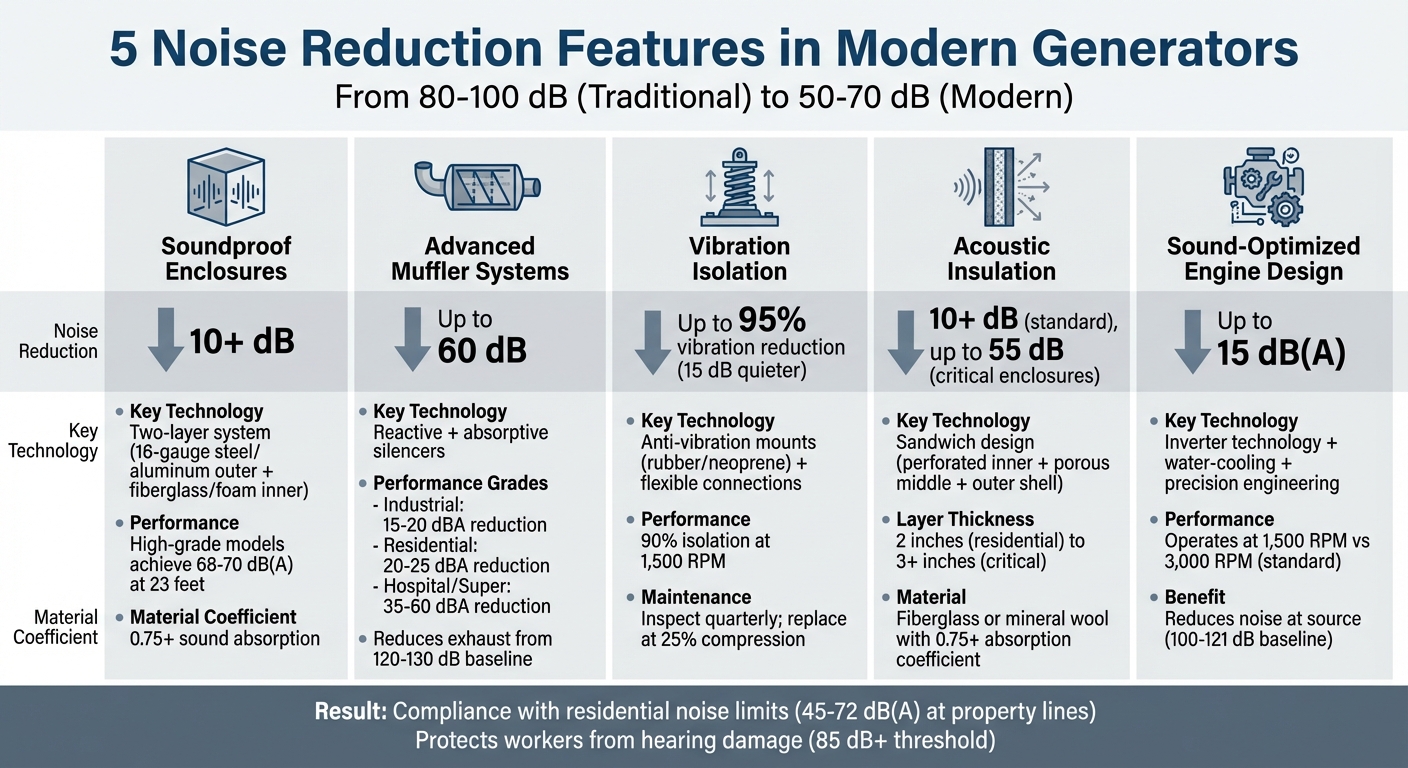
5 Noise Reduction Technologies in Modern Generators: Comparison Chart
How to make a generator quieter - 9 Ways That Work!
1. Soundproof Enclosures
When it comes to cutting down generator noise, soundproof enclosures are a go-to solution. These acoustic barriers are designed to both contain and absorb sound, using a clever two-layer system. The outer layer - usually made from 16-gauge steel or aluminum - acts as a shield, blocking sound waves from escaping. Meanwhile, the inner layer, made of porous materials like fiberglass, foam, or mineral wool, absorbs the sound energy and turns it into heat. This combination makes a noticeable difference in noise reduction.
Standard enclosures provided by manufacturers can cut noise levels by at least 10 dB. For even quieter performance, high-grade enclosures like Cummins Level III models reduce operating noise to as low as 68–70 dB(A) at a distance of 23 feet. That’s quiet enough for use in residential areas. The Mass Law principle explains why this works: doubling the wall's mass per unit area increases sound transmission loss by 6 dB. Heavier enclosures block more noise but may need stronger mounting systems to handle the added weight.
Of course, noise control isn’t the only concern. Generators need airflow to stay cool, so enclosures must strike a balance between soundproofing and ventilation. High-quality designs use features like baffles or louvers to maintain airflow while keeping noise contained. To tackle vibrations, they often include vibration isolation mounts or rubber absorbers, which stop mechanical vibrations from transferring to the base and causing additional noise.
The choice of materials also matters for durability. Aluminum enclosures resist corrosion, making them perfect for humid or coastal areas, while steel enclosures are stronger and more budget-friendly for drier regions. For sound absorption, materials should have a sound absorption coefficient of at least 0.75 (with 1.0 being maximum absorption). And let’s not forget the importance of proper sealing - small gaps in gaskets can lead to significant noise leakage.
2. Advanced Muffler Systems
When it comes to tackling generator noise, advanced muffler systems focus on one of the noisiest culprits: exhaust noise. Without any noise control, engine exhaust can hit ear-splitting levels of 120–130 dB. While standard mufflers reduce this by at least 15 dB, advanced mufflers take it a step further, cutting noise across a broader range of frequencies.
Different types of silencers are designed to handle specific noise ranges. Reactive silencers use chambers and perforated tubes to cancel out low-to-mid-frequency "thumps". Meanwhile, absorptive silencers rely on materials like fiberglass or mineral wool to dampen higher-frequency sounds. For comprehensive noise control, combination silencers merge these two approaches, providing a full-spectrum reduction.
The level of noise reduction depends on the silencer's grade. Here's how they stack up:
- Industrial-grade silencers: Reduce noise by 15–20 dBA, ideal for factories and remote locations.
- Residential-grade silencers: Cut noise by 20–25 dBA, making them suitable for use in neighborhoods.
- Hospital-grade and super extreme silencers: Achieve reductions of 35–60 dBA, perfect for healthcare facilities or urban areas with strict noise regulations.
Durability is another key consideration. High-quality mufflers are built from aluminized or stainless steel, materials that can withstand the intense heat and corrosive nature of exhaust gases. Modern designs also include flexible mounting options and custom flanges, allowing them to fit snugly into various generator models, even in tight spaces.
However, choosing the right muffler isn't just about noise reduction. Proper sizing is critical. Using a high-grade silencer that creates too much backpressure can hurt generator efficiency and even damage the engine over time. Regular maintenance is equally important - inspect for soot buildup, rust, and any structural wear. Some advanced mufflers go beyond noise control, featuring spark arrestors for fire safety in industries like oil and gas or heat recovery systems that repurpose exhaust heat for facility heating, potentially offsetting costs through energy savings.
These advanced muffler systems work hand-in-hand with other noise-reduction technologies to make modern generators quieter and more efficient.
3. Vibration Isolation and Damping Technology
While advanced muffler systems tackle exhaust noise, vibration isolation focuses on a different challenge: structure-borne noise. When a generator's engine vibrates, those vibrations travel through the mounting frame into nearby structures, eventually radiating as sound in other areas. Without proper isolation measures, these vibrations can spread easily, creating unwanted noise in adjacent spaces.
To combat this, vibration isolation systems use anti-vibration mounts (AVMs) to separate the engine and alternator from their mounting surfaces. These mounts, often made from rubber or neoprene, are placed between the generator and its base or foundation. High-quality AVMs can reduce vibrations by as much as 95%, delivering up to 90% isolation at 1,500 rpm. For example, the Cummins Quiet Diesel series incorporates advanced 4-point mounting systems, making these generators up to 15 dB(A) quieter than standard diesel models.
Effective vibration isolation involves more than just mounts. Flexible connections, such as exhaust bellows and reinforced rubber hoses, and spring isolators operating at 3–5 Hz, are also critical in preventing vibration from transferring to other structures.
MTU Onsite Energy notes that reducing noise at the initial stages is relatively affordable, but achieving the final few decibels can be significantly more costly. To maintain performance, it's essential to inspect mounts quarterly. If the rubber shows more than 25% compression, it's time to replace them.
sbb-itb-501186b
4. Acoustic Insulation Materials
Once vibrations are minimized, the next step is addressing the lingering sound waves with acoustic insulation. These materials work by converting sound energy into heat through internal friction. The secret lies in the sound-absorbing materials inside the generator housing - dense materials with open-pore surfaces that guide sound waves deep into the material's interior.
Modern generators often use a layered "sandwich" design. This includes a perforated inner lining with at least 20% open cavity space, a porous middle layer (commonly fiberglass or mineral wool), and a durable outer shell made of steel or aluminum. A standard acoustic canopy from the manufacturer can reduce noise levels by at least 10 dB, and specialized designs can achieve even greater reductions.
The effectiveness of these materials is measured by their absorption coefficient. A coefficient of 0.75 or higher means the material absorbs 75% of the sound energy it encounters. For example, a 500 kVA open-type generator producing 100–105 dB(A) at 3.3 feet requires significant acoustic treatment to meet typical nighttime noise limits of 55 dB(A). "Residential" enclosures usually feature 2-inch-thick mineral wool, while "Critical" enclosures use 3 inches or more. To put it in perspective, achieving 25 dB attenuation for a 2 MW generator costs around $75,000, while achieving 55 dB attenuation can exceed $750,000.
One key maintenance tip: never paint or seal the porous surfaces. If the pores are sealed, as with closed-cell foam, the material loses its ability to absorb sound effectively. Protective coverings can also turn a good absorber into a sound reflector, reducing its performance dramatically.
Durability is another critical factor. High-quality systems use stainless steel or zinc-coated fasteners and 16-gauge steel or aluminum shells to ensure long-lasting performance. Aluminum is especially useful in coastal or humid environments, as it resists corrosion while maintaining similar noise reduction levels - approximately 70 dB(A) at 23 feet. Up next, we'll explore how sound-optimized engine designs further reduce operational noise.
5. Sound-Optimized Engine Design
Sound-optimized engines tackle noise at its root, focusing on reducing the source rather than just containing it. Modern generators are built with precision to minimize the mechanical clatter, combustion noise, and vibrations that are common in traditional engines. While standard diesel engines typically produce noise levels ranging from 100 to 121 dB, advanced designs have made it possible to significantly lower these levels.
One major advancement in this area is inverter technology. Unlike constant-speed generators that run at a fixed 3,000 RPM, inverter engines use microprocessors to adjust their speed based on the actual power demand. By operating at slower speeds, such as 1,500 RPM, these engines naturally generate less noise due to reduced mechanical friction and slower intake and exhaust processes.
Water-cooled engines further contribute to noise reduction by offering a quieter alternative to air-cooled models. Air-cooled engines rely on high-speed fans, which can produce noise levels between 100–105 dB. In contrast, water-cooled engines use liquid jackets around the combustion chambers to act as a sound barrier, eliminating the need for noisy fans. When combined with high-pressure common-rail fuel injection, these engines also reduce the mechanical clatter that occurs during combustion. Together, these features result in a noticeable decrease in overall noise levels.
The impact of these advancements is striking. For example, Cummins' Quiet Diesel Series reduces noise by up to 15 dB(A). According to Cummins:
Their revolutionary design makes these generator sets up to 15 dB(A) quieter than other diesel-powered generators, and quieter than most gasoline sets.
Beyond making engines quieter, these innovations also bring economic benefits. Although sound-optimized engines come with higher initial costs due to their specialized components and precision engineering, they offer long-term savings. These include better fuel efficiency, reduced wear and tear from lower vibrations, and longer service intervals. For applications in noise-sensitive environments, such as residential areas or hospitals, these savings can also help avoid compliance issues, making the investment worthwhile.
Conclusion
Modern generators incorporate five key noise reduction technologies to tackle sound pollution effectively. Enclosures help contain noise, insulation absorbs sound waves, and mounts minimize structural vibration. Mufflers address combustion noise - often the loudest source, reaching levels of 120–130+ dB - while optimized engine designs reduce noise at its origin using lower operating speeds and water-cooling systems.
These technologies work together to ensure quieter operation. When tailored to the engine's specific frequency profile, they can achieve noise levels that comply with strict residential ordinances, typically ranging between 45–72 dB(A) at property lines. Additionally, they safeguard workers in industrial settings, where prolonged exposure to noise above 85 dB over an eight-hour period can result in permanent hearing damage.
Thanks to these advancements, generators are now viable for use in noise-sensitive areas like hospitals, residential communities, and construction sites near public spaces. Features such as inverter systems further enhance their practicality by improving fuel efficiency, extending equipment lifespan, and ensuring adherence to local noise regulations.
FAQs
What do soundproof enclosures do to reduce generator noise?
Soundproof enclosures are designed to dampen generator noise by using materials that absorb and block sound waves. These enclosures are often lined with acoustic insulation, which helps contain the noise while still allowing the generator to function properly. To maintain efficiency, they include features like noise barriers and ventilation systems that ensure adequate airflow for cooling without letting excessive sound escape.
How do advanced muffler systems help reduce noise in modern generators?
Advanced muffler systems are essential for cutting down generator noise by dampening the sound waves created by exhaust gases. They achieve this through the use of specialized chambers and materials that absorb sound, effectively reducing high-frequency noise. This makes generators quieter and better suited for use in residential areas, commercial settings, or even industrial applications.
What’s impressive is that these systems are engineered to reduce noise without affecting the generator’s overall performance. This balance between quiet operation and efficiency is particularly valuable in places where maintaining low noise levels is crucial - think hospitals, event venues, or residential neighborhoods.
Why is vibration isolation crucial for modern generators?
Vibration isolation plays a crucial role in modern generators by limiting the spread of mechanical vibrations. This helps lower noise levels and shields nearby structures and delicate equipment from possible harm.
By keeping vibrations in check, generators can run more smoothly and efficiently. This not only boosts their operational lifespan but also creates a more comfortable environment around them. It’s an important factor in ensuring both reliability and longevity in power generation systems.