

Checklist for Choosing Generator Silencers
Generator silencers reduce noise, protect engines, and ensure compliance with local noise regulations. Without them, generators can emit dangerously high noise levels (up to 130 dB), exceeding safety limits and causing hearing damage. Proper silencer selection ensures optimal performance while maintaining acceptable noise levels for residential, commercial, or industrial zones. Here’s a quick breakdown of what to consider:
- Measure Noise Levels: Use a sound meter at 23 feet to establish baseline noise output.
- Set Noise Reduction Goals: Match reduction needs with local legal limits (e.g., 15–60 dBA).
- Check Compatibility: Ensure the silencer fits your generator’s exhaust outlet and layout.
- Evaluate Back-Pressure: Keep total system back-pressure under 90% of the engine’s limit (typically 7–10 kPa).
- Choose the Right Type: Reactive, absorptive, or combination silencers depending on noise frequency and reduction needs.
- Material Selection: Use stainless steel for corrosive environments; carbon steel for dry indoor setups.
- Compliance: Verify adherence to NFPA, EGSA, and local codes.
Proper selection balances noise reduction with engine performance and regulatory compliance. Always document specifications and test performance post-installation to ensure long-term reliability.
Determine Your Noise Reduction Requirements
Start by assessing your generator's current noise output and setting reduction goals that align with both legal requirements and the specific needs of your site. Here's how you can measure and establish your noise baseline effectively.
Measure Current Noise Levels
Getting accurate baseline measurements is crucial. Industry standards recommend measuring sound levels for generator silencers at a distance of 23 feet (7 meters) from the generator. This distance ensures consistent grading of sound levels. To capture a complete noise profile, position microphones at 45° intervals around the generator.
For the most accurate results, measure noise with the generator running at full load. Also, record ambient noise levels when the generator is off, as many jurisdictions restrict generator noise to no more than 3 dB above ambient levels at the property line. Without this baseline, you won’t be able to determine how much additional noise your generator contributes.
Use a sound level meter to measure noise in A-weighted decibels (dB(A)), which adjusts for how the human ear perceives sound. Take readings across eight octave bands - center frequencies typically range from 31.5 Hz to 8,000 Hz. These measurements help identify whether the noise issue stems from low-frequency mechanical vibrations or high-frequency exhaust sounds, which will influence your choice of silencer.
If measuring at exactly 23 feet isn’t possible, you can estimate sound pressure levels at different distances using the inverse square law formula:
Lp = Lw - 20(log₁₀(r)) + 2.34 dB, where r represents the distance in feet.
Set Target Attenuation Levels
Once you’ve established a baseline, define your noise reduction goals by comparing your measurements to local legal limits. Permissible noise levels at property lines typically fall between 45 and 72 dB(A), depending on zoning regulations. The difference between your generator’s noise output and these limits will determine the level of attenuation your silencer needs to provide.
"Determining the requirements of your local ordinance should be one of the first tasks in the design process, since that will determine everything about the installation." – Ken Lovorn, PE, President, Lovorn Engineering Associates
The location of your generator plays a huge role in the required noise reduction. For instance:
- Industrial zones often need reductions of 15–20 dBA (Industrial Grade).
- Residential areas usually require 20–25 dBA (Residential Grade).
- Hospitals, schools, or other quiet zones may demand 35–42 dBA (Hospital Grade).
- Ultra-quiet areas might call for reductions of 45–60 dBA (Super Extreme Grade).
Keep in mind that achieving higher attenuation comes with steep costs. For example, reducing noise by 35 dB for a 2MW generator can cost around $110,000, while achieving 55 dB attenuation may exceed $750,000. Additionally, the physical size of the enclosure increases significantly. Doubling the attenuation from 25 dB to 55 dB can double the enclosure length, increase its width by 33%, and result in a 2.5x larger footprint overall.
Before finalizing your goals, review local ordinances carefully. Some areas enforce maximum sound pressure levels at the property line, while others have stricter limits during nighttime hours compared to daytime.
Assess Compatibility and Installation Requirements
Once you've identified your noise reduction needs, the next step is to ensure the silencer is compatible with both your generator and installation site. The outside diameter of your exhaust outlet is the most crucial measurement to get right. For portable generators, standard bolt-on silencers usually fit outlets up to 2-3/8 inches. If your outlet is larger, you'll likely need custom welding or specialized adapters.
Make sure the silencer’s inlet and outlet configuration matches your existing exhaust piping. Silencers are available in various orientations - Side-in/Side-out, End-in/End-out, or even combinations like Side-in/End-out - so take accurate measurements of your piping layout before purchasing. Determine whether you'll need a threaded adapter, a clamp-on connection, or a welded joint to integrate the silencer smoothly into your system.
The available physical space often determines the silencer's shape. Cylindrical silencers are typically the most budget-friendly and can be mounted either horizontally or vertically, making them a flexible choice for many setups. However, if you're working with tight spaces - like low ceilings or compact enclosures - consider low-profile designs such as rectangular, oval, or disc-shaped silencers that fit snugly in confined areas.
Material selection is another key consideration, especially when factoring in environmental conditions. For areas with high humidity or near coastal regions, opt for stainless steel (grades 304 or 316) to resist corrosion caused by acidic condensation and salt exposure. Exhaust gases usually range between 842°F and 1,022°F, but heat recovery silencers can handle temperatures up to 1,400°F. If you're in a dry industrial setting, 14-gauge aluminized steel is a more affordable option that still provides basic resistance to heat and rust.
Don’t overlook thermal expansion and vibration isolation. Exhaust piping expands approximately 1 mm per meter for every 212°F increase in temperature. To avoid damage from the silencer's weight or thermal movement, always install flexible bellows between the turbo outlet and rigid piping. For spark-arrested models, which are essential in environments with fire risks, ensure there's sufficient clearance to access and clean the collection box regularly. This keeps your system running safely and efficiently.
Check Generator Specifications
Grab your generator’s data sheet to verify its key parameters. Two numbers you’ll want to focus on are the exhaust mass flow (in kg/s) or volume flow (in m³/min) and the maximum allowable back-pressure. For most engines, back-pressure usually ranges between 7 and 10 kPa. Going over this limit can hurt engine performance, reduce fuel efficiency, and negatively impact load response.
Keep the gas velocity within 20 to 35 m/s. Lower velocities can make the system quieter, but they may require larger (and more expensive) piping. When calculating total system back-pressure, don’t forget to include friction losses from the pipe length, each elbow (use a K-factor of 1.5), and the silencer’s pressure drop. Aim to keep the total system back-pressure below 90% of the engine’s maximum limit. This leaves some room for potential fouling over time.
Temperature is another crucial factor. Exhaust gases typically reach between 842–1,022°F (450–550°C), causing your piping to expand by about 1 mm per meter for every 212°F (100°C) increase. Use flexible bellows to manage this thermal expansion and check compatibility guidelines for proper installation. Finally, review your installation space and environmental conditions to ensure the silencer fits well and operates efficiently in your setup.
Evaluate Installation Space and Environmental Factors
Once you’ve nailed down the generator’s specs, take a close look at the available space and surrounding conditions to choose the right silencer design. Cylindrical silencers are often the most cost-effective and can be installed horizontally or vertically. For installations in tight spaces, like sound-attenuated enclosures or areas with low ceilings, disc or rectangular low-profile silencers are a better fit. Make sure to maintain at least 1.5 times the pipe diameter as clearance from any combustible materials.
The environment also plays a big role in material selection. For outdoor setups or coastal areas with high humidity, go with stainless steel grades 304 or 316, which resist corrosion caused by acidic condensation and salt exposure. For indoor installations in dry conditions, carbon steel is a more budget-friendly option, though it’s not suited for outdoor use. Additionally, ensure your exhaust piping slopes downward at a minimum of 3° away from the engine. Install drain taps at the lowest points to prevent acidic liquid buildup, which could corrode the silencer from the inside.
Evaluate Pressure Drop and Engine Performance Impact
When designing a generator system, it's crucial to assess how added back-pressure affects engine performance. While silencers are excellent at reducing noise, they can also restrict airflow, which can lead to issues like reduced fuel efficiency, slower load response, higher operating temperatures, and even a drop in power output. Over time, this can shorten the lifespan of components like the alternator.
The total pressure drop in your system comes from multiple factors: friction losses in pipes, bends, and the silencer itself. If your system includes emission controls like Diesel Particulate Filters (DPF) or Selective Catalytic Reduction (SCR) units, they can add up to 10 kPa (around 1.45 psi) of extra restriction. To maintain performance, the combined pressure drop should stay below 90% of the engine’s maximum limit. This buffer allows for fouling or soot buildup over time. A 30% increase in back-pressure during operation could indicate internal issues, such as corrosion or blockages, and should prompt further investigation.
Different silencer types contribute different levels of restriction. For example:
- Reactive silencers: Add 0.5–1.5 kPa of pressure drop and reduce noise by 15–20 dB(A).
- Absorptive silencers: Typically introduce 1.0–2.0 kPa of restriction and offer 20–25 dB(A) of noise reduction.
- Hospital-grade silencers: Provide the highest noise reduction at 25–35 dB(A) but add 1.5–3.0 kPa of back-pressure.
Choosing the right silencer means balancing noise reduction needs with the engine’s back-pressure limits.
A practical case study from Jubaili Bros’ 2025 technical design guide evaluated a Perkins 2806C-E18TAG3 generator (650 kVA). This engine produced 9.2 m³/s (about 19,500 CFM) of exhaust at 120°C (248°F) and had a maximum back-pressure allowance of 7 kPa (approximately 1 psi). For this setup, an 8-inch exhaust pipe with a velocity of 32 m/s (105 ft/s) was used over a 40-foot run with two 90° elbows. The friction losses were calculated at 3.4 kPa, and a hospital-grade silencer added another 2.0 kPa. The total system pressure drop came to 5.4 kPa, staying well within the engine’s 7 kPa limit.
To simplify calculations for your system, tools like Nett Technologies’ online silencer calculator can estimate the impact of a specific silencer on your pressure drop. Once your system is up and running, measure the static back-pressure at full load during commissioning and use this as a baseline for future maintenance. Regularly monitoring back-pressure will help you identify when cleaning or replacement is necessary to keep the system running smoothly.
Compare Silencer Types and Applications
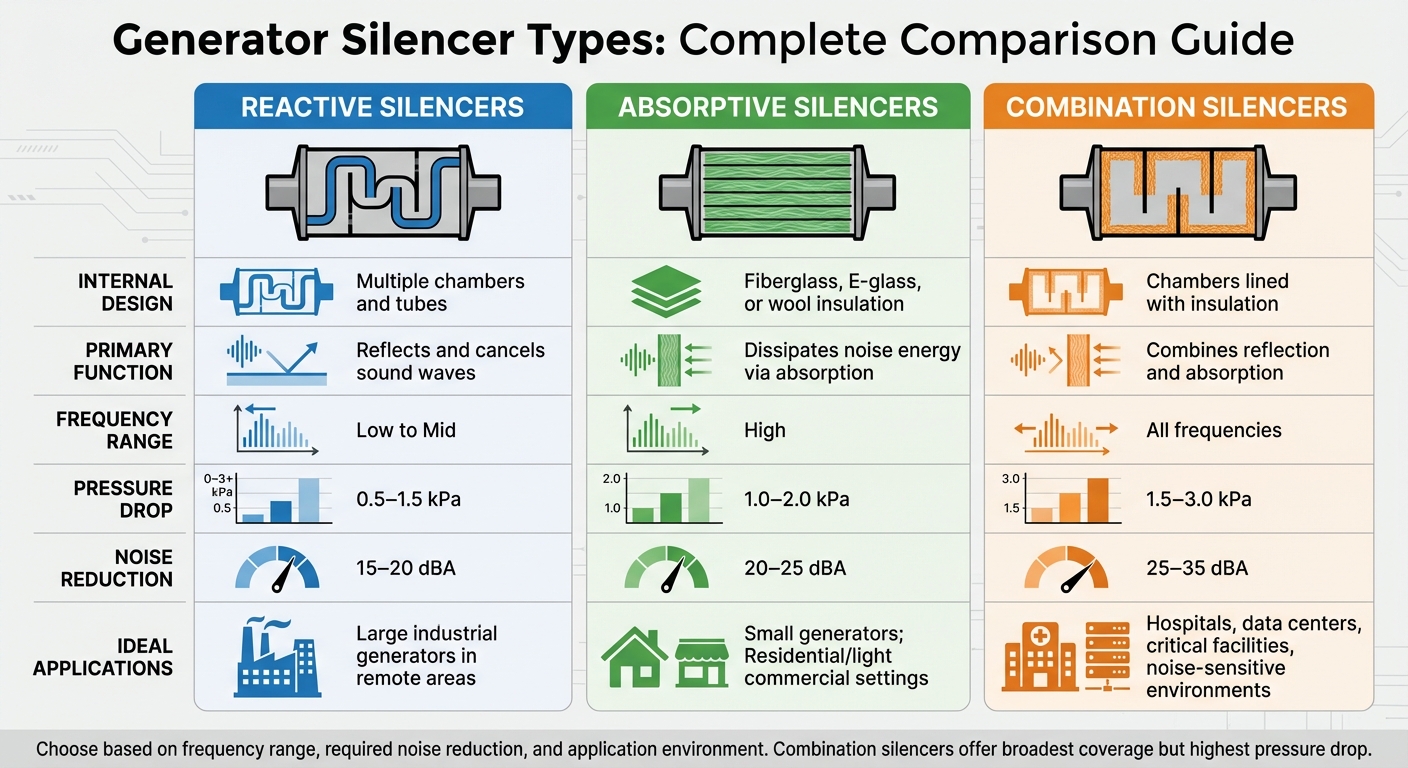
Generator Silencer Types Comparison: Performance, Pressure Drop, and Applications
When aiming to reduce noise effectively, it’s important to choose the right silencer type that matches your specific frequency and noise level requirements.
Generator silencers are grouped into three main types, each with a distinct method for reducing noise:
- Reactive silencers: These use chambers and tubes to reflect and cancel out sound waves.
- Absorptive silencers: These rely on sound-absorbing materials like fiberglass, E-glass, or ceramic wool to dampen noise energy.
- Combination silencers: These combine reactive chambers with absorptive insulation, blending reflection and absorption to handle a wide range of noise frequencies.
Each type has its strengths, especially when it comes to targeting specific frequency ranges. Reactive silencers are most effective for low- to mid-frequency noise, while absorptive silencers shine at reducing high-frequency sounds. Combination silencers, on the other hand, work across all frequencies, making them a go-to choice for noise-sensitive environments like hospitals, data centers, and other critical facilities.
Matching Silencers to Applications
Selecting the right silencer depends on both the frequency range and the level of noise reduction needed. Here’s a breakdown:
- Large industrial generators in remote areas: A reactive silencer providing a noise reduction of 15–20 dBA is usually sufficient.
- Residential or light commercial settings: An absorptive silencer offering 20–25 dBA of attenuation is often the preferred choice.
- Noise-sensitive environments (e.g., hospitals, schools, or office buildings): Combination silencers delivering 25–35 dBA of reduction are recommended for these applications.
Space considerations are also crucial. Cylindrical silencers are versatile and cost-effective for standard horizontal or vertical mounting. However, if you’re dealing with space constraints or need to fit the silencer within a sound-attenuated enclosure, low-profile rectangular or disc-shaped designs are better suited.
Silencer Type Comparison Table
| Silencer Type | Internal Design | Primary Function | Frequency Range | Pressure Drop | Noise Reduction | Ideal Applications |
|---|---|---|---|---|---|---|
| Reactive | Multiple chambers and tubes | Reflects and cancels sound waves | Low to Mid | 0.5–1.5 kPa | 15–20 dBA | Large industrial generators |
| Absorptive | Fiberglass, E-glass, or wool insulation | Dissipates noise energy via absorption | High | 1.0–2.0 kPa | 20–25 dBA | Small generators; lightweight applications |
| Combination | Chambers lined with insulation | Combines reflection and absorption | All frequencies | 1.5–3.0 kPa | 25–35 dBA | Hospitals; Data centers; Critical sites |
sbb-itb-501186b
Verify Compliance with Local Codes and Standards
After addressing the technical and installation aspects, it's crucial to ensure your silencer meets all local codes and standards. For emergency power systems, NFPA 110 (Standard for Emergency and Standby Power Systems) is the key reference. Chapter 7 outlines installation and environmental guidelines, while Chapter 5 specifies requirements for generator accessories like silencers and exhaust systems. For stationary engines, NFPA 37 provides safety requirements focused on installation and operation, including exhaust systems and silencers. These standards should be adapted based on your facility's classification and location.
Understanding your facility's classification is essential. For example, facilities categorized as Level 1 (life safety critical) under NFPA 110 face stricter maintenance and testing requirements. Additionally, check local zoning maps to determine if your site is in a "silent zone", such as near hospitals or schools. These areas may demand a Hospital Plus or Extreme grade silencer to meet strict decibel limits.
Beyond NFPA and local codes, the Electrical Generating Systems Association (EGSA) rating system offers further clarity on silencer performance. This system includes eight classes, with Class 1 providing a 10–15 dBA noise reduction and Class 8 achieving 45–50 dBA reduction. To ensure compliance, request a manufacturer's performance chart that includes predicted back pressure and overall Dynamic Insertion Loss (DIL) in dBA for your specific engine model. According to EGSA:
"It is the responsibility of the silencer manufacturer to ensure that the EGSA silencer performance grade is met for that stated application. Silencer manufacturers should be able to provide, upon request, a silencer performance chart with supporting calculations that includes an overall insertion loss value (dBA) and predicted back pressure for a specific application."
If your setup includes a sound-attenuated enclosure, opt for low-profile silencers, such as rectangular or oval designs, that adhere to NFPA guidelines for compact spaces. Also, ensure the installation aligns with the International Mechanical Code (IMC), which governs exhaust piping, termination points, and support structures to prevent hazardous fumes from entering buildings.
| Silencer Grade | Noise Reduction (dBA) | Typical Application |
|---|---|---|
| Industrial / Commercial | 15–20 | Industrial areas with high ambient noise |
| Residential | 20–25 | Standard commercial or residential zones |
| Critical | 25–35 | Areas with moderate noise sensitivity |
| Super Critical | 30–42 | Quiet residential or office environments |
| Hospital / Hospital Plus | 35–50 | Hospitals and 24-hour care facilities |
| Extreme / Super Extreme | 40–60 | Highly sensitive "silent zones" |
Confirm Material Quality and Durability
After completing compliance checks, the next step is ensuring the durability of materials used in silencer construction. This is a key factor in maintaining long-term performance, especially in challenging environments.
Stainless steel stands out as the top choice for corrosive conditions. For generators located in coastal areas, chemical plants, or humid climates, Grade 316 stainless steel is recommended for all exposed exhaust components. While this option typically costs 20–30% more than Grade 304, it provides much better protection against rust and corrosion, which can quickly degrade carbon steel silencers. For indoor installations in controlled climates, carbon steel silencers can be a practical choice, but they must be coated with high-heat paint (rated for 800–1,200°F) to prevent flaking.
To effectively absorb sound, use porous damping materials like fiberglass, E-glass, ceramic wool, or steel wool - steer clear of closed-cell foams. Additionally, applying 50 mm ceramic fiber lagging to the first 20 feet of exhaust piping can significantly reduce surface temperatures from 842–1,022°F to below 176°F. This also helps lower low-frequency noise by 2–3 dBA. These material choices align with previously discussed installation and performance considerations, ensuring a reliable system over time.
Flexible bellows or braided stainless steel compensators are essential between the turbo outlet and rigid piping. These components absorb thermal expansion (approximately 1 mm/m for every 212°F) and help prevent structural damage. It's also critical to coordinate vibration isolators, pipe hangers, and flexible connections with a mechanical engineer to avoid resonance frequencies that could amplify noise and lead to pipe fractures.
For standby generators running below 30% load, wet-stacking can occur, producing acidic condensate that corrodes standard metal silencers quickly. In such cases, stainless steel construction is non-negotiable. If carbon steel piping is used in humid or coastal areas, ultrasonic testing should be performed every three years to monitor for wall thinning. Regular material quality checks and maintenance are crucial to preserving system performance and avoiding premature failure. Be sure to document these material and inspection protocols as part of your final verification process.
Document Final Selection and Verify Performance
Checklist for Final Specifications
When finalizing specifications, ensure they meet the compatibility, durability, and compliance standards outlined earlier. Key details to document include the manufacturer, model, and configuration (e.g., cylindrical, disc, rectangular). Specify the EGSA Class, attenuation grade, and material type (such as carbon steel or stainless steel [304/316]). For operational considerations, note the predicted pressure drop and confirm it stays within 90% of the engine's maximum allowable limit to accommodate potential fouling over time.
Additionally, record inlet and outlet locations (e.g., Side-in/End-out), mounting orientation (horizontal or vertical), and any specialized features like spark arrestors or catalytic converters. Verify compliance with all relevant codes, including local noise regulations, NFPA standards, and EPA Tier IV requirements.
"The silencer manufacturer should be able to provide, upon request, a silencer performance chart with supporting calculations that includes an overall insertion loss value (dBA) and predicted back pressure for a specific application." - Electrical Generating Systems Association (EGSA)
Once all specifications are documented, proceed to validate system performance through comprehensive commissioning tests.
Commissioning and Testing
To confirm that the documented specifications align with operational needs, carry out detailed commissioning tests. Start with mechanical integrity checks - ensure gasketed and torqued joints are secure, and perform a soap-bubble leak test before startup. Measure static back-pressure at full load to confirm it remains below 90% of the engine's limit (7–10 kPa). During operation, check that the temperature rise does not exceed 12.6°F (7°C).
For acoustic performance, position microphones 4.9 feet (1.5 m) above the ground and 23 feet (7 m) from the generator in six different directions. Record octave-band noise levels near the exhaust stack (3.3 feet / 1 m) and at the site boundary to verify attenuation. Ensure background noise is at least 10 dB lower than the generator's measured noise level for accurate readings. At full load, document static back-pressure, generator load, ambient temperature, and engine speed. Lastly, confirm that the stack exit velocity reaches at least 115 ft/s (35 m/s) to avoid issues like soot fallout or backflow.
Conclusion
When selecting a silencer, it's crucial to weigh factors like noise reduction, engine compatibility, regulatory requirements, and durability. Start by measuring noise levels accurately to determine the necessary attenuation. For instance, industrial sites might require 15–20 dBA, while sensitive urban areas could demand reductions of 45–60 dBA. Keep total back-pressure under 90% of your engine's maximum allowable limit to avoid performance issues.
From there, align your choice with industry regulations, such as EPA Tier IV, NFPA, and local noise standards. In environments prone to corrosion, like coastal or humid areas, opt for stainless steel (grades 304 or 316) to extend the silencer's lifespan. Also, remember that about 33% of a diesel engine's fuel energy exits as hot exhaust gas, so effective thermal management is critical.
"It can be very expensive to fix noise issues in the field, which can result in significant problems and delays in project completion, commissioning, and approval by the local authority." - Electrical Generating Systems Association (EGSA)
Once you've nailed down the technical details, focus on sourcing high-quality components. Document specifications like manufacturer, model, EGSA Class, and material type before moving to commissioning tests. Confirm performance through full-load back-pressure and octave-band noise tests. To simplify procurement, consider platforms like Electrical Trader (https://electricaltrader.com), which offers a range of new and used power generation equipment and silencers.
FAQs
What type of silencer should I choose for my generator based on noise frequency?
When choosing a silencer for your generator, it's important to match it to the type of noise your generator produces. Reactive silencers are best suited for tackling low-to-mid-frequency sounds, while absorptive silencers handle high-frequency noise effectively. If your generator produces a mix of frequencies, a combination silencer might be the most efficient choice. Make sure the silencer is compatible with your specific generator model and can meet your requirements for durability and noise reduction.
What should I consider to ensure a generator silencer is compatible with my equipment?
To get the best results, start by ensuring the silencer’s inlet matches the diameter of your generator’s exhaust port. Next, confirm that its shape and mounting orientation - whether horizontal, vertical, or low-profile - fits seamlessly within the available space in your setup. Pay attention to the type of silencer you need: reactive, absorptive, or a combination, depending on your generator’s noise-frequency characteristics. It’s also crucial to verify that the silencer complies with NFPA standards and addresses any spark-arrest or heat-recovery requirements. Lastly, check that the pressure drop remains within the engine’s maximum allowable back pressure. Following these steps will help maintain both performance and safety.
How can I make sure my generator silencer meets local noise regulations?
To make sure your generator silencer aligns with local noise regulations, start by determining the noise limits specific to your area. These limits are usually measured in decibels (dB(A)) at a given distance, often 25 feet from the exhaust outlet. Be aware that stricter limits may apply in sensitive areas like hospitals, schools, or residential neighborhoods.
When choosing a silencer, opt for one that meets or surpasses the required noise reduction levels. Silencer types - like reactive, absorptive, or combination models - are designed for different frequency ranges, so it’s important to select one that matches your generator’s primary noise output. Look for silencers with ratings that meet the necessary dB(A) reduction and comply with National Fire Protection Association (NFPA) standards. To ensure reliability, ask the manufacturer for a test report or certification, and conduct a sound-level test after installation to confirm compliance.
For dependable options, Electrical Trader provides silencers with NFPA documentation and verified noise ratings. To maintain compliance and performance over time, regular upkeep is essential. This includes cleaning, inspecting insulation, and checking the mounting hardware.