

Top Brands for Insulation Resistance Testers
Insulation resistance testers are essential for evaluating the health of electrical equipment by measuring insulation resistance, typically in megohms (MΩ) or gigaohms (GΩ). High readings indicate good insulation, while low readings may signal potential issues. This guide highlights the key factors to consider when choosing a tester and compares top brands like Fluke, Megger, Hioki, Kyoritsu, and AEMC Instruments.
Key Takeaways:
- Measurement Range & Test Voltage: Choose a tester with suitable voltage levels (e.g., 500V for <1,000V equipment) and a wide resistance range for accurate diagnostics.
- Safety Ratings: Look for devices with CAT III or CAT IV ratings and features like live voltage warnings.
- Advanced Features: Options like Polarization Index (PI), Dielectric Absorption Ratio (DAR), data logging, and wireless connectivity enhance functionality.
-
Top Brands:
- Fluke: Reliable tools for residential, commercial, and industrial use. Models like the Fluke 1507 and 1550C cover a wide range of applications.
- Megger: Known for durability and advanced diagnostics, with models like the MIT and S1 series.
- Hioki: Compact and precise testers for intricate setups.
- Kyoritsu: Affordable and straightforward options for routine inspections.
- AEMC Instruments: Advanced testing capabilities, strong US support, and compliance with local standards.
Quick Comparison:
| Brand | Best For | Key Features | Price Range |
|---|---|---|---|
| Fluke | General-purpose & industrial | Durable, wireless options, CAT IV ratings, PI/DAR testing | $757–$6,748 |
| Megger | Advanced diagnostics | High voltage, software integration, predictive maintenance tools | Varies by model |
| Hioki | Compact setups | Precise, compact designs for tight wiring | Varies by model |
| Kyoritsu | Routine inspections | Simple, affordable, easy-to-use testers | Varies by model |
| AEMC | Complex diagnostics | Step/ramp voltage testing, strong US support | Varies by model |
The right tester depends on your specific application, equipment voltage, and diagnostic needs. Always prioritize safety features and ensure the tester meets your work environment's requirements.
Best Insulation Resistance Testers 2026 [Expert Review of Top 6 Picks]
sbb-itb-501186b
Key Factors When Choosing an Insulation Resistance Tester
Insulation resistance testers come in various configurations, each suited to different tasks. Choosing the right one depends on its measurement capabilities, safety features, and added functionalities. These aspects determine how well the tester fits the needs of electrical professionals. Let’s break down the three most critical factors.
Measurement Range and Test Voltages
The required test voltage often depends on the equipment being tested. For example, equipment rated under 1,000V typically requires a test voltage of 500V DC, while higher-voltage systems may need test voltages of 5 kV or more.
| Rated Equipment Voltage | Recommended DC Test Voltage |
|---|---|
| < 1,000V | 500V |
| 1,000V – 2,500V | 500V – 1,000V |
| 2,501V – 5,000V | 1,000V – 2,500V |
| 5,001V – 12,000V | 2,500V – 5,000V |
| > 12,000V | 5,000V – 10,000V |
| Source: IEEE 43 and ANSI/EASA standards |
Beyond voltage levels, the measurement range is equally important. A tester limited to the megohm range might miss early signs of insulation degradation. For thorough diagnostics, opt for a unit that can measure into the gigaohm (GΩ) or even teraohm (TΩ) range. Temperature also influences readings - insulation resistance drops by about 50% for every 10°C increase. To ensure accuracy, readings should be adjusted to a standard temperature of 40°C.
Safety Ratings and Build Quality
"When more tests need to be conducted, the overall quality, durability, and convenience features of the test instrument become more important." - Fluke
Safety is paramount, especially for fieldwork. Look for testers with safety ratings like CAT III 1,000V or CAT IV 600V, which indicate the device can handle high-voltage transients without compromising safety. Build quality is another critical aspect. A reliable tester should feature a live voltage warning, which protects both the user and sensitive equipment such as PLCs and variable speed drives. Additionally, durable and well-insulated test leads are vital for maintaining measurement accuracy and ensuring safe operation.
Modern testers also integrate features that enhance diagnostic precision, making them invaluable for professionals who conduct frequent or complex tests.
Advanced Features and Calibration Support
Some testers go beyond basic measurements by offering advanced diagnostic tools like the Polarization Index (PI) and Dielectric Absorption Ratio (DAR). These ratios provide deeper insights into insulation health. The PI, for instance, compares resistance values at 10 minutes and 1 minute, making it ideal for detecting moisture in form-wound motors. The DAR, a quicker 1-minute test, works well for equipment where leakage current stabilizes rapidly. Generally, a PI value between 2.0 and 4.0 indicates good insulation, while values above 4.0 are considered excellent.
Additional features, such as data logging and software integration, can significantly enhance maintenance workflows. For instance, platforms like Megger's CertSuite Asset allow users to monitor insulation trends over time, enabling a shift from reactive to predictive maintenance. Wireless connectivity options, such as Fluke Connect®, simplify data sharing by allowing technicians to send test results directly to smartphones or cloud storage without manual input.
Top Brands for Insulation Resistance Testers
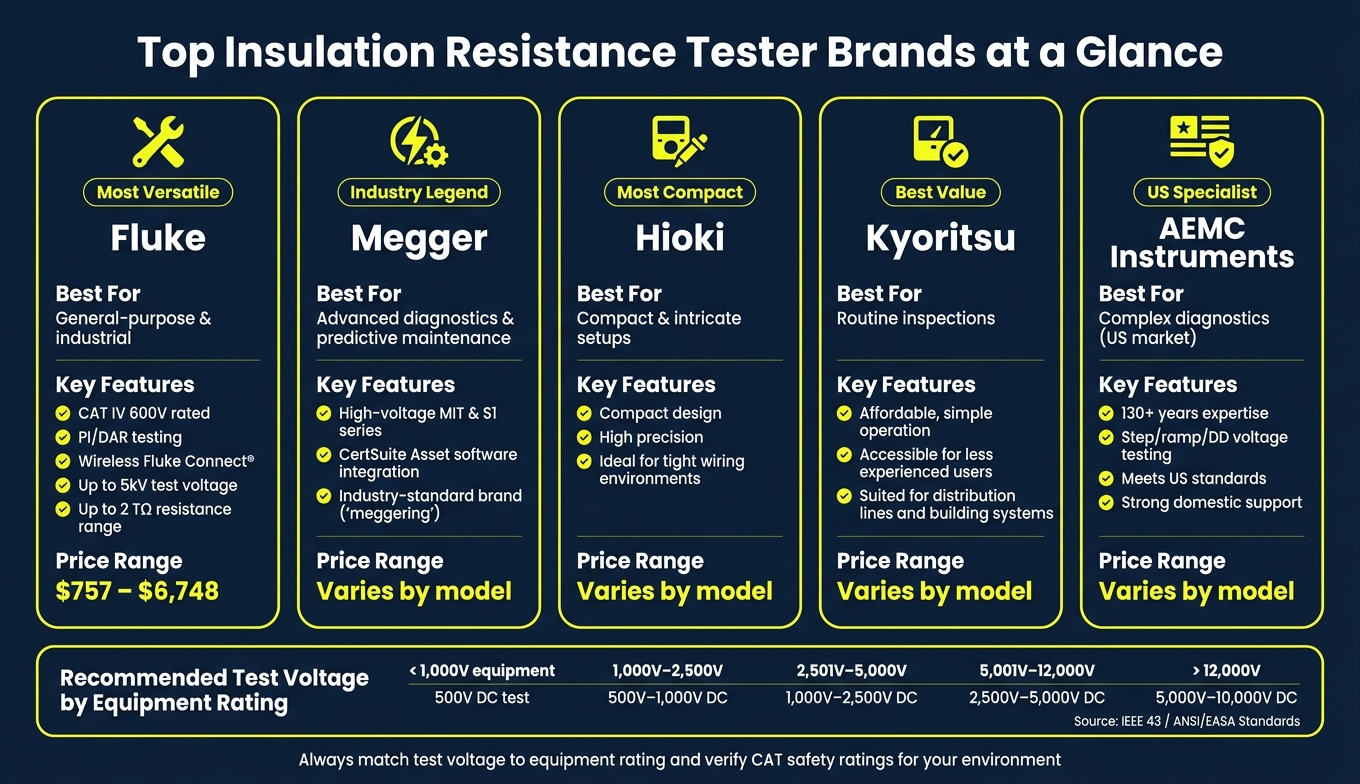
Top Insulation Resistance Tester Brands Compared: Features, Use Cases & Pricing
Not all insulation resistance testers are created equal. Different brands bring varying levels of durability, precision, and features to the table. Below is an overview of some of the top names in the industry and what sets them apart.
Fluke
Fluke is a trusted name in electrical testing, offering models like the 1507 and 1550C that cater to a wide range of applications, from routine motor maintenance to high-voltage industrial diagnostics.
The 1507 is perfect for contractors and maintenance crews. It operates on four AA batteries, providing up to 1,000 insulation tests (at 1,000V into 1 MΩ) per charge. This model is priced at around $891.27 and boasts a 4.7/5-star rating on Fluke's website.
For high-voltage work, the 1550C is a standout. It supports test voltages up to 5 kV, offers wireless connectivity through Fluke Connect® for cloud storage, and is priced at approximately $6,747.99. It also comes with a 3-year warranty.
| Feature | Fluke 1507 | Fluke 1550C |
|---|---|---|
| Max Test Voltage | 1,000V | 5,000V (5 kV) |
| Resistance Range | 0.01 MΩ to 10 GΩ | Up to 2 TΩ |
| Safety Rating | CAT IV 600V | CAT IV 600V / CAT III 1,000V |
| Wireless Connectivity | No | Yes (Fluke Connect®) |
| Power Source | 4 AA batteries | 12V rechargeable lead-acid |
| Approx. Price | $891.27 | $6,747.99 |
"Whether you work on motors, generators, cables, or switch gear, the Fluke digital insulation resistance testers provide noise-free, reliable results." - Fluke Corporation
While Fluke is known for its rugged and reliable tools, Megger stands out for its legacy and reputation in the industry.
Megger
Megger is a name that has become almost synonymous with insulation testing itself - many electricians refer to the process as "meggering." Their products are known for quality and reliability.
"Megger is well known in the industry and is associated with top quality and features. It is literally a household name in the electrical industry." - Tradeskills4u
Their MIT series is designed for standard motor, cable, and switchgear testing, while the S1 series targets high-voltage applications in utility and industrial settings. In addition, Megger's CertSuite Asset software helps maintenance teams monitor insulation trends over time, which is especially useful for facilities adopting predictive maintenance strategies.
Hioki
Hioki, a Japanese brand, specializes in compact and precise instruments. Their testers are ideal for troubleshooting in tight or complex wiring setups. For technicians working with intricate systems, Hioki's tools provide dependable and accurate readings.
Kyoritsu
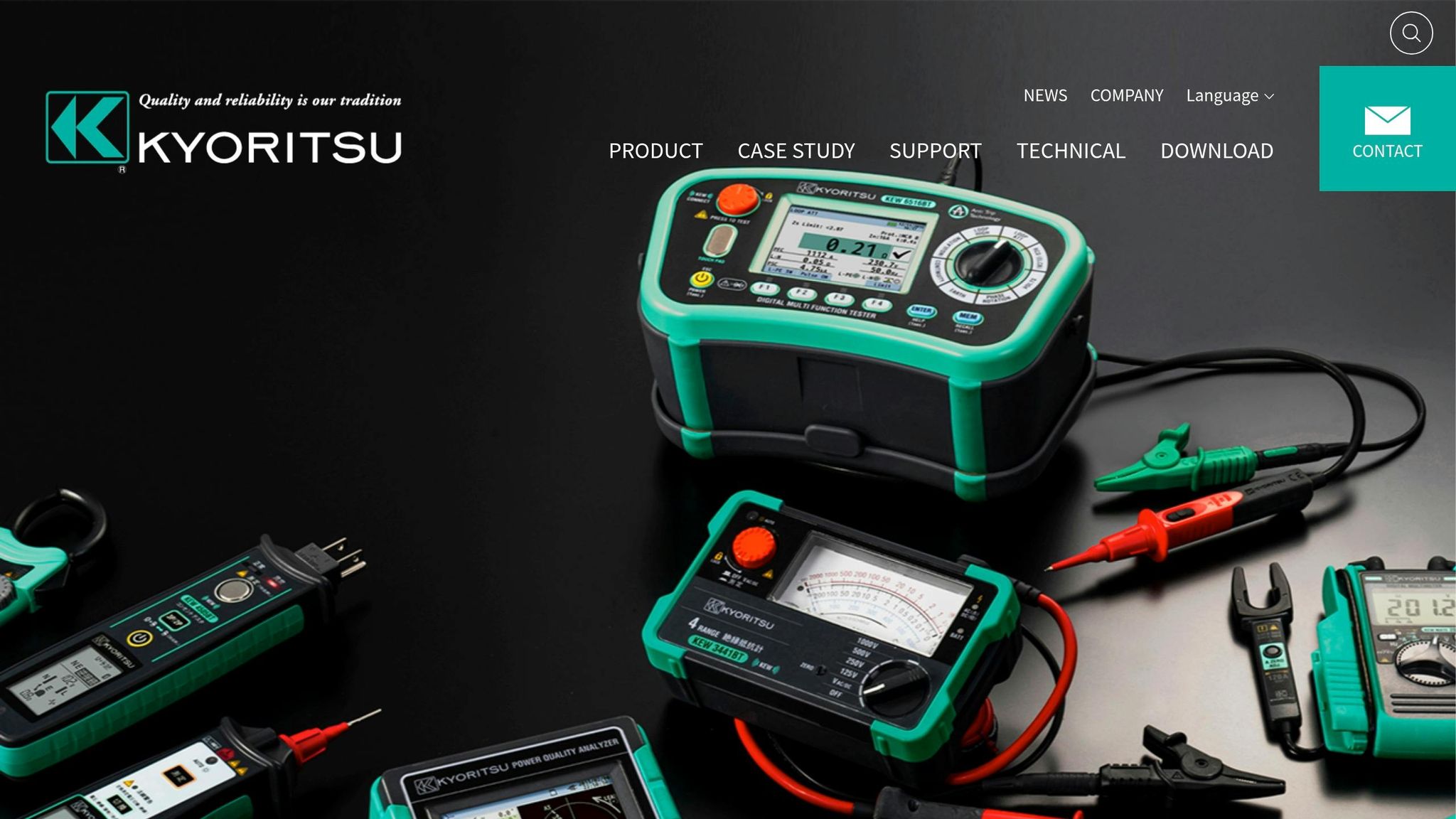
Kyoritsu focuses on affordability and simplicity, making their testers a great choice for contractors and electricians performing routine inspections. Known for their straightforward operation, these testers are accessible even to less experienced users. They’re particularly suited for regular checks on distribution lines, electrical appliances, or building systems where advanced diagnostics aren’t required.
AEMC Instruments
AEMC Instruments brings over 130 years of expertise to the table, producing testers that meet U.S. standards and voltage classifications. Their tools offer advanced testing capabilities, including step voltage, ramp voltage, and Dielectric Discharge (DD) testing. With strong domestic technical support, AEMC is a reliable option for professionals tackling complex diagnostics in the field.
Choosing a Brand by Application and Setting
Residential and Light Commercial Use
For electricians working on home wiring, apartment buildings, or small commercial spaces, Fluke is a go-to brand. The Fluke 1503, priced at about $757.11, is a solid option for standard inspections. It supports the two most common insulation test voltages - 500V and 1,000V - making it a practical choice for these settings. If you need more versatility, the Fluke 1507 offers five voltage settings (starting as low as 50V) and includes automatic PI (Polarization Index) and DAR (Dielectric Absorption Ratio) calculations. This model is available for approximately $891.27.
"The Fluke 1503 is a great choice for basic residential and commercial electrical insulation testing." - Fluke
Industrial Plants and Power Distribution Systems
Industrial applications often require tools that go beyond the capabilities of residential models. These settings, which include motors, transformers, switchgear, and motor control centers, demand testers with higher voltage ranges and enhanced safety features. In such environments, insulation resistance should meet or exceed 1 MΩ per 1,000 volts of operating voltage. For motors and other critical equipment, a reading of 10 MΩ or more is generally considered acceptable, while values below 2 MΩ may indicate potential problems. Additionally, industrial fieldwork often involves unpredictable outdoor conditions, so durability and rugged design are key features to look for in a tester.
Harsh and Outdoor Environments
Fieldwork in outdoor substations, utility corridors, or industrial yards often exposes equipment to extreme temperatures, physical impacts, and harsh environmental conditions. The Fluke 1507 handles these challenges well, though its IP40 rating only protects against solid objects, not moisture. For high-voltage outdoor work, models like the Fluke 1555 FC, which offers a 5–10 kV output, are better suited. Many modern testers also come with wireless connectivity, making it easier to log data without manual input during long field sessions.
Conclusion
Choosing the right insulation resistance tester boils down to your specific needs and the nature of your work. There’s no one-size-fits-all solution - your decision should factor in your work environment, the type of equipment you’re testing, and the level of diagnostic detail you require. For instance, Fluke offers a wide range of testers suitable for everything from residential checks to industrial high-voltage applications. On the other hand, Megger and Hioki excel in advanced diagnostics or specialized testing environments, while Kyoritsu and AEMC cater to professionals seeking tools tailored for specific purposes.
No matter the brand or model, a few universal principles apply. Always ensure the tester’s output voltage aligns with your equipment’s nominal rating. Look for units with auto-discharge functionality to safely dissipate residual voltage after testing. And don’t overlook the importance of the correct CAT safety rating for your specific work environment. If you’re working in industrial or power distribution settings, it’s wise to prioritize testers capable of PI and DAR testing to pinpoint issues like moisture or contamination before they lead to equipment failure.
If you’re ready to invest in a new or pre-owned insulation resistance tester, check out Electrical Trader. This marketplace offers a wide selection of tools from leading brands, making it easy to find the right fit for your needs.
FAQs
What test voltage should I use for my equipment?
The test voltage you need depends on your equipment's operating voltage. A good guideline is to aim for 1 megohm of insulation resistance for every 1,000 volts of operating voltage, with a minimum of 1 megohm. For instance, if you're testing a motor rated at 2,400 volts, it should show at least 2.4 megohms of resistance. Always double-check the specific guidelines for your equipment to ensure accurate testing.
What CAT rating do I need for my job site?
The CAT rating you need for your job site hinges on two key factors: the voltage level of the equipment and the working environment. For higher voltage applications, you'll need a higher CAT rating to maintain safety and meet industry standards. Make sure the rating you choose matches - or goes beyond - the voltage and environmental risks specific to your site.
Do I need PI/DAR testing or just basic insulation resistance?
Basic insulation resistance testing typically meets most needs unless there are unique high-voltage or safety demands. In those situations, Polarization Index (PI) or Dielectric Absorption Ratio (DAR) testing might be required for more thorough diagnostics and to ensure compliance with safety standards.