IEEE 519 vs IEC 61000: Harmonic Limits
Here’s the short answer: IEEE 519 is for the site, and IEC 61000 is for the device. If you’re checking whether a facility meets harmonic limits at the service point, use IEEE 519. If you’re checking whether a VFD, UPS, LED driver, or EV charger meets product harmonic emission rules, use IEC 61000-3-2 or IEC 61000-3-12.
That difference matters because a device can pass IEC testing and the full building can still miss IEEE 519 limits after installation. In many U.S. facilities, the common IEEE 519 voltage distortion limit is 5.0% THD at 1 kV to 69 kV, while IEC 61000-3-2 covers equipment at 16 A per phase or less, and IEC 61000-3-12 covers above 16 A up to 75 A per phase.
If I had to boil the whole topic down, I’d put it like this:
- Use IEC 61000 for buying decisions
- Use IEEE 519 for system review
- Measure IEC at the device terminals
- Measure IEEE 519 at the PCC
- Don’t treat product compliance as proof of site compliance
- Check generator-backed systems with extra care, because lower fault current can make harmonic issues worse
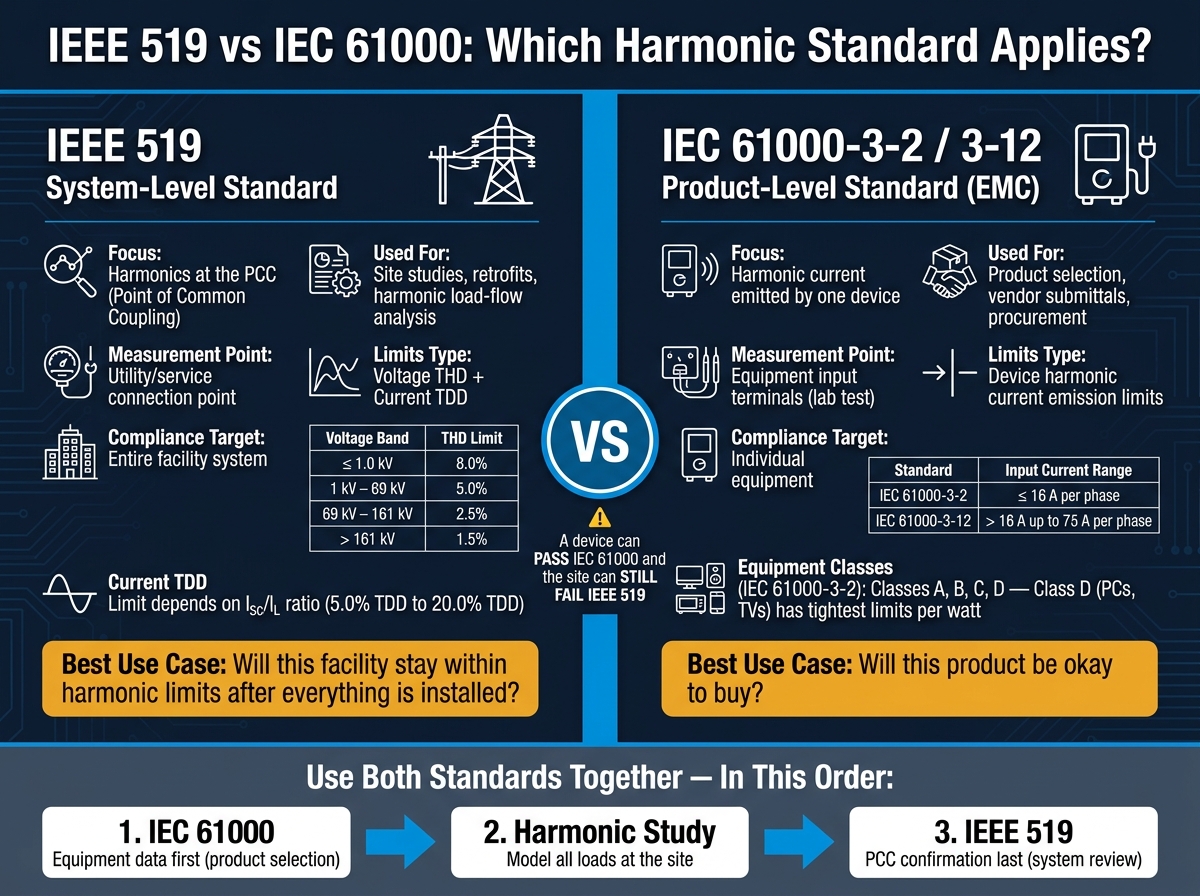
IEEE 519 vs IEC 61000: Which Harmonic Standard Applies?
19 - IEEE 519 Standard for harmonics – what do I need to know and where do I start?
sbb-itb-501186b
Quick Comparison
| What to check | IEEE 519 | IEC 61000-3-2 / 3-12 |
|---|---|---|
| Main focus | Harmonics at the PCC | Harmonic current from one device |
| Used for | Site studies, retrofits, PCC review | Product selection, vendor submittals |
| Measurement point | Utility/service connection point | Equipment input terminals |
| Main limits | Voltage THD and current TDD | Device harmonic current limits |
| Typical trigger | Installed system performance | Lab-tested product compliance |
| Current range | Based on Isc/IL and system conditions | ≤ 16 A/phase or > 16 A to 75 A/phase |
Bottom line: if you’re asking, “Will this product be okay to buy?” start with IEC 61000. If you’re asking, “Will this facility stay within harmonic limits after everything is installed?” use IEEE 519.
What Each Standard Covers
With the basic difference out of the way, the next step is scope: what each standard is meant to control.
IEEE 519: PCC-Based Harmonic Limits for Power Systems

IEEE 519 is a recommended practice, not a product certification standard. It sets limits for voltage and current distortion at the PCC. The PCC is the point on the utility system nearest the facility where other loads connect, or could connect.
The big idea is shared responsibility. The utility should provide a reasonably clean power supply, and the end user should avoid sending harmonic currents back into the system at levels that push distortion at the PCC too far.
IEEE 519 also gets stricter as system voltage goes up.
For current distortion, the allowed limit depends on the ratio of short-circuit current to load current, or Isc/IL, at the PCC. In plain English, a facility with a stronger utility connection can often be allowed to inject more harmonic current.
One more point matters here: IEEE 519 says its limits should not be used for single pieces of equipment or for internal points inside a facility. It’s a system-level tool, not a device pass/fail test.
IEC 61000: Equipment Emission Limits Within the EMC Framework
IEC 61000 looks at harmonics from a different angle. It treats them as a product emission issue. This is an EMC standard family that covers emissions and immunity for electrical and electronic equipment. For harmonics, the parts that matter most are IEC 61000-3-2 and IEC 61000-3-12.
IEC 61000-3-2 applies to equipment with input current up to and including 16 A per phase that connects to public low-voltage AC systems. It groups equipment into Classes A–D, and each class has its own harmonic current limits.
IEC 61000-3-12 applies to equipment with rated input current above 16 A and up to 75 A per phase. In other words, it extends harmonic emission limits to loads in the 16 A to 75 A per phase range on public low-voltage networks.
Comparison Table: Scope, Intent, and Typical Use
The table below separates system-level review from product-level compliance.
| Attribute | IEEE 519 | IEC 61000-3-2 / 3-12 |
|---|---|---|
| Type | Recommended practice | EMC equipment standard |
| Compliance target | Facility PCC (system level) | Individual equipment (product level) |
| What it limits | Voltage THD and current TDD at PCC | Harmonic current emitted by a device |
| Measurement point | Point of common coupling | Equipment terminals (lab test conditions) |
| Applies to | Industrial and commercial power systems | Equipment on public low-voltage supply systems |
| Best used for | Site design, harmonic studies, retrofits | Vendor submittals, product compliance |
Harmonic Limits, Voltage Levels, and Measurement Basis
The next step is to look at the actual limits and, just as important, where each standard checks them.
IEEE 519 Voltage Bands and Distortion Limits at the PCC
For installed systems, the limits that matter are the ones at the PCC. IEEE 519 groups voltage distortion into four bands based on system voltage. The limits are shown below.
| Voltage Band at PCC | Individual Harmonic Limit | Total Harmonic Distortion (THD) |
|---|---|---|
| V ≤ 1.0 kV | 5.0% | 8.0% |
| 1 kV < V ≤ 69 kV | 3.0% | 5.0% |
| 69 kV < V ≤ 161 kV | 1.5% | 2.5% |
| V > 161 kV | 1.0% | 1.5% |
Many U.S. facilities run at 4.16 kV, 12.47 kV, or 13.8 kV, so the 1 kV to 69 kV band often applies. That means a 5.0% THD limit is common in practice.
Current distortion works a bit differently. IEEE 519 uses Total Demand Distortion (TDD), not THD. TDD compares harmonic current to the site's maximum demand load current (IL) rather than the current at one moment in time.
That detail matters. A site with a higher Isc/IL ratio is allowed more current distortion. For example:
- If Isc/IL is below 20, the limit is 5.0% TDD
- If Isc/IL is above 1,000, the limit can be 20.0% TDD
Because Isc and IL depend on the site, you usually need a harmonic study to know where a facility lands.
Put simply: IEEE 519 sets system limits at the PCC, while IEC 61000 sets device limits at the terminals.
IEC 61000 Current Ranges and Equipment Applicability
For sourcing and vendor review, the product-side limits are the ones to check. IEC 61000-3-2 and IEC 61000-3-12 are based on the equipment's rated input current, not the facility voltage at the PCC. The ranges and measurement basis are summarized below.
| Attribute | IEEE 519 | IEC 61000-3-2 | IEC 61000-3-12 |
|---|---|---|---|
| Applicability basis | PCC system voltage and Isc/IL ratio | Equipment input current ≤ 16 A/phase | Equipment input current > 16 A and ≤ 75 A/phase |
| Typical voltage level | Low- to high-voltage power systems | Public low-voltage AC supply | Public low-voltage AC supply |
| What is limited | Voltage THD and current TDD at PCC | Harmonic current emitted by the device | Harmonic current emitted by the device |
| Measurement point | Facility PCC | Equipment input terminals (lab test) | Equipment input terminals (lab test) |
Both IEC standards assume the equipment connects to a public low-voltage AC network. Under IEC 61000-3-2, the equipment class - A, B, C, or D - decides which harmonic limits apply. Class D equipment, such as personal computers and TVs, faces tighter harmonic limits per watt of input power.
So even if a device passes IEC 61000-3-2 or IEC 61000-3-12, that does not mean the full site will meet IEEE 519 at the PCC.
How Each Standard Applies to Equipment Selection and System Review
With the scope split in place, use IEC 61000 to check the device before you buy it.
Using IEC 61000 in Product Selection and Vendor Review
For pre-purchase review of drives, UPSs, LED drivers, and EV chargers, start with IEC 61000. It tells you how much harmonic current that specific device may inject under the test conditions used for compliance.
In plain terms, ask the vendor for the standard and edition, the equipment class, the rated input current, and the harmonic spectrum or table through the required harmonic order. If the equipment has a rated input current above 16 A per phase, IEC 61000-3-12 applies. In that case, the submittal should also state the short-circuit ratio used for the test conditions.
When you're comparing vendors, don't stop at a simple pass/fail check. Look at the margin at the 5th, 7th, and 11th harmonics. That extra detail matters. A product with lower harmonic current at those orders leaves more room if the site already has other harmonic sources tied to the same feeder.
Product compliance answers one question. Installed-system performance answers another.
Using IEEE 519 in Site Design, Retrofits, and Harmonic Studies
For the installed system, IEEE 519 is the right tool when you're adding a bank of VFDs to an existing facility, expanding a data center, or reviewing power quality in a generator-backed system.
IEC-compliant submittals do not prove PCC compliance. To check that, use a harmonic load-flow study that combines all nonlinear loads, available short-circuit current, and loading patterns to predict PCC THD and TDD.
This shows up most often in VFD-heavy retrofits and generator-backed systems. On generator power, available short-circuit current is often lower, which makes the system more sensitive to harmonic currents. So even if a site with several IEC 61000-compliant 6-pulse drives stays within limits on utility power, it may still exceed the 5% THD threshold after transfer to generator power.
That same split carries into equipment sourcing.
Applying These Standards When Sourcing Electrical Equipment
When sourcing drives, transformers, breakers, or power distribution equipment on Electrical Trader, use the same two-layer approach.
At the product level, look for:
- IEC 61000 compliance
- Harmonic-mitigation features
- Available test data
For used equipment, verify the as-built configuration and test data.
At the system level, collect nameplate data and harmonic test data before installation so the engineer can include the equipment in a site harmonic study.
Summary and Conclusion
After looking at scope, limits, and where each one is measured, the practical answer is pretty clear: IEC 61000 applies to product-level harmonic emissions under EMC rules, while IEEE 519 applies to distortion in the installed electrical system at the PCC. And yes, both can apply to the same project.
Comparison Table: Which Standard to Use and When
| Factor | IEEE 519 | IEC 61000 |
|---|---|---|
| Scope | Facility harmonic performance at the PCC | Equipment harmonic emission compliance under EMC rules |
| Limit type | Voltage THD and current TDD at the system level | Harmonic current emission limits for individual equipment |
| Measurement point | Point of common coupling (PCC) | Equipment terminals under EMC test conditions |
| Best use case | Site design, retrofits, harmonic studies, utility interconnection | Product selection, vendor review, procurement |
Key Takeaways for Engineers, Buyers, and Facility Teams
The main question is simple: are you checking a product or checking a site?
For procurement and engineering review, a good rule is this: use IEC 61000 for equipment selection, and use IEEE 519 for installed-system review. IEC 61000-3-2 applies to equipment up to 16 A per phase. IEC 61000-3-12 applies to higher-current equipment. IEEE 519 looks at total distortion at the PCC, and its voltage limits get tighter as system voltage goes up.
That matters in practice. A device can pass IEC 61000 and still push the finished facility past IEEE 519 limits, which can lead to filters or system changes after installation. When sourcing equipment through Electrical Trader, collect nameplate data and harmonic test data before purchase so the site study starts with inputs you can actually use.
Use both standards together: equipment data first, harmonic study second, PCC confirmation last. They aren’t in conflict. They deal with different parts of the same harmonic issue.
FAQs
Can one IEC-compliant device still cause an IEEE 519 issue?
Yes. An IEC-compliant device can still create an IEEE 519 problem if its harmonic current emissions, or the voltage distortion that follows, push values at the PCC past IEEE 519-2022 limits.
Here’s the plain-English version: IEC 61000 looks at EMC performance at the device level. IEEE 519 looks at distortion at the system level, measured at the PCC with statistical criteria.
That means a device can pass IEC 61000 and still contribute to an IEEE 519 violation. IEC compliance by itself does not guarantee IEEE 519 compliance.
How do I know whether IEC 61000-3-2 or 3-12 applies?
Use the equipment’s input current per phase to pick the EMC harmonic emission standard:
- ≤16 A: IEC 61000-3-2 / IEC 61000-3-3
- 16–75 A: IEC 61000-3-12
- >75 A: IEC/TS 61000-3-4 or IEC/TS 61000-3-5
Then check that the selected standard also fits the type of equipment being assessed. That means confirming whether it should be treated as a Component, System, Apparatus, or Installation.
This second check matters. Current range tells you which harmonic standard to look at, but the equipment category tells you whether that standard applies to the product in the first place.
Why are generator-backed systems more prone to harmonic problems?
Generator-backed systems tend to run into harmonic issues more often. The reason is pretty simple: they often support sensitive equipment or feed non-linear loads like variable frequency drives and uninterruptible power supplies.
Those loads can create harmonic distortion, which may overheat equipment and cut generator and transformer efficiency.
If distortion goes above 15%, standard transformers may need derating, or K-factor rated transformers may be needed. Proper sizing and low-harmonic drives can also help limit these problems.