IEC vs. ISO: Electrical Standards Compared
If you mix up IEC and ISO, you can approve the wrong paperwork. I’d put it this way: IEC checks the electrical product or installation, while ISO checks how the company runs its system.
Here’s the short answer:
- IEC covers electrical rules for products and installations
- ISO covers company processes like quality and worker safety
- IEC 60364 applies to low-voltage installations up to 1,000 V AC and 1,500 V DC
- 30 mA RCDs are required in key IEC 60364 cases, such as socket-outlets up to 20 A
- ISO 9001 does not prove a breaker, panel, or switchgear assembly meets electrical ratings
- In the U.S., this matters most when you review imported equipment, submittals, and supplier files
If I were checking compliance documents, I’d split the review into two parts:
-
Does the product meet the electrical standard?
Look for IEC standard numbers like IEC 60364, IEC 61439, or IEC 62271-200. -
Does the supplier have controlled internal processes?
Look for ISO certificates like ISO 9001, ISO 14001, or ISO 45001.
That’s the whole issue in plain English: IEC is about what the equipment must do. ISO is about how the company works.
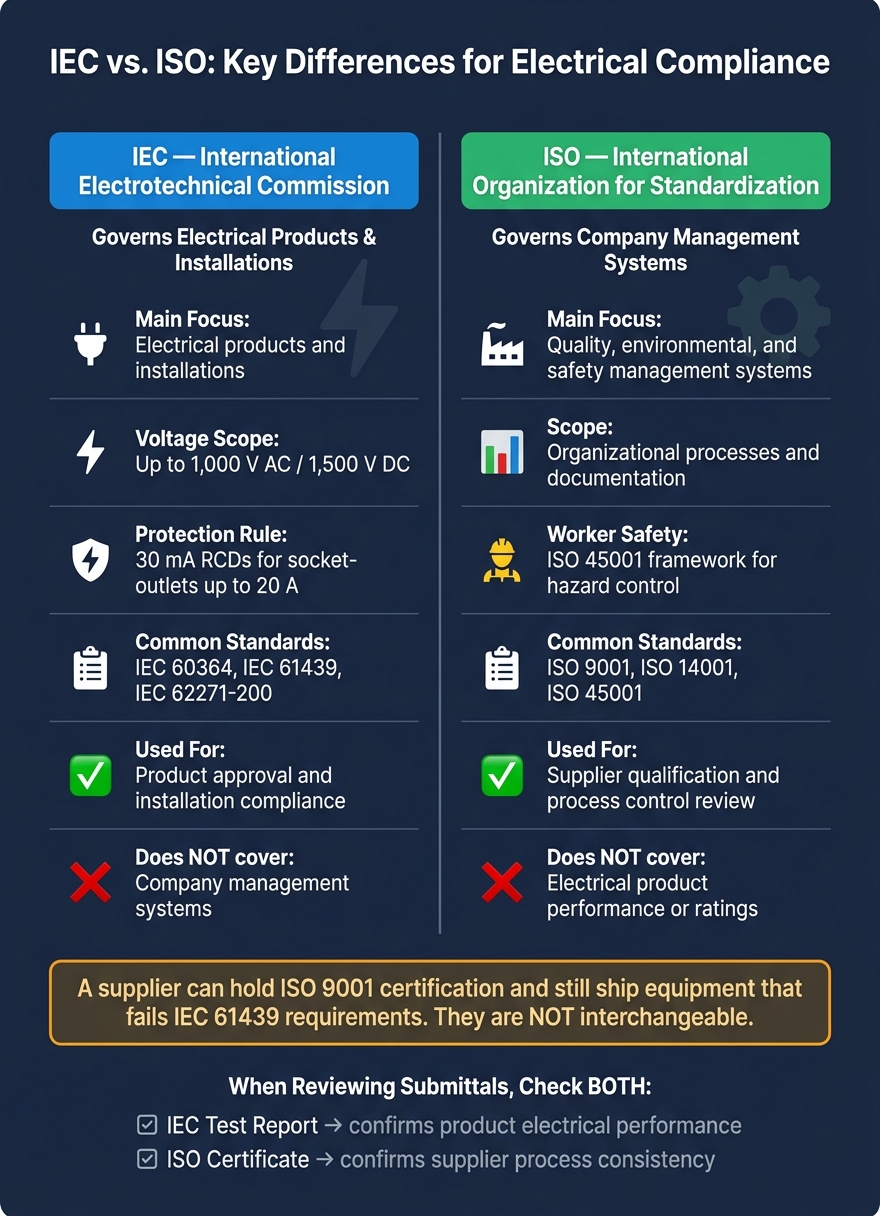
IEC vs. ISO: Key Differences for Electrical Compliance
The Difference ISO vs. IEC
Quick Comparison
| Criteria | IEC | ISO |
|---|---|---|
| Main focus | Electrical products and installations | Company systems and processes |
| What it checks | Safety, ratings, insulation, protection, testing | Quality, waste/process controls, worker safety systems |
| Common examples | IEC 60364, IEC 61439, IEC 62271-200 | ISO 9001, ISO 14001, ISO 45001 |
| Used for | Product approval and installation compliance | Supplier review and company-level checks |
| Can it replace the other? | No | No |
A simple way to read the paperwork is this: IEC tells me whether the equipment fits the job. ISO tells me whether the supplier runs an orderly system. I need both, but for different reasons.
IEC standards: the main international rules for electrical installations
IEC scope and technical focus
For electrical installations, IEC serves as the main technical rulebook for design, protection, and verification. It publishes the core standards used for installation work across homes, office buildings, industrial plants, marinas, construction sites, and medical locations.
IEC 60364 applies to low-voltage systems up to 1,000 V AC and 1,500 V DC, including 50 Hz, 60 Hz, and 400 Hz systems. It deals with risks tied to electric shock, overcurrent, short circuit, heat, voltage issues, and electromagnetic effects in both normal operation and fault conditions.
The protection methods it sets out are specific and practical. IEC 60364-4-41 requires 30 mA or lower RCDs for socket-outlet circuits up to 20 A and for portable equipment up to 32 A used outdoors. It also covers other protection methods, including:
- double or reinforced insulation
- electrical separation using isolation transformers
- extra-low-voltage systems, such as SELV and PELV
IEC 60364 and related installation standards
IEC 60364 covers the full path of a low-voltage installation, from the first design choices to final verification.
| IEC 60364 Part | Focus |
|---|---|
| Part 1 | Fundamental principles, assessment of general characteristics, definitions |
| Part 4 | Protection for safety |
| Part 5 | Selection and erection of electrical equipment |
| Part 6 | Verification - initial and periodic inspection and testing |
| Part 7 | Requirements for special installations or locations (medical locations, marinas, construction sites, photovoltaic systems, external lighting) |
For earthing, IEC 60364 helps designers choose the right system type - TN, TT, or IT - based on fault current behavior, touch voltage limits, and coordination with protective devices. Part 6 covers both initial and periodic testing, including continuity checks and RCD function tests before commissioning. In many systems, insulation resistance should be at least 1 MΩ at 500 V DC.
IEC 60364-8-1 also adds energy efficiency requirements and recommendations to installation design.
Why IEC matters for equipment sourcing
IEC installation rules shape how sourced equipment must fit into the full system, how it must coordinate with other devices, and how it must be checked before use. For internationally traded equipment like breakers, transformers, switchgear, and power distribution panels, IEC compliance shows that the product was designed and verified against a known technical benchmark.
When breakers, RCDs, and other protective devices follow the same IEC product standards, they are more likely to coordinate correctly inside one protection scheme. That's a big deal when you're buying replacement parts or adding to an existing installation.
For U.S. buyers sourcing equipment for projects outside the United States, including listings on Electrical Trader, check the IEC markings, confirm voltage and short-circuit ratings, and make sure the equipment matches local protection schemes. If you skip that step, you can run into code conflicts and approval delays.
That installation-level role is what sets IEC apart from ISO's broader management-system role.
sbb-itb-501186b
ISO standards: broader frameworks that support electrical work
ISO scope in electrical contexts
After IEC sets the rules for products and installations, ISO deals with the management systems behind the scenes. It covers the quality, safety, and documentation processes that support electrical work. It does not set the electrical design rules themselves.
For electrical contractors, manufacturers, and equipment suppliers, that distinction matters. ISO shapes the processes around the technical work, not the technical work itself.
Common ISO standards that affect electrical businesses
Three ISO standards show up most often in electrical industry work:
| Standard | Focus | How It Affects Electrical Businesses |
|---|---|---|
| ISO 9001 | Quality Management | Consistent production and supplier control |
| ISO 14001 | Environmental Management | Hazardous waste handling and environmental controls |
| ISO 45001 | Occupational Health & Safety | Hazard control and safe work practices |
ISO 9001 often comes up during supplier qualification. In electrical equipment, that helps with traceability.
ISO 45001 gives companies a framework for controlling electrical jobsite hazards.
This support role becomes more useful when ISO records are reviewed alongside IEC product evidence.
Where ISO and IEC intersect
In procurement, ISO and IEC answer different questions. If you're qualifying a supplier for switchgear or low-voltage assemblies, ISO 9001 certification shows that the manufacturer has reliable, repeatable processes. IEC compliance - such as IEC 61439 for low-voltage switchgear assemblies - shows that the product itself meets specific technical performance and safety requirements.
One speaks to the factory-floor management system. The other speaks to what the product must actually do. Put them together, and you get a clearer view of whether a supplier and its equipment are fit for approval.
For U.S. buyers, pairing ISO certificates with IEC test reports can speed up supplier review. That split matters most when you're checking submittals and supplier documents side by side.
IEC vs. ISO: key differences, overlaps, and compliance impact
Side-by-side comparison of scope and requirements
Once you separate IEC and ISO by function, the comparison gets much easier. The simplest way to read it is this: IEC focuses on product performance, while ISO focuses on company processes.
| Feature | IEC | ISO |
|---|---|---|
| What it governs | Electrical products and installations | Management systems and broader industrial processes |
| Type of Requirements | Voltage ratings, current density, thermal management, and safety clearances | Quality management, safety documentation, and organizational procedures |
| Example Standards | IEC 60364 (installations), IEC 61439 (switchgear) | ISO 9001 (quality), ISO 14001 (environmental) |
| Relevance to Sourcing | Verifies whether equipment meets specific electrical performance requirements | Helps evaluate a supplier's management systems and process consistency |
This distinction matters most when a buyer has to approve both the product and the supplier file.
How the differences affect compliance decisions
For low-voltage switchgear, IEC 61439 sets the product requirements. It covers temperature rise limits, short-circuit withstand strength, and current density for busbars. ISO 9001, on the other hand, applies to the manufacturer's quality system. It does not prove product performance.
That means a supplier can have ISO 9001 certification and still ship equipment that fails to meet IEC 61439 requirements. For U.S. buyers reviewing imported equipment and submittal packages, an IEC test report and an ISO certificate are not interchangeable. They answer two different approval questions.
How to read certifications and technical documents correctly
This is where people often get tripped up. When you're reviewing submittals, certificates, and test reports, start with the standard number.
IEC 60364 covers low-voltage installation rules. IEC 61439 and IEC 62271-200 cover low-voltage and medium-voltage switchgear performance requirements. Those standards deal with product-level checks like thermal performance and insulation coordination.
An ISO 9001 certificate is different. It's a company-level document tied to quality management and process control. It does not confirm the electrical performance of one specific product. Mix those up, and you can end up with a compliance gap later in the sourcing process.
For IEC switchgear documents, check for:
- Design Verification - proof that the design was tested
- Routine Verification - checks performed on each unit
That simple distinction can save a lot of back-and-forth during approval reviews.
Conclusion: matching the right standard to the job
The main takeaway is straightforward: IEC sets technical rules for electrical products and installations, while ISO sets management-system rules. Mix them up, and you can end up with gaps in sourcing, submittals, and project approvals.
Key points to carry into purchasing and project planning
In procurement, that means you need to check both documents separately. If you're reviewing breakers, transformers, or switchgear on Electrical Trader, use IEC to confirm product compliance and ISO to check the supplier’s process control.
Start with the standard number. IEC points to product compliance. ISO points to supplier systems.
FAQs
Do I need both IEC and ISO documents?
It depends on your project scope and local requirements. In some cases, you may need both so your equipment meets the rules in each market you plan to serve.
For equipment used in the U.S., put UL certification or another nationally recognized mark at the top of the list. IEC paperwork on its own often won’t pass local inspections. For installations outside North America, IEC standards are usually expected. If you can source dual-certified components, that can make compliance a lot easier.
How do I verify IEC compliance on equipment?
Review the manufacturer’s technical documentation first. That includes design verification reports, type-test certificates, and CB reports. IEC compliance is usually performance-based, which means the manufacturer needs to show that the design meets the right functional standard through testing.
It’s also smart to check labels and submittals for the correct IEC standard, such as IEC 61439. For U.S. installations, you may also need NRTL certifications, because IEC reports by themselves may not satisfy local inspectors.
Does ISO 9001 mean a product is electrically compliant?
No. ISO 9001 covers an organization’s quality management system. It does not set the technical or safety rules for a specific electrical product.
In the U.S., electrical compliance depends on the codes and standards that apply to the product and where it will be used. Local authorities enforce these rules, and common references include UL, NEMA, and the NEC.
For international projects, compliance is usually based on IEC standards.