

IEC Standards for Electrical Equipment Testing
IEC test reports help, but in the U.S., they do not replace an NRTL mark. If I’m reviewing electrical equipment for a U.S. site, I want four things up front: the exact IEC standard and part, the edition, the test report, and the U.S. approval path.
Here’s the short version:
- IEC sets global test and design rules for equipment like breakers, motors, panels, meters, and safety systems.
- U.S. acceptance usually depends on an OSHA-recognized NRTL mark, such as UL, CSA, Intertek, or TÜV.
- A label that says “IEC compliant” is not enough by itself.
- I should match the standard to the equipment:
- IEC 60364-6 for installation checks
- IEC 61010 for instrument safety
- IEC 61557 for test instrument performance
- IEC 60034 for motors and generators
- IEC 60947 for low-voltage devices like breakers and contactors
- IEC 61439 for low-voltage assemblies like switchboards and MCCs
- IEC 61508 for safety-related control systems
- For imported gear, a CB Test Certificate and CB Test Report can support U.S. review, but they do not guarantee site acceptance.
- Before I buy, I should confirm ratings, short-circuit duty, marking, installation limits, and model match.
One detail that gets missed a lot: IEC 61439 covers assemblies up to 1,000 V AC or 1,500 V DC, and SIL 2 under IEC 61508 maps to a PFDavg range of 10^-3 to 10^-2. Numbers like these matter because approval is not just about the product family name. It is about the exact build and rating.
If I had to reduce the whole article to one rule, it would be this: use IEC as the test baseline, then verify the U.S. listing path before purchase, install, or startup.
IEC 61439-1 and IEC 61439-2 Switchboard Testing Procedure
sbb-itb-501186b
How IEC Standards Are Organized and Applied
Once IEC is your technical baseline, the next step is simple: read the standard in the right order.
IEC standards are grouped by series and parts. The series covers the big topic. The part narrows that topic to a certain equipment type or use case. For example, IEC 60364 covers electrical installations, while IEC 60364-6 deals with verification. IEC 60947 covers low-voltage switchgear and controlgear, and IEC 60947-2 focuses on circuit breakers.
You also need to check the edition number. A newer edition can change test methods or acceptance criteria. That detail can make or break a submittal review.
When you're reviewing a standard or product package, follow this order:
- Scope
- Ratings
- Verification clauses
Main IEC Categories Used in Electrical Equipment Testing
Five categories cover most testing and buying decisions. Start with the category first. It points you to the clauses and test results that matter most.
| Category | Relevant IEC Standard(s) | Typical Equipment |
|---|---|---|
| Installation verification | IEC 60364-6 | Low-voltage installations |
| Test and measurement safety | IEC 61010 | Multimeters, clamp meters, power analyzers |
| Product-specific performance and safety | IEC 60034, IEC 60947 | Motors, generators, breakers, contactors |
| Low-voltage assemblies | IEC 61439 | Panelboards, switchboards, motor control centers (MCCs) |
| Functional safety systems | IEC 61508 | Safety PLCs, safety relays, shutdown systems |
IEC 61439 uses design verification, shown by testing, calculation, or design rules. That gives manufacturers more room in how they prove compliance. But here's the catch: you need to ask how compliance was verified, not just whether the product is said to comply.
What to Look for in a Standard or Product Document
In IEC standards, Clause 1 is the Scope. Start there every time.
The scope tells you what equipment, voltage ranges, and use cases the standard covers, along with what it leaves out. Clause 1 (Scope) defines coverage only; it contains no requirements.
After that, check the ratings: voltage, environmental limits, and fault duty. For example, IEC 61439 applies to assemblies with rated voltage up to 1,000 V AC or 1,500 V DC. Other standards set limits for altitude, humidity, and indoor or outdoor use.
Those limits matter on U.S. projects. A 480 V system falls within that voltage range, but that alone doesn't settle it. You still need to confirm that the short-circuit rating matches the available fault current at your site. That's where a lot of people get tripped up.
Then move to the test and verification clauses. If a product claims compliance with IEC 60947-2, the file should include a type-test report showing short-circuit performance, mechanical endurance, and making/breaking capacity results, with actual measured values compared against the stated limits.
Treat generic "IEC compliant" claims as insufficient; require the exact standard, part number, edition, and test report.
Core IEC Standards for Electrical Equipment Testing
Start by matching the standard to the equipment. That gives you the right test and validation path from the outset.
| Standard | Scope | Equipment | Key Verification Items |
|---|---|---|---|
| IEC 60364-6 | Verification of low-voltage electrical installations | Building and plant power distribution systems | Continuity, insulation, polarity, loop impedance, RCD operation, voltage drop |
| IEC 61010 | Safety requirements for electrical equipment for measurement, control, and laboratory use | Portable test instruments, analyzers, and control devices | Overvoltage category rating, insulation coordination, single-fault condition testing |
| IEC 61557 | Performance of instruments that verify protective measures in low-voltage systems | Continuity testers, insulation resistance meters, loop impedance testers, RCD testers | Accuracy class verification, test current/voltage checks, interference immunity |
| IEC 60034 | Rotating electrical machines | Motors and generators | Insulation resistance, dielectric (hi-pot), temperature rise, winding resistance, vibration |
| IEC 60947 | Low-voltage switchgear and controlgear (individual devices) | Circuit breakers, contactors, motor starters | Dielectric strength, short-circuit performance, mechanical endurance |
| IEC 61439 | Low-voltage switchgear and controlgear assemblies | Motor control centers, panelboards, switchboards | Temperature rise, dielectric properties, short-circuit withstand of busbars, degree of protection, routine verification |
| IEC 61508 | Functional safety of electrical/electronic/programmable safety-related systems | Safety PLCs, safety relays, emergency shutdown systems | SIL assessment, PFDavg analysis, diagnostic coverage, validation, and lifecycle verification |
IEC 60364-6, IEC 61010, and IEC 61557
IEC 60364-6 lays out what must be verified in a low-voltage installation before it goes into service. The test sequence includes continuity of protective conductors, insulation resistance, polarity, loop impedance, automatic disconnection of supply, RCD operation, and voltage drop.
IEC 61557 deals with the test instruments used for that work. It sets the performance requirements for continuity testers, insulation resistance meters, loop impedance testers, and RCD testers. That includes accuracy classes, test current and voltage characteristics, and immunity to interference.
IEC 61010 focuses on instrument safety. It covers overvoltage categories like CAT II, CAT III, and CAT IV, plus rated voltage, insulation coordination, creepage and clearance distances, and single-fault conditions. For panel work, use a CAT III-rated meter. CAT II is not suitable.
Taken together, these standards guide field testing and instrument selection. The next set shifts to installed equipment and complete assemblies.
IEC 60034, IEC 60947, and IEC 61439
IEC 60034 applies to rotating machines such as motors and generators. It covers efficiency determination, temperature rise limits, dielectric strength, and mechanical performance. IEC 60034-2-1 standardizes test methods, including no-load and back-to-back tests. A proper test report should show measured winding resistance, insulation resistance, and temperature rise at rated load.
IEC 60947 and IEC 61439 deal with the switchgear and assemblies that protect and distribute power to those machines. The split matters. IEC 60947 applies to individual devices such as breakers, contactors, and motor starters. IEC 61439 applies to complete assemblies such as motor control centers and panelboards.
When you review records for an IEC 61439 assembly, check the short-circuit withstand report closely. It should show:
- The prospective fault current tested
- The test duration
- Evidence that the assembly kept its structural and functional integrity after the test
IEC 61508 for Safety-Related Control Systems
When equipment performs a safety function, the work moves beyond product testing and into system-level validation.
IEC 61508 applies when a control system carries out a safety function, such as emergency shutdown, burner management, or protective interlocks. It introduces Safety Integrity Levels, or SIL 1–4, as measured targets for risk reduction. SIL 4 provides the highest risk reduction, while SIL 1 provides the lowest. Each SIL maps to a target range of average probability of failure on demand, or PFDavg. For example, SIL 2 corresponds to a PFDavg between 10^-3 and 10^-2.
One point trips people up all the time: SIL capability on a component does not mean the full safety function complies. A component may be assessed for SIL capability, but the complete safety function still needs system-level validation. That review covers diagnostic coverage, proof test intervals, and lifecycle verification.
For a U.S. project where IEC 61508 applies, the testing plan should include hazard analysis, SIL determination, hardware and software verification, and formal validation before the safety system is commissioned.
Certification Pathways and U.S. Compliance
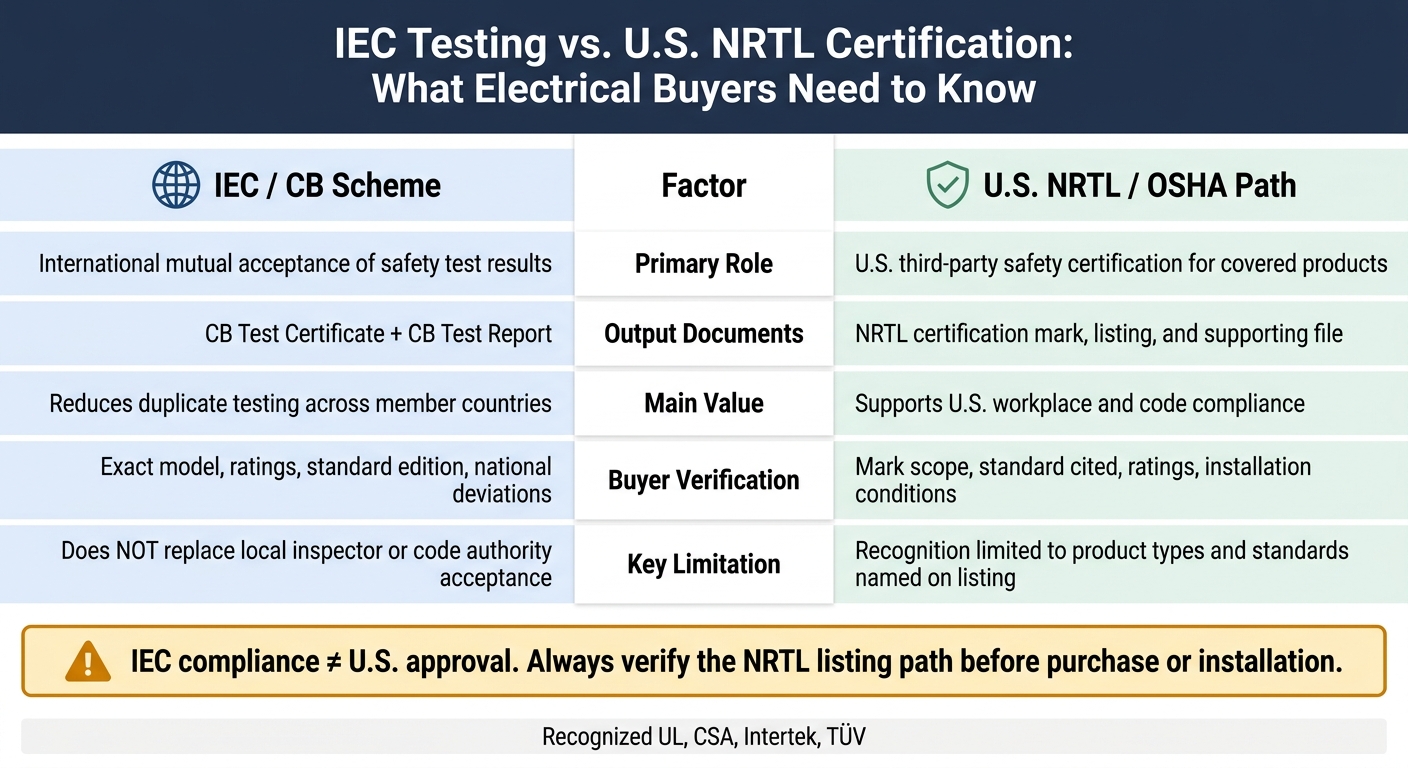
IEC vs. U.S. NRTL Certification: Key Differences for Electrical Equipment
Once you have IEC test results, the next step is figuring out whether they help with U.S. acceptance. IEC testing shows technical conformity. U.S. acceptance still needs its own certification path. The key is understanding how those two pieces fit together.
The IECEE CB Scheme and International Test Reports
The IECEE CB Scheme is an international conformity assessment system under the IEC framework. It lets a product tested once in an accepted lab support certification in multiple participating countries. The scheme produces a CB Test Certificate and CB Test Report, which together summarize compliance with the relevant IEC standard.
For U.S. buyers, the big advantage is time. If a supplier provides CB documentation, a participating U.S. certification body can use that material as a starting point instead of running the full test program again. That can shorten review cycles for globally sourced equipment such as drives, switchgear assemblies, and control panels built to IEC requirements.
Still, a CB file does not replace U.S. certification. Final U.S. acceptance still depends on the local inspector or code authority, the product category, and whether the recognized U.S. certification body accepts the CB evidence for that exact product type. Check that the CB file matches the exact model, ratings, standard edition, and configuration being ordered - not just the product family name.
What NRTL Marks Mean for U.S. Buyers
In the U.S., electrical product safety approval is tied to OSHA-recognized Nationally Recognized Testing Laboratories, or NRTLs. OSHA recognizes these labs to perform independent safety testing and certification within a defined scope. That recognition lasts five years unless revoked earlier, and each NRTL is limited to the product types and test standards listed in its scope.
An NRTL certification mark means the product met the applicable consensus safety standard. But the mark by itself doesn't tell you everything. It won't spell out the voltage class, enclosure rating, ambient temperature limits, or installation conditions. So don't stop at the logo. Review the full mark language. OSHA doesn't require one standard mark format, which means each NRTL uses its own mark. It's smart to confirm that the mark falls within that lab's current approved scope on OSHA's NRTL site.
IEC Testing Requirements vs. U.S. Approval Requirements
IEC conformity and U.S. approval do different jobs, and they lead to different documents. The table below shows how the two paths differ in day-to-day buying and approval work.
| Factor | IEC / CB Scheme | U.S. NRTL / OSHA Path |
|---|---|---|
| Primary role | International mutual acceptance of safety test results | U.S. third-party safety certification for covered products |
| Output documents | CB Test Certificate + CB Test Report | NRTL certification mark, listing, and supporting file |
| Main value | Reduces duplicate testing across member countries | Supports U.S. workplace and code compliance |
| Buyer verification | Exact model, ratings, standard edition, national deviations | Mark scope, standard cited, ratings, installation conditions |
| Limitation | Does not replace local inspector or code authority acceptance | Recognition is limited to the product types and standards named on the listing |
A lot of imported equipment is built to IEC requirements first, then reviewed for U.S. listing through a certification body that converts the technical file into a domestic compliance decision. IEC compliance can help that process, but it is not the same as U.S. approval. If equipment shows up IEC-tested but without U.S. certification, expect the chance of supplemental testing or a local NRTL evaluation before installation.
Before purchase, ask for the full certification package:
- Certificate
- Test report summary
- Scope confirmation
- Installation instructions
Then use those documents to confirm the exact model, ratings, and installation conditions. That's how certification paperwork turns into clear purchase requirements.
Applying IEC Standards in Specifications, Sourcing, and Commissioning
How to Write Clear Equipment Specifications
Once you know the right standard and approval path, turn that into plain procurement language. Saying "IEC compliant" sounds fine at first glance, but for purchasing, it's too loose. The better move is to name the exact standard, part, edition, and the proof you expect.
For low-voltage switchgear assemblies, specify IEC 61439-1 and IEC 61439-2:2020 with documented design verification. For motors, specify IEC 60034. For test instruments, cite IEC 61010 and, for insulation resistance, loop impedance, and RCD testers, IEC 61557.
At that point, IEC standards stop being general references and become pass/fail checks in the purchase order and submittal review. Ask for:
- Design verification
- Routine test records
- Project fault-level short-circuit ratings
- The CB Test Certificate and attached test report, matched to the exact model
Also make suppliers state any deviations from the cited standard in writing. That saves time later, especially when a product looks right on the surface but misses a key project requirement. In the RFQ, add a line that spells out whether you need NRTL listing, field evaluation, or AHJ acceptance of IEC/CB evidence.
Using IEC Details When Sourcing Equipment
Once the RFQ sets the ground rules, use those same details to filter vendor data sheets. An IEC data sheet only helps if the ratings, enclosure class, temperature range, and test evidence fit the job site conditions. If they don't match, the paper looks good, but the equipment may still fail review.
Look for the exact IEC standard numbers. For example, check for IEC 61439-1/2 on switchgear assemblies and IEC 60947 on circuit breakers and control components. Then confirm that voltage, current, frequency, and short-circuit ratings line up with your project needs.
Use Electrical Trader as a sourcing starting point for IEC-marked electrical equipment. Then verify ratings, markings, and test records before purchase. For used equipment, confirm that markings are still intact and that recent test results reflect IEC 60364-6 verification checks before you buy.
Conclusion: Key Points for Testing and Certification
Those same documents should carry straight into commissioning, so field testing matches the spec. Clear IEC specs, complete test records, and the right approval path help cut procurement risk and commissioning delays by tying factory test data to field acceptance.
FAQs
Do IEC reports satisfy U.S. approval?
No. IEC reports alone usually do not meet U.S. approval rules.
In the United States, local Authorities Having Jurisdiction (AHJs) enforce compliance. In most cases, they want certification or listing from a Nationally Recognized Testing Laboratory (NRTL).
IEC standards may be used for test methods, but they are not a substitute for U.S. requirements. In plain English: an IEC report can help support a case, but it generally won't stand in on its own for U.S. approval.
How do I match the right IEC standard?
First, figure out your equipment type and mission profile. That means looking at where it will be installed, how it will be stored, and what kind of stress it may face during transport. Then check the product-specific standard, because that’s where the pass/fail criteria are set.
For environmental testing, use the IEC 60068 framework, with extra attention to Part 3, to choose and read tests that match field conditions such as temperature, vibration, and humidity. If you’re buying from a supplier, make sure the technical documentation points to those standard test methods.
What documents should I request before buying?
Ask for the full test report, not just a summary or a simple compliance letter.
You want the report to show:
- the exact test method number
- the severity level
- the test duration
- the pass criteria
That level of detail matters. A short statement that says a product “meets requirements” doesn’t tell you much. The full report shows what was tested, how hard it was pushed, and what counted as a pass.
You should also request the manufacturer’s technical documents, including:
- design verification reports
- type-test certificates
- CB reports
For U.S. installations, check that the product has valid NRTL certifications, such as UL or CSA listings. And don’t stop there. Ask for nameplate photos, traceable part numbers, and recent inspection or service records so you can match the paperwork to the actual equipment in the field.