




IEC 60068 Testing: What You Need to Know
IEC 60068 does not tell you a product is “good.” It tells you which lab stress tests were run, at what severity, and whether the item met the stated pass criteria. That matters because the series has 80+ test methods, and a claim like “IEC 60068 tested” means little without the method number, duration, temperature, humidity, and pass/fail limits.
If I were buying, specifying, or selling electrical equipment, I’d focus on four things first:
- The exact test method used, such as cold, dry heat, vibration, shock, humidity, or salt mist
- The severity level, like -40 °F, 158 °F, 95% RH, or 15–100 g
- Whether the unit was tested powered or unpowered
- The full lab report, not just a one-line claim
Here’s the short version:
- Part 1 sets the ground rules for test conditions
- Part 2 lists the actual test methods
- Common checks include cold, heat, temperature cycling, vibration, shock, bump, humidity, and salt mist
- A product can be “tested” and still be a poor fit if the test severity was too light
- For used or surplus equipment, the old report only shows what the design handled when new, not what that specific unit has gone through since
Bottom line: I’d treat IEC 60068 as a lab test library, not a blanket stamp of reliability. The only way to judge the claim is to match the report to the product’s shipping, storage, and use conditions.
This article breaks down what the series covers, how the parts are organized, which tests matter most for electrical equipment, and what to check before you rely on any IEC 60068 claim.
Thermal Shock Testing Explained | AIS 156, IEC 60068-2-14 & More | EV & Electronics Reliability Test
sbb-itb-501186b
How the IEC 60068 Series Is Organized
IEC 60068 is divided into Part 1 and Part 2. That split isn't just editorial. It shapes how the whole series works.
Part 1 sets the test conditions.
Part 2 defines the test methods used for reliability checks.
Put simply, Part 1 lays out the ground rules, while Part 2 deals with the stresses that can affect reliability.
IEC 60068-1: General Rules and Test Atmospheres
IEC 60068-1 sets the rules for how IEC 60068 tests are carried out. It covers test atmospheres, specimen types, and how tests can be tailored to a product's life cycle.
What it doesn't do is tell you which tests a product has to pass. That's an important line in the sand.
Once those rules are set, Part 2 moves into the specific types of stress used in testing.
IEC 60068-2: The Main Test Methods for Electrical Equipment
Part 2 contains the test methods. For electrical equipment, these are the methods that matter most for reliability.
| Method | Test Name | What It Checks |
|---|---|---|
| IEC 60068-2-1 | Cold (Test A) | Low-temperature operation and material brittleness |
| IEC 60068-2-2 | Dry Heat (Test B) | High-temperature operation and plastics softening |
| IEC 60068-2-14 | Change of Temperature (Test N) | Thermal expansion mismatch and solder-joint fatigue |
| IEC 60068-2-6 | Vibration, Sinusoidal (Test Fc) | Resonances and fatigue from rotating machinery |
| IEC 60068-2-27 | Shock (Test Ea) | Handling drops and in-service impacts |
| IEC 60068-2-29 | Bump (Test Eb) | Accumulated fatigue from repeated low-level shocks |
| IEC 60068-2-30 | Damp Heat, Cyclic (Test Db) | Condensation and enclosure breathing in outdoor use |
| IEC 60068-2-78 | Damp Heat, Steady State (Test Cab) | Insulation resistance and moisture absorption |
| IEC 60068-2-11 | Salt Mist (Test Ka) | Corrosion of metals and finishes in coastal environments |
IEC 60068 Tests That Directly Affect Electrical Equipment Reliability
The list above names the methods. This section gets into the failures they’re meant to bring to the surface.
Each Part 2 test family maps to problems that show up in actual electrical equipment: brittle materials, failed seals, fatigue, moisture ingress, and corrosion. Once you know what a test is stressing, it gets much easier to judge whether a product fits the place where it will be used.
Temperature and Humidity Tests
These tests deal with some of the most common reliability risks in power distribution and control equipment.
Cold (IEC 60068-2-1) drives equipment down to severities such as −40 °F (−40 °C). The goal is to see whether seals shrink, plastics turn brittle, or the unit won’t start in harsh winter conditions. It also separates storage conditions from energized operation, which is a big deal for self-heating equipment.
Dry Heat (IEC 60068-2-2) checks the hot side of the range, often at 158 °F (70 °C) for industrial equipment. It looks for plastic deformation, insulation breakdown, and overheating risk in electronic assemblies. With self-heating equipment, powered testing matters because the internal temperature can be quite different once the unit is running.
Change of Temperature (IEC 60068-2-14) simulates fast thermal cycling, like day-to-night temperature swings. Since different materials expand and contract at different rates, repeated cycling can strain mechanical joints and construction materials.
For moisture, Damp Heat Cyclic (IEC 60068-2-30) reproduces condensation and “breathing” effects through daily cycles between 77 °F and 131 °F (25 °C and 55 °C) at 95% relative humidity. Damp Heat Steady State (IEC 60068-2-78) looks at long-term moisture absorption in insulation and housings without condensation. That makes it especially useful for equipment used in stable tropical settings.
Mechanical Stress Tests
Heat and moisture are only part of the story. Mechanical stress testing shows what can go wrong during handling, transport, installation, and operation.
Sinusoidal Vibration (IEC 60068-2-6) applies harmonic motion that mirrors rotating or pulsating machinery, including motors, pumps, and generators. It helps find resonant frequencies, where parts can amplify stress and wear out faster than expected.
Shock (IEC 60068-2-27) uses half-sine pulses in the 15–100 g range to simulate sudden impact, like a drop during unloading, a collision in transit, or a jolt in service. This test puts mounting points and internal connections under pressure.
Bump (IEC 60068-2-29) applies repeated lower-level impacts that build fatigue over time. It’s useful for equipment exposed to repeated stress during transport or installation, where small hits can add up and lead to failure.
Corrosion Resistance Tests
Salt Mist (IEC 60068-2-11) exposes equipment to a 5% sodium chloride fog at 95 °F (35 °C) for periods from 2 to 1,000 hours. It checks whether coatings, metal enclosures, and connector contacts can hold up against corrosion from coastal air or road de-icing salts. Salt fog is good at revealing thin coatings, weak coating adhesion, and bare spots around edges and fastener holes.
Use these failure modes to connect test claims with the conditions the equipment will actually face.
How to Use IEC 60068 Results When Buying, Specifying, or Selling Equipment
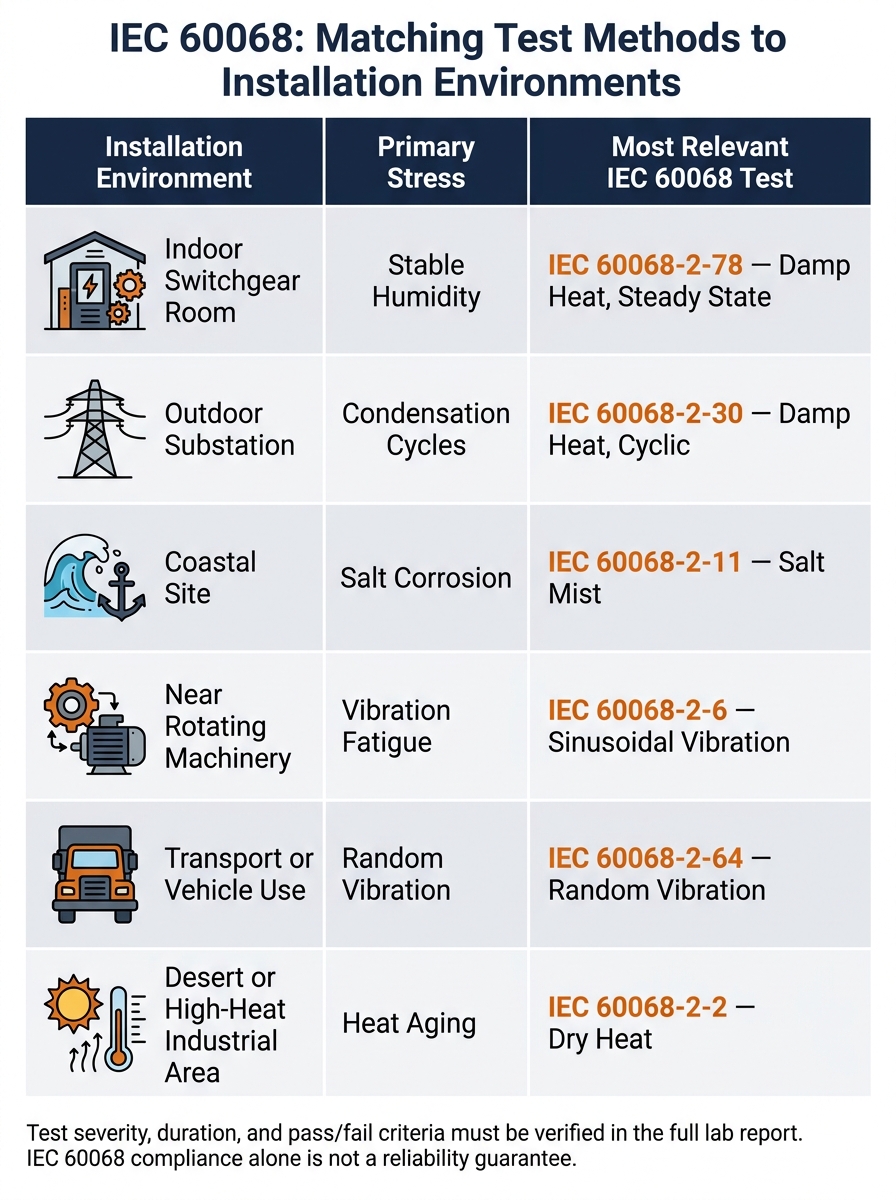
IEC 60068 Test Methods: Installation Environment vs. Relevant Test
Matching Tests to Product Type and Installation Conditions
Match the test severity to the way the product will be transported, stored, and used.
Here’s how common U.S. installation settings line up with the IEC 60068 tests that matter most:
| Installation Environment | Primary Stress | Most Relevant Test |
|---|---|---|
| Indoor switchgear room | Stable humidity | IEC 60068-2-78 (Damp heat, steady state) |
| Outdoor substation | Condensation cycles | IEC 60068-2-30 (Damp heat, cyclic) |
| Coastal site | Salt corrosion | IEC 60068-2-11 (Salt mist) |
| Near rotating machinery | Vibration fatigue | IEC 60068-2-6 (Sinusoidal vibration) |
| Transport or vehicle use | Random vibration | IEC 60068-2-64 (Random vibration) |
| Desert or high-heat industrial area | Heat aging | IEC 60068-2-2 (Dry heat) |
A breaker in a climate-controlled switchgear room does not need the same test coverage as equipment sitting in an outdoor substation. That’s the whole point. The data only helps if the test matches the place where the equipment will live. Compliance on paper is one thing; a useful test result is another. Once you’ve picked the right test family, the report itself tells you whether the claim has any weight.
Reading Severities, Pass Criteria, and Product Documentation
A test reference by itself proves almost nothing. The result comes from the severity, the duration, and the pass criteria.
Check the exact temperature, test time, humidity level, and pass/fail criteria listed in the report. That’s what separates a real qualification result from a vague marketing claim.
It also helps to check whether the unit was tested powered or unpowered. A storage test run unpowered does not show that the equipment can operate at that same temperature. For equipment that gives off heat, the report should include internal temperature measurements, not just the chamber setpoint. And before you lean on the result, confirm that the lab is accredited to ISO/IEC 17025.
Using Test Data When Evaluating New, Used, and Surplus Equipment
The same test report can mean very different things depending on whether the equipment is new or used.
For new equipment, IEC 60068 reports work as design qualification evidence. The main issue is simple: did the manufacturer set the test parameters to fit the product’s actual mission profile, or did they just run a generic test to check a box?
For used and surplus equipment, the original report is more of a starting line. It shows what the design was built to handle when it left the factory. What it does not show is what that specific unit has been through since then. That gap matters.
Before relying on the original claims, look for signs of cumulative stress, such as:
- Moisture ingress inside enclosures
- Solder-joint fatigue from thermal cycling
- Corrosion at dissimilar-metal junctions
On Electrical Trader, it makes sense to pair the original qualification report with recent inspection and service records before buying or selling used equipment.
Conclusion: Key Points to Check Before Relying on IEC 60068 Claims
Before you trust an IEC 60068 claim, check the report itself. IEC 60068 is a library of test methods, not a pass/fail rulebook. The qualification plan sets the tests and the pass criteria.
What matters most is the detail behind the claim. The exact Part 2 method number, the severity level, the test duration, and the pre-agreed pass/fail criteria are what separate a useful result from a marketing checkbox. A -10°F, 2-hour test is not the same as a -40°F, 96-hour test. Both can still be described as "IEC 60068-2-1 tested."
IEC 60068 is a qualification standard, not a regulatory one. Passing means the design made it through the stated conditions. It does not guarantee field reliability.
Ask for the actual test report - not a summary and not a compliance statement. Then verify:
- The method number
- The severity
- The duration
- The pass criteria
That’s the line between a test claim and a reliability signal you can use. If the report is incomplete, treat the claim as unverified.
FAQs
Does IEC 60068 certification exist?
Not exactly. IEC 60068 is an internationally recognized series of standards for environmental testing of electrical and electronic products. It is not a certification on its own.
Instead, it lays out standardized test methods, such as vibration, shock, and temperature testing. These methods are used when product standards, contracts, or industry requirements call for them to help verify product reliability.
Which IEC 60068 test matters most for my environment?
There’s no single most important test. The right IEC 60068 test depends on the conditions your product will face across its full lifecycle, including transportation, storage, and end use.
For example, temperature swings may point to thermal cycling or humidity tests. But if the product is likely to face transit stress or machine-related movement, vibration or shock testing may matter more.
Can a used unit still be trusted if it passed IEC 60068 when new?
Passing IEC 60068 when a unit was new means it met a set of environmental toughness checks at that point in time. But that does not mean the unit is still reliable today.
With a used unit, the current condition comes down to what happened after that original test. Storage conditions, shipping, and day-to-day use all matter. Parts age. Heat, moisture, dust, and vibration can take a toll. Mechanical wear can also chip away at performance, even if the unit passed its first qualification without issues.





