How Hybrid Generators Lower Noise And Emissions
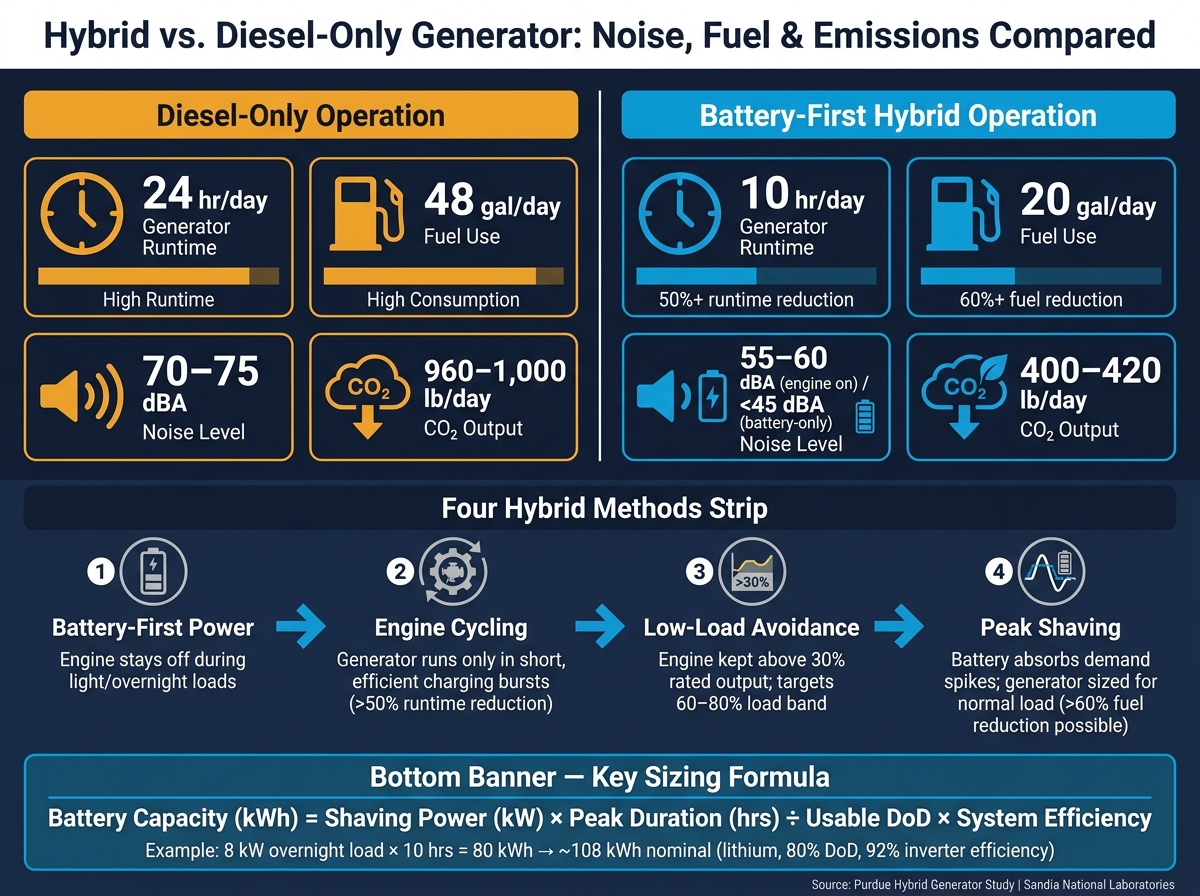
A hybrid generator is quieter and cleaner because the battery does the light work, and the engine runs less often. In many cases, that cuts generator runtime by 50% or more, and some peak-shaving setups have shown fuel-use cuts above 60%. I’d boil it down to this: store power, use the battery first, and only run the engine when load or battery charge says you have to.
If you want the short answer, here it is:
- Battery-first power keeps the engine off during low demand, especially at night
- Engine cycling turns the generator on only for short charging periods
- Low-load avoidance keeps the engine out of the dirty 30%–40% load zone
- Peak shaving lets the battery take short spikes, so the generator doesn’t need to be oversized
That setup helps lower:
- Noise, because the engine is off more often
- Fuel use, because the engine runs fewer hours
- Exhaust output, because the engine spends more time in the 60%–80% load range instead of idling along at low demand
- Maintenance trouble, including wet stacking, soot buildup, and extra wear from chronic underloading
A simple example shows how this works. If a site has an 8 kW overnight load for 10 hours, it needs about 80 kWh before losses. After inverter losses and battery depth-of-discharge limits, I’d size closer to 108 kWh of nominal battery capacity to cover that quiet period without the engine kicking on.
Here’s the main idea in one glance:
| Method | What it does | Main result |
|---|---|---|
| Battery-first | Battery serves light loads first | Less noise, less engine runtime |
| Engine cycling | Generator runs in short charging bursts | Lower fuel burn over a full day |
| Low-load avoidance | Keeps engine above low, dirty output | Less soot, less wet stacking |
| Peak shaving | Battery handles short surges | Smaller generator pressure, steadier sound |
Bottom line: if you size the battery, inverter, and generator around measured site load instead of guesses, you can cut noise, trim fuel use, and keep the engine from running when it shouldn’t.
Hybrid vs. Diesel-Only Generator: Noise, Fuel & Emissions Compared
Battery-First Power: How Stored Energy Enables Silent Operation
In battery-first mode, stored energy handles light and mid-level loads while the engine stays off. No combustion means no exhaust at the site and far less noise. In practice, the only sound you usually hear is from the inverter fans.
How Battery-First Mode Works Through Daily Load Changes
The controller keeps an eye on SOC, site load, and inverter capacity. If SOC drops below the lower limit, or if load climbs past what the inverter can carry, the engine kicks on. It then runs in its more fuel-efficient range while charging the battery.
Once SOC moves back above the upper threshold and demand drops to a level the battery can support, the controller turns the engine off and sends the site back to battery-only operation. On sites with busy daytime use and quiet nights, that on-and-off cycle may happen several times in one day. And that operating pattern plays a big role in battery sizing and SOC settings.
How to Set Battery Capacity and SOC Thresholds
Battery sizing starts with actual load data, not guesses. A good rule is to log real kW draw for 1 to 4 weeks with a data logger. Then look for the low-load hours, such as overnight lighting and trailer loads, and total up how much energy those periods need.
Here’s a simple example. An 8 kW overnight load running for 10 hours needs 80 kWh before losses. If you account for 92% inverter efficiency and 80% usable depth of discharge on a lithium battery, the needed nominal battery capacity comes out to about 108 kWh. That gives the battery enough headroom to cover the full quiet window without the engine firing up at the wrong time.
For SOC thresholds, many experienced designers set:
- Engine start at about 30% to 40% SOC
- Engine stop at about 80% to 95% SOC
Set the start point too low, and you risk deep discharge and shorter battery life. Set the stop point too high, and the engine may keep running just to move the battery from 90% to 100%, which burns extra fuel for very little return. The table below shows a sample comparison for a mid-size site:
| Mode | Generator runtime (hr/day) | Fuel use (gal/day) | Noise level (dBA) | Estimated CO₂ output (lb/day) |
|---|---|---|---|---|
| Diesel-only operation | 24 | 48 | 70–75 | 960–1,000 |
| Battery-first operation | 10 | 20 | 55–60 (engine on) / under 45 (battery-only) | 400–420 |
After startup, check the controller’s built-in logs during the first few weeks. Those logs tell you a lot. If the engine starts often for short bursts, the battery may be too small or the start threshold may be too high. If the battery almost never gets close to the lower threshold, you may have room to change the stop point and stretch quiet hours even more. The best settings come from logged load data, not from nameplate estimates.
When load stays above what battery-only operation can support, the controller shifts to engine cycling.
sbb-itb-501186b
Engine Cycling and Low-Load Avoidance: Running the Generator Only When Efficient
When battery-first mode can’t cover the job anymore, the controller switches to engine cycling. That means the generator doesn’t sit there idling through light demand. Instead, it turns on in short runs, does the work while it’s in a good operating range, and then shuts back off.
That matters for two reasons. It cuts total runtime, and it keeps the engine out of the low-load zone where diesel units tend to run dirty and wear themselves down.
How Engine Cycling Cuts Runtime and Exhaust Output
A Purdue thesis on hybridizing diesel generators found that limiting engine operation to battery recharge periods enabled more than a 50% reduction in generator runtime. Fewer run hours means less exhaust at the site and less noise for workers or nearby residents.
How to Keep the Engine in Its Efficient Load Band
Diesel engines running below about 30% of rated output don’t burn fuel cleanly. That can lead to wet stacking, which is unburned fuel buildup in the exhaust. Cylinder walls can also glaze, which hurts ring seal. Those issues push up maintenance costs and can shorten engine life. Keeping the engine in the right load band helps cut soot, smoke, and exhaust buildup.
Hybrid controllers deal with this by stacking battery-charging demand on top of site load whenever the engine is on. The goal is to move total output into the 60–80% load band. On a U.S. construction site, for example, a 100 kW diesel unit paired with 80–100 kWh of usable battery might be set to deliver 60–70 kW of combined output during each engine run. That gives the battery a solid recharge while keeping the engine in its efficient band, then the system shuts down once SOC reaches 85–90%.
Low-load operation drives up fuel burn per kWh, emissions, and maintenance risk. Running at the right load cuts all three.
| Operating Mode | Fuel Use (gal/hr) | Relative NOx/PM Output | Maintenance Impact | Expected Engine Life Effects |
|---|---|---|---|---|
| Low-load (≈20–30% of rated output) | 0.6–0.8 | High per kWh | Higher risk of wet stacking, glazing, and DPF fouling; more frequent cleaning needed | Accelerated wear from poor combustion and ring sealing issues |
| Optimal-load (≈60–80% of rated output) | 1.4–1.8 | Lower per kWh | Cleaner combustion; less buildup; longer service intervals on exhaust components | More stable operation; supports full rated engine life with proper maintenance |
At first glance, the optimal band looks like it uses more fuel per hour. And it does. But that’s only part of the story. Total fuel use per shift still drops because the engine runs far fewer hours and delivers more useful energy each time it starts.
If buildup has already started, there’s still a way to clean things out. A burn-off session at about 75% load for 2–4 hours can clear deposits and bring combustion back to normal before the issue gets worse.
In practice, this usually means setting a minimum load target - often 50–60% of rated kW - so the controller won’t let the engine run unless the combined site load and charging load can meet that floor. It also helps to set minimum run-time and off-time rules, such as 30–60 minutes per run and 30 minutes off between cycles. That keeps contactors and starter systems from getting hammered by fast on/off cycling. Watching exhaust gas temperature along with load percentage can also give an early warning that the settings need a tune-up before wet stacking sets in.
When demand spikes instead of staying steady, peak shaving handles the surge.
Peak Shaving: Using the Battery to Handle Demand Spikes
After low-load control, the next issue is the opposite one: short demand spikes. Demand can jump fast when a compressor kicks on, a welder starts, or several tools fire up at the same time. In a standard setup, the generator has to take that hit on its own.
That creates a common problem. The generator has to be sized for the peak, even if those peaks last only a short time. So for much of the day, the unit ends up too large for the job and runs underloaded.
Peak shaving changes that. Instead of making the generator chase every spike, the battery and inverter step in to cover short surges while the generator keeps a steady output. In plain terms, the battery handles the quick punches, and the engine keeps doing its job without bouncing up and down. That usually means a steadier and quieter output. The next step is sizing the battery and checking whether the inverter can react fast enough to those spikes.
How Peak Shaving Cuts Noise, Fuel Use, and Generator Size Pressure
When the battery absorbs a spike, the engine doesn’t have to ramp up hard to follow it. That matters because fast load swings change fuel flow and airflow, which can make the generator louder. With the battery acting like a buffer, the engine stays in a tighter load range, and the sound level stays more even.
A Sandia National Laboratories study found greater than 60% reduction in fuel consumption at 100 kW when energy storage was used for peak shaving and smarter load control, compared with a standard diesel generator. That steadier output also cuts noise spikes and exhaust surges.
This is why measured load data matters so much. Nameplate ratings might look fine on paper, but they don’t show what the site is doing minute to minute.
How to Set Peak Limits for Changing Site Demand
Start by logging 15-minute load data for 1 to 2 weeks so you catch both weekday and weekend patterns. Then look at two things:
- How far the spikes rise above the base load
- How long those spikes last
A construction site, for example, might sit at a steady 20 kW most of the time, then jump to 40 kW when several tools start at once. That’s the pattern the system needs to handle.
From there, the math is simple. Battery capacity (kWh) = shaving power (kW) × peak duration (hours), then adjust for usable depth of discharge and system efficiency.
For controls, set discharge to turn on at about 70%–75% of generator rating. Also set a 40%–50% SOC floor. Below that point, peak shaving should back off to protect battery health.
Here’s how that can look for a site with a 25 kW base load and frequent peaks up to 45 kW:
| Scenario | Required Generator Size (kW) | Average Load Factor (%) | Runtime (hr/day) | Estimated Emissions Reduction (%) |
|---|---|---|---|---|
| No Peak Shaving (Conventional) | 50 | 40 | 24 | 0 |
| Hybrid with Peak Shaving | 30 | 70 | 16–18 | 20–40 |
In the hybrid setup, the generator stays closer to its efficient operating range, while the battery takes the short spikes instead of forcing the use of a larger diesel unit.
Selecting a Hybrid System and Key Takeaways
What to Check Before Buying or Specifying a Hybrid Unit
Once you understand how hybrid operation lowers noise and emissions, the next step is simple: make sure the equipment can actually support those operating modes.
Start with measured site load, not a rough guess. Log 1–2 weeks of demand data at 15-minute intervals or finer so you can see the full load profile, including nighttime base load, daytime average demand, and short peak spikes. That data is what lets you size the system for battery-first operation, engine cycling, low-load avoidance, and peak shaving.
Three specs shape the hardware choice:
- Battery capacity for off-engine runtime
- Inverter rating for short peaks
- Generator kVA for steady demand and battery recharge duty
It also helps to confirm voltage and phase requirements early. If your site panel doesn’t match the inverter output, you can end up with expensive rework later.
Physical fit matters too. Check trailer weight limits, crane capacity, and pad space before you commit. In many cases, a smaller generator paired with a battery cabinet fits where a large conventional set won’t. Local noise rules can also affect where the unit can go.
Electrical Trader can help source compatible generators, transformers, breakers, and panelboards in one place.
Conclusion: Four Methods That Deliver Lower Noise and Emissions
Four connected methods drive the reduction. Battery-first power keeps the engine off during light demand. Engine cycling reduces total runtime, so the engine runs only when it can do useful work at an efficient load. Low-load avoidance keeps combustion cleaner by holding the engine above roughly 30% of rated capacity, which helps prevent wet stacking and the particulate buildup that comes from chronic underloading. And peak shaving lets the battery handle short demand spikes, so the generator can be sized for normal loads instead of rare peaks, which improves efficiency and cuts noise.
The key point is that these methods only work well together. If generator size, battery capacity, inverter rating, and controller thresholds don’t match the site’s actual load, the engine will keep running when it should be off.
FAQs
How do hybrid generators switch between battery and engine power?
Hybrid generators use an Energy Management System (EMS) to switch between battery power and engine power based on real-time data, such as load levels and battery charge.
During low-demand periods, the EMS gives priority to battery power. When demand climbs, or the batteries need charging, the diesel engine starts on its own to recharge the battery bank or supply extra power. That setup helps the engine run in its most efficient 60% to 80% range instead of sitting at low load and idling.
What size battery does a hybrid generator need for quiet overnight operation?
There’s no one-size-fits-all battery size for a hybrid generator. The right capacity comes down to your power needs, especially your average energy use and peak demand.
A good setup starts with historical usage data and load modeling. That helps you pair the battery bank with the generator so the system can handle short spikes in demand without oversizing everything.
It also helps the unit stay quieter overnight. Instead of running the engine all night, the system can rely on battery storage and kick the engine on only when it needs to recharge.
Can a hybrid generator use a smaller engine without losing peak power?
Yes. With battery storage, a hybrid generator can handle sudden power spikes from equipment like motors or compressors without needing a bigger engine.
That means you can size the engine closer to the average load, while the battery steps in to supply extra power during short periods of heavy demand.