

Hybrid Diesel Generators vs Traditional Diesel
Looking for the best power solution? Here's the bottom line: Hybrid diesel generators are more efficient and cost-effective for long-term and variable power needs, while traditional diesel generators are better for short-term, constant heavy loads.
Key Takeaways:
- Fuel Efficiency: Hybrids consume 50–70% less fuel by running on battery power during low demand, while diesel engines run continuously, burning more fuel.
- Maintenance: Hybrids require less frequent servicing due to reduced engine runtime, cutting maintenance costs by 30–50%.
- Noise Levels: Hybrids operate quietly (50–60 dB in battery mode), making them ideal for noise-sensitive projects. Diesel units are louder at 70–80 dB.
- Cost: Hybrids save up to $1,155/month in fuel costs for a 50kW unit but have a 10–20% higher upfront cost.
-
Best Use Cases:
- Hybrid: Long-term projects, variable loads, quiet environments (e.g., events, healthcare, urban sites).
- Diesel: Short-term jobs, constant heavy loads, remote locations without charging options.
Quick Comparison:
| Feature | Diesel Generators | Hybrid Generators |
|---|---|---|
| Fuel Consumption | ~18 gallons/day (50kW unit) | ~6–9 gallons/day (50kW unit) |
| Noise Levels | 70–80 dB | 50–60 dB (battery mode) |
| Maintenance Cost | Higher | Lower |
| Runtime Efficiency | Runs constantly | Engine runs only as needed |
| Best For | Heavy, constant loads | Variable loads, quiet settings |
Bottom Line: Choose hybrid for efficiency and long-term savings. Opt for diesel when simplicity and heavy-duty power are required.
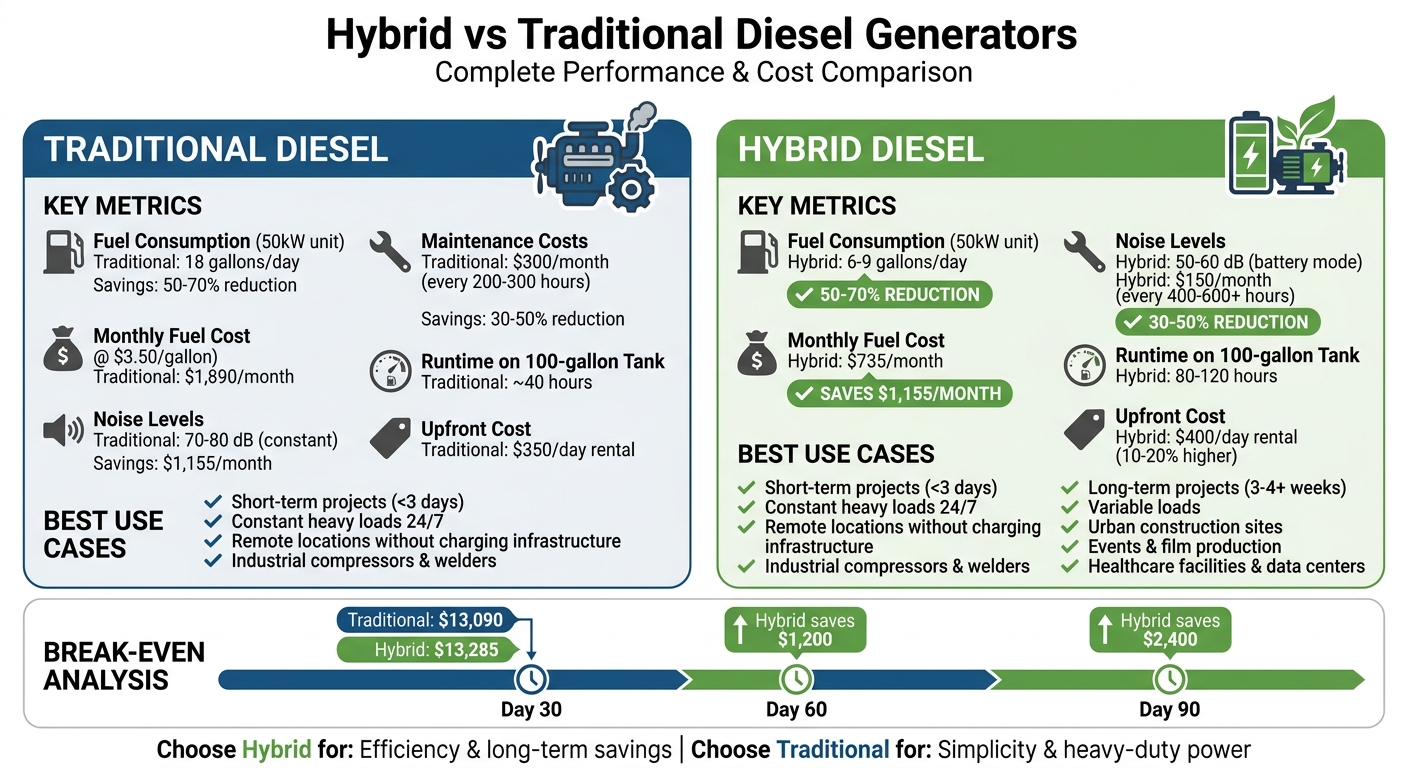
Hybrid vs Traditional Diesel Generators: Cost, Efficiency & Performance Comparison
Atlas Copco Rental | Diesel versus hybrid: a real-life comparison for a temporary power supply
sbb-itb-501186b
Efficiency Comparison
Efficiency differences between traditional and hybrid diesel generators stem from how they manage power. Traditional systems run continuously, regardless of demand, while hybrid models adjust power output using battery support to optimize performance.
Traditional Diesel Efficiency
Traditional diesel generators operate at a constant 3,600 RPM to maintain a steady 60Hz frequency. This fixed-speed operation means they burn fuel at nearly the same rate, even when power demand is low.
Diesel engines perform most efficiently when running above 70% of their rated capacity. Below this level, their efficiency declines sharply. Worse, prolonged low-load operation can cause wet stacking - a condition where unburnt fuel builds up in the engine’s exhaust and injection systems due to suboptimal operating temperatures. Wet stacking wastes fuel, accelerates engine wear, and increases maintenance costs, making it a costly issue for operators.
Hybrid systems mitigate these challenges by incorporating batteries into the power setup.
Hybrid Diesel Efficiency
Hybrid systems shine in low-demand scenarios by relying primarily on battery power. The diesel engine only kicks in to recharge the batteries or handle peak loads. This ensures that when the engine runs, it operates in its most efficient range.
During high-demand periods, the battery storage helps manage surges, allowing the use of a smaller engine that avoids the inefficiencies of partial-load operation. This design reduces fuel consumption and eliminates many of the problems associated with traditional generators.
For example, a 100-gallon fuel tank powering a traditional 50kW generator typically lasts about 40 hours. In a hybrid system, the same tank can run for 80–120 hours. Fewer engine hours mean extended maintenance intervals and almost no risk of wet stacking. This translates to lower operational costs and better overall performance.
Efficiency Comparison Table
| Feature | Traditional Diesel Generator | Hybrid Diesel Generator |
|---|---|---|
| Efficiency at Low Load | Low (Fixed 3,600 RPM operation) | High (Battery-powered; engine stays off) |
| Efficiency at High Load | High (Optimal above 70% load) | High (Engine runs within optimal range) |
| Fuel Consumption | ~18 gallons/day (50kW unit) | ~6–9 gallons/day (50kW unit) |
| Runtime on 100‑gal Tank | ~40 hours (at 50% load) | 80–120 hours |
| Wet Stacking Risk | High during low-load operation | Minimal (Engine primarily runs at high load) |
| Emissions Reduction | Standard (Tier 4 Final compliance) | High (Reduced engine runtime) |
Fuel Savings and Cost Analysis
Continuing from earlier discussions on efficiency, let’s dive into how hybrid diesel systems can lead to substantial reductions in fuel and maintenance costs.
Fuel Consumption Rates
Consider this: A traditional 50kW diesel generator typically consumes around 18 gallons of fuel daily. At $3.50 per gallon, that adds up to about $1,890 per month. In contrast, a hybrid unit consumes only 6–9 gallons per day, costing approximately $735 per month. That’s a monthly fuel savings of $1,155 per unit. These savings are possible because hybrid systems rely on battery power during periods of low demand, using the diesel engine only for recharging or handling surge loads.
A 2018 Power Electrics case study demonstrated the real-world impact of hybrid systems. Over 40 days, pairing a hybrid generator with a diesel unit reduced fuel consumption by 9,080 liters and cut CO2 emissions by 24 tons. The hybrid unit also operated silently at night, meeting residential noise restrictions while maintaining power for security systems.
These fuel savings don’t just lower operating costs - they also contribute to fewer maintenance needs over time.
Maintenance and Operating Costs
The reduced runtime of hybrid generators directly translates to lower maintenance costs. Traditional diesel units require servicing every 200–300 hours, which typically costs $200–$400 monthly. Hybrid systems, on the other hand, need less frequent servicing - every 400–600+ hours - bringing monthly maintenance costs down to about $150. That’s a 30%–50% reduction in maintenance expenses.
Advancements like telematics and predictive maintenance enhance these savings further. By 2023, industry data showed that hybrid units could cut total service costs by about 12%. When combined with fuel savings, hybrid systems can reduce overall operating expenses by 50%–80% compared to traditional diesel units.
Cost Comparison Table
| Cost Component (50kW Unit) | Traditional Diesel | Hybrid Diesel | Weekly Savings |
|---|---|---|---|
| Weekly Fuel Consumption | 126 gallons | 49 gallons | 77 gallons |
| Weekly Fuel Cost (@ $3.50/gal) | $441.00 | $171.50 | $269.50 |
| Maintenance Interval | Every 200–300 hours | Every 400–600+ hours | ~50% reduction |
| Monthly Maintenance Cost | $300 | $150 | $150/month |
| Monthly Fuel Cost | $1,890 | $735 | $1,155/month |
While hybrid generators come with a slightly higher upfront cost - about 10%–20% more ($400/day compared to $350/day) - the savings quickly offset this difference. For instance, a 30-day rental might cost $13,285 for a hybrid unit versus $13,090 for a traditional diesel unit. By day 60, however, the hybrid system saves $1,200, and by day 90, the savings grow to $2,400. For projects lasting more than three to four weeks, hybrid systems clearly provide a more cost-effective solution over the long term.
Operating Differences and Applications
Load Management Capabilities
Hybrid generators rely on battery storage as their primary power source, using the diesel engine mainly for recharging batteries or handling peak demand. This approach ensures the engine operates within its most efficient range (typically 60–80%). By avoiding low-load operation or idling, hybrids achieve better fuel efficiency and reduced wear.
In contrast, traditional diesel generators run continuously, regardless of the demand. This often results in inefficiency during fluctuating loads. For example, on many jobsites, diesel generators operate at just 3% load for most of the day (22 out of 24 hours). Hybrids address this issue by maintaining a steady 75% load during a few hours of charging.
Surge loads reveal another critical distinction. Equipment like motors or compressors can cause sudden power spikes during startup. Hybrid systems handle these surges smoothly, with the battery providing instant power while the engine adjusts, preventing voltage dips. Traditional generators, however, often require oversizing - installing a larger unit than necessary - to handle these spikes. For instance, a 60kW diesel generator might be used for a 40kW load to accommodate startup surges. Hybrids, on the other hand, can be sized closer to the average load since the battery absorbs the surge.
These differences in operation directly influence the types of applications each system serves best.
Best Use Cases
The choice between hybrid and traditional diesel generators depends on the specific demands of the job. Hybrid generators excel in situations with variable loads or strict requirements for noise and emissions. For example, events and film productions benefit from the silent battery-only mode during performances or filming. Similarly, healthcare facilities and data centers prefer hybrids for their uninterrupted power supply (UPS) capability, which ensures clean power and prevents damage to sensitive equipment. Urban construction sites, especially in cities like New York and California, increasingly choose hybrids to comply with Tier 4 Final engine standards and noise regulations.
Traditional diesel generators, however, are better suited for tasks requiring constant, heavy power. Remote locations without charging infrastructure or projects needing 24/7 high-load operation still rely on these units. Additionally, for short-term projects lasting less than three days, traditional generators often make more sense due to their lower upfront rental costs, which can outweigh fuel efficiency benefits.
These operational distinctions highlight the efficiency and cost considerations discussed earlier.
Operating Comparison Table
| Feature | Traditional Diesel Generator | Hybrid Diesel Generator |
|---|---|---|
| Runtime Hours (per week) | 168 hours (Continuous 24/7) | 14–20 hours (Engine only runs to charge) |
| Refueling Frequency | Every 2 days (approx. 40 hours) | Every 4–5 days (approx. 80–120 hours) |
| Engine Wear | High (Constant operation, often at low load) | Low (Reduced runtime, runs at optimal load) |
| Suitability | Steady, high-load industrial tasks | Variable loads, events, residential sites |
| Noise Profile | 70–80 dB constant | Silent during battery mode (50–60 dB) |
| Power Stability | Prone to voltage drops during surges | Clean power via inverters |
Choosing Between Hybrid and Traditional Diesel
When to Choose Hybrid Diesel Generators
Hybrid generators shine on projects lasting three to four weeks or longer, where their fuel efficiency can offset the 10–20% higher rental cost. For instance, a 50 kW hybrid generator running for 60 days can save about $1,200 in operating costs compared to a traditional diesel unit.
These systems are also a smart choice for projects with environmental or noise restrictions. In cities like New York and Los Angeles, regulations often require Tier 4 Final engines or equipment capable of zero emissions, making hybrids a better fit for sensitive environments such as film sets, hospitals, and residential construction. Operating in battery mode, hybrids produce noise levels of 50–60 dB, much quieter than the 70–80 dB typical of diesel units. A 40-day project using a hybrid system not only reduced emissions and saved fuel but also maintained a quieter work environment.
Hybrid generators also excel at handling variable loads and provide an immediate uninterruptible power supply (UPS) response. This makes them particularly useful for industries like healthcare and data centers, where reliable power is critical.
When to Choose Traditional Diesel Generators
Traditional diesel generators are better suited for short-term projects or applications requiring consistent heavy loads. Their lower rental costs make them more economical for projects lasting less than three days. They’re ideal for powering equipment like construction welders, industrial compressors, or any machinery needing 24/7 high-wattage output.
Additionally, traditional diesel units are more practical in remote locations where charging infrastructure for hybrid systems is unavailable. Hybrid batteries can be difficult to recharge on-site, making diesel generators the more reliable choice in such scenarios.
Sourcing Power Generation Equipment
No matter your choice, finding reliable equipment is essential to ensure performance and cost efficiency. Platforms like Electrical Trader provide a wide range of power generation tools, including emergency standby diesel generators and other essential electrical components. Whether you're looking for new or used equipment, this marketplace offers solutions tailored to different project needs and budgets.
Conclusion
Select your generator based on what your project needs most. Hybrid systems can lower fuel consumption by 50–70% and cut maintenance costs by 30–50%, thanks to reduced engine runtime. These features make hybrids a smart choice for projects lasting over three to four weeks, where the savings can outweigh their 10–20% higher rental costs. Additionally, their quieter operation - 50–60 dB in battery mode - makes them ideal for urban areas with strict noise regulations or for sensitive applications like hospitals and film sets.
On the other hand, traditional diesel generators are better suited for short-term projects under three days or tasks requiring constant heavy loads, such as running industrial compressors or construction welders non-stop. They’re also the go-to option for remote locations without access to charging infrastructure.
The efficiency difference between these systems is clear. Over a 60-day project, hybrid systems can significantly reduce operating costs. However, for shorter projects, the savings on fuel may not justify the higher upfront costs.
Choosing the right generator also depends on how you manage your power needs. Hybrids shine when handling variable loads and can quickly respond to power surges. In contrast, diesel units are built for round-the-clock, high-wattage output, where reliability is key. Ultimately, your decision should balance long-term efficiency against immediate power requirements.
When it’s time to secure the right equipment - whether hybrid or diesel - platforms like Electrical Trader offer a range of options, from new and used generators to emergency standby diesel units and other electrical essentials. Having the right tools ensures your project stays on track without unexpected delays or cost overruns.
FAQs
How do I size a hybrid generator for my load profile?
To determine the right size for a hybrid generator, begin by assessing your energy requirements. Look at both your peak demand and average energy usage, using historical data and projections for future needs. Choose a system that combines battery storage and generator capacity in a way that can efficiently handle peak loads. Getting the sizing right ensures the system runs efficiently, minimizes fuel usage, and smoothly alternates between battery and generator power to meet your energy demands.
Do hybrid generators need onsite charging infrastructure?
Hybrid generators offer a practical advantage: they usually don't need dedicated onsite charging infrastructure. These systems pair a diesel engine with battery storage, which can be charged by the engine itself or through built-in renewable sources like solar or wind. This design helps cut down on fuel consumption and emissions without relying on external charging stations. However, in cases where the system is tailored for renewable energy integration or specific charging needs, external charging might be required - but this is less common in typical setups.
What’s the typical payback time for a hybrid vs diesel rental?
Hybrid generators offer a payback period of just 2 to 4 years, primarily due to their impressive fuel efficiency. By consuming up to 70% less fuel, they can slash operational costs by 50-80%. While traditional diesel generators might have a lower upfront cost, their higher fuel consumption and maintenance expenses make them more expensive in the long run. Hybrid systems shine in scenarios involving frequent start-stop cycles or low load demands. In these cases, the battery backup reduces engine runtime, making them a smart financial choice.