

7 Generator Fuel Types: Pros and Cons
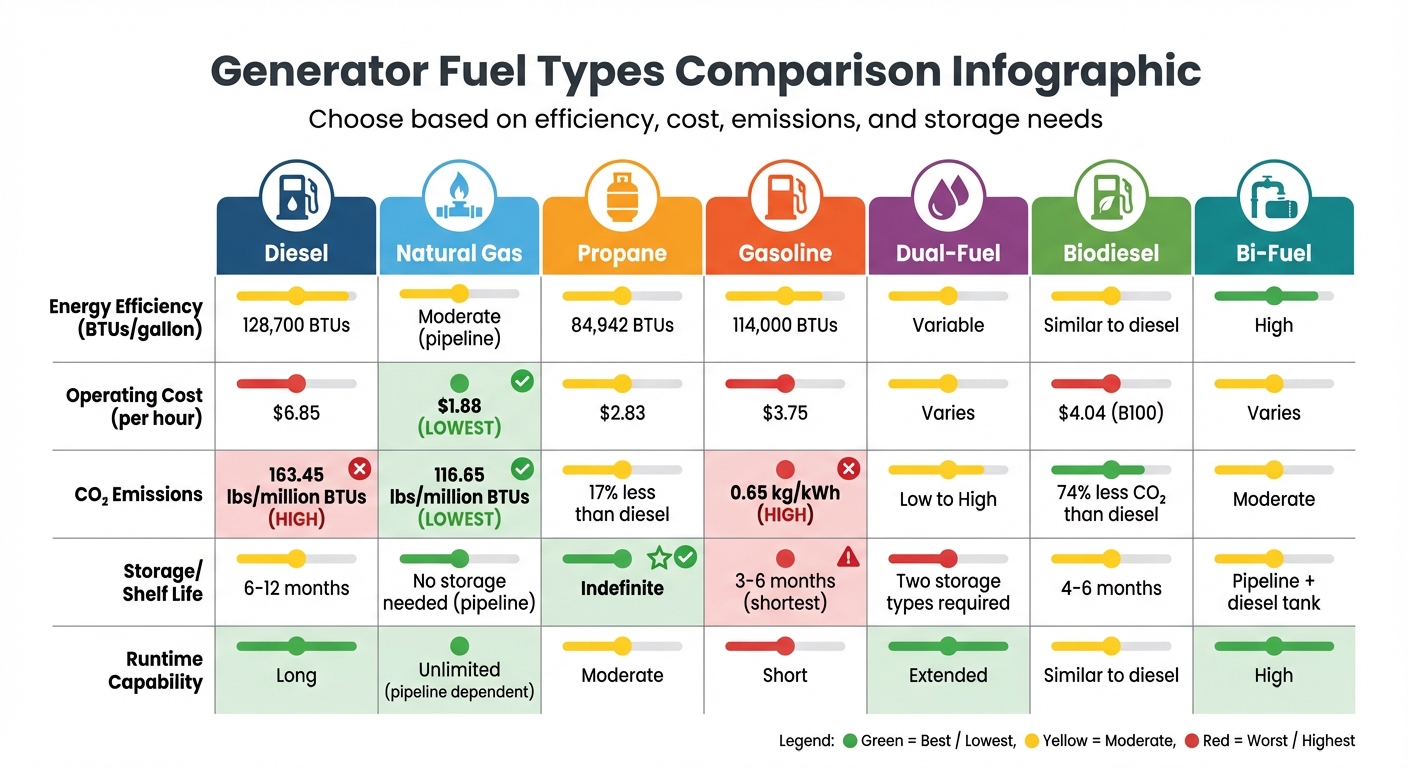
Picking the best fuel for your generator depends on efficiency, cost, emissions, and storage needs. Here's a quick breakdown of the 7 most common fuel options:
- Diesel: High energy density and long runtime but produces more emissions and requires regular maintenance.
- Natural Gas: Clean-burning and cost-effective but relies on pipeline access.
- Propane: Long shelf life and clean emissions but higher consumption rates.
- Gasoline: Widely available and portable but has a short shelf life and higher emissions.
- Dual-Fuel: Switches between gasoline and propane for flexibility, combining the pros and cons of both.
- Biodiesel: Renewable and reduces emissions but has a shorter shelf life and can clog older engines.
- Bi-Fuel: Uses diesel and natural gas for extended runtime but requires complex storage setups.
Quick Comparison
| Fuel Type | Efficiency | Cost (per hour) | Emissions | Storage Needs | Runtime |
|---|---|---|---|---|---|
| Diesel | High (128,700 BTUs) | $6.85 | High (163.45 lbs CO₂) | 6–12 months shelf life | Long |
| Natural Gas | Moderate | $1.88 | Lowest (116.65 lbs CO₂) | No storage, pipeline | Unlimited |
| Propane | Moderate (84,942 BTUs) | $2.83 | Low (17% less than diesel) | Indefinite shelf life | Moderate |
| Gasoline | Low (114,000 BTUs) | $3.75 | High (0.65 kg CO₂/kWh) | 3–6 months shelf life | Short |
| Dual-Fuel | Variable | Varies | Low to High | Two storage types | Extended |
| Biodiesel | Moderate | $4.04 (B100) | Moderate (74% less CO₂) | 4–6 months shelf life | Similar to diesel |
| Bi-Fuel | High | Varies | Moderate | Pipeline + diesel tank | High |
Each fuel type suits different needs, from industrial setups to emergency backups. Diesel is ideal for heavy-duty use, while natural gas offers clean, continuous power. Propane is reliable for storage, and gasoline works well for short-term, portable use. Dual-fuel and bi-fuel systems provide flexibility for unpredictable situations. Choose based on your generator's purpose, fuel availability, and long-term costs.
Generator Fuel Types Comparison: Efficiency, Cost, Emissions & Storage
SIMPLE! Which Fuel Should I Use For My Generator? - GAS, PROPANE, NATURAL GAS, DIESEL
sbb-itb-501186b
Understanding Generator Fuel Types
Different fuel types are suited to specific operational needs, each with its own strengths and limitations. Diesel, for example, is a go-to choice for hospitals and data centers due to its high energy density and ability to handle heavy loads. It’s built for continuous operation and reliability. However, in temperatures below 20°F, anti-gel additives are necessary to keep the fuel from thickening.
Natural gas, on the other hand, connects directly to underground pipelines, ensuring uninterrupted power as long as the infrastructure remains intact. It’s the cleanest-burning fossil fuel, making it a popular choice for continuous residential standby power. But there’s a catch: natural disasters can damage gas lines, cutting off the supply. As engineers Lilly Vang, PE, and Joshua Hunter, PE, explain:
"If the facility is legally required and classed as emergency or critical life safety... the facility will need a generator that can start within 10 seconds. Out of the fuel types discussed, only diesel and some natural gas generators can start within 10 seconds".
For other scenarios, propane and gasoline offer unique advantages. Propane can be stored indefinitely in sealed tanks without degrading, making it a solid option for rural or residential backup power where the generator might sit idle for months. Gasoline, while widely available and commonly used in portable and recreational generators, has a shorter shelf life - lasting only 3 to 6 months unless stabilizers are added - and poses a higher fire risk during storage.
Modern solutions like dual-fuel systems and renewable options add even more flexibility. Dual-fuel generators, which can run on either gasoline or propane, are perfect for handling outages. Biodiesel, a blend of diesel and renewable sources like vegetable oils or animal fats, reduces carbon emissions. Meanwhile, bi-fuel systems combine natural gas and diesel for industrial applications, offering greater efficiency.
The right choice depends on your specific needs - whether it’s emergency backup, continuous operation, or portability. Natural gas, for instance, plays a huge role in the U.S. energy landscape, accounting for about 30% of the country’s energy use, with 40% of that going toward electric power generation. While it comes with higher upfront piping costs, its growing popularity makes it a common option for residential setups. These characteristics set the stage for a detailed comparison of fuel types below.
1. Diesel
Diesel stands out for its impressive energy density - 128,700 BTUs per gallon compared to propane's 84,942 BTUs. This translates to fewer refueling stops and reliable performance under heavy loads. Diesel engines also consume less fuel per kilowatt-hour and operate at lower RPMs, making them a go-to option for extended operations.
Fuel Efficiency
Diesel engines are 30% to 50% more fuel-efficient than gasoline engines, particularly when handling heavy, sustained loads. This efficiency is largely due to diesel's dense energy content and its engine design, which ensures a more thorough fuel burn. However, this comes with higher operating costs - diesel averages $6.85 per hour, compared to $1.88 for natural gas and $2.83 for propane. While diesel's efficiency can save money over time, its environmental impact is an important factor to consider.
Emissions
Diesel's downside lies in its emissions. At 163.45 pounds of CO₂ per million BTUs, it produces about 29% more carbon dioxide than natural gas (116.65 pounds). Diesel generators also emit 17% more CO₂ than propane units, along with higher levels of nitrogen oxides (NOx) and particulate matter. Modern Tier 4-compliant diesel generators help mitigate these issues with advanced filtration systems, but they require frequent maintenance, including oil and filter changes every 500 hours. These emissions and maintenance demands highlight the importance of proper fuel handling and storage for optimal performance.
Storage Requirements
Diesel fuel has a limited shelf life, degrading within 6 to 12 months unless treated with stabilizers or biocides. According to engineers Lilly Vang, PE, and Joshua Hunter, PE:
"Diesel fuel will eventually degrade, which will start to happen in as little as 28 days and result in the fuel being unusable in 6 to 18 months".
To maintain fuel quality, regular polishing is essential. In colder climates - below 20°F - anti-gel additives or tank heaters are necessary to prevent gelling.
Runtime
With its high energy density, diesel enables longer operational periods between refueling. Diesel engines typically last 15,000 to 30,000 hours, far outpacing gasoline engines, which last between 2,000 and 5,000 hours. This durability makes diesel a top choice for facilities that need continuous and dependable power. However, running diesel generators at very low loads for extended periods can cause "wet stacking", where unburnt fuel and carbon build up in the exhaust system. This combination of endurance and reliability makes diesel a strong contender for applications requiring uninterrupted power, setting the stage for comparison with other fuel options.
2. Natural Gas
Natural gas is a cleaner and cost-efficient alternative to diesel for various applications. One of its standout features is the ability to connect directly to municipal utility lines, eliminating the need for on-site fuel storage. As long as the municipal system remains operational, this pipeline delivery system ensures an uninterrupted fuel supply during outages. On average, operating a natural gas generator costs about $1.88 per hour.
Fuel Efficiency
Natural gas isn't just budget-friendly; it also performs well environmentally. While it has the lowest operating costs among common fuels, its lower energy density compared to diesel means it requires a larger volume of fuel to generate the same power. At 85% efficiency, the cost of natural gas is approximately $8.24 per million BTU, making it almost three times cheaper than propane, which costs $23.12 per million BTU. For example, running a 22 kW generator at 50% load for 24 hours would cost between $36 and $72.
Emissions
When it comes to emissions, natural gas stands out as the cleanest-burning fossil fuel for generators. It produces 116.65 pounds of CO₂ per million BTUs, which is about 29% less than diesel's 163.45 pounds. Additionally, its clean combustion process significantly reduces particulate matter, sulfur compounds, and nitrogen oxides, avoiding the strong odor often associated with diesel engines. This makes natural gas generators particularly appealing in residential areas where maintaining air quality is a priority.
Storage Requirements
The convenience of natural gas does come with a trade-off: reliance on external infrastructure. If the gas main is damaged or shut down during a disaster - such as an earthquake - the generator will not function. James Wilson, a Certified Home Power Systems Technician, explains:
"For most suburban homeowners with natural gas service, the convenience and reliability of never refueling makes natural gas the clear winner despite higher installation costs."
Before committing to a natural gas generator, it's crucial to confirm with your local utility that natural gas service is available and can meet the generator's pressure requirements. Installation costs typically range between $3,000 and $6,000, as professional pipeline hookups and permits are required. These factors highlight natural gas's suitability for continuous operation, which will be compared to other fuel sources later.
Runtime
Natural gas generators offer unlimited runtime during outages, as they aren't restricted by tank capacity. They also require less maintenance due to reduced residue buildup, with lifespans ranging from 8,000 to 15,000 hours, or roughly 15 to 20 years of service. These features make them a reliable choice for long-term use.
3. Propane
Propane combines clean performance with dependable reliability, making it a solid option for emergency backup power. Operating a 22 kW propane generator at 50% load costs between $2.50 and $5.00 per hour. While this is pricier than natural gas, it's reasonable for occasional use. Propane delivers around 91,000 BTUs per gallon - less than gasoline or diesel. This lower energy density means higher fuel consumption, but propane brings other benefits. Like natural gas, it’s reliable, but propane adds the advantage of on-site storage, offering a self-contained fuel solution.
Fuel Efficiency
Though propane has a lower BTU content (about 91,000 BTUs per gallon), its clean burn significantly reduces engine residue, cutting maintenance costs by roughly 40% compared to diesel. The National Propane Gas Association highlights its environmental edge: "propane-powered engines emit 12 percent less CO₂ and 60 percent less CO than gasoline-powered engines". A standard 500-gallon residential tank can keep a 20 kW whole-house generator running for 144 to 192 hours at 50% load.
Emissions
Propane stands out as one of the cleanest fossil fuels for generators. It generates 80% fewer smog-producing hydrocarbons and 90% fewer nitrogen oxides compared to diesel engines. Its exhaust is nearly odorless and colorless, making it more suitable for residential use. Additionally, propane is non-toxic in its unburned state, posing no risk to soil or water in the event of a leak - unlike liquid fuels that can cause contamination.
Storage Requirements
Unlike natural gas, propane requires on-site storage in pressurized tanks ranging from 250 to 1,000 gallons. A 500-gallon tank strikes a good balance between cost and runtime. Installation costs, including tank setup and professional hookup, typically range from $3,500 to $7,000. Propane also has an indefinite shelf life, eliminating the need for routine fuel rotation. Tanks can be installed above ground or buried underground for a cleaner look.
Runtime
A 500-gallon propane tank can power a 20 kW generator for about 6 to 8 days at 50% load. Unlike natural gas, which offers unlimited runtime via municipal pipelines, propane requires refilling once the tank is empty. However, its on-site storage ensures availability even during disasters when utility infrastructure may be compromised. Propane also performs well in cold weather, starting easily without the gelling problems diesel faces. That said, extreme cold (below 20°F) can reduce its vapor pressure and impact performance. In contrast, natural gas pipelines provide a steady feed, ensuring uninterrupted runtime.
4. Gasoline
Gasoline is widely available across the country and works well for portable generators that need to start quickly for short-term power needs. Running a gasoline generator costs about $3.75 per hour, based on an average price of $3.75 per gallon and a fuel consumption rate of 1 gallon per hour. This makes it slightly less expensive than propane, which costs around $3.90 per hour to operate.
Fuel Efficiency
Gasoline delivers around 114,000 BTUs per gallon, which is enough to power a 4,000W generator running at 50% load for 6 to 8 hours. At half load, it uses about 0.1 to 0.15 gallons per kW. A mid-size portable generator (3 to 5 kW) consumes roughly 0.3 to 0.6 gallons per hour at lighter loads, increasing to 0.7 to 1.0 gallons per hour under heavier loads. Inverter models with Eco-mode can stretch runtime further by adjusting engine speed to match demand, using less than half the fuel when operating at lower loads.
Emissions
Gasoline generators produce more emissions compared to cleaner options like propane or natural gas. They emit higher levels of carbon monoxide and particulate matter, and the carbon residue left behind can lead to faster engine wear. For safety, always run gasoline generators outdoors, at least 20 feet away from any openings, and maintain a 5-foot clear zone around the unit.
Storage Requirements
One downside of gasoline is its short shelf life - lasting only 3 to 6 months without a fuel stabilizer. Adding a stabilizer can extend this to 1 to 2 years. Store gasoline in approved red containers made from durable HDPE plastic or metal, leaving about 5% of the container empty for expansion. Keep containers in a cool, dry, and well-ventilated area, away from direct sunlight and living spaces. Many local fire codes restrict residential gasoline storage to 25 gallons. To keep fuel fresh, use the "first in, first out" method, rotating stored gasoline every six months. Before use, check for signs of spoilage, like discoloration or a strong chemical odor.
Runtime
A standard 5 kW gasoline generator can power essential household items for 8 to 12 hours on a full tank. Smaller inverter generators (1 to 2 kW) use between 0.1 and 0.25 gallons per hour at low loads, while larger contractor-grade units (7 to 10 kW) may burn 1.0 to 1.5 gallons per hour at full capacity. Unlike propane or natural gas, gasoline requires frequent refueling and careful planning. To make the most of your fuel during outages, stagger the use of high-demand appliances like well pumps or space heaters rather than running them all at once. Gasoline-powered engines also tend to start more reliably in extreme cold, unlike propane models, which may struggle due to low vapor pressure.
5. Dual-Fuel
Dual-fuel generators are designed to run on both gasoline and propane, giving you flexibility when fuel availability becomes an issue. By combining the advantages of these two fuels, dual-fuel generators create a balance where one fuel’s strengths offset the other’s weaknesses. For instance, the DuroMax XP13000HX (13,000 watts) is priced around $1,399.00, while premium inverter models like the DuroMax XP16000iH (16,000 watts) are available for about $4,999.00.
Fuel Efficiency
Gasoline packs about 27% more energy per gallon compared to propane, which translates to a 10%–15% drop in wattage output when running on propane. For example, the Westinghouse WGen9500DF delivers 12,500 peak watts on gasoline but only 11,200 peak watts on propane. Modern inverter generators help counter fuel inefficiency by adjusting engine speed to match power demand, minimizing waste. Gasoline tends to perform better in colder conditions, while propane is more efficient in warmer climates. These differences also affect the emissions and overall performance of each fuel type.
Emissions
Propane stands out as the cleaner-burning option, producing about 12% less carbon dioxide and up to 50% less carbon monoxide compared to gasoline. It burns cleaner inside the engine, reducing carbon buildup on spark plugs and other components, which could lower maintenance needs. Propane’s sealed, pressurized tanks further reduce environmental risks, as there’s little chance of spills contaminating soil or water. Additionally, propane can cost 30% to 50% less per hour to run than gasoline, depending on local fuel prices and tank size.
Storage Requirements
Proper storage is essential for dual-fuel systems. Propane has an indefinite shelf life when stored in sealed tanks, while gasoline typically lasts only 3–6 months unless treated with a stabilizer. Propane tanks should always be stored upright in well-ventilated outdoor areas, and hoses should be inspected regularly for leaks. For gasoline, regular rotation and periodic generator testing are necessary to ensure smooth operation when switching between fuels.
Runtime
A standard 20-pound propane tank generally provides 6 to 8 hours of runtime at a 50% load, while a full gasoline tank can last anywhere from 8 to 14 hours, depending on the generator’s size. While gasoline offers more power per gallon, propane’s indefinite storage life makes it more practical for standby use. Propane may result in slightly shorter runtimes due to its lower energy density, but it offers the advantages of lower fuel costs and reduced engine wear over time.
6. Biodiesel
Biodiesel is a renewable fuel derived from sources like vegetable oils, animal fats, or recycled cooking grease. It serves as a direct substitute for conventional diesel. As of October 2024, the average price for pure biodiesel (B100) was $4.04 per gallon, while a 20% blend (B20) cost $3.53 per gallon, compared to standard diesel at $3.64 per gallon.
Fuel Efficiency
Biodiesel contains about 10% less energy per gallon than petroleum diesel, meaning you’d need approximately 1.1 gallons of B100 to equal the energy output of one gallon of diesel. On the plus side, its higher cetane number (ranging from 45 to 67 compared to diesel's 40 to 45) improves ignition quality, leading to smoother combustion. Even blending as little as 2% biodiesel with petroleum diesel enhances lubricity, which helps reduce engine wear over time.
Emissions
Switching to B100 can significantly cut net carbon dioxide emissions - by 74% to 95%, depending on the feedstock used. It also produces fewer particulates and soot, which can reduce wear on engine components. However, biodiesel tends to emit about 10% more nitrogen oxide (NOx) than conventional diesel, which could contribute to smog formation. On the upside, biodiesel has a much higher flashpoint (over 266°F or 130°C) compared to petroleum diesel's 126°F (52°C), making it safer to store.
Storage Requirements
Biodiesel has a shelf life of 4 to 6 months due to its susceptibility to oxidation. It absorbs up to nine times more water than petroleum diesel, which can encourage microbial growth and corrosion in storage tanks. To avoid moisture issues, it's best to store biodiesel between 40°F and 70°F in nearly full tanks, leaving just 2% air space. Pure biodiesel can begin to gel at around 41°F (5°C), though this varies by feedstock - beef fats may gel at 61°F, palm oil at 55°F, and canola oil at 14°F. For generators that sit idle for long periods, biodiesel might require a strict rotation schedule and the use of additives to remain practical.
Runtime
Because biodiesel has a lower energy density, generators running on it will burn through fuel faster than those using petroleum diesel. The exact difference depends on the generator's load and the biodiesel blend being used. Additionally, biodiesel's solvent properties can loosen deposits in the fuel system, potentially clogging filters during initial use. For older generators, especially those made before 1993, replacing rubber seals and gaskets with materials like Viton or polyurethane is recommended, as biodiesel can degrade natural rubber components. This look at biodiesel lays the groundwork for discussing bi-fuel systems next.
7. Bi-Fuel
Bi-fuel generators operate using two distinct fuel sources - commonly diesel combined with natural gas or propane - and can automatically switch between them based on load demands. This is different from dual-fuel systems, which blend fuels simultaneously. One of the standout features of bi-fuel systems is their adaptability: they can automatically choose the most efficient fuel for the current load or allow users to manually switch based on factors like availability or cost. Compared to dual-fuel options, bi-fuel generators provide another layer of flexibility by optimizing fuel use in real-time.
Fuel Efficiency
Bi-fuel generators are equipped with an automatic governor that adjusts fuel types based on preset conditions, ensuring the engine always runs on the most efficient option without requiring manual input. This adaptability can lead to significant cost savings - up to 45% compared to running solely on gasoline or diesel. For lighter loads, the system often switches to natural gas, which burns cleaner and costs less, while diesel is used for higher loads. This efficiency not only reduces operating costs but also has environmental benefits, which are covered in the emissions section.
Emissions
By relying less on diesel and incorporating cleaner-burning fuels like natural gas or propane, bi-fuel generators can significantly reduce harmful emissions. For example, propane - a popular secondary fuel - emits up to 50% less carbon monoxide compared to gasoline. Some systems even take it a step further by using flare gas recapture, converting industrial by-products into usable energy. This makes bi-fuel generators a cleaner alternative to traditional single-fuel systems.
Storage Requirements
The storage setup for bi-fuel generators depends on the fuel combination being used. Pairing diesel with natural gas requires an on-site diesel tank, which must be rotated every 6 to 12 months, along with a natural gas pipeline connection. When diesel is paired with propane, each fuel is stored in separate tanks. Propane, stored in sealed and pressurized containers, has the advantage of an indefinite shelf life. This dual-storage arrangement simplifies fuel management and can reduce the need for large diesel reserves.
Runtime
Bi-fuel systems are designed for extended runtimes, often lasting several days, thanks to their dual fuel supplies. This feature not only increases runtime but also provides added reliability during unexpected outages. If one fuel source runs out, the generator seamlessly switches to the backup, ensuring uninterrupted operation. This redundancy is particularly useful during emergencies or fuel shortages. For instance, while gas stations might be inaccessible during power outages, a pre-stored propane tank remains ready for use.
Fuel Type Comparison Table
Here's a breakdown of seven generator fuel types, comparing efficiency, emissions, storage, and runtime to help you make an informed choice.
| Fuel Type | Fuel Efficiency | Emissions | Storage Requirements | Runtime |
|---|---|---|---|---|
| Diesel | Highest (128,700 BTUs/gallon) | High (163.45 lbs CO₂ per million BTUs) | 6–12 months shelf life; requires ventilation | Long (efficient consumption) |
| Natural Gas | High cost-efficiency ($1.88/hr) | Lowest (116.65 lbs CO₂ per million BTUs) | None - pipeline connection | Continuous (pipeline dependent) |
| Propane | Moderate (84,942 BTUs/gallon) | Low (17% less CO₂ than diesel) | Indefinite shelf life; pressurized tanks | Moderate (higher consumption rate) |
| Gasoline | Low (high consumption rate) | High (0.65 kg/kWh CO₂) | 3–6 months shelf life; highly flammable | Short (frequent refueling needed) |
| Dual-Fuel | Variable (depends on active fuel) | Low to High (fuel-dependent) | Requires two separate storage types | Extended (can switch between fuels) |
| Biodiesel | High (similar to standard diesel) | Moderate (lower than diesel) | Similar to diesel; prone to gelling in cold | Long |
| Bi-Fuel | High (optimized fuel mixing) | Moderate (reduced through NG/diesel mix) | Pipeline connection plus diesel tank | High (redundant fuel supply) |
Diesel stands out for its energy density, delivering 128,700 BTUs per gallon, making it ideal for heavy-duty applications. On the cost side, natural gas is a budget-friendly option at $1.88 per hour, while propane costs around $2.83 per hour but offers the advantage of an indefinite shelf life.
When it comes to emissions, natural gas leads with the lowest output - 116.65 lbs CO₂ per million BTUs, about 29% less than diesel. Propane also performs well, emitting up to 50% less carbon monoxide compared to gasoline. Gasoline, however, produces the highest emissions at 0.65 kg of CO₂ per kWh.
Storage requirements depend on the fuel type. Natural gas simplifies things with no need for storage, thanks to its direct pipeline connection. Propane's indefinite shelf life makes it a solid choice for emergency situations. On the other hand, gasoline requires stabilizers to last beyond its 3–6 month shelf life.
This table serves as a quick reference to help you choose the right fuel type based on your specific power generation needs.
Conclusion
Selecting the right generator fuel type boils down to understanding your specific needs and matching them to the performance characteristics of each option. Natural gas stands out for its lower operating costs and cleaner emissions, making it a great choice for stationary, long-term use where pipeline access is available. Diesel, with its high energy density, is perfect for industrial settings and handling heavy loads. Propane is a reliable option for emergency backup systems, thanks to its indefinite shelf life and low maintenance requirements. Gasoline, on the other hand, is best suited for short-term, portable applications.
Your decision should factor in usage patterns, local fuel availability, environmental considerations, and long-term costs. Over a 15+ year period, the type of fuel you choose often has a bigger financial impact than the generator's initial purchase price.
For those in areas where fuel supply disruptions are a concern, dual-fuel and bi-fuel systems provide flexibility by allowing you to switch between fuel types depending on availability - offering a practical solution for unpredictable situations.
Whether you're looking for a standby generator for your home, a primary power source for your business, or portable power for a job site, Electrical Trader has you covered. Explore their wide selection of new and used power generation equipment, designed to meet your specific fuel and power needs.
FAQs
Which generator fuel is best for long outages?
Diesel fuel stands out as a dependable option for extended power outages thanks to its fuel efficiency, rugged performance, and long storage life. These features make it a solid choice for meeting power demands during emergencies or extended periods without electricity.
What fuel is easiest to store for emergencies?
Diesel stands out as a practical fuel for emergency storage due to its safety and ease of handling. Unlike gasoline, diesel is less flammable and has lower volatility, which not only makes it safer but also more stable for long-term storage. These qualities make it a reliable option in emergency situations.
Can my generator be converted to another fuel type?
Converting a generator to use a different fuel type is sometimes possible, but it largely depends on the generator's design and model. For instance, dual-fuel generators are designed to seamlessly switch between fuels like propane and gasoline without requiring extensive adjustments. On the other hand, single-fuel generators are typically built for a specific fuel type, and converting them can involve complex modifications. To ensure safety and proper functionality, it’s always best to consult the manufacturer or a qualified technician before attempting any conversion.